AI and digital tools for non-English-speaking families navigating Medicare and Medicaid enrollment
AI tools promise multilingual Medicare and Medicaid help, but most still fall short.

Roughly 8% of Medicare beneficiaries had limited English proficiency in 2023, according to CMS data, and that number hides how concentrated the problem actually is. A wave of AI tools now claims it can bridge Medicare and Medicaid enrollment across dozens of languages at once. Most of them can't, at least not yet. Figuring out which ones actually might is the point of this piece.
What the language gap actually costs these families
Start with the plainest number available: people with limited English proficiency are three times as likely as fluent English speakers to be uninsured. That ratio does more work than any policy paper, because it tells you how large the gap really is before a single anecdote gets involved.
Medicare specifically bears this out. A nationally representative study found that beneficiaries with limited English-reading proficiency were 16.7 percentage points less likely to have used a CMS resource than those who read English well or very well. Call it what it is: nearly one in five people never touching the materials meant to help them navigate the program in the first place.
The downstream effects show up in bodies, not just paperwork. LEP populations face documented disparities in chronic disease management and health outcomes. Those are specific, named conditions, and they track directly back to whether someone understood a renewal notice or a plan comparison sheet well enough to act on it.
The Medicaid unwinding period made the mechanism visible in real time. Immigrants and LEP individuals faced heightened risk of disenrollment even when they remained fully eligible, because the paperwork itself was an obstacle regardless of the underlying qualification. California is living a version of this right now: Medi-Cal enrollment dropped by roughly 5%, about 730,000 people, between June 2025 and March 2026, and researchers tied a meaningful share of the decline among immigrants to fear of immigration enforcement rather than any actual change in eligibility.
Here's the part worth sitting with. Confusion about process, inability to read the material, and fear of the system itself don't sit side by side; they compound each other. A tool that only translates words and does nothing to address trust has solved maybe a third of the actual problem, and mistaking that third for the whole thing is the most common error in this space.
What the law already requires, and where it falls apart in practice
CMS's 2024 Language Access Plan commits to "timely, quality language assistance services" across Medicare and Medicaid. Federal rulemaking has pushed Medicare Advantage plans to translate materials into languages prevalent in their service areas. The intent behind these requirements is that a member's documented language preference should carry forward without repeated requests, though implementation has been uneven.
Why did CMS bother writing that rule at all? Its own audits found enrollees routinely forced to ask more than once for translated materials, a pattern CMS itself flagged as a "critical delay in accessing care timely." CMS audits have found plans failing to deliver translated materials even after members requested them, documented failures inside a system that was supposed to have this solved already.
There's a financial lever attached too. Plans have both compliance and competitive reasons, alongside the compliance reason, to get translation right.
Medicaid sets a similar federal floor requiring that communications be accessible to LEP individuals and that language assistance be available. That floor got stress-tested hard during the unwinding period, and it was missed often enough that the disenrollment numbers above tell their own story without much need for interpretation.
Layer on top of this a narrowing eligibility map. Recent policy changes have narrowed eligibility pathways for certain immigrant populations seeking to enroll in Medicare. California's Medi-Cal has faced policy pressure to restrict enrollment for adults based on immigration status. Language access, in other words, is operating on top of an eligibility landscape that keeps shrinking underneath it.
The gap worth naming plainly is this: regulation sets floors for what plans and agencies must provide once someone is already inside the system. LEP families usually hit the wall before that, in the discovery and initial enrollment phase, which is exactly where regulatory requirements run thinnest. The rules protect people after they've found the door, but almost nothing in the current framework is built to help them find it.
How AI is being deployed today to close the gap: specific tools in use
Medicare.gov offers a site-wide Spanish toggle and CMS resources in multiple languages, useful but predominantly Spanish-oriented and mostly static: document downloads rather than interactive guidance that responds to one person's actual situation.
State Medicaid agencies have moved further, and unevenly. A growing number of states now use AI-powered chatbots to support Medicaid or CHIP enrollees, and several states have embedded these bots directly on their Medicaid websites. Some state tools answer questions in multiple languages around the clock, and when they hit a question they can't resolve, they route the person to a live help line. That routing matters more than it sounds, functioning as a triage layer with a human safety net underneath it rather than a final answer standing on its own.
Even a handful of languages is real progress, but it's also worth being blunt about what it still misses: Vietnamese speakers with LEP number over 880,000 nationwide, and they're routinely underserved by tools built around Spanish first and everything else bolted on as an afterthought. Including Vietnamese at all signals a design choice most Spanish-only tools skip entirely.
Some AI voice agents now push furthest in this space, proactively contacting Medi-Cal enrollees by call, text, and email in dozens of languages, using HIPAA-compliant access to enrollee data to walk each person through exactly what they need to do to renew. A broad language count is the number that actually matters here, because it starts to address the long-tail problem: Census data has identified over 350 languages spoken in U.S. homes, and no single-digit language count was ever going to cover that distribution. Careforce is deployed specifically to prevent involuntary disenrollment, which lines up directly with the Medi-Cal drop-off numbers from the first section. It operates in California for an obvious reason: California holds roughly 30% of the nation's LEP Medicare beneficiaries, more than any other state by a wide margin.
The private enrollment market has its own version of this problem. GoHealth's PlanGPT helped agents assist more than 481,000 consumers enroll in a new plan during the 2024 Annual Enrollment Period. The average Medicare-eligible adult faces a choice among 42 plans; that's a hard decision in a first language, and considerably harder in a second one, which is exactly the population PlanGPT-style tools are built around.
Voice AI more broadly is emerging as its own category: automated systems built to handle enrollment conversations, qualify leads, and collect information without a human agent on the line. For an LEP caller, a voice system that speaks their language removes a bottleneck at the very first point of contact, before a human agent ever enters the picture at all.
Benefits-discovery platforms round out the picture. These are AI tools that screen for eligibility across Medicare, Medicaid, and supplemental caregiver compensation programs, increasingly with multilingual intake built in from the start. They address the discovery gap named earlier, which is the part of the journey regulation barely touches.
What actually separates a working multilingual tool from a decorative one
Translation alone doesn't solve much, and this is where most vendor pitches quietly overstate what they've built. Rendering an English sentence in Spanish doesn't make the underlying bureaucratic logic any easier to follow; the harder and more valuable job is explaining and simplifying alongside converting words. A perfectly translated form that's still confusing is still confusing, and no language count fixes that.
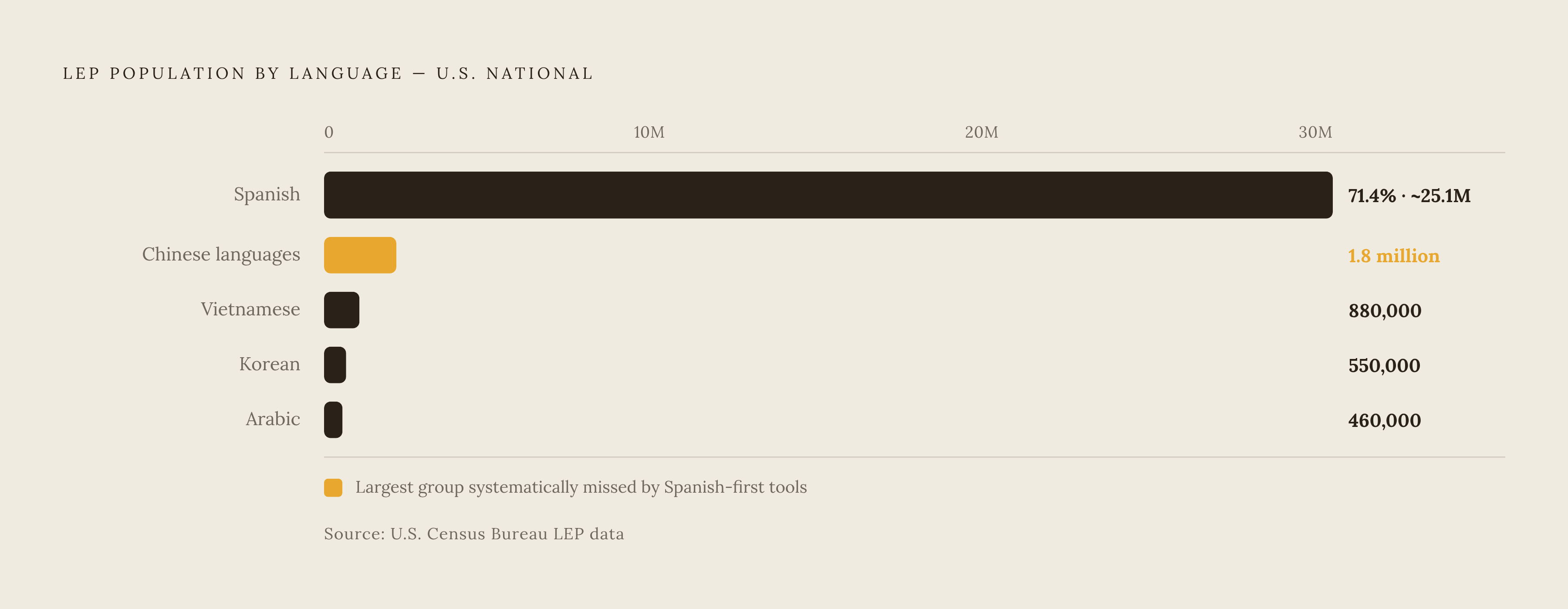
Language coverage is worth checking against actual numbers rather than assuming Spanish plus English covers "most people." Spanish accounts for 71.4% of LEP speakers nationally, which sounds like most of the problem solved until you count what's left over: 1.8 million Chinese-language speakers with LEP, 880,000 Vietnamese speakers, 550,000 Korean speakers, 460,000 Arabic speakers. A tool that stops at Spanish is leaving several million people exactly where they started, and calling that comprehensive coverage is the industry's most common overstatement.
Modality matters almost as much as language count. Many LEP individuals carry lower digital literacy alongside the language barrier, so a voice-first interface, the proactive voice-agent model, lowers the access bar in a way text-heavy web forms simply don't manage.
Who moves first is a design question with real consequences. A tool that waits for someone to find it and type in a question serves a fundamentally different population than one that reaches out first. Careforce's proactive outreach model targets precisely the people least likely to go looking for help on their own, and given the the disengagement reflected in the Medi-Cal enrollment numbers, that's probably the harder and more important group to reach.
Treat human backup as a core feature, not an afterthought bolted on for liability reasons. Routing to a live help line when the AI can't resolve a case is the right instinct: the most tangled enrollment situations need human judgment, and a well-built AI tool should recognize its own limits and hand off rather than leave someone stuck circling a menu.
Trust, meanwhile, is a design constraint, not a marketing line. For immigrant communities navigating a more restrictive policy environment right now, how a tool handles data privacy and how clearly it explains what happens to that information determines whether the tool gets used at all. Ignore that dimension and the fear documented in the Medi-Cal enrollment drop just replicates itself inside the new tool.
One more thing worth flagging: Federal nondiscrimination principles, including those under Section 1557 of the Affordable Care Act, have been interpreted to apply to AI tools used in patient care. That means multilingual tools need evaluation for differential accuracy across language groups specifically, not an average performance number that can hide a tool working fine in Spanish and badly in Tagalog.
Put together, the checklist is this: language coverage breadth, voice availability, whether the design is proactive or reactive, a real human escalation path, transparent data practices, and whether the tool covers the whole journey from eligibility discovery through completed enrollment rather than one isolated step wedged in the middle.
Where this is heading: federal momentum and what LEP families can use now
CMS has issued a Request for Information on AI tools for modernizing the Medicare experience, explicitly asking about conversational AI, personalized plan recommendations, accessible decision support, and call center automation. That's a direct federal signal that tools like the ones described above are being evaluated for adoption at a much larger scale than any single state program.
The infrastructure behind that signal is already expanding fast. AI use cases across eleven federal agencies nearly doubled in the span of a year. HHS recorded one of the largest increases among agencies over that same span. Whatever comes out of the RFI, the capacity to build and run these systems at scale is being put in place right now, ahead of any final policy decision.
Federal momentum doesn't automatically translate into tools that work for the 55% of Hispanic Medicare beneficiaries or the 49% of Asian beneficiaries who have limited English proficiency. An RFI is a question, and the gap between policy interest and lived outcome is exactly the space this piece has spent five sections mapping.
So what can an LEP family or caregiver actually use today? Medicare.gov's Spanish-language toggle and the 1-800-MEDICARE line with interpreter services remain the most reliable federal starting point, unglamorous as that sounds. It's worth checking whether a state's Medicaid agency runs a chatbot and which languages it covers before calling a general help line; that alone can save a long hold. AI-powered benefits screening platforms with multilingual intake are worth seeking out specifically because they tend to cover the full journey, from figuring out what someone qualifies for through actually completing enrollment, rather than one link in that chain. For Medi-Cal enrollees, proactive outreach programs like Careforce exist precisely to reach people who wouldn't otherwise ask for help; if one of these calls comes in, engaging with it for the ten minutes it takes is worth doing.
Some states and third-party services have started pairing multilingual AI chatbots with human enrollment specialists, combining instant language support with the ability to answer the kind of context-specific question a machine alone can't resolve. Brevy operates in that space, offering AI-assisted intake backed by human specialists who step in when a case gets complicated. It's one option among a growing field, and the underlying lesson holds regardless of which tool a family ends up using.
The language gap in Medicare and Medicaid enrollment was built into a system that was never designed with non-English speakers in mind. AI can close that gap at scale, but only the tools built for the full range of languages rather than the largest one, for the entire enrollment journey rather than just the paperwork stage, and for the real fear that keeps some of the most eligible families from ever picking up the phone. Translation without trust is a nicer-looking version of the same wall.