How AI Identifies Benefits Seniors Miss
Machine learning now scans dozens of benefit programs simultaneously for eligible seniors.

Roughly $58 billion in SNAP, SSI, and Medicare benefits goes unclaimed every year, according to the National Council on Aging. Programs aren't being gamed, and they aren't running dry. Eligible people simply never get the money because the process of finding out what they qualify for is harder than it should be — and AI is starting to change that math by scanning dozens of programs at once instead of asking a person to do it one form at a time.
The paradox sits right there in plain sight. The programs exist. The funding exists. The eligibility exists, often for years at a stretch. And yet most of that money sits uncollected, year after year, while the population that needs it most keeps growing.
Who is being left out and why the numbers keep growing
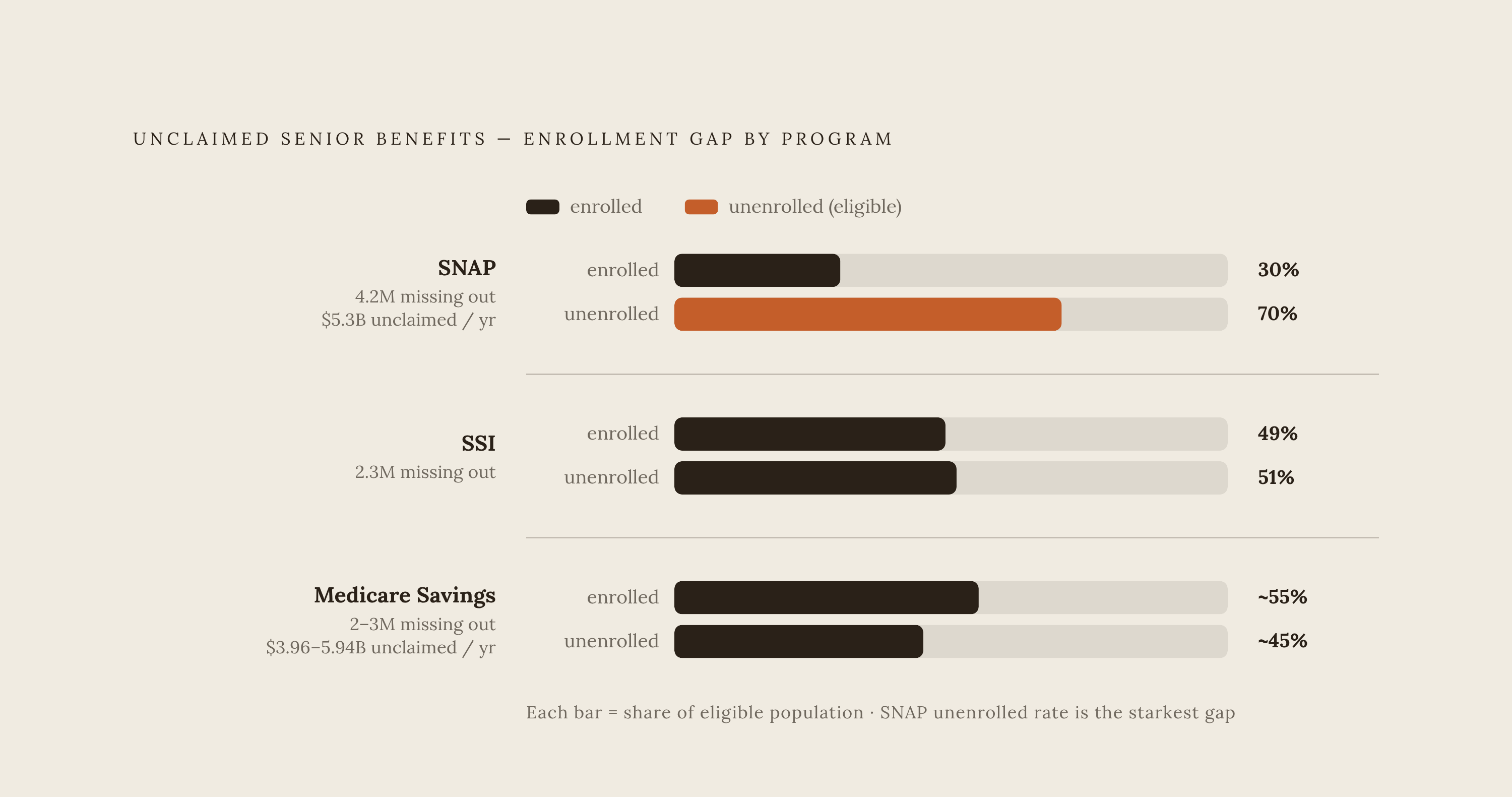
Start with the scale of who qualifies but never enrolls. NCOA's 2024 Benefits Participation Map, built with the Urban Institute, puts the number at 9 million adults age 65 and older with limited incomes who are eligible for programs that would help them pay for food, healthcare, or daily expenses, but aren't enrolled in them. Break that down by program and the picture sharpens further. Only 30% of eligible older adults are enrolled in SNAP, leaving 4.2 million seniors without food assistance worth $5.3 billion annually. Supplemental Security Income enrollment sits at 49%, with more than 2.3 million eligible people missing out. Medicare Savings Programs, which cover premiums and cost-sharing, are missing somewhere between 2 million and 3 million eligible enrollees, forfeiting between $3.96 billion and $5.94 billion a year in benefits worth at least $2,220 annually per person just from the Part B premium alone.
These are systemic participation failures, concentrated in a population that is both growing and getting poorer relative to everyone else. NCOA puts the number of economically insecure Americans 65 and older, living at or below 200% of the federal poverty level, at 17 million; that threshold works out to $31,920 a year for a single person in 2026. Census Bureau data shows the poverty rate for adults 65 and up climbed to 15% in 2024, above the national rate of 12.9%. Social Security and Medicare exist specifically to keep older adults out of poverty, so it's worth sitting with why the numbers still look like this.
Part of the answer is demographic. Adults 65 and older made up 12.4% of the U.S. population in 2004; by 2024, that figure had climbed to 18%, and it's projected to hit 20% by 2040. The pool of people who need to navigate benefits systems is expanding faster than the systems themselves are getting any easier to use. Economic insecurity and non-enrollment aren't randomly scattered across this group, either; they cluster tightly around the people who need help most and have the fewest resources to go find it.
Why the system defeats people before they even apply
NCOA's research identifies four barriers that keep eligible seniors from applying: not knowing a program exists, the complexity of the application itself, stigma, and flat-out misconceptions about who qualifies. Each of these compounds the others, and none of them are incidental. They're built into how the system works.
Take Medicare Advantage. In 2025, the average beneficiary could choose from 42 plans across 8 different organizations, with no neutral party required to walk them through the comparison. Choosing among 42 anything without guidance is a lot to ask of someone who just wants coverage that works. SNAP has its own structural trap: eligibility for seniors is calculated after a set of deductions that most applicants have no idea they can claim, so people run the math wrong in their heads, assume they make too much, and never apply at all. Medicare Savings Programs compound the problem further because they're administered at the state level and vary by location, which makes them nearly invisible to anyone who doesn't already know to go looking.
Stigma might be the least-discussed piece of this, and arguably the most costly. Many seniors came of age in economic eras that framed public assistance as a last resort, something you accepted only when you'd run out of other options. That framing doesn't disappear just because the program in question is Medicare Savings or SNAP rather than what people used to call welfare. It costs real people thousands of dollars a year, quietly, because asking for help still feels like admitting defeat.
Then there's plain awareness. Fewer than half of eligible beneficiaries enroll in Medicare Savings Programs, in part because so few know the programs exist in the first place. Put it all together, and even a sharp, motivated senior with no cognitive impairment faces a system that demands knowing what to look for, where to look for it, how to apply, and what documents to gather, across programs that were never built to talk to each other. That last part matters more than it sounds. A person can be fully eligible for three different programs and never realize it, because nothing in any one application points them toward the next.
What AI actually does differently when screening for benefits eligibility
Here's where the mechanics change. Traditional benefits navigation requires the person to already know which programs to check, essentially guessing at doors before knocking on them. AI-based screening tools flip that sequence: they start from the person, their income, age, household size, state of residence, health conditions, and work outward to check every relevant program at once.
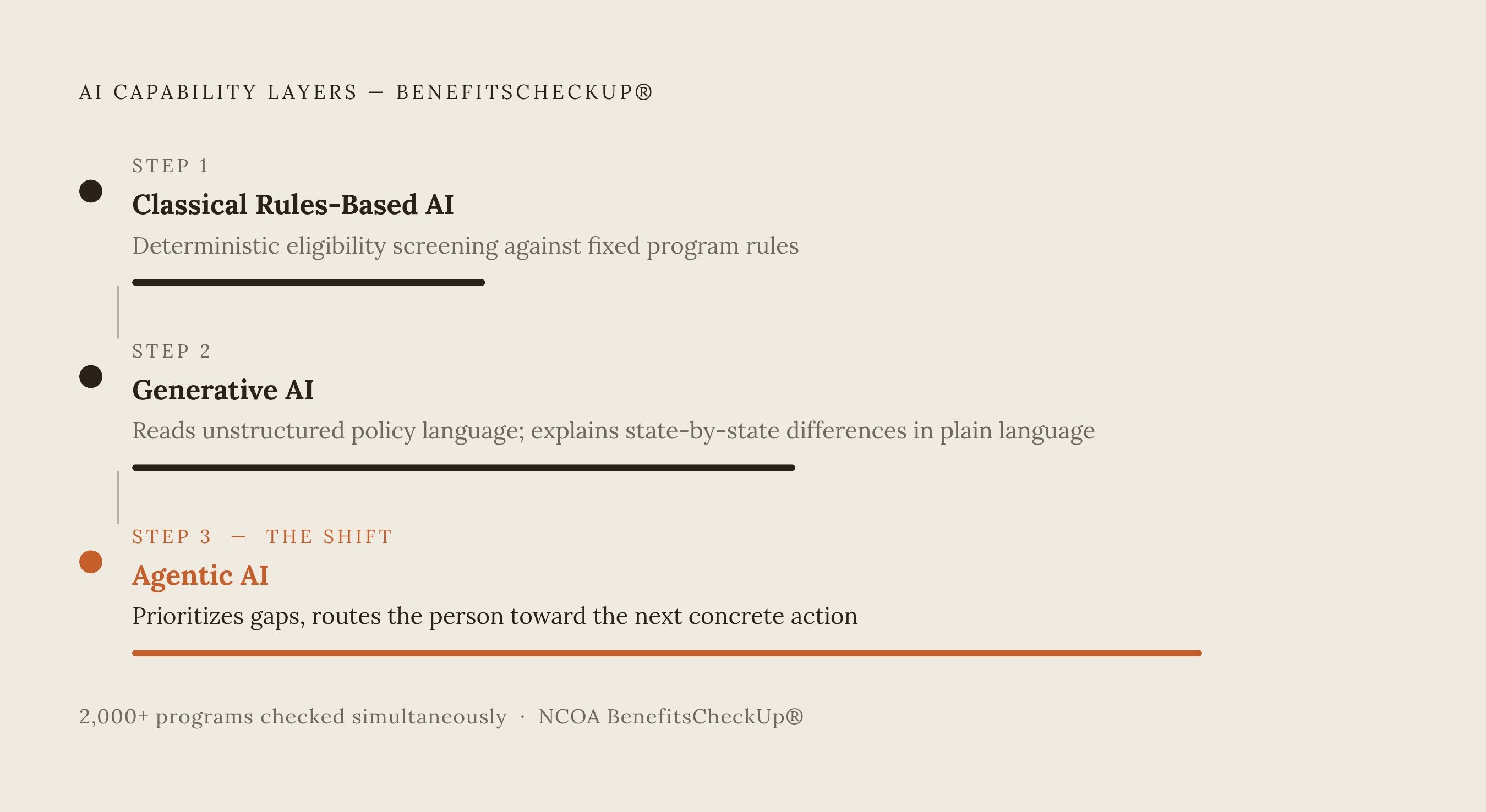
That cross-referencing is the core function, and it happens across three layers of AI capability that are worth distinguishing, since they get lumped together in casual conversation more often than they should. Classical, rules-based AI does deterministic eligibility screening against fixed program rules; it's fast, it's auditable, and it's accurate wherever the eligibility criteria are structured and clear. Generative AI adds another layer on top, processing unstructured material like policy language and state-by-state variation so a tool can compare programs and explain differences in plain language rather than legalese. Agentic AI goes a step further still, prioritizing which gaps matter most for a given person and routing them toward the next concrete action, moving the tool from simply identifying a problem to actually guiding someone through solving it.
The advantage over a single human caseworker, however skilled, is straightforward: NCOA's BenefitsCheckUp® database alone covers more than 2,000 programs, and a screening tool can check all of them simultaneously without fatigue, without inconsistency between one client and the next, and without being limited to whatever programs happen to be familiar in a given county. AI tools can also show their work, explaining why a given program was surfaced as a match, which builds a kind of transparency that a printed pamphlet never could.
Adoption is already happening, quietly. Accenture survey data shows 40% of Medicaid users already prefer chatbots for simple benefits questions over calling a hotline or visiting an office. That's a present behavior, already showing up in the data.
The tools currently doing this work and how they differ
NCOA's BenefitsCheckUp® remains the most established platform in this space. It's free, confidential, screens against more than 2,000 benefits programs, and runs on rules-based logic rather than generative AI. In 2023 and 2024, it helped connect 4.7 million lower-income adults to benefits, and NCOA's network of local partners helped eligible individuals apply for more than $825 million in public assistance in 2024 alone.
DiscoverSeniorBenefits takes a narrower, faster approach: a deterministic rule engine that returns a source-cited map of qualifying programs pulled from government pages, typically within about five minutes, without requiring a Social Security number.
AARP's Ask AARP tool sits on the generative AI side of the ledger, built into AARP's Social Security and Medicare pages to deliver tailored answers drawn from AARP's own expert-reviewed content. Its scope is narrower by design, focused on Social Security and Medicare rather than the full landscape of federal and state benefits.
On the federal side, CMS launched its Health Tech Ecosystem in 2025, aiming to expand conversational AI so Medicare beneficiaries can find doctors, compare plans, and navigate care more easily. It's early-stage, but it signals that even the federal government has concluded this complexity problem needs AI-scale tools to solve it. A separate category of platforms combines AI-powered screening with human enrollment support, addressing not just the identification problem but the follow-through gap where a person finds out they're eligible and then the application stalls anyway. Brevy, for instance, is a free government healthcare benefits navigation service that pairs an AI chatbot with live enrollment specialists for exactly this kind of handoff.
Choosing among these tools comes down to a handful of real differences: how many programs each one actually covers, whether it stops at identifying eligibility or walks a person through enrollment, whether a human is available for complex cases, what personal data or documentation it demands upfront, and how accessible it is for someone with limited tech fluency or a disability. None of these differences are cosmetic. They determine whether a tool actually closes the gap or just relocates it online.
Why voice and conversational interfaces matter specifically for this population
Medicare Advantage members skew toward the older end of the senior population, a generation that grew up conducting business over the phone, not filling out dropdown menus on a website. That detail alone explains a lot about why interface design matters as much as the underlying eligibility logic.
The hardware gap has largely closed. AARP data shows smartphone ownership among adults 50 and older rose from 55% in 2016 to 90% in 2025. So the phones are in people's hands; what's still catching up is whether the software on them was built with this population in mind. Research indicates that a large share of users prefer chatbots for simple questions, and the rapid growth in AI adoption among older adults cuts against the assumption that this population is simply averse to this kind of technology. The barrier looks like design, not temperament.
Voice AI in particular solves problems that a dropdown-based web form structurally cannot: vision impairment, motor limitations that make typing difficult, language barriers, and low digital literacy generally. AI usage among adults 50 and older jumped from 18% in 2024 to 30% in 2025, a rate of growth that outpaces most assumptions about senior tech resistance. And AARP research finds 65% of older adults agree that AI tools for health monitoring and assistance could help them stay independent. That's the frame that matters: staying in your own home, on your own terms, rather than learning a new technology for its own sake. Tools that still require someone to already know how to navigate a benefits website just replicate the original problem in a new format. Conversational interfaces that ask a few questions and listen for the answers lower the activation energy close to zero, which is exactly where it needs to be for a population already worn down by complexity.
The trust gap that limits AI's reach — and what closes it
None of this works if people don't trust it, and right now, plenty don't. A KFF survey found only 31% of Medicare enrollees age 65 and older trust AI "a great deal" or "a fair amount" to access their medical records or offer personalized health advice. That leaves a clear majority skeptical, and that skepticism is not irrational. Seniors are among the most targeted groups for financial fraud, and AI-driven scams have only made that risk sharper and harder to spot.
Stigma compounds the trust problem in an obvious way: people already reluctant to ask a human for help are not going to feel more comfortable handing sensitive financial details to an unfamiliar chatbot. So what actually closes this gap? A few things, based on where adoption has worked. Transparency helps: tools that cite their sources, government pages rather than vague assurances, and explain plainly why they're recommending a given program earn more credibility than any black-box output ever will. Human backup helps too; pairing an AI screening step with a human who handles the actual enrollment conversation addresses both the complexity problem and the trust problem at once, rather than asking one tool to solve both.
Trusted intermediaries matter as much as the technology itself. NCOA paired BenefitsCheckUp® with 90 community-based organizations in 2024, which shows that AI tools scale fastest when they're rooted in institutions people already trust, rather than showing up as a stand-alone app asking for personal information cold. Privacy design closes gaps too; tools that don't require a Social Security number remove a specific, named fear before it ever becomes a reason to quit halfway through. The strongest signal in all of this is that 65% of older adults already want AI's help staying independent. The audience is reachable. It just has to be earned rather than assumed.
What a senior or caregiver should actually do to start closing their own benefits gap
Here's a number worth sitting with: the average SNAP benefit for an older adult living alone comes to $188 a month from a single program. Many seniors qualify for several programs simultaneously, which means the real number on the table is often much higher than anyone assumes going in.
The first move is simple and almost always skipped: run an actual benefits screening before assuming ineligibility. The single most common reason eligible seniors miss out on benefits is never applying at all, usually because of a wrong assumption about income limits or a belief that Social Security income disqualifies them from something it doesn't.
From there, the practical steps are fairly direct. Use a multi-program screening tool, whether that's NCOA's BenefitsCheckUp®, DiscoverSeniorBenefits, or an enrollment platform that pairs AI screening with human follow-through, rather than researching each program one at a time from scratch. Check Medicare Savings Programs specifically; the $185 monthly Part B premium, $2,220 a year, is fully recoverable for eligible seniors who simply never got around to applying. If the process still feels like too much to take on alone, community-based organizations in NCOA's network or enrollment support services that combine AI screening with a human guide exist precisely for that reason. Caregivers should widen the lens too. Programs that compensate family caregivers, including Medicaid waiver programs and various state-funded options, rank among the least-known and most underused benefits out there, and a multi-program AI screen will typically surface these right alongside the senior's own eligibility results.
There's a real cost to waiting, and it's calculable, not abstract. Benefits carry enrollment windows, and some, Medicare Savings Programs among them, can even hold retroactive value if a person applies before the year ends. The system was never designed with this population's needs as the starting point, and it isn't going to redesign itself out of good will. AI screening tools exist because the complexity is structural, not incidental. Using one is the appropriate response to a system that was supposed to serve people like this from the start, and mostly hasn't.