AI platforms that handle both benefits discovery and enrollment for older adults
Millions of seniors qualify for benefits but never finish applying.
Every year, older adults in the U.S. leave roughly $58 billion in benefits unclaimed. The programs exist, and many seniors have heard of them, but the road from finding a program to actually getting enrolled in it collapses somewhere in the middle. That figure comes from NCOA's May 2026 Benefits Participation Map, alongside another hard number from the same report: 9.1 million adults 65 and older are eligible for SNAP, SSI, or Medicare Savings Programs but enrolled in none of them. What follows is an investigation into why that gap exists, what AI platforms are actually doing about it, and where most of them are still cutting corners.
This is not a population with slack to absorb a missed SNAP benefit averaging $188 a month, or an SSI payment of $552, or the roughly $165 a month a Medicare Savings Program saves an enrollee. The $58 billion figure represents millions of individual moments where someone needed help, maybe even started the paperwork, and then the system simply gave them nowhere clear to go next.
Two distinct failures are getting lumped together here, and separating them changes everything about how you'd fix it. Discovery failure is not knowing a program exists or that you qualify for it, while enrollment failure is knowing you qualify and still not finishing the process. Traditional outreach, paper mailers, call centers, one-time screening events, addresses the first problem reasonably well, but it does almost nothing for the second. Most of the industry, and most of the public conversation about closing this gap, still treats it as a single problem solvable with better advertising, when the persistence of the numbers suggests otherwise. The real question is what closes both.
Why the discovery-to-enrollment gap persists even when seniors find the right program
Only 38% of eligible adults 65 and older participated in SNAP in 2023, and only 40% of eligible older adults were enrolled in SSI. Those numbers haven't moved much in years, and that persistence is the tell, since awareness campaigns have been running the whole time. If the fix were simply telling more people they qualify, these percentages would have climbed. They haven't, because plenty of seniors get screened, get told plainly that they're eligible, and still never finish an application.
Why does that happen? Start with the paperwork itself. Applying for SNAP might mean one agency, one form, one deadline, while applying for SSI means a different agency entirely, with its own documentation rules. Stack a Medicare Savings Program on top of that and someone is now juggling income verification, proof of residency, and medical records across three bureaucracies that don't talk to each other. Most of these forms were built for a caseworker to process, not for a person sitting at a kitchen table trying to parse fine print, and that mismatch compounds with every added program. There's a quieter barrier too: some older adults still carry stigma around anything that reads as "welfare," and that hesitation alone can stall an application that's otherwise ready to go.
The Medicare Savings Program numbers show the compounding effect with unusual clarity. Roughly 1.25 million people already receiving Extra Help, the low-income subsidy for Medicare prescription drug costs, also qualify for an MSP but aren't enrolled in one. These two programs share overlapping eligibility rules. In a system designed with any coherence, qualifying for one would automatically trigger a check for the other. Nobody built that bridge, so 1.25 million people are falling through a gap that a single database query could close.
Even CMS's own consumer tools show the same pattern at a larger scale. Medicare.gov, the Medicare Plan Finder, and 1-800-MEDICARE all lean heavily on static comparison tables, according to CMS's own AI Request for Information. Static tables are hard to navigate for someone with limited health literacy, someone who doesn't read English as a first language, or someone managing cognitive decline alongside everything else. Handing that person a PDF or a phone number after telling them they qualify moves the failure one step downstream, where it's harder to track and easier to blame on the individual. Closing the gap for real means building a continuous line from the first question someone asks to a confirmed, completed enrollment.
What AI actually does differently across the discovery-to-enrollment sequence
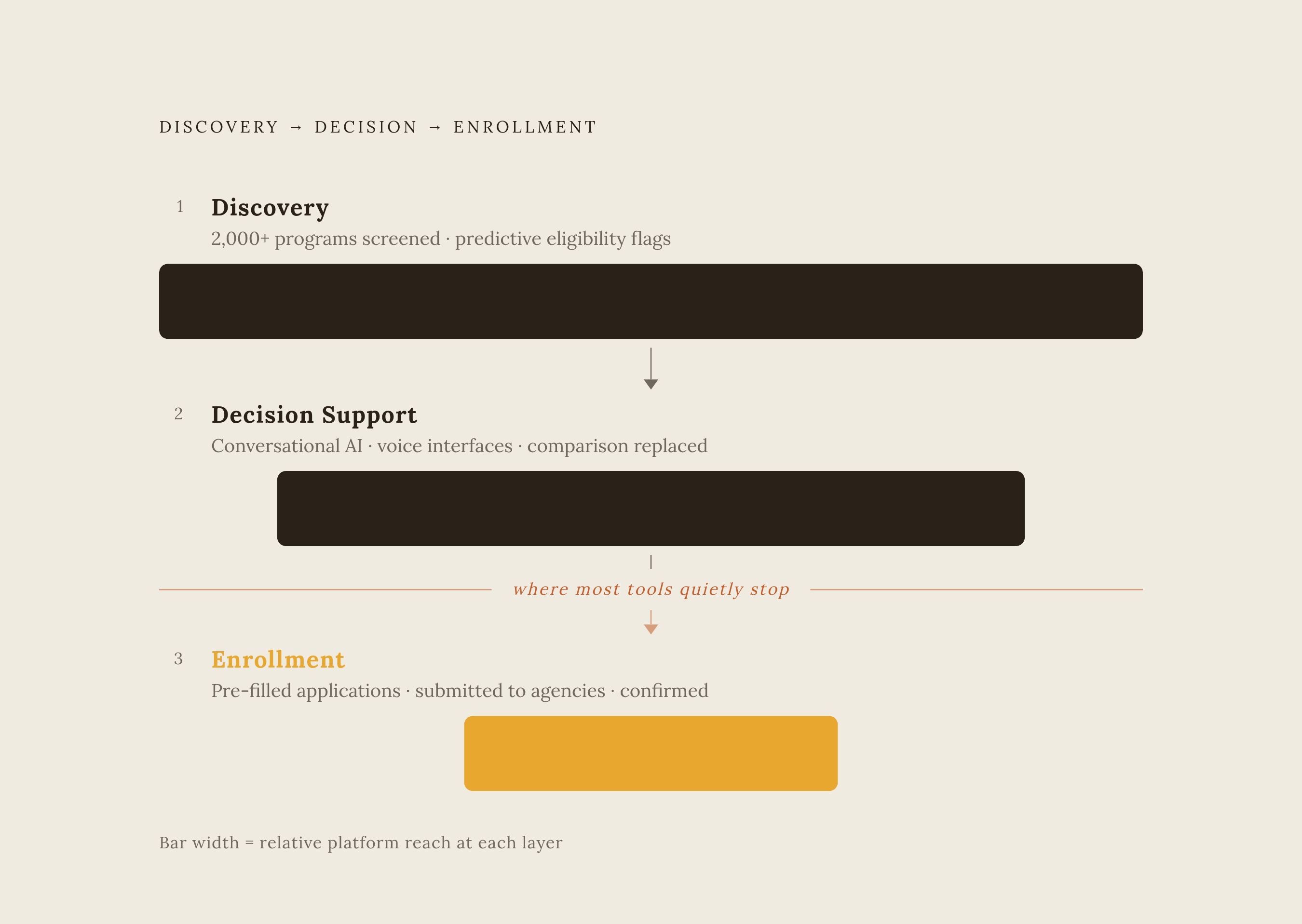
Picture the process as three layers stacked on top of each other, each with its own failure point.
Discovery is where AI earns its keep first, and it's the layer where the technology is genuinely mature. Instead of a person manually checking eligibility rules program by program, a system can take someone's health profile, income, medications, and location, and check eligibility across thousands of programs simultaneously. That's the cross-referencing that surfaces the Extra Help and MSP linkage mentioned above, a connection a person would almost never think to look for unassisted. Predictive analytics pushes further still, flagging people statistically likely to qualify for something before they've ever thought to ask.
Decision-support replaces the static comparison table with something closer to a conversation. Instead of scanning a grid of Medicare plans and premiums, someone asks a plain question and gets a plain answer, informed by data on health status and local service availability. Voice-activated interfaces matter enormously here, since they extend access to people dealing with vision loss or limited hand mobility, groups who'd otherwise get filtered out by a clunky web form before reaching the actual decision.
Enrollment is where most tools quietly stop, and it's the layer that separates the platforms worth paying attention to from the ones that aren't. This is the part that pre-populates an application using data already gathered during screening, checks eligibility in real time against the agency's own database, submits the application, and tracks it until it's resolved. It also handles sequencing: applying to three agencies in the right order, with the right documents attached to each one.
That structural shift deserves to be stated plainly, because it's the whole argument in miniature. A traditional screener produces a list of programs someone might qualify for, while an integrated platform produces a completed application waiting on a signature. The user's job changes from navigating a maze to confirming a decision already made on their behalf, which is a fundamentally different task and a fundamentally lower barrier. That said, AI hits a real ceiling here. It handles structured, documentable eligibility decisions well, but appeals, Medicaid redeterminations, and anything genuinely contested still need a human. The platforms doing this responsibly build that handoff into the design instead of pretending it away.
Platforms doing this now and where each draws the line
NCOA's BenefitsCheckUp searches more than 2,000 public and private benefits programs across all 50 states and D.C. It provides applications for more than 50 of those programs, including Extra Help, Medicaid, and state pharmacy assistance programs. Its strength is breadth and two decades of nonprofit credibility. Its limitation is equally clear: it's primarily a screening and application-initiation tool, and whether someone reaches confirmed enrollment still depends on them following through on the agency's side, unassisted.
Healthpilot goes narrow on purpose, focusing on Medicare plan selection with personalized recommendations based on health profile, medications, and finances. Inside that lane, it turns a genuinely confusing comparison process into an actual decision, while outside that lane, it isn't built to touch SNAP, SSI, or utility assistance at all, and it doesn't pretend otherwise.
Fair Square Medicare uses AI voice agents for both Medicare eligibility screening and enrollment. That voice-first approach matters directly for seniors who struggle with typing or reading small text on a screen, which is not a small population.
Humana runs its own AI chatbot to help people navigate Medicare plan options, and it's reportedly boosted conversion by cutting hold times on routine questions, freeing human agents for harder cases. Worth flagging plainly: Humana is a plan sponsor, so whatever the chatbot recommends is bounded by Humana's own product lineup, not the full market of available plans. That's the conflict CMS's RFI is explicitly trying to screen out, discussed further below.
Findhelp, formerly Aunt Bertha, is a widely used social care network serving health systems, government agencies, and employers across the country. Its strength is breadth of referral, connecting people to food banks, housing assistance, and similar resources. But it functions as a referral layer, not a direct enrollment engine; it typically hands the user or a care coordinator off to complete enrollment themselves, which puts it on the discovery side of the line this piece keeps drawing.
There's also a category of enterprise-grade tools built for real-time Medicare eligibility verification and automated CMS data submission. These are built for health plans and brokers running compliance workflows, not for a senior sitting at home trying to figure out what she qualifies for.
A newer, smaller category deserves its own mention: platforms built to screen across the full benefits landscape, not just Medicare, while also supporting the family caregiver alongside the senior. That second part matters more than it sounds like it should, since caregivers are frequently the ones actually filling out these applications, and they're often eligible themselves for caregiver compensation programs they've never heard of. Brevy, a free service guiding people through eligibility checks and enrollment for Medicaid, Medicare, and caregiver payment programs, fits this category. It pre-populates applications from screening data, checks eligibility in real time against agency databases, and automates submission and status tracking, shifting the user from navigator to confirmer rather than leaving them holding a list and a phone number.
Taken together, the market has plenty of strong discovery tools and a handful of strong Medicare-specific enrollment tools. What's still rare, and what remains the least-solved piece of the puzzle, is genuine end-to-end coverage across Medicare, Medicaid, SNAP, and caregiver programs all at once.
How CMS's 2026 AI initiative signals where the whole system is heading
CMS issued an AI Request for Information on February 23, 2026, explicitly looking for tools that handle personalized plan recommendations, conversational AI, predictive analytics, and call center automation. An RFI like this is itself an admission: the tools CMS has now, the static tables and the 1-800 number, aren't cutting it, and the agency is saying so in writing.
The bar CMS set for respondents is telling in its specifics. Tools need active production deployment, direct Medicare experience, and organizational independence from insurance sales. That last requirement is not boilerplate; it's a direct acknowledgment that a recommendation engine owned by an insurer carries a built-in conflict of interest, whether or not anyone running it intends that outcome. It's also, not coincidentally, the exact issue that limits what Humana's chatbot can responsibly claim to do.
Zoom out and the pattern holds at a much larger scale. CMS's Health Technology Ecosystem initiative has already drawn interest from more than 600 organizations. Benefits navigation is becoming a stated institutional priority inside the federal government, not a side project.
Not everyone is cheering unconditionally, and that caution earns its place here. The Medicare Rights Center has said, while broadly supporting modernization, that AI "is not infallible, well understood, or always safe" when deployed at scale without enough oversight. Worth sitting with that for a moment: a search engine getting something wrong is an inconvenience, while an enrollment platform getting something wrong can cost someone months of benefits. The standard has to be higher here than it is almost anywhere else AI gets deployed, and the organizations building toward CMS's requirements now are effectively shaping how tens of millions of people will enroll in these programs for the next decade.
The adoption reality: older adults are more ready for AI than the tools are ready for them
Generative AI use among adults 50 and older stood at just 9% in 2023, according to AARP research, while about 30% of older adults now report having interacted with an AI platform or app — a striking shift in a short period. That's a faster shift than most product teams in this space appear to have planned around, and it undercuts a lazy assumption baked into a lot of benefits-tech design: that older users need to be eased into AI slowly. The data says they've already moved.
The infrastructure backs that up. About 9 in 10 adults 50 and older own a smartphone now, up 35% since 2016, and this group uses roughly 14 digital services and 10 apps over a three-month stretch. Whatever is blocking AI-assisted benefits navigation, it is not a lack of devices in people's pockets.
Trust remains a live issue: 46% of older adults still say they have little or no trust in AI-generated information. That kind of trust gets built through accuracy and transparency held steady over time, not from a slicker onboarding screen.
Here's the part that lands squarely on the industry, not on the users: three in 5 adults 50 and older say technology just isn't designed with their age group in mind. That's a design failure, worth naming as one rather than dressing it up as a generational adoption curve that will simply resolve itself over time.
What actually moves adoption forward, according to the data? Voice-first interfaces cut down the literacy and dexterity barriers that trip people up on standard forms, and plain, jargon-free language matters enormously, given how dense Medicare and Medicaid terminology gets even for people who read it daily for a living. A human available when the AI hits its limit isn't a nice-to-have; it's the difference between a tool people trust and one they abandon halfway through. A 2025 study out of Michigan State University, published in JMIR, found older adults rated emergency assistance features at 78.6% desirability and health monitoring at 75%, both well ahead of flashier, more novel AI features. People respond to usefulness over novelty, which should surprise no one, but keeps getting ignored in product roadmaps chasing the more exciting feature.
One caveat shouldn't get buried under the good news: these adoption gains don't reach everyone equally. Older women, lower-income adults, and people in underserved regions face a wider gap than the topline numbers suggest. A platform that works well for the average user but misses the hardest-to-reach populations has only closed part of the $58 billion problem, and arguably not the most urgent part.
What to look for in a platform that genuinely closes both gaps
Everything above narrows down to a short checklist, and the most important item on it is the one platforms are least likely to advertise honestly: where does the tool's job actually end?
Program breadth beyond Medicare comes first. A tool that only handles Medicare plan selection will miss SNAP, SSI, MSPs, utility assistance, and caregiver compensation, which happen to be exactly the programs with the lowest enrollment rates and the largest dollar gaps. Ask directly: does this screen across more than one program category, or just one?
Enrollment completion matters more than a tidy list of eligibility results. A list of programs someone qualifies for still leaves the application work ahead of them. Look for platforms that pre-populate the application, submit it, and track it through to a decision, and ask plainly where the platform's job ends: at the list, at the submitted application, or at confirmed enrollment. Those are three very different products wearing the same marketing language.
Conflict-of-interest structure deserves real scrutiny, not a passing glance. Platforms run by insurers or plan sponsors have recommendations bounded by their own product catalog, whether or not that's stated outright anywhere in the interface. CMS built organizational independence into its own RFI requirements for exactly this reason, and that requirement should be the baseline expectation, not a bonus feature.
Human backup for complex cases isn't optional. AI is good at structured eligibility matching, but it is not the right tool for a Medicaid appeal or an SSI reconsideration, and platforms worth trusting build a path to a real specialist into the design rather than leaving someone stuck in a chat loop with no exit.
Accessibility has to be designed in from the start, not patched on after launch. Voice interfaces, plain language, low-literacy pathways: these matter more here than almost anywhere else, given that the $58 billion gap concentrates among lower-income seniors who are also less likely to be digitally fluent.
Caregiver inclusion is easy to overlook and shouldn't be. Family members are frequently the ones actually filling out these forms, and they're often eligible themselves for compensation programs nobody's ever mentioned to them. A platform that accounts for that double eligibility serves the whole household, not just the name on the paperwork.
A cleaner PDF or a better awareness campaign will not close this gap on its own; the numbers from 2001 to now already prove that. It closes when someone who thinks they might qualify for something can walk through one guided session and come out the other side actually enrolled, no phone tag, no second form, no dead end handed to them at the exact moment they needed a next step. The technology to do that exists right now, in pieces, across the platforms named above. What's left is building it well enough, and honestly enough, that people who've been failed by this system before are willing to trust it a second time.