AI-powered platforms that help families navigate elder benefit enrollment
Unclaimed benefits persist because families can't find them, not because they don't qualify.
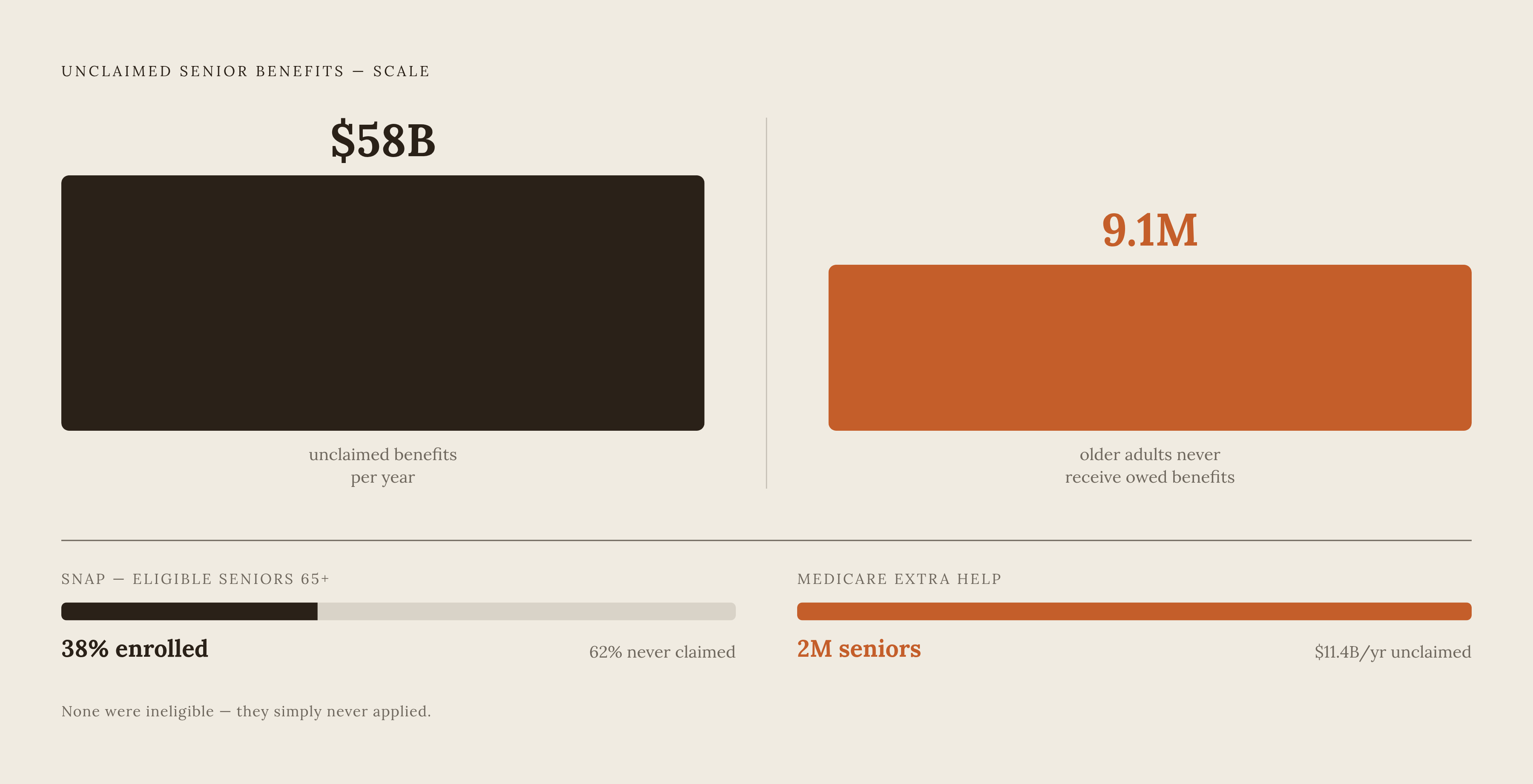
Roughly $58 billion in benefits that older Americans qualify for goes unclaimed every year, according to the National Council on Aging, and the reason has almost nothing to do with eligibility rules. That figure covers an estimated 9.1 million older adults who never receive money and services they're legally entitled to. Weeks of investigation into why that gap persists year after year despite the programs existing pointed to an answer that had little to do with generosity or funding. This piece asks a narrower question: why does that gap exist, and which of the AI tools built to close it are actually doing the job instead of just marketing around it.
Break the number down program by program and the shape of the problem gets sharper. Only 38% of adults 65 and older who were eligible for SNAP were actually enrolled in 2023, per NCOA. Roughly 2 million seniors who qualify for Medicare Extra Help never sign up, leaving $11.4 billion in prescription drug savings unclaimed each year.
Notice what's missing from that list. Nobody here earns too much or owns too much to qualify; they simply never applied. Eligibility rules explain almost none of the shortfall. Access explains nearly all of it, and that distinction points toward a fix most policy conversations skip over entirely: better ways of connecting people to programs that already exist, rather than more generous programs themselves. Findability, more than money, is the binding constraint.
Why the system is so hard to navigate even for people who know help exists
Programs are scattered across dozens of federal and state agencies, and each one runs its own application, its own income thresholds, its own asset tests, its own renewal calendar. Nobody walks into one office and asks "what am I eligible for?" There are separate front doors for SNAP, for Medicare Savings Programs, for Medicaid, for veteran caregiver stipends, and a family has to already know which door to knock on before anyone can help them.
Misconceptions make it worse before they make it better. The 2025 Nationwide Retirement Institute Long-Term Care Survey found that 58% of Americans believe Medicare covers long-term care costs. That belief is flatly wrong, and it leaves families blindsided when a parent needs nursing home care and the bill arrives with no Medicare coverage behind it. By the time the misunderstanding surfaces, families are in crisis mode instead of planning mode, and crisis mode is the worst possible time to learn a new bureaucracy from scratch.
Open enrollment hasn't gotten any friendlier either. The 2025 Medicare Advantage enrollment period landed alongside a significant wave of plan pullbacks, insurers exiting markets and reconfiguring benefits mid-stream. A plan that worked fine last year might not exist this year, or might exist with a different formulary and a different provider network, and catching that change falls entirely on the beneficiary, who has no reason to expect it.
Medicaid is set to get heavier too. Proposed changes to federal Medicaid renewal rules could significantly increase how often patients must renew their coverage. That would multiply the paperwork load for people who, in a lot of cases, already struggle to keep up with a single annual renewal.
Four barriers sit underneath all of this, and they repeat across every program mentioned so far: dense paperwork stuffed with jargon, seniors who self-disqualify because they assume they make too much money, no single front door into the system, renewal deadlines that are easy to miss while managing a health condition on top of everything else. Whether someone deserves help has little bearing on any of this. The relevant question is whether the system was built for a human being to actually use, and on the evidence here, it wasn't.
Who is doing the navigating — and what it costs them
As of 2025, 68.9 million Americans are enrolled in Medicare, and 90.1% of them are 65 or older. Behind a large share of that population sits an unpaid caregiver, usually a spouse or adult child, trying to make sense of a system that wasn't designed with them in mind. The Bureau of Labor Statistics puts the number of people providing unpaid eldercare at 38.2 million, 14% of the civilian population age 15 and over, using 2023-24 data.
What that role demands has intensified faster than the support around it has grown. Over 40% of family caregivers now perform high-intensity medical tasks, things like injections, wound care, managing durable equipment, yet only 22% receive any formal training to do it. Half report a negative financial impact from caregiving, and a quarter have taken on debt because of it.
Family caregivers provide an estimated $375 billion worth of care annually, more than the country spends on homecare and nursing facilities combined. Benefits navigation, the one task that could partially offset those costs, lands squarely on the shoulders of these same overstretched people, most of whom have no background in Medicaid rules or Medicare plan design. Their struggles have little to do with carelessness. The obstacle is a system that assumes a level of bureaucratic fluency nobody should have to acquire in the middle of a family health crisis. That's the audience the tools in the rest of this piece are actually built for, and each one deserves to be judged against that standard rather than against how polished its interface looks.
What AI actually does differently in benefits enrollment
Traditional navigation looks like phone trees, in-person agency visits, paper forms, months of waiting. At every step, the family needs to already know the right question before anyone can answer it. AI is starting to reshape that model, though it's worth being precise about where the reshaping actually happens rather than treating "AI" as one undifferentiated fix.
Eligibility surfacing means cross-referencing a household's income, assets, age, prescriptions, health conditions, and location against hundreds or thousands of programs at once, work that would take a human counselor hours compressed into seconds of computation. Application guidance means walking someone through a form field by field, catching the kind of error that would otherwise get an application bounced back weeks later. Outreach and renewal tools contact people proactively before their renewal window closes, in whatever language they're most comfortable in, instead of waiting for someone to remember on their own. Plan matching tools compare Medicare Advantage and Part D options against a person's actual prescriptions and provider network, accounting for their specific circumstances rather than a generic national average.
Relaw.ai's 2025 analysis of elder law tools found that AI-powered platforms can cut Medicaid application processing time by up to 85%. That's the difference between an application that sits untouched for months and one that actually moves through the system.
Here's where the honest version of this story gets less flattering to the technology, though. AI in this space works best paired with human case workers who do final verification and submission, and the platforms worth trusting are the ones that say so plainly. Full replacement of human judgment isn't realistic once a case gets complicated: a disputed asset, an unusual family arrangement, a state-specific wrinkle in the rules. Any platform that implies otherwise is overselling what the technology actually does, and that overselling is the single biggest reason to distrust a slick pitch in this category before checking what happens after the eligibility screen.
Platforms built around finding benefits seniors already qualify for
NCOA's BenefitsCheckUp is the widest net cast in this space, and probably the right starting point for most people, full stop. It's free, run by a nonprofit, and built specifically to address the unclaimed-benefits problem this piece opened with. It screens against nearly 2,000 public and private benefit programs across all 50 states and D.C., covering food assistance, medicine, utility help, and other everyday costs.
It has a real limit, though, and it's the one that matters most: BenefitsCheckUp tells you what you're eligible for and points you toward where to apply, but the path from screening to completed enrollment still requires additional steps. The gap between "you qualify" and "you're enrolled" is exactly where a family with a complicated schedule or a language barrier tends to fall off, and it's the gap a second category of platform now exists to close.
AI-assisted caregiver benefit platforms pair eligibility screening with guided application support, and several are built specifically for family caregivers who are themselves eligible for compensation: Medicaid-funded home care wages, veteran caregiver stipends, state-run payment programs, not just benefits for the person receiving care. The strongest ones combine AI speed with human follow-through, software that finds the match in minutes and a real person who helps finish the paperwork. That combination beats a pure screening tool, because it addresses the exact point where eligible families stall out: they learn they qualify, and then nothing happens next because the application itself is too dense to finish alone.
Platforms built for Medicare plan selection
Medicare plan selection is its own version of the same problem, and arguably the version where getting it wrong costs the most. As of 2025, 54% of eligible beneficiaries are enrolled in Medicare Advantage, and plan networks, drug formularies, and out-of-pocket limits vary widely from one plan to the next. Add the plan exits and benefit changes of the 2025 open enrollment season, and comparing plans by hand becomes genuinely difficult even for someone who does it every year.
Some Medicare plan-matching platforms are designed to be payer-agnostic, and that's the design choice worth sitting with, because it cuts against how this industry usually works. Rather than favoring any particular insurer, these tools take a person's health profile, providers, and prescription list and run a comparison across available plans. It's worth naming the conflict that more traditional structures are designed around: a human broker's recommendation can be shaped, consciously or not, by which plans pay better commissions. A model trained to match need to plan carries a different set of incentives. That's the strongest argument for trusting a payer-agnostic tool over a broker relationship in a year this volatile, and it's the argument most people evaluating these platforms skip past too quickly.
The value of AI plan-matching tools shows up most clearly in a year like 2025, when the plan that worked last year might not even exist this year. The matching algorithm itself is a small part of the real contribution here. The larger one is removing the assumption that a person should be able to track dozens of shifting plan details on their own, every single year, without help, an assumption that was never realistic to begin with.
Platforms tackling Medicaid renewal and re-enrollment at scale
Kern Family Health Care, the largest Medi-Cal provider in Kern County, California, shows what AI-scaled outreach looks like when the volume problem is too big for human staffing to solve on its own. Medicaid re-enrollment requires repeated contact with hundreds of thousands of members on tight renewal timelines, and there's no realistic way to cover that with human callers alone.
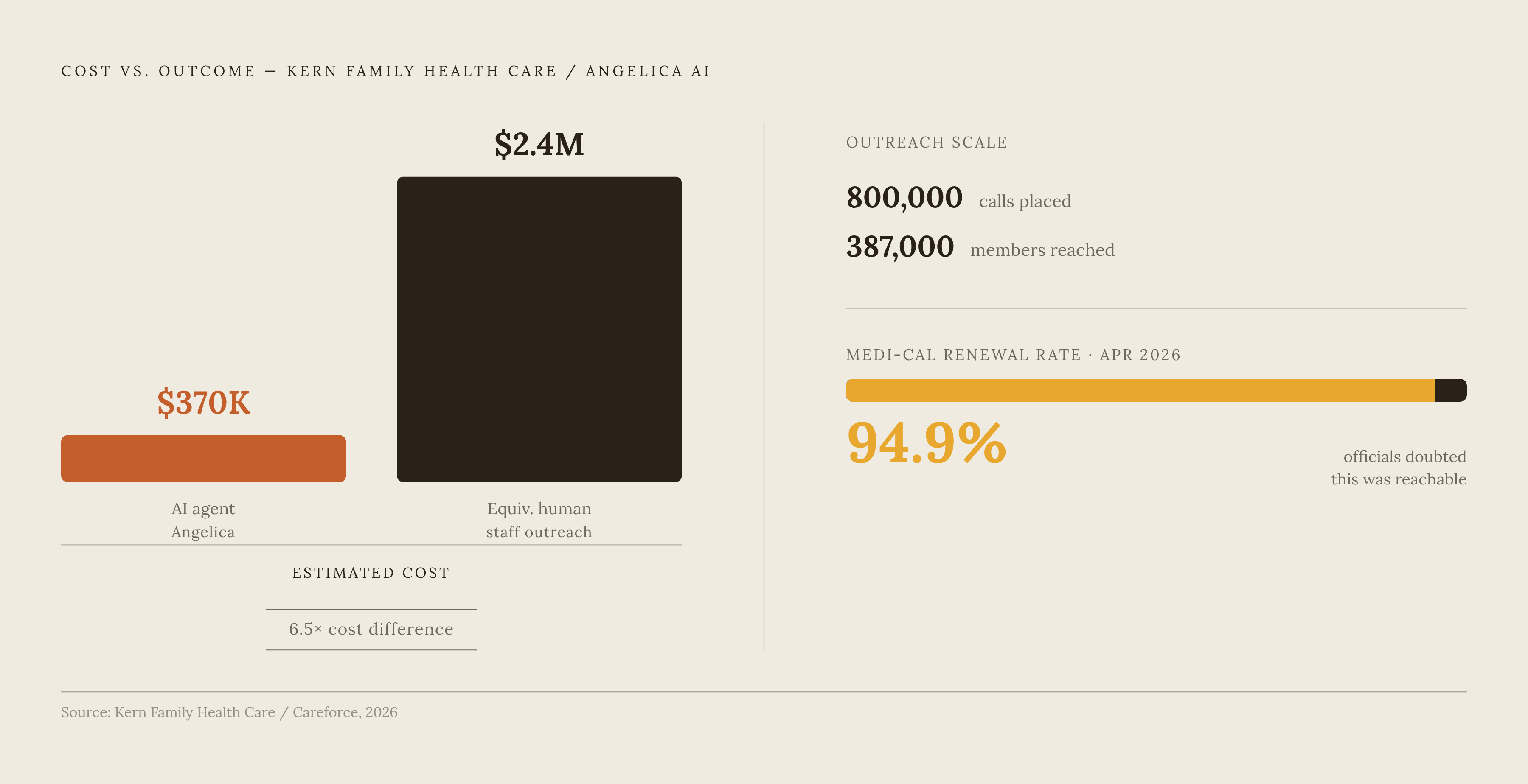
Kern Family deployed Careforce's conversational AI agent, Angelica, to close that gap. Angelica handles complex member questions, operates in more than 30 languages, and schedules appointments with plan staffers who complete and submit the actual applications. Since late 2025, the system has logged more than 800,000 calls across Kern Family's 387,000 members.
The cost comparison makes the case on its own. Kern Family spent approximately $370,000 on the Careforce software; running that same volume of outreach through human staff was estimated at $2.4 million. Kern Family's Medi-Cal renewal rate hit 94.9% in April 2026, a number plan officials had genuinely doubted was reachable given the renewal-volume pressure they were already under.
That pressure is only going to grow. If Medicaid renewal frequency increases under pending federal rule changes, every plan and every state agency could face roughly double the outreach load Kern Family was already straining against. It's worth being precise about what Angelica actually does, though, because the precision matters more here than anywhere else in this piece: eligibility determinations aren't part of its job. Scheduling the humans who make them is. The AI handles scale; the judgment stays human, and that division of labor is the model worth copying. Any competing platform that blurs the line between the two deserves suspicion, not the benefit of the doubt.
Platforms built for long-term care planning before a crisis hits
Go back to that 58% figure, the share of Americans who mistakenly believe Medicare covers long-term care. That misconception is exactly why so few families plan before they need to, and it's the reason most start only after a health event forces the issue, at which point the options are narrower and more expensive than they would have been with a year or two of lead time.
The demand curve makes the timing question more urgent. The population needing nursing home care is projected to grow from 1.3 million to 2.3 million by 2030, and 63% of people who need long-term care are already 65 or older.
Waterlily tackles the planning gap directly. An intake form covering health history and family medical background feeds a prediction model trained on the long-term care journeys of other families, generating a projection of likely care needs, timelines, and costs in seconds. Families use it to plan independently; financial advisors use it as a client-facing tool during retirement planning conversations. A projection built from an individual's actual health history leads to different, better insurance and savings decisions than one built from a generic national average that may not resemble that family's situation at all.
Assured Allies, through its AgeAssured program, works the other end of the same problem. It partners with long-term care insurers to offer policyholders science-based interventions, aging coaches, evidence-based health support, aimed at delaying or reducing the need for a claim in the first place. The company has reported reducing long-term care insurance claims costs by up to approximately 20%. That reframes the insurer-policyholder relationship in a genuine way: the insurer invests upfront in keeping someone independent longer, rather than waiting passively for a claim to arrive.
Planning tools and enrollment tools are solving sequential problems, and treating them as interchangeable is the mistake most families make. The families with the best outcomes engage with the planning side before circumstance forces them into the enrollment side, and that ordering matters more than which specific platform a family ends up choosing.
AI tools built for elder law attorneys handling Medicaid planning
Medicaid planning for nursing home eligibility is among the more punishing legal and financial exercises a family will face. Asset spend-down rules, look-back periods, and spousal impoverishment protections vary by state, and getting any one of them wrong can delay eligibility by months or trigger a penalty period nobody saw coming.
Elder law practice shifted meaningfully because of AI over the course of 2025. Specialized platforms now run Medicaid eligibility analysis automatically, processing a client's assets, income, and medical needs against the specific rules of their state, work that used to require an attorney doing it by hand or with generic legal software never built for the job. Relaw.ai is one example in practice: it offers targeted Medicaid eligibility analysis for elder law attorneys alongside support for guardianship proceedings and broader elder care legal work, and the 85% processing-time reduction cited earlier comes from Relaw.ai's own 2025 reporting on this category.
There's a signal from the employer side worth noting too. SHRM's 2026 Employee Benefits Survey found that 11% of U.S. employers now offer access to eldercare services and information, up from 7% in 2025. That growth suggests eldercare navigation is becoming a workforce benefit in its own right, which in turn creates more demand for the attorney-facing tools supporting it. Families dealing with a nursing home transition or a genuinely complicated asset picture should take one thing from this section: the legal counsel working on their behalf now has faster, more accurate tools too, on top of whatever consumer apps have also improved.
What to look for when choosing a platform — and what no platform can fully replace
The right platform depends on what stage of the journey a family is actually in, and no single tool covers every stage well. Matching the tool to the moment matters more than picking whichever one has the longest feature list. A family that just needs to know what they qualify for is better served by a broad screener than by a narrow enrollment tool built for one program; a family staring down a Medicare Advantage decision needs a plan-matching engine, not a Medicaid eligibility calculator.
Two questions cut through most of the noise in this category. Does the platform carry you through to submission, or does it stop at telling you what you're eligible for? And is there a human being available once the case gets complicated in a way no eligibility algorithm was built to handle, a disputed asset, an unusual family arrangement? Brevy, a free benefits navigation service, is built around exactly that combination: its AI chatbot checks eligibility across Medicaid, Medicare, and caregiver payment programs in minutes, then connects the user with a live enrollment specialist to finish the application. That pairing, fast automated screening plus a person who can handle what doesn't fit a template, is the shape the strongest tools in this space keep taking, and it's a reasonable filter for evaluating any new one that comes along.
What none of these platforms can fully replace is judgment in a genuinely hard case: assets spread across multiple states, a Medicaid look-back period complicated by a prior gift, a guardianship dispute tangled up with an eligibility question. An elder law attorney, AI-assisted or not, still earns the fee in that scenario, and no amount of processing-time reduction changes that. This technology hasn't eliminated the need for expertise, and it was never going to. Its real achievement lies elsewhere: making sure the tens of millions of families who never needed a complicated case, who just needed someone to tell them they qualified and help them fill out the form, don't fall through a crack that was never about their eligibility in the first place.