Barriers That Stop Caregivers From Claiming Compensation
Only one in five compensated caregivers reach programs built without knowing they exist.

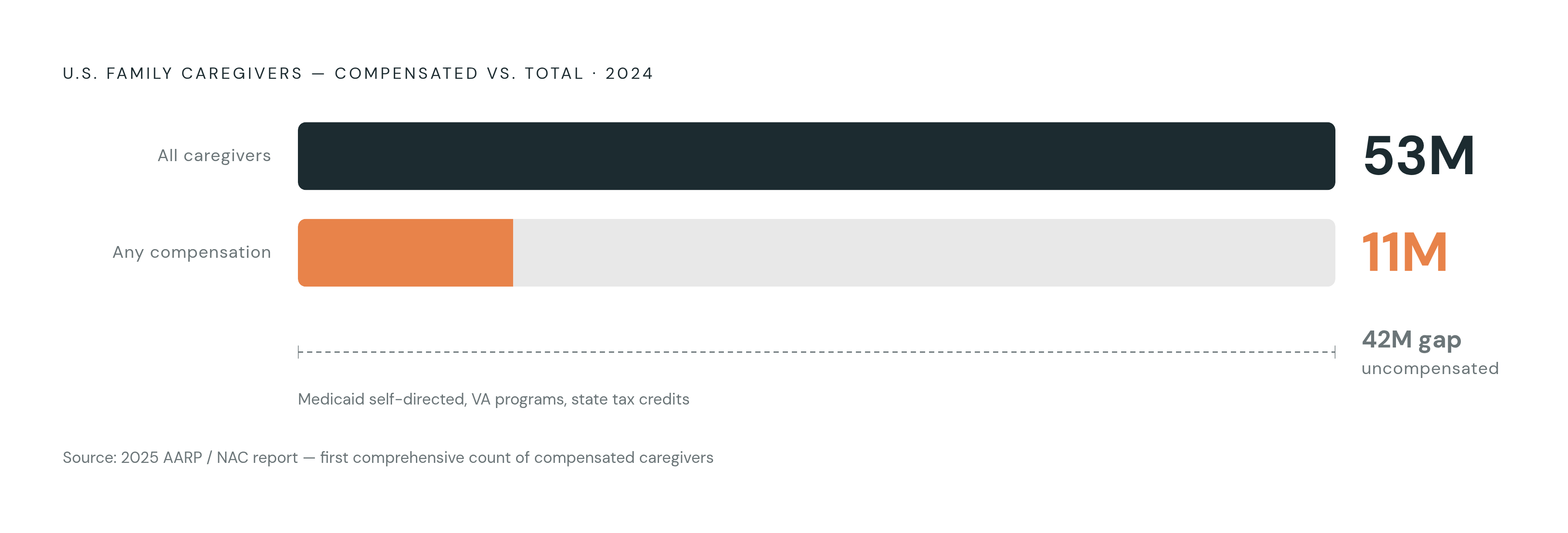
Family caregiving in the United States has reached a scale that strains the imagination. Approximately 53 million Americans fill this role as of 2024, and more than one in four adults aged 50 and older are doing it right now. Half of them report a negative financial impact. One in five cannot reliably afford food. A quarter have taken on debt. The direct costs of care, when someone has to pay for them out of pocket, ran between $5,700 and $6,300 per month in 2024.
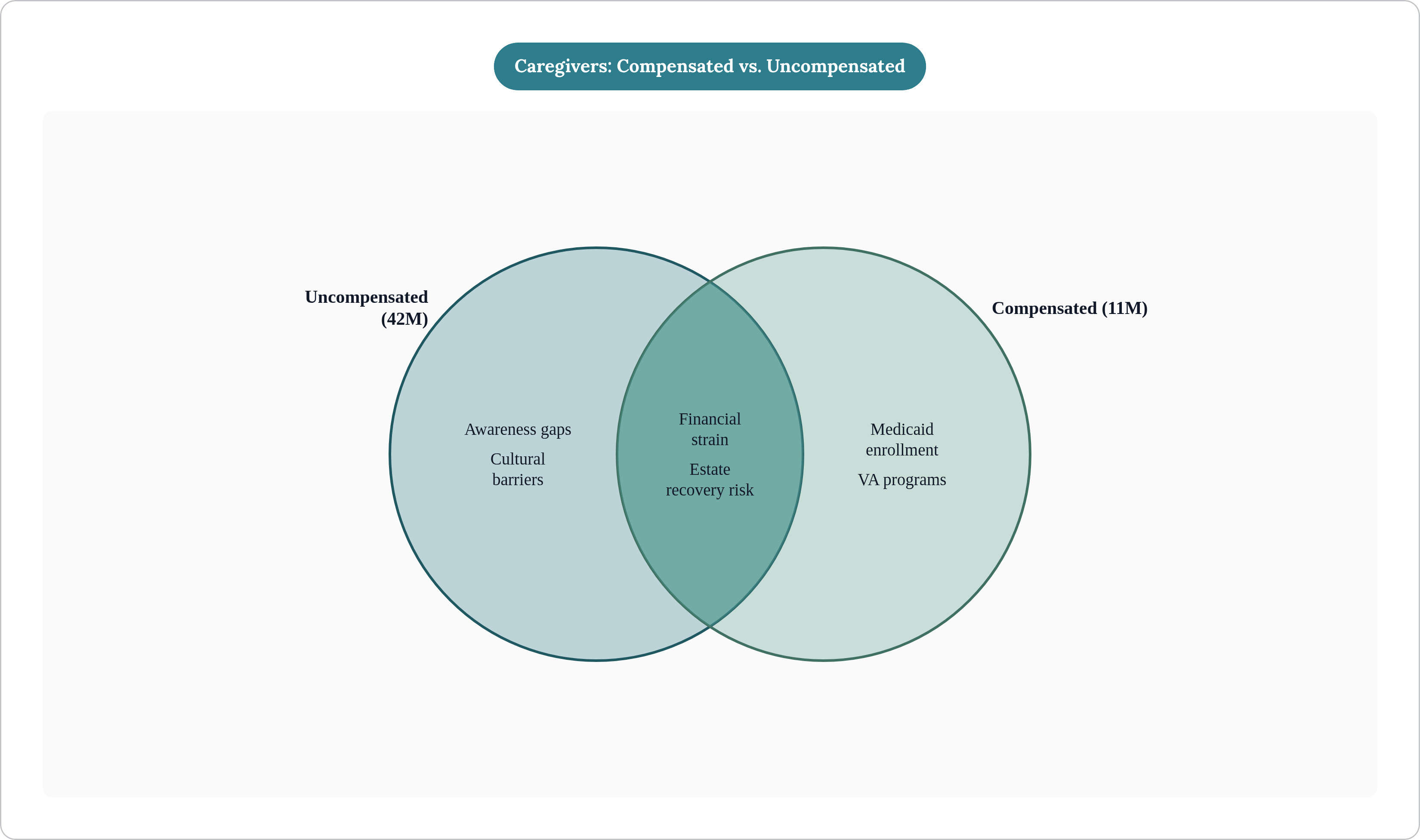
Compensation programs exist. Medicaid self-directed care, VA programs, and state caregiver tax credits collectively reach some caregivers in nearly every state. The 2025 AARP/NAC report counted, for the first time, approximately 11 million caregivers receiving some form of compensation through those channels. That number is not nothing. But against 53 million, it reveals a gap that demands explanation.
The explanation is not, as I have come to understand after years of working inside caregiver support systems, that caregivers lack initiative or that the need isn't real enough to motivate action. It is that between a caregiver and a compensation payment stands a sequence of barriers, each capable of ending the effort independently — and most caregivers encounter them without knowing what they are or that alternatives exist. What follows is an attempt to name each one precisely, because naming a barrier is the first condition of getting past it.
Why So Many Caregivers Don't Know Compensation Programs Exist
Two-thirds of caregivers report difficulty finding adequate resources, according to the research. That figure always struck me as underselling the problem, because it implies caregivers are looking and coming up short. The deeper issue is that many never look at all, not because they are incurious, but because nothing in their daily life signals that looking would be worth their time.
On the employer side, a quarter of employers offer some form of senior care benefit, yet only 15% of employees are aware those benefits exist, according to the CareBenefits 2026 Future of Benefits Report. That is not a reporting anomaly. It reflects a consistent pattern across benefit types: programs are built, announced through channels that caregivers aren't monitoring, and then go largely unclaimed.
The federal government's own 2024 Progress Report to Congress identified "caregiver self-identification and knowledge of services" as a key gap requiring attention. That is a careful bureaucratic way of acknowledging something more direct: caregivers don't know they are caregivers in the formal sense the programs use, and caregivers who do identify themselves that way still rarely know which programs apply to them or that compensation is even a possibility.
Programs are almost never marketed to caregivers the way consumer products are marketed. Most people encounter the system only when a crisis forces them in, usually at exactly the moment when they have the least time and cognitive bandwidth to navigate something new. Even a caregiver who is motivated and literate still has to discover that a relevant program exists, confirm that it is currently active in their state, determine whether the care recipient qualifies, and understand enough about the program's structure to pursue it. That is a significant research task before a single form is filled out.
Low awareness is not a personal failure. It is the predictable outcome of programs that were built without outreach infrastructure proportional to the population they are meant to serve.
What the Application Process Itself Demands From People Who Are Already Stretched Thin
Bureaucratic complexity ranks among the top challenges reported to caregiver resource centers. The specifics are familiar to anyone who has tried to navigate them: invasive paperwork, extended hold times, difficulty scheduling in-person appointments in windows that don't conflict with caregiving hours, and denials that arrive without clear explanations of what was missing.
The documentation requirements in particular carry a consequence that goes beyond inconvenience. Without proper records, Medicaid can require repayment of amounts already paid to a caregiver in order for the care recipient to maintain eligibility. The system can effectively claw back compensation the family already spent on care. That possibility, once known, introduces a rational hesitation about participating at all.
The bipartisan Alleviating Barriers for Caregivers (ABC) Act, introduced in both chambers of the 119th Congress, would require the Centers for Medicare and Medicaid Services and the Social Security Administration to simplify eligibility, enrollment, and coverage maintenance processes. The bill's existence is itself a form of evidence. When lawmakers from both parties agree that administrative burden is a structural problem requiring legislative intervention, the argument is no longer theoretical.
The more fundamental problem is that the application process extracts its price in time. For a caregiver already providing round-the-clock assistance, every hour spent on paperwork is an hour taken directly from caregiving. The process costs them the resource they have the least of. And the cumulative friction of the process matters more than any single step: each requirement that demands a phone call, an office visit, or a correctly formatted document is another point at which a reasonable person with insufficient time concludes that this isn't going to work and stops trying.
How Eligibility Rules Create Traps Even for Caregivers Who Qualify in Principle
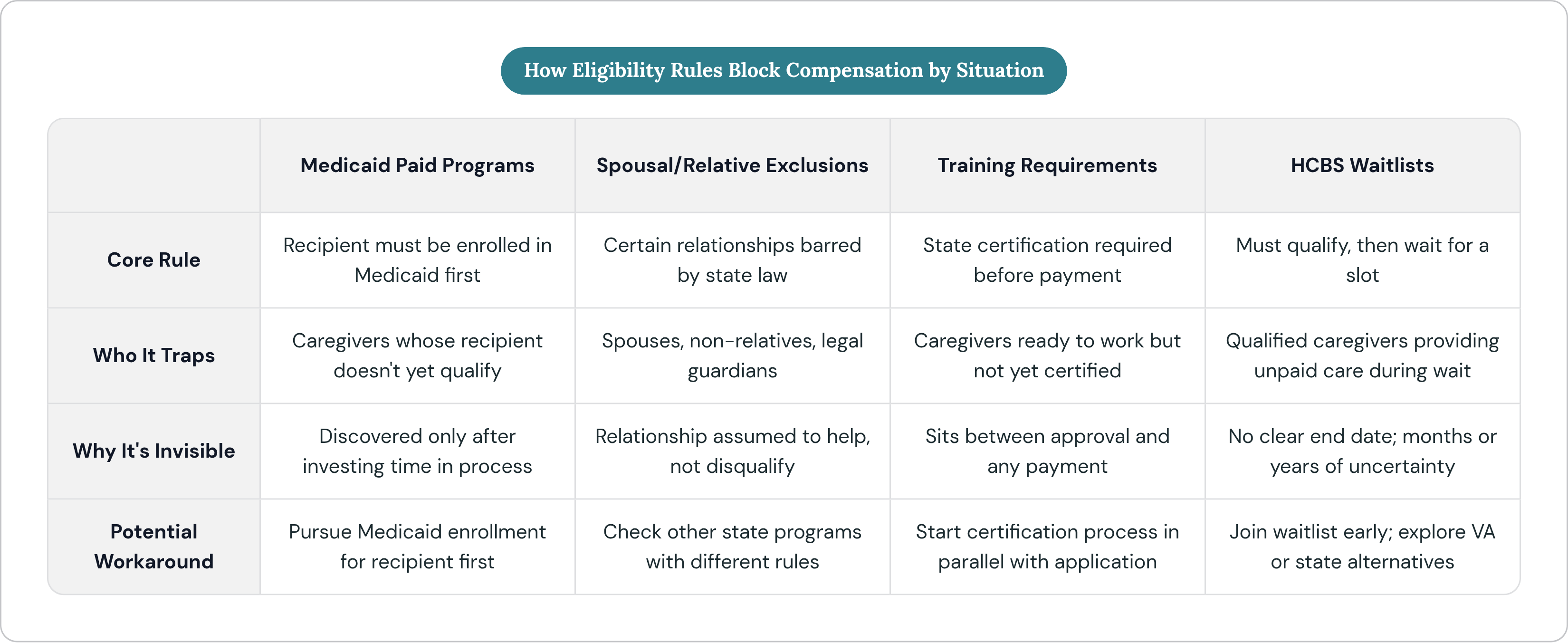
Medicaid paid family caregiver programs require the care recipient to be enrolled in Medicaid first. If the recipient doesn't qualify or isn't enrolled, the caregiver cannot be paid through that pathway, regardless of how significant or financially burdensome the care is. The caregiver's eligibility is contingent on someone else's eligibility, which is a structural dependency most caregivers don't discover until after they've invested time in the process.
State rules introduce further variation that can feel arbitrary from the inside. Some programs exclude spouses as paid caregivers; others exclude non-relatives. Legal guardians may be barred from receiving payment while also serving in a guardian capacity. The relationship that motivated the care in the first place can be exactly the feature that disqualifies the caregiver from compensation.
Training and certification requirements add another conditional layer. Many programs require a caregiver to be registered or certified by their state before compensation begins. That step takes time, may carry its own eligibility conditions, and sits between the caregiver and any payment even when everything else is in order.
Home and community-based services waitlists compound the problem in a way that is particularly disorienting. Caregivers and care recipients who qualify in principle may wait months or years before compensation actually begins, providing unpaid care throughout. Some paid caregiver programs that were introduced during the COVID-19 pandemic have since ended. Caregivers who built their household budgets around that income lost it when states discontinued the programs. The practical effect of all of this is that a caregiver can clear the awareness barrier, survive the application process, and still find that a rule they couldn't have anticipated blocks payment entirely.
How Medicaid's Estate Recovery Rules Turn a Benefit Into a Perceived Threat
Federal law requires states to seek recovery of Medicaid payments from the estate of recipients aged 55 and older after they die, including payments made for home and community-based services. For families whose primary or only significant asset is a home, this requirement translates into a concrete fear: accepting Medicaid-funded care now means the state may claim the house later.
That fear is not irrational. It is a reasonable response to a documented policy. The result is that some families go into debt paying for care out of pocket, or reduce care to a level they can self-fund, specifically to protect an inheritance they may have been counting on. The avoidance is rational; its cost is severe.
Fourteen states offer waivers that exempt or defer estate recovery for caregiving heirs who lived in the home for a specified period, typically one to two years, and provided care that delayed the care recipient's need for institutional services. Those waivers represent a meaningful policy accommodation, but they are rarely well-publicized, and caregivers don't know to ask about them.
Communities of color and low-income families face compounded harm here. Limited access to estate planning reduces the options available for protecting assets, and systemic barriers that restrict access to legal counsel or financial advice mean that even existing protections go unused. The estate recovery barrier is worth treating separately because it is invisible to caregivers who don't get far enough into the system to encounter it. And it affects not only the caregiver's willingness to be paid, but the care recipient's willingness to enroll in Medicaid at all.
Why Employed Caregivers Often Don't Use the Workplace Protections They Have
Seven in ten family caregivers are employed. According to AARP and S&P Global 2024 data, 27% of working caregivers reduce their hours, 16% decline promotions, 13% change employers, and 16% stop working entirely for a period to manage caregiving responsibilities. These are not choices made in a vacuum. They reflect calculations about risk.
The Family and Medical Leave Act protects the right to unpaid leave, but protection on paper and protection in practice are not the same thing. Employers can and do retaliate through demotions, exclusion from advancement opportunities, disciplinary action, or termination using pretextual reasons that are difficult to disprove in practice. A caregiver who takes leave and returns to find herself sidelined must prove the connection against a well-resourced employer with every incentive to characterize the treatment as unrelated.
As of 2025, only about 31% of private-sector workers have access to paid family leave insurance, with substantially lower rates among part-time workers and low-wage earners. Those two groups are frequently the same people who are most financially strained by caregiving. The United States remains the only OECD member country without a national paid leave policy; paid caregiving benefits of some kind exist in close to three-quarters of OECD countries.
The fear of retaliation is not irrational. It is a documented pattern. Many caregivers calculate, correctly, that exercising their formal rights costs more than absorbing the loss directly. Reducing hours is cheaper than risking termination. Declining a promotion is less damaging than poisoning a relationship with a manager whose goodwill you depend on every day. The math is uncomfortable, but it is real math.
How Cultural Norms and Identity-Based Factors Suppress Help-Seeking Before Caregivers Reach Any Formal Barrier
Some of the most durable barriers never appear on any application form, because they operate before the first search, before the first phone call. In communities where filial piety, reciprocity norms, or ideals of family honor are central, accepting outside compensation for caregiving can carry a moral charge that has nothing to do with need and everything to do with identity. This is prominent in many Asian, Middle Eastern, Hispanic, and other cultural communities; the frameworks vary, but the effect is similar. Compensation can feel like a statement about the family's willingness to care for its own.
Stigma around disability in some communities means caregivers work to protect the care recipient's dignity by avoiding clinical systems, even when those systems are the access point for financial support. The protective instinct is genuine; the consequence is isolation from programs that could help.
Low health literacy, particularly among immigrants and refugees navigating Western bureaucratic systems in a second language, creates compounded friction at every step. What is already a confusing system becomes substantially harder when the language of the forms, the jargon of the eligibility rules, and the expectations of the administrative process are all being processed across a linguistic and cultural gap.
HIPAA creates a specific and often underappreciated barrier for caregivers supporting someone with a behavioral health condition. Ambiguity about what information providers can share with family members leaves some caregivers unable to obtain the information they need to understand which programs the care recipient even qualifies for. Privacy concerns more broadly, particularly reluctance to open the home to an outside assessment or to disclose financial information to a government agency, also suppress enrollment in programs that require in-home evaluation.
These are not problems that administrative simplification resolves. They precede administration entirely, which is why purely systemic reforms, while necessary, do not reach the full population.
How Income Limits and Asset Tests Lock Out the Caregivers Who Need Compensation Most
SSI asset limits cap eligibility at $2,000 in resources for individuals and $3,000 for couples, thresholds that have not kept pace with real-world costs and that exclude caregivers with even modest savings. The policy logic of asset tests is that limited public funds should target people with the fewest alternatives; the operational effect is that caregivers who have managed, through disciplined saving, to accumulate a small buffer are penalized for it by being excluded from the programs that could most benefit them.
A Pew Research study found that 57% of workers earning less than $30,000 went into debt after caregiver leave, even when leave was partially paid. The people most financially exposed are the same people most likely to fall on the wrong side of income and asset thresholds. Urban Institute research from 2024 estimated that a federal paid family and medical leave program modeled on the FAMILY Act would reduce poverty among leave-takers by 16%, with the largest income gains for low-income families. That figure measures not just what such a program would provide, but what the current gap costs.
The underlying trap is structural. A caregiver typically must be poor enough to qualify for Medicaid-linked programs, but reaching that threshold may require spending down savings or impoverishing themselves first. The eligibility process itself causes financial harm as a precondition of access to financial assistance. And geographic variation layers additional inequity on top: as of 2025, only 13 states and the District of Columbia have active paid family and medical leave laws. Which state a caregiver lives in determines, in large part, whether any paid option exists at all.
Financial pressure is sharpest among younger caregivers, lower-income households, and Hispanic, Latino, Black, and African American caregivers. The gap between need and compensation is not an accident. It is the product of these specific, nameable conditions, each of which operates on a population that is already absorbing disproportionate cost.
What Changes When Caregivers Can See Which Barriers Apply to Their Specific Situation
The barriers described here are not evenly distributed. A rural, low-income, immigrant caregiver who also faces cultural norms around help-seeking confronts a denser and more interconnected cluster of them than an employed professional with employer benefits, legal literacy, and English fluency. The aggregate statistics obscure how differently this system lands depending on where you are standing.
Most caregivers who fail to claim compensation never learn which barrier stopped them. They encounter friction, grow confused or discouraged, and stop. They don't learn that a different program might have applied, that a different state rule might have created an opening, or that the specific exclusion they hit had a workaround. The system does not explain its own architecture to the people it turns away.
The approximately 11 million caregivers who receive some compensation through Medicaid, VA, or state programs — first counted comprehensively in the 2025 AARP/NAC report — skew younger, lower-income, and more diverse. That is worth examining carefully. It suggests that the caregivers who most need compensation can be reached. They are being reached, in some cases, which means the pathways exist; what differs is whether a given caregiver can find and navigate them.
Naming the barrier changes the problem. The wrong state, the wrong relationship to the care recipient, the wrong program for the diagnosis: these are discrete problems, and some of them have workarounds. An awareness gap can be addressed by a single informed conversation. An eligibility conflict in one program doesn't preclude eligibility in another. An estate recovery concern can sometimes be addressed by learning which states offer caregiver heir exemptions.
For any caregiver reading this, the question is not whether compensation exists in some abstract sense. It does. The more useful question is which of these specific barriers applies to your situation, because that question has a real answer, and a real answer can be worked with. The system's overwhelming complexity tends to paralyze. The specific barrier, once named, tends not to.