Caregiver Compensation Impact on Benefits Eligibility
Medicaid waiver payments can eliminate Social Security benefits through hidden tax and asset traps.

The Main Compensation Sources and What Type of Income Each Produces
The category of income matters before anything else. Benefit programs do not treat all dollars identically; earned income, unearned income, and excluded income each trigger different downstream calculations, and misidentifying which bucket your payment falls into is where problems begin. That raises an important question: how do you know which bucket applies before the first paycheck arrives?
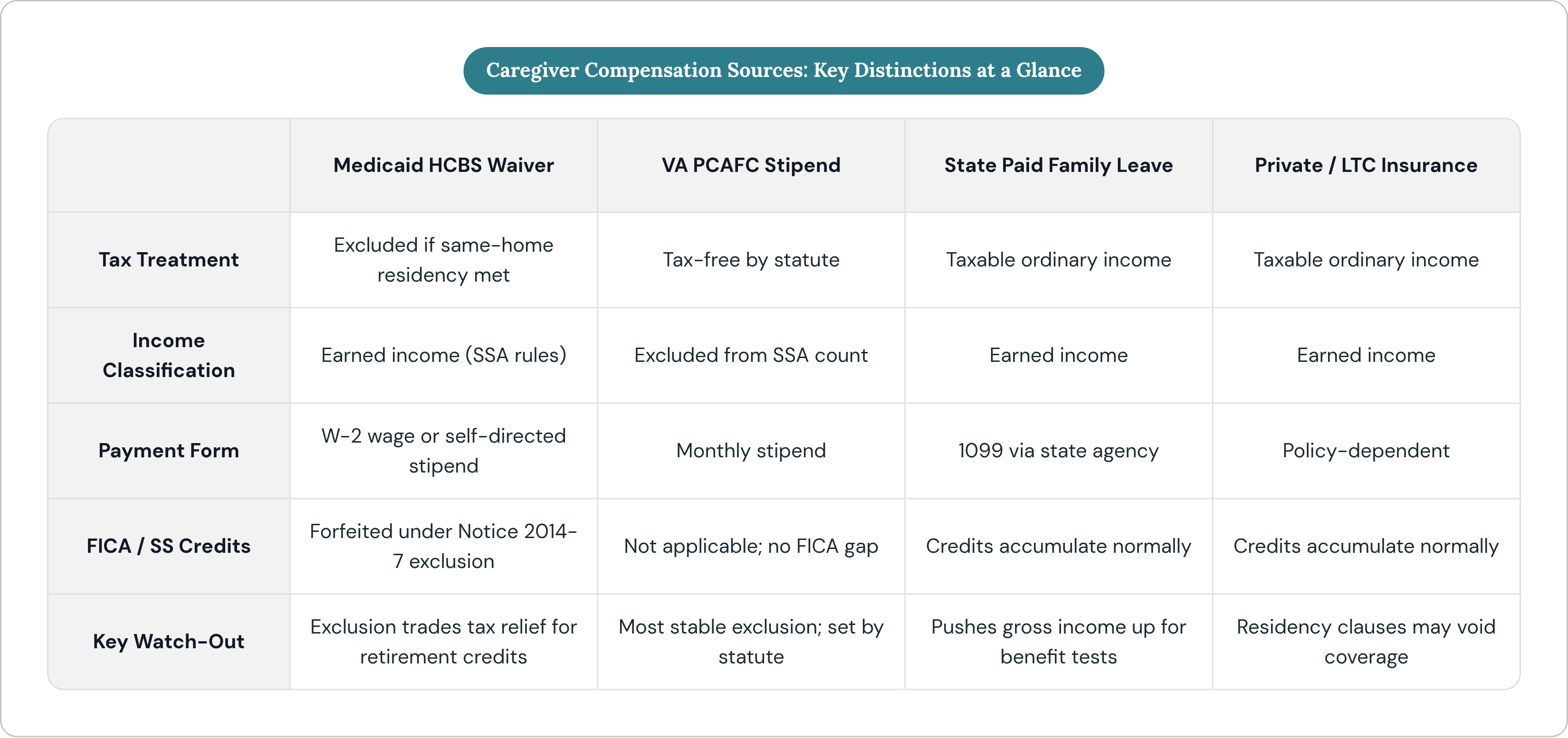
Medicaid HCBS waivers are the largest and most structurally complex source. Most states now offer consumer-directed options allowing a care recipient to hire a family member as a paid provider. The state pays the caregiver at a Medicaid-approved hourly rate, which has reached the $18 to $20 range in several states as of 2025, tracking minimum wage increases (Paid.Care, 2025). Depending on how the state administers the arrangement, payment may arrive via a fiscal intermediary as a W-2 wage or as a self-directed stipend. That structural distinction carries tax and benefit consequences that are not obvious at enrollment; in my experience, most caregivers discover them only after something has gone wrong.
VA Program of Comprehensive Assistance for Family Caregivers (PCAFC) provides a monthly stipend calculated as a percentage of local home health aide wages. Tier 1 is set at 62.5% of that local rate; Tier 2 at 100%, reaching roughly $3,200 per month in higher-cost areas (AgingWest.org). These payments are tax-free by statute. That word — "statute" — means the exclusion is not subject to annual renewal or administrative interpretation, making VA stipends structurally more stable than some other compensation sources.
State paid family leave is available in 11 states plus the District of Columbia, with Delaware, Maine, Maryland, and Minnesota among those joining in 2025 and 2026 (NCOA). These payments are generally taxable as ordinary income, administered through state workforce agencies, and arrive as a 1099 or equivalent. They are treated as earned income for most benefit-counting purposes.
Personal care agreements and long-term care insurance payments arranged privately are taxable as ordinary income. Some long-term care policies exclude caregivers who share a residence with the recipient, so the terms of any policy deserve careful review before assuming coverage applies.
The operational point is this: the tax classification of each compensation source is the first variable to establish before modeling any benefit impact. Conflating sources produces wrong answers, and wrong answers in this context produce overpayment debts.
How the IRS Exclusion for Medicaid Waiver Payments Works, and What It Costs
IRS Notice 2014-7 is the provision most Medicaid waiver caregivers encounter, and it is frequently misunderstood in both directions. Under the Notice, Medicaid waiver payments are treated as "difficulty-of-care" payments excluded from gross income under IRC Section 131, but only when the caregiver and the care recipient share the same home (IRS.gov). The exclusion applies to both family members and unrelated caregivers meeting that residency requirement.
After the Tax Court's 2019 ruling in Feigh v. Commissioner, an important improvement was codified: caregivers who exclude these payments from gross income can still treat them as earned income for the Earned Income Tax Credit and the Additional Child Tax Credit. For lower-income caregivers, this matters in immediate and tangible ways, reducing federal tax liability without requiring the waiver income to appear as taxable wages.
But what if that short-term relief carries a long-term cost that never appears on a tax return? If FICA taxes are neither withheld nor owed on excluded payments, the caregiver accumulates no Social Security earnings credits for that work. The Social Security Administration calculates retirement benefits using a worker's 35 highest-earning years; years spent providing Medicaid waiver care under the Notice 2014-7 exclusion may register as zero-earning years, extending the same career gap that unpaid caregiving has created, even though a paycheck is now arriving. The short-term tax relief is real. So is the long-run retirement cost. There is no version of this tradeoff that makes both problems disappear simultaneously.
VA stipends are tax-free by statute and do not share this FICA gap, which is one reason distinguishing between compensation sources matters rather than treating all caregiver pay as equivalent.
What Medicaid Waiver Income Does to the Caregiver's Own SSI and Medicaid Eligibility
The Social Security Administration treats Medicaid waiver pay as earned income regardless of how the payment is structured or whether it is excluded from federal income tax. That classification is the starting point for any SSI impact analysis.
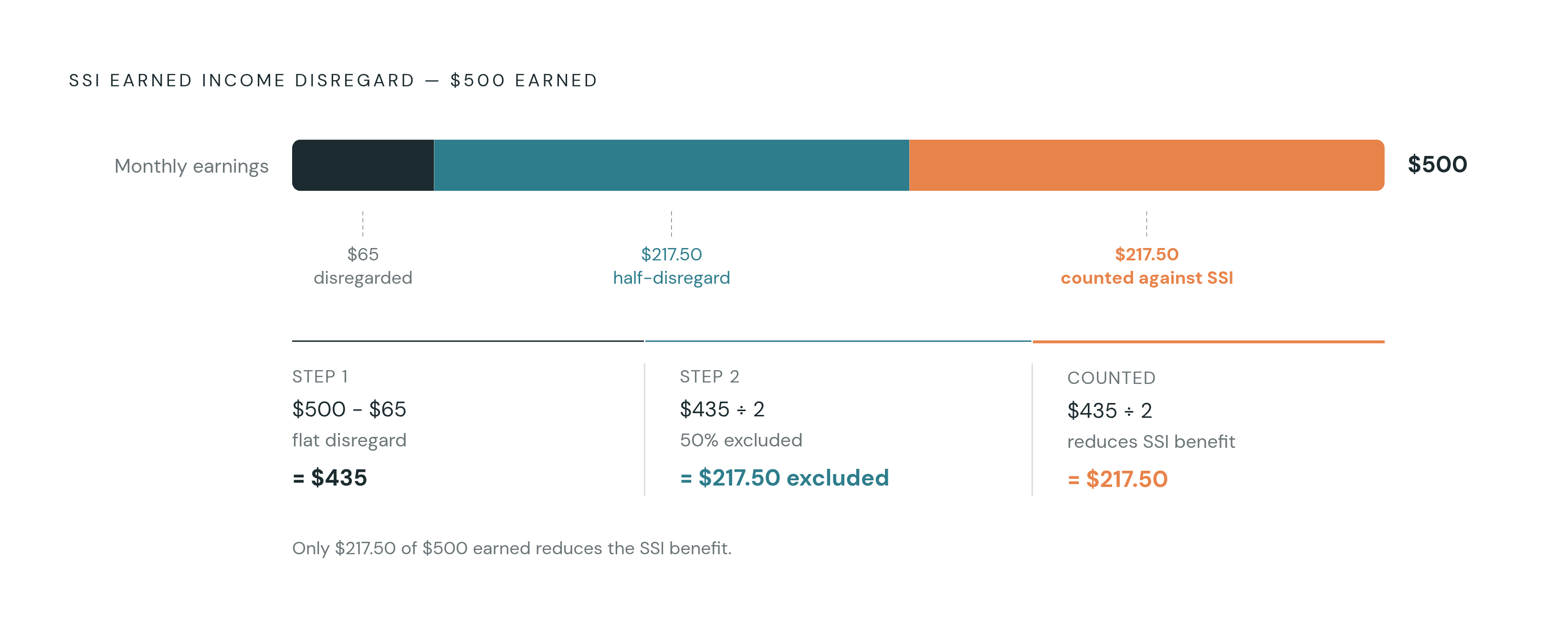
SSI applies a specific earned income exclusion formula: the first $65 of monthly earnings is disregarded entirely, and then half of everything above $65 is excluded from the benefit calculation. A caregiver receiving $500 per month sees only $217.50 counted against the SSI benefit. The impact is real but more moderate than many caregivers fear.
Resource limits present a separate and underappreciated risk. SSI's asset limits are $2,000 for individuals and $3,000 for couples. Monthly income that isn't spent accumulates in a bank account, and once resources cross those thresholds, the caregiver may lose SSI eligibility on asset grounds even if the monthly income calculation alone wouldn't have caused a problem. I have watched this happen incrementally, a caregiver earning modest wages over several months and never spending down, until a routine account review reveals a balance that disqualifies them. It is a slow-motion trap.
The most important protection in this space is Section 1619(b) of the Social Security Act, and it is the provision most caregivers on SSI have never heard of. Under 1619(b), even when earned income pushes the SSI cash payment to zero, the caregiver may retain Medicaid eligibility as long as gross earnings remain below the state's designated threshold. In 2026, those thresholds range from roughly $40,000 to over $84,000 depending on the state (LegalClarity.org, 2026). This decouples Medicaid from the SSI cash payment for working recipients, which substantially changes the calculus of accepting caregiver pay. A caregiver who earns enough to eliminate the monthly SSI check may still keep Medicaid coverage, but only if they know to assert it and have reported correctly throughout.
How Caregiver Pay Interacts with SSDI, and Why the Trial Work Period Changes the Calculation
SSDI operates under a different income framework than SSI, and its threshold-based structure is more forgiving than most recipients assume, provided the mechanics are understood in advance.
The operative figure is Substantial Gainful Activity (SGA). The threshold for non-blind individuals is expected to remain near $1,550 per month in 2026. Earnings below that line don't affect SSDI at all; many Medicaid waiver and VA stipend amounts for part-time caregiving fall below SGA, so some caregivers on SSDI can begin receiving compensation without disrupting their disability benefit.
When earnings do exceed SGA, SSDI provides a nine-month Trial Work Period. The months need not be consecutive; a month counts as a trial work month when earnings exceed approximately $1,110 in 2026. During those nine months, the SSDI benefit continues regardless of earnings level. After the Trial Work Period concludes, a 36-month Extended Period of Eligibility allows SSDI to resume for any month in which earnings fall back below SGA.
It is also worth considering what happens to Medicare coverage during this window. Caregivers on SSDI who also carry Medicare retain that coverage for at least 93 months after the Trial Work Period ends, meaning the health coverage tie does not sever when SSDI does. For caregivers whose own health conditions depend on Medicare, this is a protection worth building a plan around.
Unexpected overpayment demands almost always originate in months that were miscounted or unreported, not in the underlying benefit structure. The system is more forgiving than its reputation; it requires careful month-by-month tracking to stay that way.
The Reporting Obligation That Makes or Breaks Every Caregiver's Benefit Situation
Every earned income source must be reported to the SSA, regardless of amount. For SSI, even $50 per month matters to the benefit calculation, and failure to report it creates an overpayment debt the SSA will recover by reducing future checks. This is not a theoretical risk — it is the most common source of financial disruption I have seen in this space, and it is almost entirely preventable.
For SSDI, any month in which earnings exceed the Trial Work Period threshold must be reported as a trial work month, even if earnings drop back below the threshold the following month. The obligation attaches to the month in which the earnings occurred, not to a later pattern. Changes in household composition, shifts in the care arrangement, and transitions in payment structure, such as moving from a self-directed stipend to a W-2 employer relationship, all require separate reports.
Contact the SSA before the first caregiver paycheck clears. Retroactive corrections are slower, more adversarial, and more expensive than reporting upfront — the time cost of a proactive call is trivial compared to disputing a multi-month overpayment demand.
When the Caregiver's Income Threatens the Care Recipient's Medicaid or SSI, and When It Doesn't
The default rule is more favorable than most families assume: a caregiver's income generally does not count against the care recipient's Medicaid or SSI eligibility. Medicaid evaluates the recipient's income and assets, not the caregiver's. Adult children providing care for a parent on Medicaid, or siblings in a shared household, do not have their earnings attributed to the recipient under standard deeming rules.
The exception is spousal deeming, and it is the most consequential element in this section. When the caregiver and care recipient are legally married, SSI may attribute a portion of the caregiver-spouse's income to the SSI recipient. Under 2026 benefit levels, deeming reductions begin once the non-SSI spouse earns approximately $1,080 per month in gross income (DREDF, 2026). The maximum SSI benefit for an individual is $994 per month in 2026, and $1,491 for a married couple; the math of spousal deeming can reduce the recipient's SSI payment substantially, or eliminate it, at relatively modest caregiver income levels.
SSA recognizes four deeming categories: ineligible spouse, ineligible parent, sponsor of an alien, and essential person. For most family caregiving arrangements, the spousal category is the operative one. Parent-to-adult-child and sibling arrangements sit outside the deeming rules and do not carry this risk.
The "marriage penalty" in SSI is well-documented in the disability policy literature. Couples in caregiving arrangements who are considering legal marriage should model the deeming impact before formalizing that decision, particularly when one partner's Medicaid coverage depends on maintaining SSI eligibility. This is not a romantic calculation, but it is a necessary one.
How Caregiver Wages Affect SNAP Eligibility and the New Work Requirement Landscape
SNAP treats caregiver wages as earned income but applies a 20% earned income deduction before calculating net income for eligibility purposes, which partially offsets the impact of new compensation. Gross monthly income must still fall at or below 130% of the federal poverty line for most households.
Resource limits in FY2026 are set at $3,000 in countable resources for most households, rising to $4,500 for households where at least one member is age 60 or older or has a disability (USDA FNA, FY2026). Caregiver income that accumulates as savings rather than being spent carries the same slow-accumulation risk described above in the SSI context.
The more immediate change is in work requirements. Legislation informally known as the "One Big Beautiful Bill Act," enacted in 2025, expanded SNAP work requirements to adults aged 18 through 64, mandating 80 hours of monthly work or participation in a qualifying work program. Adults aged 55 through 64 without dependents may now be subject to these requirements as of February 2026, an age group previously exempt (NCOA/USDA FNA, 2026). Caregivers providing substantial hours of care may qualify for an exemption, but final guidance on what constitutes qualifying caregiving activity is still being developed. Whether compensated caregiving hours count toward that 80-hour threshold remains unsettled. The specific interaction to watch: a caregiver whose waiver income pushes gross household income above 130% of the poverty line could lose SNAP — even if that income is modest in absolute terms — because the SNAP threshold is not indexed to caregiving-related expenses.
The Long-Term Social Security Retirement Cost That Current Compensation Choices Create
Social Security retirement benefits are calculated using a worker's 35 highest-earning years. Years with zero or low earnings are folded into that average, pulling the lifetime benefit figure down. Caregivers have historically accumulated those low-earning years in disproportionate numbers. Women who leave the workforce to provide care can lose up to 20% of their Social Security benefits compared to women who work continuously (Capita, 2025). That is a retirement shortfall that compounds over decades.
The gap is already visible in retiree data. Women aged 65 and older received an average Social Security benefit of $1,808 per month as of December 2024, compared to $2,215 for men the same age, a difference of $407 per month (National Women's Law Center, reported by TheStreet, June 2026). Daily caregiving reduces workforce participation by nearly two percentage points, compounding economic disparities for groups already facing wage and savings disadvantages (ASA Generations, 2025).
The IRS Notice 2014-7 exclusion adds another layer to this problem. Years worked as a Medicaid waiver caregiver under the exclusion may produce no Social Security earnings credits, effectively extending the same career gap unpaid caregiving created. The immediate tax relief is tangible and, for some caregivers, necessary. The retirement cost is equally real and arrives at the moment in life when the capacity to compensate for it is most limited. Neither consideration cancels out the other; both deserve space in the decision.
What Caregivers Should Do Before Accepting Pay, and How to Navigate the Tradeoffs
Before the first payment, identify every benefit you currently receive and confirm which income-counting rules apply to each. SSI, SSDI, Medicaid, and SNAP operate under different frameworks, and a caregiver may be subject to more than one simultaneously. The rules do not harmonize automatically, and no single agency will surface the full picture unprompted.
Contact the SSA before accepting compensation, not after. Report the anticipated income and ask explicitly how it will be classified. For Medicaid waiver arrangements, confirm with the state agency whether the payment will arrive as a W-2 wage or a self-directed stipend, because that structural distinction affects FICA obligations and, consequently, Social Security credit accumulation.
For Medicaid waiver caregivers specifically: understand the Notice 2014-7 exclusion fully before electing it. The exclusion reduces current tax liability and preserves eligibility for refundable credits, but forfeits Social Security earnings credits for those years. The right choice depends on the caregiver's age, benefit situation, and how many zero-earning years already exist in their earnings record. Neither option is categorically superior; the analysis differs meaningfully for a 34-year-old caregiver versus one who is 58.
For married caregiving couples where one spouse is on SSI: model the spousal deeming impact against actual benefit levels before accepting pay that could eliminate the recipient's SSI cash payment and Medicaid. The Credit for Caring Act, reintroduced in March 2025, proposes a credit of up to $5,000 covering 30% of qualifying care expenses above $2,000. It has not passed, but its reintroduction reflects a policy direction worth tracking.
Section 1619(b) is underused to a degree that is costly for the people it is designed to protect. Knowing the state-specific earnings threshold allows a caregiver to earn significantly more than the SSI benefit level without losing Medicaid, often well into the range of ordinary caregiver wages. That knowledge changes the risk calculus of accepting compensation. The provision exists; claiming it requires only that someone surface it at the right moment.
The rules span multiple agencies, statutes, and administrative thresholds that were not designed in coordination. Most carry protections that caregivers miss not because those protections are inaccessible, but because no one explains them at the moment of enrollment. That is the actual problem, and it is worth naming plainly.