Tax Implications of Getting Paid as a Family Caregiver
Caregiver payments may be taxable income unless properly structured and documented.
How the IRS Categorizes Caregiver Income Before Any Exemptions Apply
The IRS starts from one premise: all income is taxable unless a specific statutory provision says otherwise. That default catches caregivers off guard, because informality feels like invisibility. It is not.
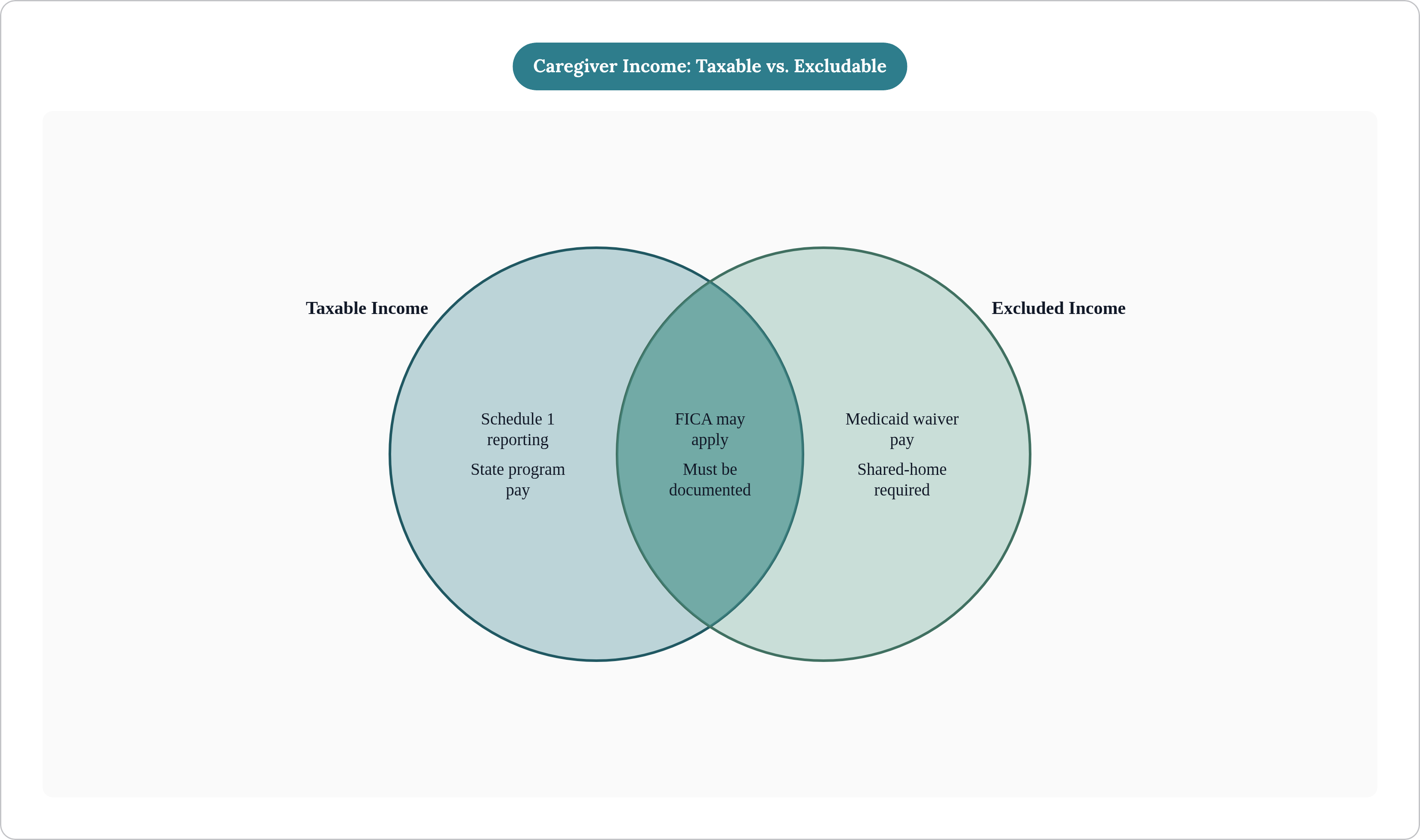
Payments made directly by a family member are generally taxable income the caregiver must report. Payments channeled through a state program are also generally taxable, though program-specific exclusions exist and matter enormously in practice. What falls outside gross income more reliably are reimbursements for documented out-of-pocket costs: medical supplies, transportation, adaptive equipment. When a program reimburses actual expenses rather than compensating for labor, that reimbursement typically does not constitute income. A casual household contribution from a relative, where a sibling chips in toward shared living costs with no formal care arrangement attached, may qualify as a nontaxable gift rather than compensation.
The governing principle is not the dollar amount. It is the source and structure of the payment. Two caregivers receiving identical checks can face entirely different tax treatment depending on who wrote the check and under what arrangement. An unwritten arrangement does not eliminate the tax obligation. Skipping that threshold analysis produces errors that compound downstream and are rarely cheap to fix.
Worker Classification: The Question That Determines Almost Everything Else
Classification is a threshold determination, not a paperwork formality. The Form 1099 does not settle the question. It records what the issuer paid; it does not adjudicate the relationship.
The default classification for most non-agency caregivers is household employee. The test is behavioral: does the person receiving care, or their family, control what is done, how it is done, and when? If yes, the relationship is employer-employee. Independent contractor status requires that the caregiver control their own methods, serve multiple clients, supply their own tools, and set their own schedule. A state agency cutting a check for care provided to one person in a private home is rarely, under any defensible reading of the IRS's control test, creating an independent contractor relationship.
There is a third category worth naming: the informally paid family member, receiving compensation without a formal work arrangement on either side. This person must still report income, but the self-employment tax analysis differs from a standard employee situation.
Misclassifying a household employee as an independent contractor carries real IRS penalties. Families assume the 1099's presence resolves the classification question. It does not. The frequency with which the error appears in amended returns suggests the confusion is structural, not individual.
When Self-Employment Tax Applies and When It Does Not
The IRS publishes explicit guidance on this at IRS.gov under "Family Caregivers and Self-Employment Tax." It is FAQ-level official material, not buried in the code. It is also among the most frequently misunderstood practical guidance in this area.
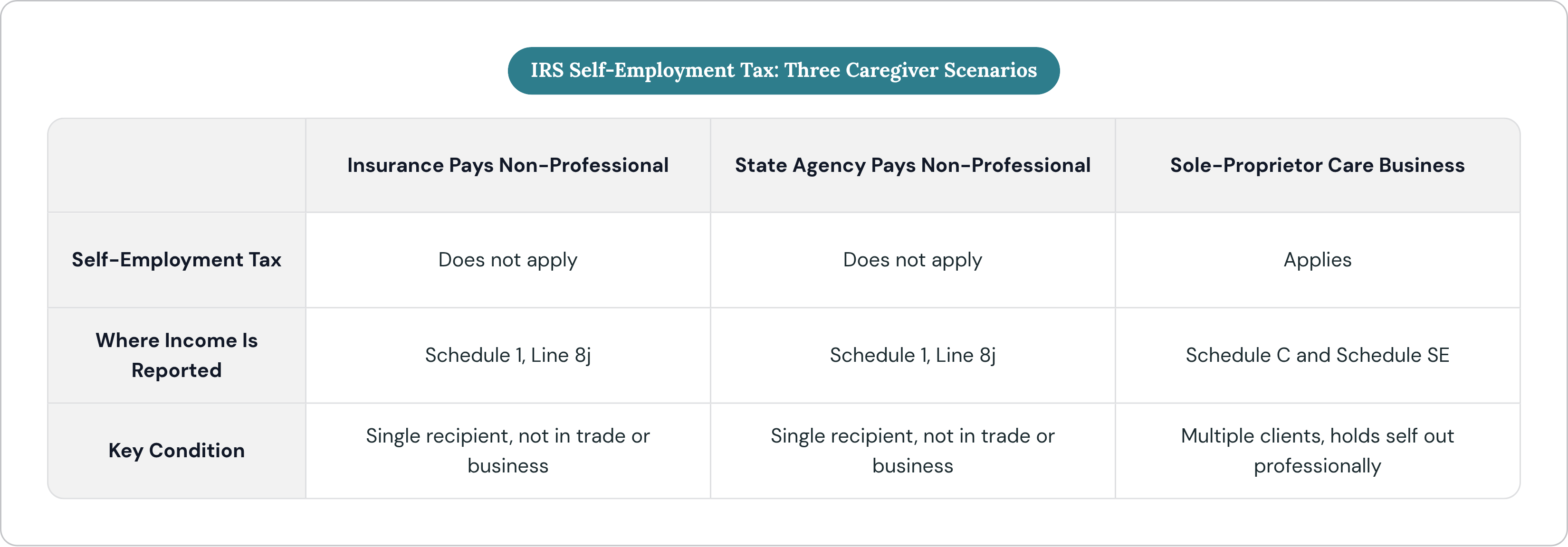
To understand why this works, we must first look at the three scenarios the IRS addresses directly. First: an insurance company pays a non-professional family member caregiver and issues a Form 1099-MISC with the amount in Box 3. No self-employment tax applies. The caregiver reports the full amount on Schedule 1, Line 8j as other income. Second: a state agency pays a non-professional caregiver to care for a single recipient. Same result, same reporting treatment, no self-employment tax. Third: a caregiver operates a sole-proprietor adult day-care business, serves multiple clients, and includes a family member among them. Self-employment tax applies; income goes on Schedule C and Schedule SE.
The hinge is not the familial relationship. It is whether caregiving constitutes a trade or business for that individual. A person who cares for one relative through a state program, who does not hold themselves out professionally, is not in the business of caregiving in any meaningful IRS sense. Reporting the income is still required, even when self-employment tax does not apply.
Household Employment Taxes: Thresholds, Rates, and Who Files What
When a caregiver is properly classified as a household employee, the employer acquires concrete obligations. For 2025, wages of $2,800 or more paid to a household employee trigger the requirement to withhold and remit Social Security and Medicare taxes. Per IRS Publication 926, that threshold rises to $3,000 for 2026.
FICA totals 15.3% of wages: 7.65% from the employer, 7.65% withheld from the caregiver. Federal unemployment tax applies separately. If wages exceed $1,000 in any calendar quarter, the employer owes 6% on the first $7,000 paid annually. The filing mechanism is Schedule H, attached to the employer's annual return. A W-2 goes to the caregiver by January 31 of the following year.
Publication 926 carves out family-based exemptions that alter the calculus. Wages paid to a spouse are exempt from both FICA and FUTA. Wages paid to a child under 21 are FICA- and FUTA-exempt. A parent's wages are FUTA-exempt, though FICA may still apply. These exemptions do not eliminate the documentation obligation; even when employment taxes are fully exempt, the compensation still needs to be recorded.
Family arrangements tend to blur the employer-employee line because the same person often arranges the care and carries the filing obligation. Wearing both hats does not merge the two legal roles.
The Medicaid Waiver Exclusion: When Caregiver Income Is Not Taxable at All
In January 2014, the IRS issued Notice 2014-7. More than a decade later, it remains among the most financially significant and least-utilized pieces of guidance affecting compensated caregivers. The notice provides that payments to individual care providers under a state Medicaid Home and Community-Based Services waiver, specifically a Section 1915(c) waiver, are treated as "difficulty of care payments" excludable from gross income under IRC Section 131. Not deferred. Not reduced. Excluded entirely.
The condition that governs eligibility is the shared-home requirement. The caregiver must live in the same home as the care recipient. A caregiver who commutes and returns each evening to a separate residence does not qualify, regardless of how intensive the care or which program funds it.
The exclusion is not limited to family members. A spouse, adult child, parent, sibling, or unrelated friend who shares the home qualifies equally. The relationship is irrelevant; the living arrangement is not.
Excluded payments are nontaxable and carry no self-employment tax, because the caregiver is not conducting a trade or business. FICA is a separate question. Even payments excluded from gross income may still carry FICA obligations if structured as employee wages, because the income exclusion and the employment tax obligation operate under different statutory frameworks. That interaction is counterintuitive and worth resolving before filing.
The most consequential interaction involves the Earned Income Credit and the Additional Child Tax Credit. Excluding waiver payments from gross income reduces earned income, which can shrink or eliminate eligibility for both credits, each worth thousands of dollars. That raises an important question: why would a caregiver voluntarily apply an exclusion that costs them more in lost credits than it saves in taxes? The IRS permits a specific election precisely to address this: caregivers may treat excluded Medicaid waiver payments as earned income for EIC and ACTC purposes while still excluding them from gross income. This election must be made intentionally and documented on the return. Running the numbers both ways before filing is not a formality; the difference in refundable credits can exceed the cost of the professional who catches it.
When a 1099 is issued for payments that qualify under Notice 2014-7, the reporting sequence is specific: include the full amount on Schedule C, then offset the nontaxable portion as an expense in Part V of that same schedule, with a notation referencing Notice 2014-7 by name.
State Programs: IHSS, CDPAP, and Others, and How Their Tax Treatment Varies
Notice 2014-7 applies federally to any qualifying Section 1915(c) HCBS waiver program. It is not attached to named state programs. California's In-Home Supportive Services and New York's Consumer Directed Personal Assistance Program have generated the most publicly documented application of those rules, including litigation and IRS clarification, which gives caregivers in those states more precedent to lean on than most.
California's IHSS pays providers directly. Payments to a provider living with the recipient have been treated as excludable under Notice 2014-7 in IRS-confirmed guidance, and that litigation history has produced a clearer paper trail than most states can offer.
New York's CDPAP allows recipients to direct their own care, including hiring family members, with payments flowing through a fiscal intermediary rather than directly from the state. The federal exclusion can apply when the program qualifies as a Section 1915(c) waiver and the shared-home condition is met. The fiscal intermediary structure often generates 1099 issuance that leaves caregivers uncertain, because the form arrives with no annotation about potential exclusions. That gap between what the form implies and what the law allows is real, and it costs people money.
Programs funded outside the federal Medicaid waiver structure do not automatically qualify for the Notice 2014-7 exclusion and may be fully taxable. Program names and funding structures vary enough across states that the same care arrangement can carry entirely different tax treatment depending on geography. Before assuming any exclusion applies, a caregiver should confirm that their specific program is a Section 1915(c) HCBS waiver. The state Medicaid agency or program administrator can provide that confirmation. Getting it in writing matters when an audit arrives.
Tax Deductions and Credits Available to the Person Paying for Care
The family arranging and funding care may have access to deductions and credits that reduce their own liability. These are frequently overlooked because the caregiver's tax situation dominates the conversation.
The Child and Dependent Care Credit is based on up to $3,000 in qualifying expenses for one eligible person and up to $6,000 for two or more, yielding a credit equal to 20 to 35% of those expenses depending on income. The Credit for Other Dependents provides up to $500 per qualifying relative, including an elderly parent or disabled adult child; it is nonrefundable and requires that the dependent's gross income not exceed $5,200 in 2025, with the taxpayer having provided more than half of that person's financial support during the year.
Caregiver wages may also be deductible as medical expenses when the care was prescribed by a licensed healthcare practitioner and the recipient qualifies as a dependent. The constraint is significant: only amounts exceeding 7.5% of adjusted gross income are deductible, and only when itemizing. The same expense cannot be claimed for both the medical expense deduction and the Child and Dependent Care Credit.
Head of household filing status, available to caregivers who qualify, materially changes the standard deduction: $21,900 versus $14,600 for a single filer in 2024. That gap is large enough to warrant verifying eligibility rather than assuming it.
For those with access to a Dependent Care FSA, pre-tax contributions reduce taxable income directly. For 2026, the contribution limit for couples filing jointly increased from $5,000 to $7,500 under the One Big Beautiful Bill Act, signed July 4, 2025, though individual employer plan documents may not reflect this immediately; caregivers should verify with their plan administrator before acting on that figure.
One change deserves explicit attention: the dependent exemption, suspended since 2018 under the Tax Cuts and Jobs Act, was widely expected to return in 2026. The One Big Beautiful Bill Act permanently eliminated it. Caregivers who had built that expectation into their planning need to revise their assumptions now.
How to Stay Compliant: Reporting Income, Estimated Taxes, and Recordkeeping
Reporting is not optional in any of the scenarios above, even the ones with favorable tax treatment.
Non-professional caregivers receiving a 1099 or informal payments not excluded under Notice 2014-7 report that income on Schedule 1, Line 8j. Self-employment tax does not apply if the caregiver is not conducting a trade or business of caregiving, but the income must appear on the return. Without employer withholding, caregivers who expect to owe income tax should make quarterly estimated payments, due in April, June, September, and January, to avoid underpayment penalties.
Household employers file Schedule H with their annual return and issue a W-2 to the caregiver by January 31, even when family exemptions eliminate the FICA or FUTA liability entirely. The W-2 obligation and the tax liability are legally separate; conflating them is common and correctable, but only if caught before filing.
For caregivers relying on the Medicaid waiver exclusion, the paper trail matters. Confirm the program is a Section 1915(c) HCBS waiver, retain records of all payments received, and when a 1099 is issued, follow the Schedule C offset approach with a specific reference to Notice 2014-7. For the EIC and ACTC election, calculate both scenarios before filing; the difference in refundable credits can be substantial, and the election does not happen automatically.
These provisions do not sit in isolation. Federal exclusions, state program variation, household employment rules, and credit calculations compound in counterintuitive ways, and the consequences run in both directions: money left unclaimed, penalties attached to income that should have been reported. Simplicity here requires professional help, not avoidance of complexity. A tax professional with specific household employment experience is worth the cost for anyone with meaningful caregiver income. Working through the full picture before filing is what separates a defensible return from an expensive one.