State-Specific Paid Family Caregiver Programs
Medicaid, not Medicare, funds most family caregiver payments through state-specific programs.

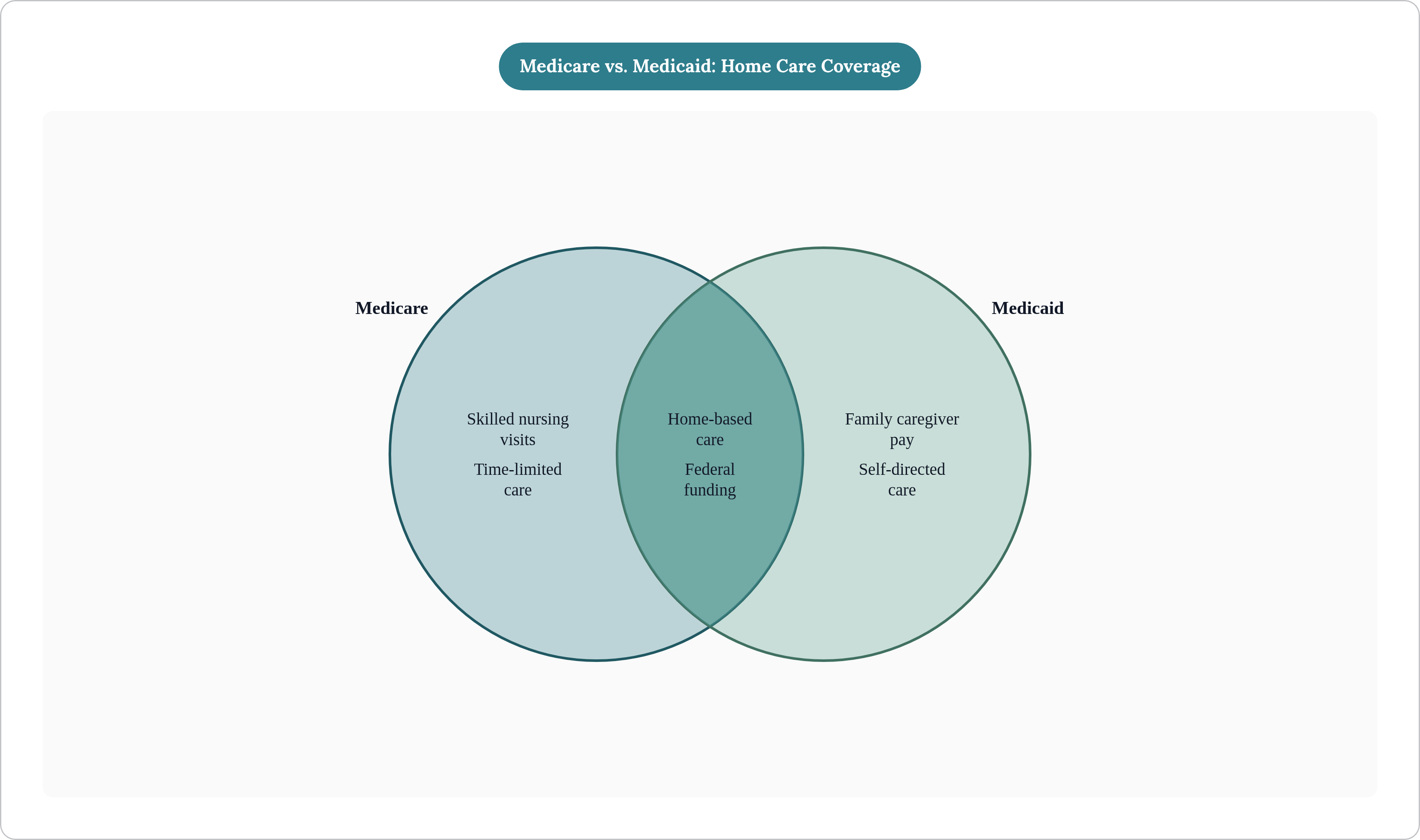
Why Medicaid, Not Medicare, Is the Foundation of Every State's Payment System
Most people assume Medicare covers sustained home-based care. This assumption is wrong — and costs families years of compensation they were entitled to receive.
Medicare covers limited skilled nursing visits following a hospitalization. It does not cover the ongoing personal care, assistance with daily activities, or round-the-clock support that family caregivers actually provide. Medicaid, the joint federal-state program for low-income individuals and people with qualifying disabilities, is the actual funding mechanism. According to KFF, Medicaid paid for two-thirds of all home care spending in the United States in 2023, covering approximately 5.1 million enrollees who use home care services. All 50 states and the District of Columbia have at least one Medicaid program capable of paying family caregivers.
States access federal Medicaid dollars through three primary legal authorities. The most common are Home and Community-Based Services waivers authorized under Section 1915(c) of the Social Security Act, which allow states to cover services not available under standard Medicaid for people who would otherwise require institutional care. States also use Section 1915(i) and 1915(k) state plan options; the latter, known as Community First Choice, does not require nursing-home-level need and carries no waiting list implications like those attached to a 1915(c) waiver. Section 1115 demonstration waivers give states broader flexibility to test new approaches, sometimes including novel caregiver payment structures.
That waiting list distinction is where the policy abstraction becomes personal. A family that qualifies under a 1915(c) waiver may wait years for an available slot. A family that qualifies under a 1915(i) state plan option may access services without any waiting period at all. Which pathway exists in a given state, and which one a specific family situation would access, determines whether compensation begins this year or five years from now, years during which the care is already being delivered and savings are already being drained.
As of January 2026, 49 states allow Medicaid enrollees to self-direct their home care in at least some circumstances, per Advancing States and KFF data. Self-direction transforms an unpaid family member into a compensated caregiver. Understanding how the mechanism actually works, and where it breaks down, is where the navigation gets complicated.
What Self-Directed Care Actually Means and Who Counts as an Eligible Caregiver
Self-direction inverts the traditional model. Instead of a Medicaid agency assigning a home health worker to a beneficiary, the person receiving care controls their own service budget and hires the caregiver of their choice. That caregiver can be a family member, who is then paid as an enrolled provider rather than treated as a volunteer.
Anyone who has spent real time in formal home care understands why this matters beyond the paycheck. Agency-assigned aides rotate. They don't know that a particular transfer technique causes pain, or that anxiety spikes when the morning routine runs late. The accumulated knowledge a family caregiver builds over years changes the quality and safety of care in ways that are hard to quantify.
The exclusions, though, are numerous and state-specific. Spouses were historically barred from most programs under the reasoning that spousal care was a familial obligation rather than reimbursable labor. That reasoning has eroded, but unevenly. According to Medicaid Planning Assistance, states including Alabama, Alaska, Arizona, California, Colorado, Florida, Maryland, Minnesota, Oregon, and Virginia now allow spouses to be paid under at least some programs. A state may permit spousal payment under one waiver and prohibit it under another, and both facts can be simultaneously true within the same state.
The general framework requires the care recipient to be Medicaid-eligible and to need assistance with activities of daily living. The caregiver must enroll as a Medicaid provider, complete any required training or certification, and in most cases work through a fiscal intermediary or support broker who manages payroll and compliance on behalf of the self-directing participant.
The same family configuration that qualifies in Oregon may not qualify in Texas, and may qualify under one Texas program but not another. This is not bureaucratic incoherence. It is the predictable result of a federal-state partnership in which states have wide discretion — discretion that reflects deliberate differences in how states balance caregiver access against program cost. That logic doesn't simplify the navigation. It does, however, explain why anyone who tells you there is a single national answer is telling you something inaccurate.
Structured Family Caregiving: The Stipend Model Available in 11 States
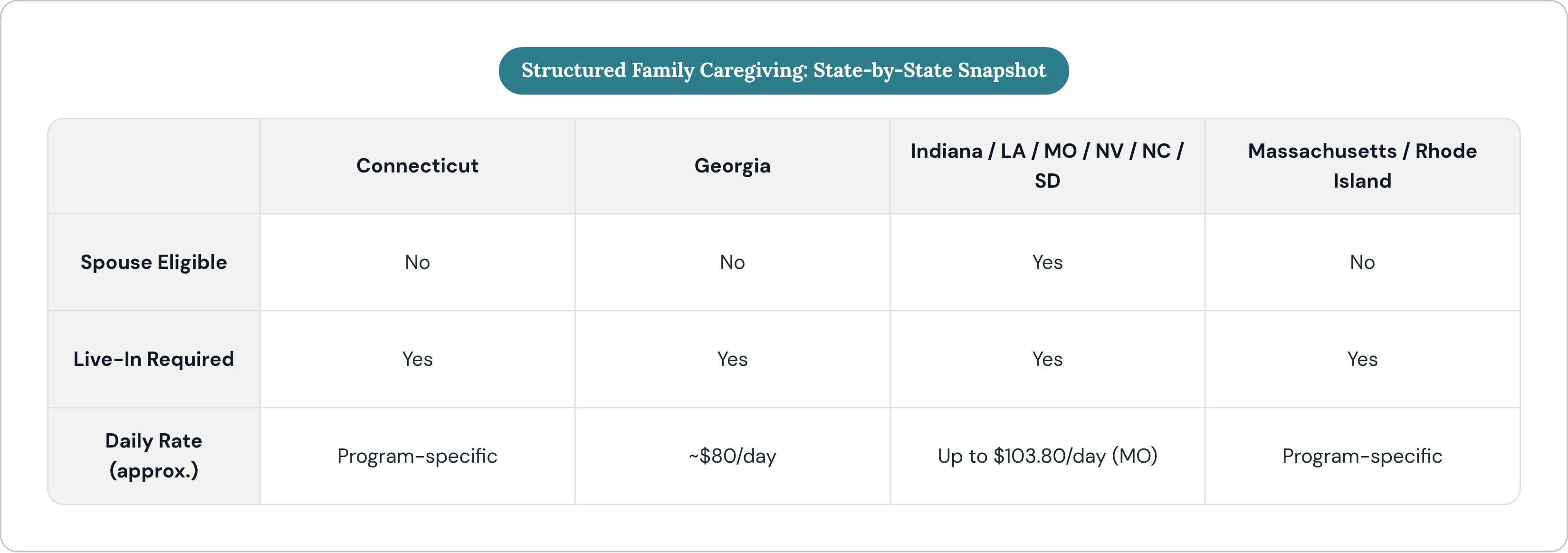
Structured Family Caregiving operates differently from hourly attendant programs. Rather than billing for hours worked, the caregiver receives a daily stipend. As of 2026, eleven states operate SFC programs: Connecticut, Georgia, Indiana, Louisiana, Massachusetts, Missouri, Nevada, North Carolina, Ohio, Rhode Island, and South Dakota.
Georgia's SFC program, funded through its CCSP and SOURCE waivers, pays approximately $80 per day in 2026, roughly $560 per week. Under IRS Notice 2014-7, this stipend qualifies as tax-free difficulty-of-care income when certain conditions are met. Spouses and legal guardians are not eligible under Georgia's program.
Missouri's SFC rate, effective July 1, 2025, is $103.80 per day. State rules cap provider retention at 35 percent, meaning caregivers receive at minimum 65 percent of that daily rate directly.
Spouse eligibility within SFC is program-specific. Indiana, Louisiana, Missouri, Nevada, North Carolina, and South Dakota allow spousal participation. Connecticut, Georgia, Massachusetts, and Rhode Island do not.
The structural requirement distinguishing SFC from other models is a live-in mandate: the caregiver must reside with the care recipient. This makes the stipend model unsuitable for family configurations where the caregiver lives separately. What it offers in exchange is predictability. Income doesn't fluctuate week to week based on hours logged, which matters in ways that have nothing to do with money and everything to do with being able to plan a life while providing one.
California's IHSS and New York's CDPAP: The Two Largest Programs and What's Changed in 2025
California's In-Home Supportive Services program and New York's Consumer Directed Personal Assistance Program are the two largest family caregiver payment programs in the country by enrollment and expenditure. Both changed substantially in 2025, in very different ways and with very different consequences for the people inside them.
California's IHSS served approximately 600,000 Californians as of 2024. Pay rates in 2025 range from $16 to $20.50 per hour depending on county, a spread that reflects how significantly local labor markets shape what Medicaid effectively pays for identical services in different parts of the same state. Adult children can be paid as IHSS providers, and spouses are eligible under certain circumstances.
New York's CDPAP allows Medicaid members to hire a friend or family member as a personal assistant. Spouses, designated representatives, and parents of CDPAP consumers under 21 are excluded. Pay rates as of January 1, 2025 are $19.10 per hour in New York City, Long Island, and Westchester County, and $18.10 per hour elsewhere in the state.
The structural change that reshaped CDPAP in 2025 is the consolidation of fiscal intermediaries. Before April 1, 2025, more than 600 fiscal intermediaries managed payroll for CDPAP participants across the state. New York consolidated this function to a single statewide entity, Public Partnerships LLC, projecting $1 billion in annual savings. The transition has not been clean. Caregivers reported payroll delays and system failures; a class-action lawsuit was filed, and a settlement is in progress.
The CDPAP situation illustrates something worth understanding before you enter any large state program. A program can be well-funded, legally sound, and structurally generous while simultaneously being operationally disruptive in ways that directly harm the people depending on it for income. Families currently navigating CDPAP enrollment should treat administrative friction as a baseline condition, not an aberration.
How Other Major States Structure Payment: Florida, Texas, Illinois, Pennsylvania, New Jersey, Virginia, and Minnesota
Florida's Consumer-Directed Care Plus program allows care recipients to hire nearly any family member as a caregiver, with the standard exclusion of spouses. Texas's STAR+PLUS Medicaid waiver permits family member selection as caregivers, spouses again excluded. Both states represent a common configuration: broad family eligibility that stops precisely at the spousal relationship.
Illinois operates its Community Care Program under Medicaid waiver rules that allow adult children and some spouses to be paid following formal assessment. Pennsylvania has several Medicaid waivers permitting self-directed care, though spouse eligibility is not uniform across all of them; the specific waiver governs the answer. New Jersey's Personal Preference Program extends eligibility to family members including some spouses through Medicaid self-direction. Virginia offers comparable self-directed options, with specifics varying by waiver.
Minnesota's Consumer Directed Community Supports program is among the more broadly accessible in the country. Its wide family eligibility has made it a frequently cited model in policy discussions about what expanded caregiver compensation looks like when a state leans into the framework rather than constrains it.
Oregon in 2025 launched both a new 1115 waiver for adults 65 and older or with physical disabilities and a new 1915(c) waiver that includes provisions for parents of minor children with disabilities to be paid for attendant care.
The variation across these states reflects deliberate policy choices made within federal guardrails, choices that shift with budget cycles, waiver amendments, and sustained advocacy. What was true of a specific program last year may not be true now, which is why the only reliable source on current eligibility is the current program administrator.
Programs Specifically for Parents Caring for Children With Disabilities
The default architecture of Medicaid home care was built around adult care. Most 1915(c) waivers historically excluded parents from serving as paid caregivers for their minor children, treating parental care as a legal obligation rather than compensable labor. That exclusion has begun to erode, though not uniformly, and not at the pace families caught inside it need.
Alaska amended its Children with Complex Medical Conditions waiver, its People with IDD waiver, and its Individual Supports waiver as of September 2024. Under those amendments, parents and guardians of a minor child can now be paid for up to 40 hours per week of In-home Supports or Supported Living services. Oklahoma added a comparable option as of February 2025, allowing legally responsible individuals to be compensated for non-residential Habilitation Training Specialist services under its developmental disability waiver. Oregon's new 1915(c) waiver, launched in 2025, explicitly includes this provision.
The policy logic driving these amendments is straightforward. For children with significant disabilities, a parent is often the most qualified, most consistent, and most available caregiver. Excluding parents from compensation doesn't reduce the care being provided; it ensures the family providing it absorbs the full financial cost of doing so.
Parents navigating this space should look specifically at their state's IDD waivers and Children with Complex Medical Conditions waivers, rather than the general adult HCBS programs. Waiver names are rarely intuitive, and amendments may not appear in a program's primary documentation until months after they take effect. Calling the state agency directly and asking specifically whether legally responsible relatives can be paid under the current waiver terms is more reliable than any published guide, including this one.
What Family Caregivers Actually Get Paid and Why the Numbers Are Hard to Pin Down
Compensation across state Medicaid programs ranges roughly from $16 per hour on the low end to $26 per hour on the high end. The Bureau of Labor Statistics reported that home health and personal care aides earned nearly $17 per hour in 2024, which provides a useful professional benchmark, though it doesn't map directly onto what Medicaid-funded family caregivers receive.
KFF data found that Medicaid programs pay around $18 per hour for personal care services, while also noting that many states cannot report average hourly rates with precision because services are bundled into managed care contracts and health plans do not consistently share rate data with the state Medicaid agency. The figure is real; the precision is largely constructed.
AARP's Valuing the Invaluable 2026 report shows state-level hourly values ranging from $14.12 in Louisiana to $27.05 in Washington, a spread that reflects underlying differences in labor market costs rather than differences in the difficulty or intensity of the work.
Pay also varies by whether services flow through fee-for-service or managed care, by the assessed level of care the recipient requires, and by whether the caregiver holds any certifications. Any figure found in an article, including this one, is an approximation useful for orientation but not for budgeting. The only reliable number for a specific family situation is what the current program administrator quotes for the current contract period.
The Common Reasons Caregivers Miss Programs They Already Qualify For
Waiting lists are the first structural barrier. The most generous 1915(c) waivers in many states carry multi-year queues. A caregiver who waits until a family crisis forces action may wait years more before compensation begins, years during which the care has already been delivered, savings drawn down, and debt accumulated. Per AARP/NAC 2025 data, nearly half of family caregivers have experienced major financial harm. Waiting lists are a significant contributor to that figure.
Program nomenclature compounds the problem. "Consumer Directed Personal Assistance," "STAR+PLUS," "CDPAP," "Community First Choice," "Structured Family Caregiving." These names don't describe what they do in plain language, aren't standardized across states, and don't surface when a caregiver searches "can I get paid to take care of my mother." The programs were designed by policy attorneys, and the names show it.
The spousal and parental exclusions create a third compounding problem. The general statement that "family members can be paid" is accurate and nearly useless. Whether a wife caring for her husband in Texas qualifies is a different and specific question; the answer depends on which waiver is in play and what the current enrollment rules say. Families who hear the general statement and stop there miss the specific answer.
Enrollment mechanics are the fourth barrier. Becoming a paid caregiver under these programs typically requires a formal functional assessment of the care recipient, a person-centered service plan, and the caregiver's own enrollment as a Medicaid provider, sometimes including background checks, training requirements, and a signed agreement with a fiscal intermediary. Most caregivers encounter these steps in sequence without having known they were coming, each one requiring time and follow-through that a person already providing full-time care may not easily have.
Finally, many caregivers are unaware that the care recipient may not currently be enrolled in Medicaid and may still qualify. Medicaid eligibility is not static. The functional and financial criteria that qualify someone for home and community-based services are sometimes more accessible than families expect, particularly after a significant health event.
How to Find Out What Your State Actually Offers and What to Do First
Start with Medicaid status. Without it, virtually every program described here is inaccessible. This is the upstream question everything else depends on, and most families should begin here — ideally before a crisis makes urgency the only operating condition.
Once Medicaid status is established or confirmed as reachable, the next task is identifying which waivers are currently active in the state and whether they have open enrollment or waiting lists. State Medicaid agency websites list active waivers. Medicaid Planning Assistance and KFF's waiver tracker organize this information in accessible form and are worth consulting as secondary sources.
The next question is which family relationships are eligible under each specific program. Spouse eligibility, adult child eligibility, and parent-of-minor eligibility are waiver-specific rules, not statewide policies. Assuming otherwise causes families to stop searching before they find the program that actually applies to their situation.
The enrollment process for the identified program comes next: a formal assessment of the care recipient, a person-centered service plan, caregiver enrollment as a Medicaid provider, and in most cases an agreement with a fiscal intermediary who handles payroll, tax documentation, and compliance. Knowing these steps in advance prevents the kind of mid-process surprise that causes families to abandon applications that would have succeeded.
Apply before the crisis arrives. This is advice that reaches most caregivers too late. Waiting lists are real, functional deterioration is nonlinear, and the time between identifying a program and receiving a first paycheck can span many months. The families who navigate this best tend to map their options while they still have runway, not after the situation has become acute and the options have narrowed.
The programs exist in every state, often in multiple forms. What separates the families who access them from those who don't is rarely eligibility. It is most often information — and when it arrives.