Medicaid Eligibility Rules for Seniors
Medicaid for seniors splits into three separate programs with different eligibility rules.

The Three Types of Medicaid for Seniors and What Each Covers
Senior Medicaid is not a single program. Confusing the three distinct tracks has real, immediate consequences.
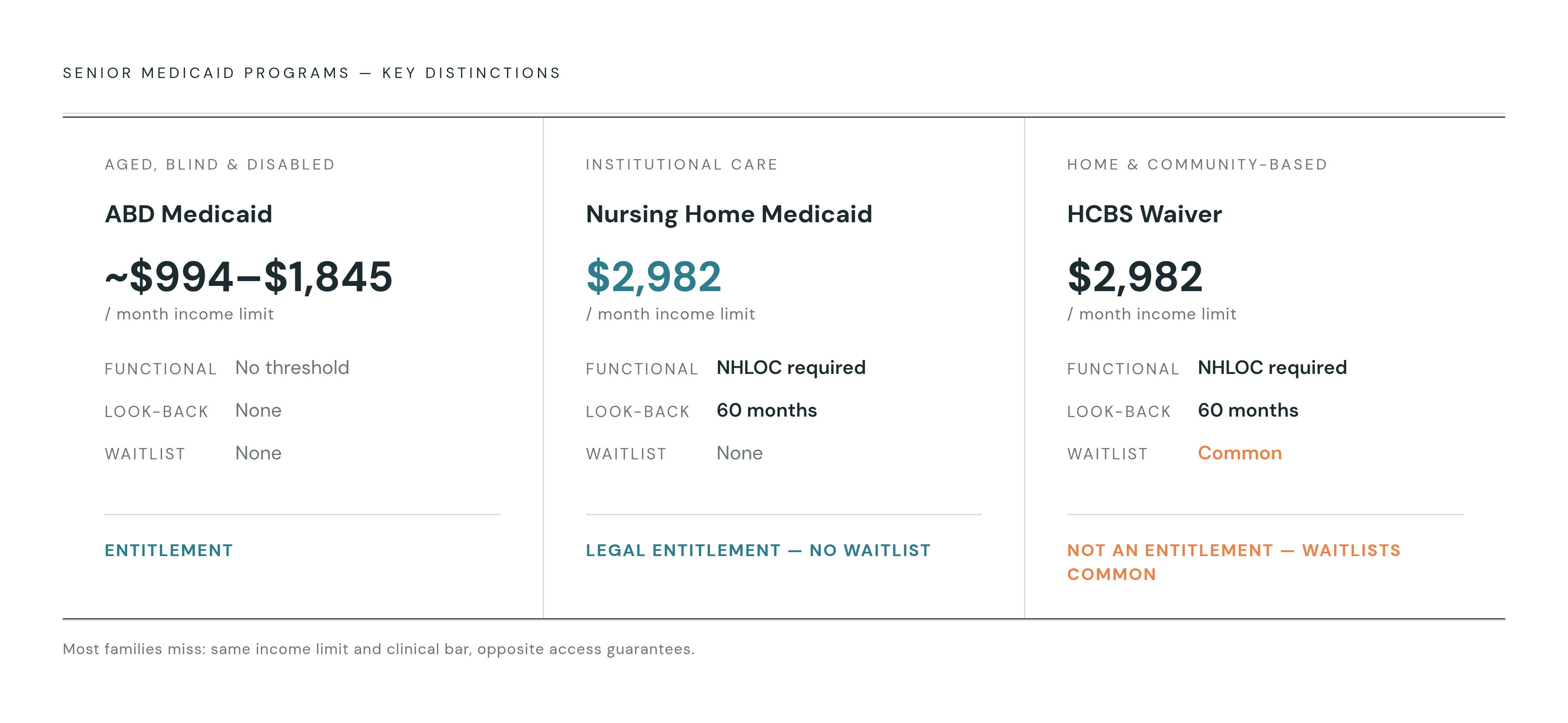
The first is Regular Medicaid for the Aged, Blind, and Disabled, commonly called ABD Medicaid. It covers physician visits, hospital stays, prescription drugs, and related services. It has the broadest eligible population and the lowest functional threshold, which is precisely why families encounter it first and mistakenly assume it covers everything that follows.
The second is Nursing Home Medicaid, which funds institutional long-term care. It carries a legal distinction worth understanding: it is an entitlement. If an applicant meets both the financial and functional requirements, the state must pay. No waitlist, no budget cap. That guarantee is rarer in this system than people assume.
The third is the Home and Community-Based Services Waiver program, HCBS Medicaid. These waivers fund care delivered at home or in assisted living for seniors who would otherwise qualify for nursing home placement. They are not entitlements. Enrollment caps are real, and waitlists are common in many states.
Three variables govern which rules apply in any given case: the program type sought, the applicant's marital status, and the state of residence. Qualifying for ABD Medicaid does not mean a senior qualifies for a nursing home waiver. Eligibility must be established at application and maintained at every annual renewal. Assuming continuity from one program to another is the kind of error that tends to surface at the worst possible moment.
Income Limits by Program Type and What Counts as Income
For Nursing Home Medicaid and HCBS Waivers, the 2026 income limit for a single applicant is $2,982 per month. ABD Medicaid limits range from roughly $994 to $1,845 per month for individuals, depending on the state. A senior whose income falls between those two bands qualifies for one program and not the other, a distinction easy to miss when you are only looking for a single number.
What counts as income is broader than most people expect: Social Security, pension payments, IRA distributions, wages, stock dividends, annuity payments. For married applicants, only the applying spouse's income is counted. Under Spousal Protection rules, up to $3,715 per month can be allocated to the non-applicant spouse in 2026, a provision designed to prevent the healthy spouse from being left without income while their partner is in a facility.
State variation here is significant enough to change the outcome entirely. Illinois sets all three senior programs at $1,330 per month for an individual. California has no income limit for Nursing Home Medicaid but, once enrolled, takes nearly all of a recipient's income toward care costs. That leaves the resident with a personal needs allowance; the median for 2026 is $70 per month. Seventy dollars. Families who haven't been told that in advance tend to find it jarring in a way no amount of preparation fully softens, because it is not an abstraction at that point. It is someone's mother asking why she can't buy a birthday card.
Asset Limits, Exempt Property, and How Married Couples Are Treated Differently
The individual asset limit for Medicaid applicants in most states is $2,000 in countable assets: bank accounts, stocks, bonds, certificates of deposit, cash, and in some states, most retirement accounts. That figure is not net worth. It applies after exempt assets are excluded, which is where the analysis actually begins.
Exempt assets include the primary home under most conditions, one vehicle, household furnishings, and personal property. The home is automatically exempt when a spouse, child under 21, or blind or disabled child resides there. That exemption is federally required.
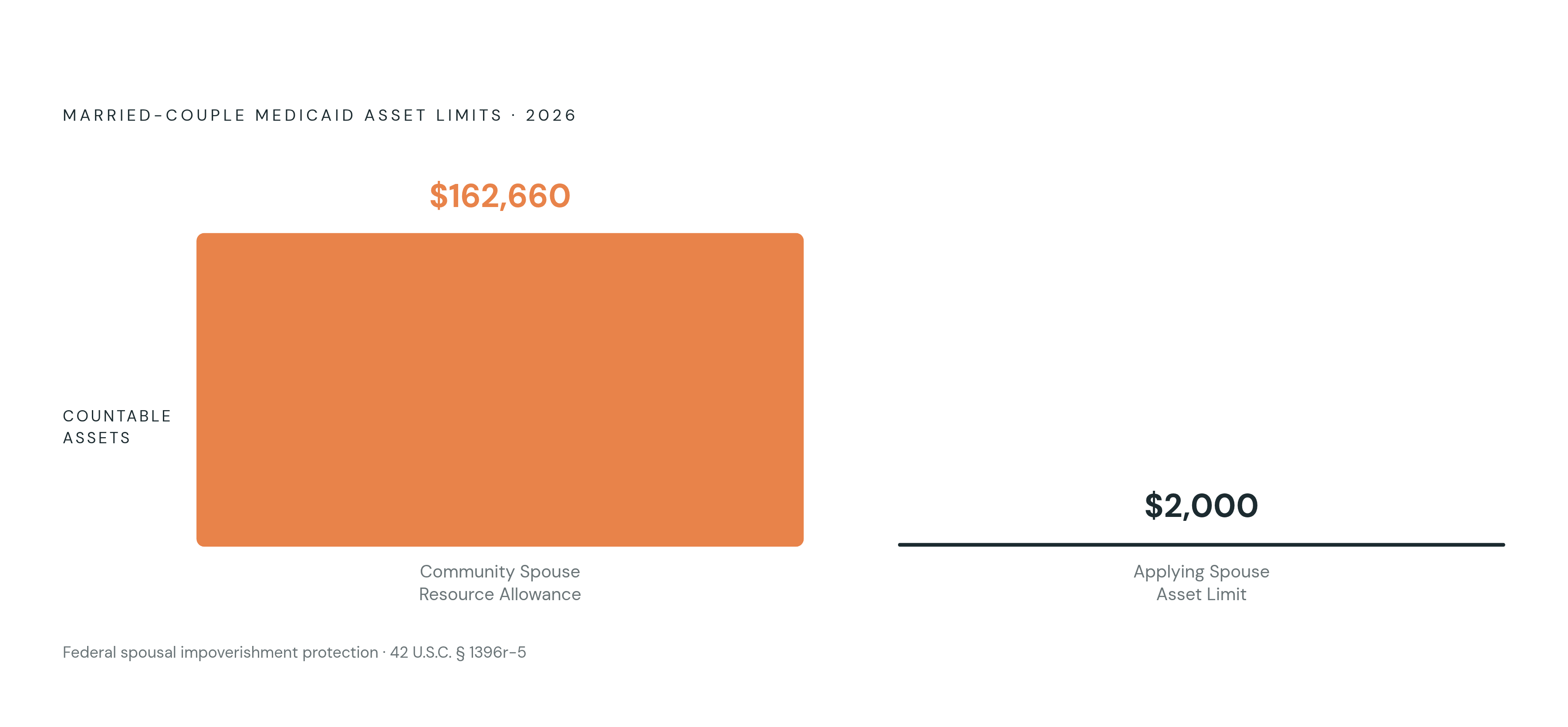
For married couples where only one spouse applies for nursing home or HCBS Medicaid, the rules split deliberately. The applying spouse is limited to $2,000 in countable assets. The non-applying spouse retains up to $162,660 through the Community Spouse Resource Allowance as of January 1, 2026. The gap between those two figures reflects a federal acknowledgment that paying for institutional care should not leave a healthy spouse destitute.
State exceptions shift this picture considerably. California's individual asset limit is $130,000 as of January 1, 2026. South Carolina's ABD Medicaid limit is $9,660. These are not calibrations at the margins; they determine who needs to spend down and who does not. National generalizations, applied without checking state-specific figures, are worse than no information at all.
The Home Equity Rule and What Is Changing in 2028
A nursing home Medicaid applicant can be disqualified in 2026 if home equity exceeds the applicable limit. Federal rules set the permissible range at $752,000 to $1,130,000; most states use the floor. California has historically imposed no home equity limit.
The cap is overridden entirely when a spouse, minor child, or disabled child lives in the home. In those circumstances the exemption is absolute.
A 2025 federal reconciliation law changes this beginning January 1, 2028. The maximum allowable home equity limit is capped at $1 million, reinstating a limit in California and affecting the eleven states currently using the higher federal ceiling. That raises an important question for families in high-cost-of-living states: does this affect you? I've watched families assume this was not going to affect them, and some of them were right, but some of them had $1.4 million in home equity and a parent who was eighteen months from needing care. The window before 2028 is a real variable with a hard close date, and whether it is usable depends on the equity value of the home, the applicant's clinical status, and whether any planning tools remain available.
The Functional Eligibility Requirement and What "Nursing Home Level of Care" Actually Means
Financial eligibility is necessary but not sufficient for Nursing Home Medicaid and most HCBS Waivers. Applicants must also demonstrate that they require nursing-facility-level care. A physician must make that designation formally.
What constitutes Nursing Home Level of Care, NHLOC, varies by state. Some states use Activities of Daily Living scoring; others rely on clinical assessment tools. The specific instrument matters less than the underlying reality: the state determines eligibility, and applicants who need care will not always satisfy the threshold on paper.
ABD Medicaid carries a lower functional threshold and does not require an NHLOC designation. HCBS Waivers require the same functional designation as nursing home Medicaid; care is simply delivered at home rather than in a facility.
Families who begin the process only at the point of crisis frequently discover the NHLOC requirement mid-application. A senior who clears every financial test but has not yet received a formal physician designation cannot complete a nursing home or waiver application. That discovery tends to arrive precisely when time is shortest.
How Seniors with Income Above the Limit Can Still Qualify Through Spend-Down
Thirty-four states offered a Medically Needy pathway as of 2025. This mechanism allows seniors to deduct qualifying medical expenses from countable income until it falls below the eligibility threshold. The list of deductible expenses is substantial: doctor bills, prescriptions, hospital costs, nursing home costs, Medicare premiums, medical equipment, personal care services, transportation to appointments.
In states without a spend-down pathway, called Income Cap States, seniors with income above the limit can use a Qualified Income Trust, commonly called a Miller Trust. Excess income is deposited into an irrevocable trust and excluded from the income calculation; funds in the trust can only be used for care-related costs. It works, but it requires precise execution and ongoing administration.
The financial pressure driving people toward these mechanisms is significant. Annual long-term services and support costs range from roughly $24,700 to $288,288, against a reported median income and savings of approximately $36,000 for older adults, per research published in JAMA Network Open based on nearly 200,000 traditional Medicare beneficiaries. That same study found nearly one in six nursing home residents admitted under Medicare or private pay ultimately enrolled in Medicaid after depleting assets.
The spend-down burden is not evenly distributed. Black residents were 10 to 17 percentage points more likely to spend down than White residents; Hispanic and Native American residents were 8 to 15 percentage points more likely, per the same study. One might argue this reflects income differences alone — but the data does not support attributing this entirely to income distribution. Medicaid's asset limits interact with structural inequities in wealth accumulation in ways that are predictable once you are looking for them. The rules are facially neutral; their effects are not.
The Five-Year Look-Back Rule and the Asset Transfer Penalties That Follow Violations
When someone applies for long-term care Medicaid, the state reviews all financial records for the preceding 60 months. Any asset transferred for less than fair market value during that window creates a Penalty Period: a duration of Medicaid ineligibility calculated from the value of what was transferred. The penalty is not a fine — it is a period during which Medicaid will not pay, even if the applicant is otherwise fully eligible.
Documentation is the operative variable: selling an asset at fair market value is permissible, but the applicant bears the burden of proof. Large transactions without paper trails become problems at application, sometimes years after the transaction occurred.
California applies a 30-month look-back for nursing home applicants and no look-back for HCBS Waiver applicants. New York applies no look-back for HCBS Waiver applicants and the standard 60-month period for nursing home applicants. ABD Medicaid carries no look-back restriction.
A gift made to a grandchild years earlier, entirely legal at the time, can produce a penalty period beginning at the exact moment care is needed. Families encountering this rule for the first time at the moment of application are not positioned to do anything about it.
Medicare Savings Programs for Seniors Who Don't Qualify for Full Medicaid
Medicare Savings Programs are Medicaid-funded but narrower in scope, covering Medicare premiums and in most cases cost-sharing rather than the full suite of Medicaid benefits. The 2026 individual income limit is $1,816 per month; the asset limit is $9,950.
Thirty-three states use federal MSP eligibility criteria. Eighteen states had expanded eligibility beyond federal minimums as of 2025.
Medicare Part B premiums exceeded $185 per month in 2026. For a senior on a fixed income, having that premium covered changes monthly arithmetic in a concrete way. MSPs are chronically underenrolled, partly because seniors who fail the income test for full Medicaid are often unaware this lower-threshold program exists. It is also worth considering why that gap persists: the connection between the two programs is not intuitive, and the people who would benefit most are frequently the least likely to encounter someone who explains it. That gap is not accidental; it is structural.
Estate Recovery and What Happens to a Senior's Assets After Medicaid Pays for Care
Under the 1993 Omnibus Budget Reconciliation Act, all states are federally mandated to seek reimbursement of long-term care costs from the estates of deceased Medicaid recipients aged 55 and older. This is the Medicaid Estate Recovery Program, MERP. Recovery targets assets remaining in the estate; the most common target is the primary home, since financial assets are typically spent down before or during enrollment.
MERP covers nursing home costs, HCBS costs, and hospital and prescription drug costs related to long-term care. States cannot pursue estate recovery while a surviving spouse is alive, a protection that is uniform across all 50 states and the District of Columbia. Additional hardship and deferral exemptions exist in most states, though they vary considerably.
The scenario that catches families off guard most reliably is this one: the home was exempt during the applicant's lifetime because a spouse resided there, preventing disqualification. That exemption does not eliminate the state's claim. After both spouses die, the state may file against the estate for the full cost of care provided. The home was protected during both lifetimes. What was not protected was what came after, and the children who receive that recovery claim years later had no opportunity to plan around it. Knowing about MERP does not change whether someone should apply — it shapes how families think about the home and surrounding estate planning, which is a different question.
How Eligibility Rules Differ Enough by State to Change the Outcome Entirely
Every variable in this piece has a state dimension. Income limits, asset limits, the home equity cap, the look-back period, spend-down availability, MSP expansion thresholds: all vary, and not modestly.
A senior in California faces a $130,000 individual asset limit, no income cap for nursing home Medicaid, no HCBS look-back period, and, until 2028, no home equity limit. A senior in a state applying federal minimums across every variable lives in a materially different regulatory environment. The same person, with identical income, assets, and clinical needs, can be eligible in one state and ineligible in another. That is a feature of the federal-state structure Medicaid was built on. It also has consequences for families who assume the rules are uniform, an assumption that the system does nothing to discourage.
A senior in an Income Cap state without a spend-down option must execute a Miller Trust to qualify. The same senior in a Medically Needy state has a more direct path. Marital status compounds this further; the Community Spouse Resource Allowance and spousal income allocation rules interact with state-specific limits in ways that require case-by-case analysis, not rule-of-thumb estimates.
A national figure is a starting point. The only reliable check is running the numbers against the specific state's current rules, in the current benefit year, for the specific program type being sought. The rules are technically public, distributed across state agency websites and regulatory documents. Practically, navigating dozens of state-specific variations is hard. Many families miss benefits they would have qualified for not because they failed to look, but because the structure of the information makes looking deceptively incomplete.