Long-Term Care Insurance vs Medicaid Planning
Choosing between insurance and Medicaid requires understanding their different timelines.

Long-term care is the financial risk most Americans understand in the abstract and ignore in practice. Seventy percent of people will need it at some point; according to a 2025 Center for Retirement Research at Boston College study, that figure climbs to roughly 80% for adults over 65. Women average 3.7 years of care; men, 2.2. Neither number is brief, and neither is cheap. Yet the median household financial assets for Americans 75 and older sit around $50,000, a figure that can dissolve in less than a year under current care costs. The gap between what care costs and what most families have set aside is where the real pressure lives. Most people don't close that gap with a plan; they close it with whatever option is available when a crisis arrives. That default, whether it is an insurance policy never purchased or a Medicaid application filed under duress, tends to be materially worse than a deliberate choice made years earlier. The two primary tools available, long-term care insurance and Medicaid planning, are not interchangeable. They serve different financial profiles and require different timelines. Understanding how each works, and where they might complement rather than compete with each other, is the starting point for making a real choice.
What Long-Term Care Actually Costs Today, and Where Costs Are Heading
The numbers are not hypothetical. Per the CareScout 2025 survey, the national median daily rate for a semi-private nursing home room is $315, which annualizes to roughly $114,975. Assisted living runs a median $6,200 per month, or $74,400 per year. Home care with a health aide cost $77,792 annually in 2024, and Bureau of Labor Statistics data shows home care costs rose 7.9% over the subsequent twelve months. These are medians, not outliers.
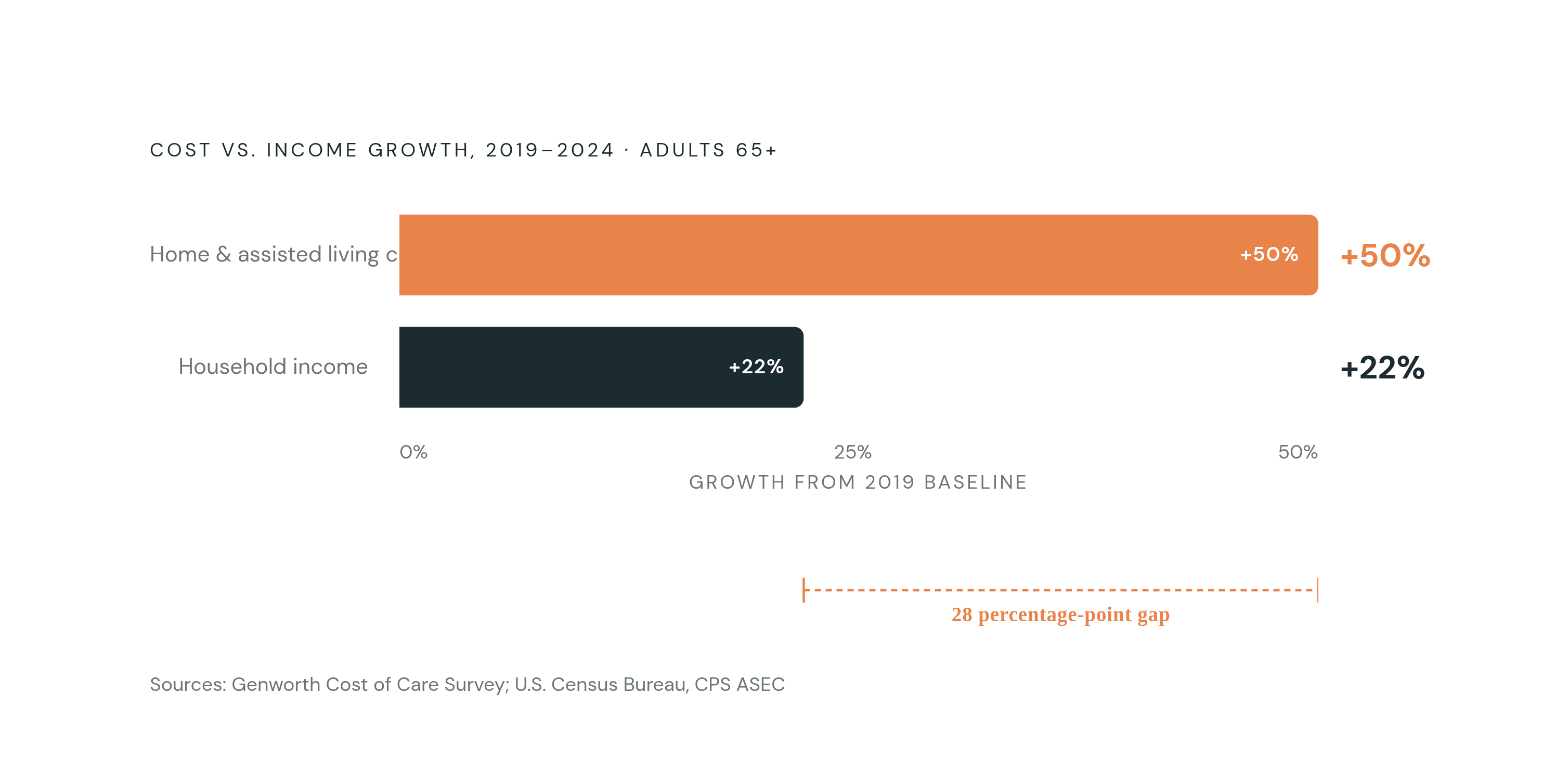
What makes the trend more concerning than the snapshot is the divergence between care inflation and income growth. Per the AARP Public Policy Institute, home care and assisted living costs rose nearly 50% between 2019 and 2024. Household income for those 65 and older grew 22% over the same period. Costs are outrunning income by a wide margin, and there is no structural reason to expect that relationship to reverse.
The Federal Long Term Care Insurance Program's 2024 Cost of Care Survey projects that at an average annual inflation rate of 2.54%, a nursing home that costs approximately $112,000 today will cost nearly $186,000 in twenty years. That projection uses a relatively modest inflation assumption. Given what assisted living costs did between 2023 and 2024 alone, rising roughly 10%, the conservative estimate may already be behind the curve.
The planning question is how a family funds a multi-year need at these prices without destroying what they spent a lifetime accumulating.
How Long-Term Care Insurance Works and Who It's Designed For
Tax-qualified long-term care insurance policies cover a defined set of care settings: nursing homes, assisted living facilities, home health care, adult day centers, and hospice. Benefits trigger when a person can no longer perform at least two of six Activities of Daily Living, which include bathing, dressing, eating, toileting, continence, and transferring, or when cognitive impairment requires substantial supervision. The benefit threshold is not a technicality; it is the gate through which all claims must pass, shaping how policies are used in practice.
According to the 2025 Milliman Long Term Care Insurance Survey, the average initial maximum monthly benefit reached a record $5,428. The average benefit period in 2024 ranged from 2.81 to 3.79 years depending on the policy class, with three-year benefit periods representing the most common option sold. Annual incurred claims across the industry reached approximately $17 billion in 2024, and the average claim size grew from roughly $110,000 in 2015 to $180,000 in 2024, per Milliman and NAIC experience reporting data.
About 5.8 million Americans still carry stand-alone long-term care coverage, but that represents only 3 to 4% of Americans 50 and older, per KFF Health News. The product's market penetration has always been limited relative to the underlying need, and understanding why requires being honest about who the product is actually designed for.
Long-term care insurance is a middle- and upper-middle-asset strategy. It protects wealth that Medicaid would otherwise require to be spent down before benefits begin. If a family has significant savings, a home, or an investment portfolio, LTC insurance is the mechanism that allows those assets to survive a prolonged care event. If a family has very little, there is less for insurance to protect, and Medicaid's spend-down rules become the more relevant framework. That distinction is not a value judgment; it is how the economics work.
The other constraint that families routinely underestimate is timing. Long-term care insurance requires medical underwriting. Cognitive impairment is a disqualifying condition. Once a parent receives a dementia diagnosis, the window for coverage closes, immediately and permanently. Most families learn this after the diagnosis, not before it.
The Premium Math: What LTC Insurance Costs and How Timing Changes the Price
The 2024 American Association for Long-Term Care Insurance Annual Price Index offers a useful baseline. A policy providing $165,000 in benefits with no inflation protection costs a 55-year-old man approximately $950 per year; a woman the same age pays roughly $1,500. A couple, both aged 55, pays around $2,080 combined annually.
Gender-distinct pricing is now standard practice across the industry. A 55-year-old woman purchasing a policy with 3% compound inflation growth pays approximately $3,750 annually, compared to $2,200 for a man of the same age, according to AALTCI 2025 price index data from an Illinois sample. The divergence reflects actuarial experience: women live longer and use more long-term care.
Age at application drives cost as sharply as gender. Premiums for a 60-year-old are meaningfully higher than at 55; by 65, AALTCI data indicates premiums are roughly 80% higher than they would have been a decade earlier. Beyond 70, many traditional stand-alone products are simply unavailable. Jesse Slome, director of AALTCI, has noted that the 55-to-65 window represents the practical sweet spot for applying, before underwriting exclusions and compounding premium increases narrow the viable options.
There is a tax dimension worth noting. Premiums on qualified long-term care policies may be deductible depending on age and tax filing status, and benefits received are generally not treated as taxable income. For business owners and self-employed individuals in particular, the deductibility can make the premium math more favorable than the sticker price suggests.
Why Hybrid Policies Have Largely Replaced Stand-Alone LTC Insurance in the Market
Stand-alone long-term care insurance sales have been declining for years, and the trajectory accelerated after combination, or hybrid, products eclipsed stand-alone sales beginning around 2014, per Society of Actuaries research. The market did not disappear; it restructured around a different product form.
Hybrid policies link life insurance or annuity contracts to long-term care benefits. The essential appeal is the elimination of the "use it or lose it" problem that made traditional LTC insurance psychologically difficult for many buyers. If care is never needed, a death benefit passes to heirs. The premium is not simply spent; it is redirected.
Per AALTCI 2024 data, a hybrid policy providing $180,000 in long-term care benefits with a $120,000 minimum death benefit costs a 55-year-old man approximately $3,540 per year, or a lump sum of around $52,753. A woman the same age pays roughly $3,265 annually or about $54,022 as a single premium. These figures are substantially higher than comparable stand-alone coverage, typically two to four times the cost. The tradeoff is fixed premiums, which eliminates the rate-increase risk that plagued traditional carriers, and generally less stringent underwriting.
Demand for this type of protection appears durable. A 2025 LIMRA and EY survey of individual life combination products found that 63% of individuals express a need for LTC-focused insurance, even as awareness of product options remains uneven.
The limitation worth watching is inflation. Most hybrid policies offer benefit growth of 3% or 5% annually. Actual assisted living costs rose roughly 10% between 2023 and 2024. Over a twenty-year horizon, a policy that grows at a fixed rate in an environment of volatile care inflation can erode significantly in real purchasing power. The psychological and financial barriers to buying stand-alone coverage are real; hybrids address many of them, but they do not fully resolve the inflation mismatch.
How Medicaid Becomes the Primary Long-Term Care Payer for Most Americans
Medicaid is the largest single payer of long-term care costs in the United States, accounting for more than 60% of those expenditures. Overall Medicaid spending reached $919 billion in federal fiscal year 2024, with the federal government covering approximately 65% and states covering 35%, according to KFF 2026 data. Enrollees who are 65 or older or eligible based on disability represent about one in five Medicaid enrollees but account for more than half of total program spending. Long-term care is the cost driver.
Most families do not choose Medicaid strategically. They arrive at it after spending down whatever assets they had, often having paid for care out of pocket for months or years until savings were exhausted. That sequence, spend down to eligibility, is Medicaid by default. Medicaid planning is the deliberate alternative: understanding the eligibility rules before the crisis, structuring assets in ways the rules permit, and entering the system on terms the family controls rather than terms the crisis dictates.
For families without significant assets, Medicaid is the primary safety net, and understanding how it functions is essential. For middle-asset families who delayed or could not obtain LTC insurance, it may become relevant even when it was not the original plan. The rules matter in both cases.
Medicaid's Eligibility Rules and the Asset Limits Families Need to Understand
Three program types cover long-term care under Medicaid: Nursing Home Medicaid, Home and Community Based Services Waivers, and Aged, Blind and Disabled Medicaid. Each has its own eligibility criteria, and state variation is substantial enough that generalizations can mislead.
In most states as of 2026, the individual asset limit for Medicaid long-term care eligibility is $2,000. But "most states" conceals significant dispersion: Connecticut sets the limit at $1,600, Illinois at $17,500, and California at $130,000. The income limit for Nursing Home Medicaid and HCBS Waivers is $2,982 per month in most states, again with meaningful state-level variation.
For married couples, the Community Spouse Resource Allowance allows the spouse remaining at home to retain assets above the individual limit. As of 2025, that allowance ranges from $31,584 to $157,920 depending on the state, with a common upper figure around $162,660. This protection is often underused because families are unaware it exists.
The 60-month look-back is the mechanism most families encounter too late. Medicaid reviews five years of financial activity before the application date. Assets transferred within that window can trigger a penalty period during which Medicaid benefits are delayed. A $100,000 transfer in a state where average nursing home costs are $10,000 per month produces a ten-month delay in benefits, with care costs accruing during that window. The look-back does not penalize spending money; it penalizes transferring it.
The home is generally exempt from asset counting during the applicant's lifetime. It is not exempt from Medicaid Estate Recovery after death. The state can file a claim against the estate to recover what Medicaid paid. Families who believed the home was protected often discover, after a parent has died, that the protection was conditional and temporary. This is perhaps the single most common planning failure I observe.
The 2025 Federal Law Change That Narrows Home Equity Protection Under Medicaid
The Budget Reconciliation Act of 2025, signed July 4, 2025, establishes a hard national ceiling of $1 million on the home equity that can be excluded when applying for Medicaid. The provision takes effect in January 2028.
Twelve states and the District of Columbia currently have higher exclusion limits; California, New York, Massachusetts, Colorado, and Hawaii are among them. Those states will be required to lower their limits when the law takes effect. The ceiling is not indexed to inflation. As home values rise over time, more families will find themselves above a threshold that never adjusts.
For families in high-cost real estate markets where home equity is the dominant asset, this change is material. The asset that most families assumed was categorically safe under Medicaid is now subject to a stricter federal cap, and the protection that states had extended beyond that cap is being withdrawn. Families in affected states who had structured plans around higher exclusion limits need to revisit those plans before 2028. The window for adjustment exists now; it will not expand.
Medicaid Planning Strategies That Work Within the Rules, and Their Timing Requirements
Medicaid Asset Protection Trusts, commonly referred to as MAPTs, are the most widely used advance planning vehicle. Assets transferred into a properly structured irrevocable MAPT are generally not counted toward Medicaid eligibility after the 60-month look-back period. Home equity transferred into a MAPT before the look-back window also avoids Estate Recovery after death. These trusts do not hide assets from Medicaid; they move assets into a structure the rules recognize as no longer belonging to the applicant.
The essential constraint is time. A MAPT funded today begins a five-year clock. Someone who transfers their home into a trust at age 63 and applies for Medicaid at 68 has cleared the look-back. Someone who does the same at 78 and applies at 80 has not. MAPTs are advance planning instruments; they are entirely ineffective as crisis tools.
Spousal planning offers a different set of options for married couples. Structuring assets to maximize the CSRA for the community spouse is legitimate, often underused, and highly state-specific. The right approach in a state with a $157,920 CSRA ceiling differs substantially from the approach in a state where the ceiling is $31,584. Spousal planning, executed correctly, can preserve meaningful assets for the healthy spouse without triggering eligibility violations.
Estate Recovery is the layer beneath eligibility planning that most families miss. A home or other asset that survives the eligibility calculation, either because it is exempt or because the spend-down consumed other assets first, can still be claimed by the state after death to recover Medicaid costs. Irrevocable transfers completed outside the look-back window, including properly structured MAPTs, are the primary legal defense. Revocable trusts, joint tenancy, and other arrangements that maintain functional control of the asset generally do not provide this protection.
The common denominator across all of these strategies is time. The 60-month look-back is a structural feature that makes the timing of planning decisions as consequential as the decisions themselves, and it cannot be engineered around at the last minute.
How to Think About Which Strategy Fits Which Financial Situation
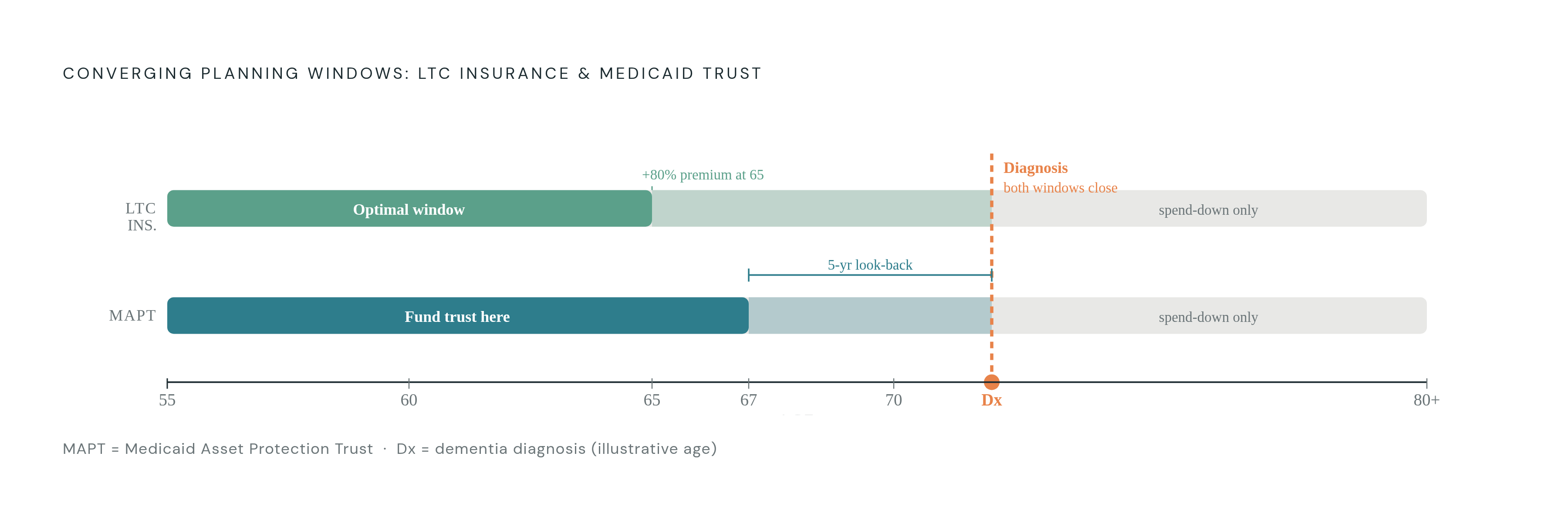
Long-term care insurance is most likely to add genuine value when a family has meaningful assets to protect, savings, home equity, or an investment portfolio, and when the individual is between 55 and 65, still insurable, and interested in preserving wealth for heirs without spending down to Medicaid eligibility. The insurance funds the care; the assets survive.
Medicaid planning is most relevant when assets are modest or already partially depleted, when LTC insurance is no longer available because of age or a health disqualification, or when the family has enough lead time to complete a five-year look-back window before care is needed. It is also the appropriate framework when the family's assets are primarily illiquid, concentrated in home equity, and likely to be consumed by a prolonged care event without protection.
The two strategies are not mutually exclusive for middle-asset families, and this sequencing is underappreciated. LTC insurance can fund the first years of care while Medicaid planning simultaneously protects remaining assets for a longer-term stay. A policy with a three-year benefit period buys time; a MAPT funded during that same period of care can clear the look-back before benefits are exhausted. Together, the two tools can accomplish what neither accomplishes alone.
Geography is not a footnote. State variation in Medicaid asset limits, CSRA amounts, and, after 2028, home equity caps means that the optimal plan in California is structurally different from the optimal plan in Connecticut. The same family, the same assets, the same diagnosis, and the same timing can produce materially different outcomes depending on where they live. Any planning that omits state-specific rules is incomplete.
A dementia diagnosis is where the analysis stops being theoretical. It closes the LTC insurance door immediately. It starts the Medicaid look-back clock. Families who have taken no action are left with spend-down as the path forward, not because it is the right path, but because it is the only one still open.
Where Family Caregivers Fit Into This Planning Picture, and What They Are Often Missing
Long-term care planning almost always centers on the person receiving care. The family members providing it are usually treated as a resource, not a stakeholder. That framing misses something important.
Caregiving carries real financial exposure for the people doing it: lost wages, out-of-pocket expenses, foregone retirement contributions, and career interruption that compounds over time. These costs are rarely quantified in a care plan, and they are almost never offset by a compensation structure the family understood in advance.
Medicaid's Home and Community Based Services Waivers, available in many states, include provisions that allow family caregivers to be compensated directly for the care they provide. Most caregivers are unaware of this. The benefit exists within the same regulatory framework that makes Medicaid eligibility confusing, which is precisely why it stays invisible. Finding and enrolling in caregiver compensation programs requires navigating rules that most families encounter, if at all, only after exhaustion has set in. Free services like Brevy, let people check eligibility for and enroll in Medicare, Medicaid, and these caregiver payment programs.
A well-structured long-term care plan addresses who will provide care, not only who will pay for it. The two questions are related. A caregiver who understands the insurance and Medicaid frameworks is far better positioned to make the plan function as intended, advocate for appropriate benefits, and avoid the financial erosion that uncompensated caregiving produces over time.
The opacity of the benefits system is not an accident of poor design; it is a feature of its complexity. The only reliable counter to it is deliberate navigation before a crisis forces improvisation. Families who have done that work arrive at the system on their own terms. Those who have not often find the system arriving at them.