Nursing Home Costs and Medicaid Coverage
Nursing home costs vary fivefold by state, reshaping Medicaid eligibility timelines.

How far costs vary by state (and why it matters for planning)
The national median is useful for framing the problem. It is nearly useless for planning.
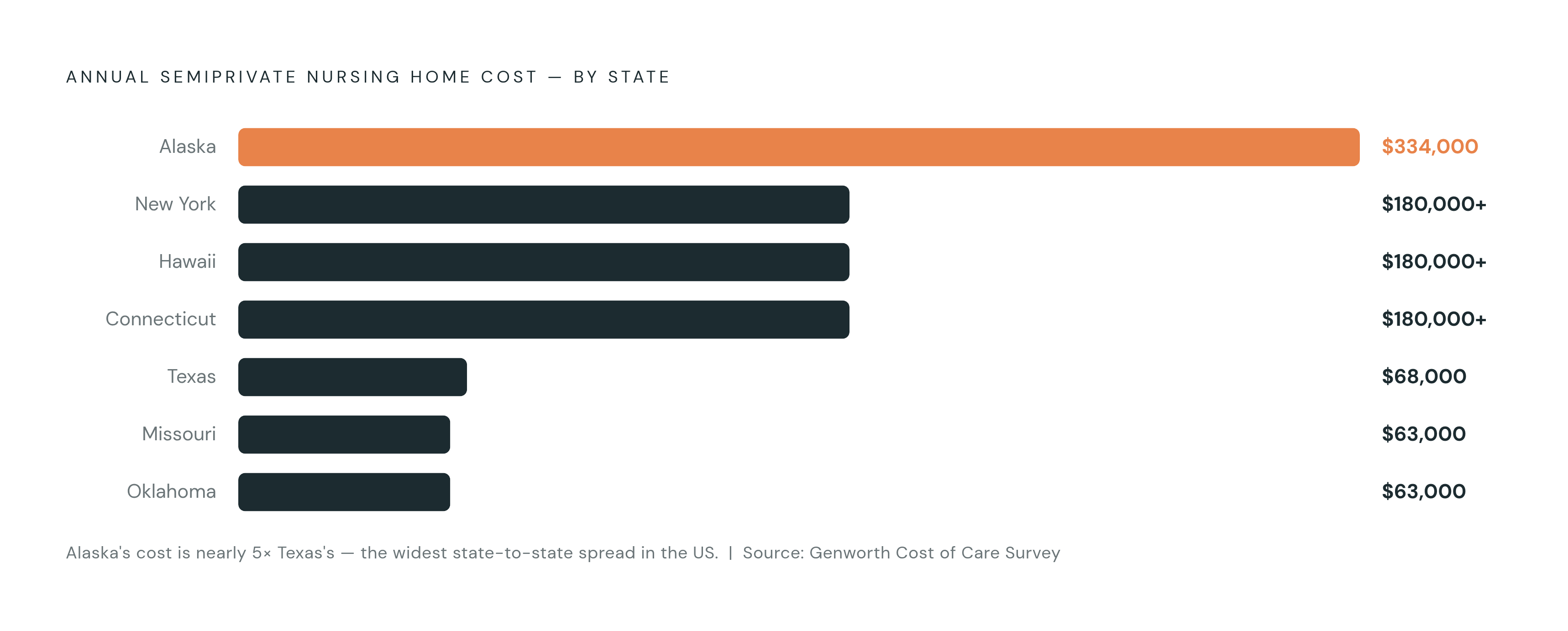
Alaska's semiprivate nursing home room runs approximately $334,000 per year, per the Genworth Cost of Care Survey 2025. Texas, for equivalent care, is roughly $68,000. That fivefold spread between two states operating under the same federal program is not an anomaly; it is the norm. New York, Hawaii, and Connecticut all exceed $180,000 annually, which means families with what most people would call substantial savings are looking at full depletion within a few years. Missouri and Oklahoma come in closer to $63,000 annually, per WorldPopulationReview 2026, offering a longer runway, but only modestly so.
The variation matters for reasons beyond sticker shock. Medicaid eligibility thresholds and asset limits also vary by state, and those two variables interact in ways that compress or extend planning timelines dramatically depending on geography. A $2,000 asset ceiling is nominally identical in Texas and New York. In practice it is not. A family in a high-cost state burns through countable assets at roughly three times the rate of a family in a lower-cost state. Decisions become urgent faster. The timeline to Medicaid eligibility tightens not because the rules changed but because the burn rate did.
State of residence is a material variable in this calculation, not a backdrop detail, and understanding where your state falls is the first act of serious planning.
Why Medicare is not the long-term answer, and what Medicaid actually is
The misconception that Medicare covers nursing home care is persistent, and acting on it is expensive.
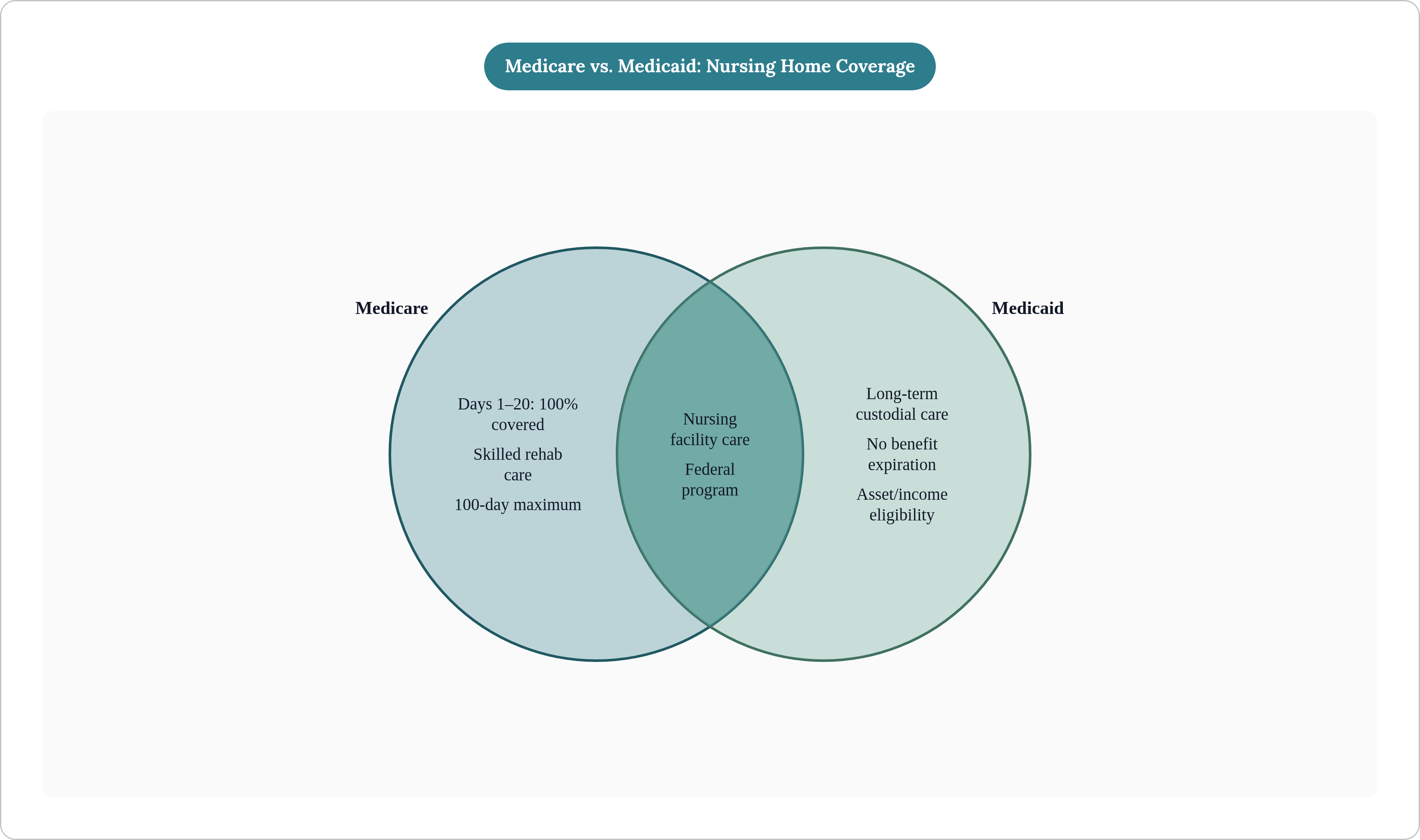
Medicare pays 100% for the first 20 days of nursing home care when that care is medically necessary and follows a qualifying hospital stay. Days 21 through 100 carry a $217-per-day copay in 2026. After day 100, coverage ends entirely. Medicare does not cover long-term custodial care, which is the category that describes most nursing home stays. Skilled nursing for rehabilitation is Medicare territory; long-term residence because someone can no longer safely live at home is not. That line is sharp and non-negotiable.
Medicaid fills that gap at enormous scale. As of July 2024, over 60% of the 1.2 million people in nursing facilities had Medicaid as their primary payer, per KFF 2025. Medicaid covered 44% of long-term institutional care costs in 2023 and 69% of home care costs nationally. Total nursing facility spending reached $219.9 billion in 2024, up 7.3% year-over-year, per CMS National Health Expenditures data. These are not the numbers of a supplemental program. Medicaid is the dominant financing mechanism for long-term care, and it is the primary payer for the majority of people who actually use it.
Anyone who needs a nursing home for more than a few months will very likely encounter Medicaid, whether they planned for it or not.
What Medicaid nursing home coverage actually includes (and its limits)
When Medicaid covers nursing home care, the coverage is broad: room, meals, medical supplies, and nursing services for as long as that level of care is required, per the National Council on Aging. No benefit cap, no expiration date tied to a diagnosis, no 100-day clock. That is the real strength of the program.
The limits tend to surface at inconvenient moments. Medicaid covers semiprivate rooms by default; a private room requires documented medical justification. Families who spent years assuming a parent would have private accommodations discover this, often for the first time, during the admission conversation, when it is too late to renegotiate expectations.
The income contribution rule deserves attention before it arrives as a surprise. A Medicaid recipient in a nursing home is required to contribute nearly all of their monthly income toward care costs; Medicaid covers the gap. What the resident keeps is called the Personal Needs Allowance, set by each state. Indiana's is $52 per month. That figure, more than any policy description, conveys how little discretionary income remains once Medicaid becomes the primary payer.
There is also the reimbursement gap, which shapes the market in ways most families never anticipate. Medicaid reimburses nursing facilities at roughly 70% of private-pay rates, per MedicaidPlanningAssistance.org 2026. A 2024 HHS/ASPE report found Medicaid payments covered approximately 82 cents per dollar of reported cost. Facilities operating on those margins have a straightforward economic rationale to limit their Medicaid beds, and some require a period of private-pay before allowing a resident to transition to Medicaid. A family unaware of this policy can find itself scrambling for a willing facility at precisely the moment it has the least leverage: when care is already underway and options have narrowed.
Who qualifies: financial eligibility rules in 2026
Financial eligibility is administered by states within federal floors, which means the question "what is the income limit?" has no single answer.
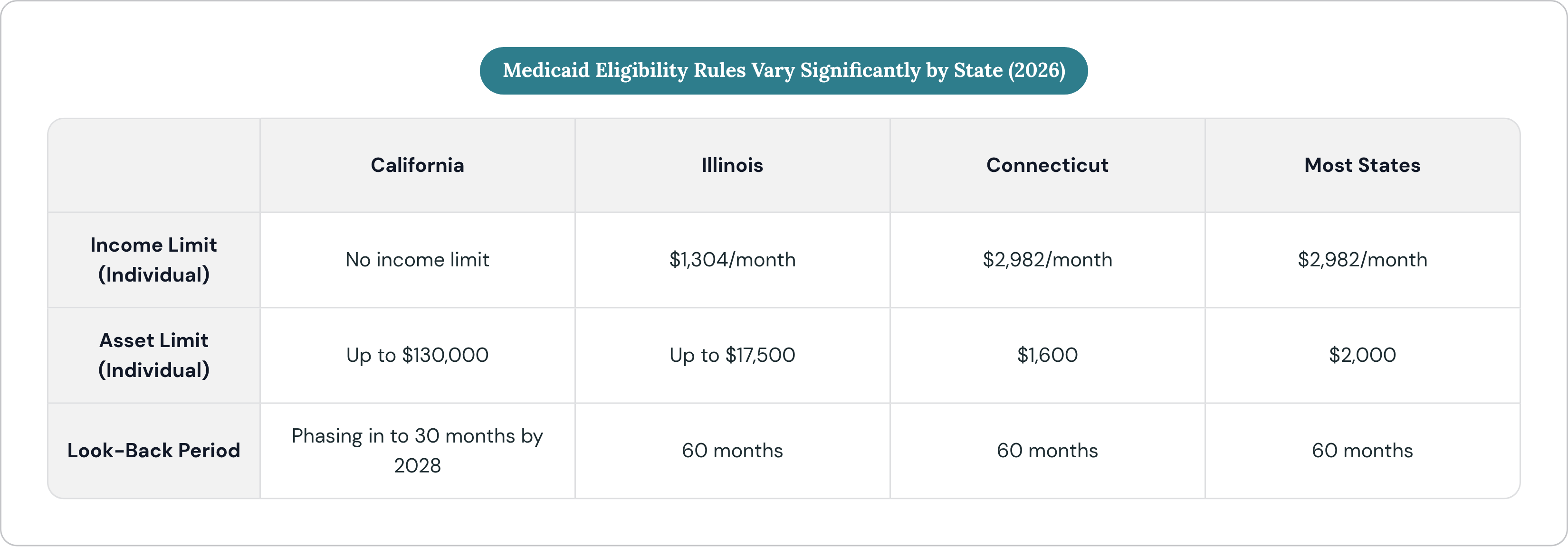
In most states, a single applicant's income must fall at or below $2,982 per month in 2026. California has no income limit for Nursing Home Medicaid. Illinois sets its limit at $1,304 per month. These are not minor variations clustering around a common theme; they are categorically different thresholds that produce different eligibility outcomes for the same applicant depending entirely on state of residence.
Asset limits follow the same pattern. Most states set the individual limit at $2,000. Connecticut's is $1,600. Illinois allows up to $17,500. California allows up to $130,000. Assuming uniformity across states is a planning error with real financial consequences.
Married couples operate under a distinct set of rules designed to prevent the community spouse's impoverishment. The non-applicant spouse can retain up to $162,660 in assets under the Community Spouse Resource Allowance in 2026. This protection exists because the alternative — reducing both spouses' assets to $2,000 — would leave the community spouse unable to sustain their own household. The protection is meaningful but not automatic; it must be correctly accounted for in the application.
Certain assets are exempt from the limit entirely: the primary home up to an equity cap ranging from $752,000 to $1,130,000 depending on the state, and one vehicle. The home is fully exempt while a spouse or dependent child resides there. What happens to it after death is governed by an entirely different set of rules.
Functional eligibility: the level-of-care assessment
Financial eligibility is necessary but not sufficient. Every state requires applicants to meet a Nursing Facility Level of Care standard, because Medicaid pays for medically necessary long-term care, not simply for the presence of a serious diagnosis.
The assessment centers on Activities of Daily Living: independent mobility, bathing, dressing, eating, toileting. Documented inability to perform these functions without assistance is the core evidentiary requirement. Cognitive impairment is relevant but not determinative on its own, which catches some families off guard.
An Alzheimer's diagnosis, particularly in early stages, does not automatically satisfy the standard. The assessment is functional, not diagnostic. Someone with a serious diagnosis who retains substantial capacity for self-care may not qualify, and families who assume a physician's referral will carry the application sometimes find themselves denied on functional grounds. That is a different kind of problem than a financial denial and requires different documentation to contest.
The practical response is building the evidentiary record before the application, not in response to a denial. Physicians, home health aides, and family members who regularly assist with daily activities can all contribute documentation. Assembling that record proactively produces better outcomes than reconstructing it under time pressure.
The spend-down path: how families get from over the limit to eligible
Spend-down is the process by which families with assets above the Medicaid limit work toward eligibility. It is plannable. It is not the same as passively watching savings disappear.
The mechanics are specific: countable assets must be reduced to the state's threshold, typically $2,000, by spending them on allowable purposes. Medical expenses, home modifications for accessibility, prepaid funeral arrangements, and paying down legitimate debts all qualify. Transferring money to relatives does not. That distinction carries serious consequences.
Nearly one in six nursing home residents who enter as private payers transition to Medicaid after depleting their assets, and that transition happens, on average, in 6.1 months. At $9,842 per month for a semiprivate room, a family beginning with $60,000 in savings reaches the $2,000 threshold in roughly six months. The average is not surprising; it is arithmetic.
Families who know the permissible expenditures, their state's asset limit, and the timing of the application relative to asset depletion are working from a plan. Those who encounter these details while the money is already running out are not. That distinction (between entering the process with orientation and entering it in reaction) determines whether spend-down is manageable or chaotic.
The five-year look-back rule and why asset transfers backfire
I have been in enough of these conversations to recognize the specific quality of disbelief that crosses a family's face when they learn that transferring assets to children in the years before an application created a penalty period. It is not anger, exactly. It is the particular confusion of someone who did something generous, something entirely legal under federal tax law, and is now being told it disqualifies their parent from coverage during the months they need it most. The financial structure of that moment is grim: the facility still expects payment, and there is no obvious source for it.
In 49 states and the District of Columbia, Medicaid reviews every asset transfer made in the 60 months before application. Any transfer below fair market value is treated as an uncompensated transfer and can produce a penalty period during which the applicant is ineligible for benefits, per MedicaidEligibilityCalculator.com 2026. The penalty is calculated by dividing the transferred amount by the state's average monthly nursing home cost. A $60,000 transfer in a state with a $6,000 monthly average yields a ten-month penalty period.
The IRS annual gift tax exclusion is irrelevant to this calculation. Families who gave money to grandchildren annually and assumed the gifts were clean from a planning standpoint are sometimes the most surprised, because the assumption was reasonable in every context except this one. The gift was legal. The penalty is still real.
California is a meaningful exception. The look-back was effectively suspended through 2025; starting January 1, 2026, a new look-back period begins at zero months and phases up to 30 months by July 2028, making 2026 a material inflection point for California families who assumed the suspension was permanent. New York currently has no look-back for Community Medicaid covering home and community-based services, but has announced plans to implement a 30-month look-back; the precise timeline remained unclear as of mid-2026.
For families who have already made transfers, the options narrow considerably. Remedies available before a transfer simply do not exist after it.
Medicaid estate recovery: what happens to the home after death
The home is exempt from the Medicaid asset limit during a recipient's lifetime. What surprises families, consistently and late, is that the exemption does not extend past it.
Federal law requires states to seek reimbursement from the estates of Medicaid recipients age 55 or older for nursing facility and related services. The home, usually the primary remaining asset, is the typical target. Families who spent years reassured that the house was protected because it was not counted during the application had confused two distinct phases of the program: the exemption during life and the recovery claim after death.
Protections exist. States cannot pursue recovery if a surviving spouse is alive, or if a surviving child is under 21 or blind or disabled at any age; in those cases, recovery is deferred or eliminated. For recipients without qualifying survivors, the estate is exposed.
The scope of recovery depends on state law, and this is where structure matters. Twenty-three states and the District of Columbia limit recovery to assets passing through probate, which creates planning opportunities through certain trusts or beneficiary deeds that transfer property outside of probate. The remaining states exercise broader estate recovery authority that can reach assets specifically structured to avoid probate. Knowing which framework governs your state is a material factor in how an estate should be structured — and most useful to know long before a Medicaid application is filed.
Estate recovery is the piece of Medicaid planning families most reliably overlook — by the time it becomes relevant, the planning window has closed.
Federal Medicaid cuts under the 2025 reconciliation law and what they mean for nursing home access
The policy environment surrounding Medicaid long-term care has not been stable, and the most consequential recent change arrived in the summer of 2025.
The "One Big Beautiful Bill Act," signed July 4, 2025, includes an estimated $911 billion in federal Medicaid spending reductions over ten years, per KFF, updated September 2025. KFF estimates these provisions could affect 22 million people ages 50 and older currently covered by Medicaid, reducing both enrollment and access to long-term care services. For nursing facilities specifically, the law delays the Biden-era minimum staffing mandates by ten years, providing short-term regulatory relief for operators already strained by labor costs. The funding reductions, however, simultaneously threaten the Medicaid reimbursement revenue those same operators depend on.
These two forces do not offset each other. Operators gain relief from one regulatory pressure while confronting a reduction in the payment base that funds a significant share of their census. Facilities with already constrained Medicaid capacity have a clear financial incentive to further limit the share of Medicaid residents they accept; whether that outcome materializes broadly is not yet certain, but the incentive structure points that direction. The concern most directly relevant to families is not abstract: it is whether the facility they want will accept their coverage at all.
The eligibility rules and spend-down mechanics described throughout this piece reflect current law. The funding landscape is shifting, and the direction of that shift is toward tighter access.
How families navigate enrollment when the rules are this complex
The complexity here is not accidental, and it does not resolve cleanly into a single point of confusion. Eligibility rules vary by state, interact differently depending on marital status, are shaped by financial decisions made years earlier, and are now subject to ongoing legislative revision. It is the accumulation of variables, not any single one of them, that tends to overwhelm families at the moment they have the least capacity to absorb complexity.
The cost of failing to navigate it is concrete. A look-back penalty or missed eligibility window translates directly to months of nursing home costs at $9,842 to $11,294 per month that Medicaid would otherwise have covered. Those losses compound against remaining resources.
Effective navigation requires at minimum three things: a clear understanding of income and asset limits specific to the applicant's state, not national averages; a thorough audit of the past five years of financial transactions before filing to identify transfers that could trigger a look-back penalty; and knowledge of which spend-down expenditures are permissible and in what sequence relative to the application date.
Knowing that a family qualifies does not guarantee a correctly filed application, properly assembled documentation, or met deadlines. Those are execution problems, not knowledge problems, and they require support that addresses them directly. Elder law attorneys who specialize in Medicaid planning, state SHIP counselors, and Benefits Enrollment Centers with expertise in long-term care programs are the resources that have, in the cases I have seen navigate this well, consistently made the difference between a clean transition and an expensive one.
The safety net is substantial. It covers the majority of nursing home residents in this country and is designed to do so. It also operates on rules that reward preparation and punish assumptions, and the window for acting on that preparation tends to close faster than families expect.