Accuracy and Trust in AI Benefits Guidance
AI benefits systems are scaling faster than accuracy safeguards, leaving eligible families at risk.
AI in public benefits promises faster claims, more consistent decisions, and fewer families falling through administrative gaps. That promise is not wrong, exactly. It is incomplete. What honest accountability for accuracy actually looks like in practice, who bears the cost when these systems fail, and what the gap between optimistic framing and operational reality means for real families: those are the most consequential questions. Having spent time inside the machinery of benefits navigation, I find those questions are still largely unanswered.
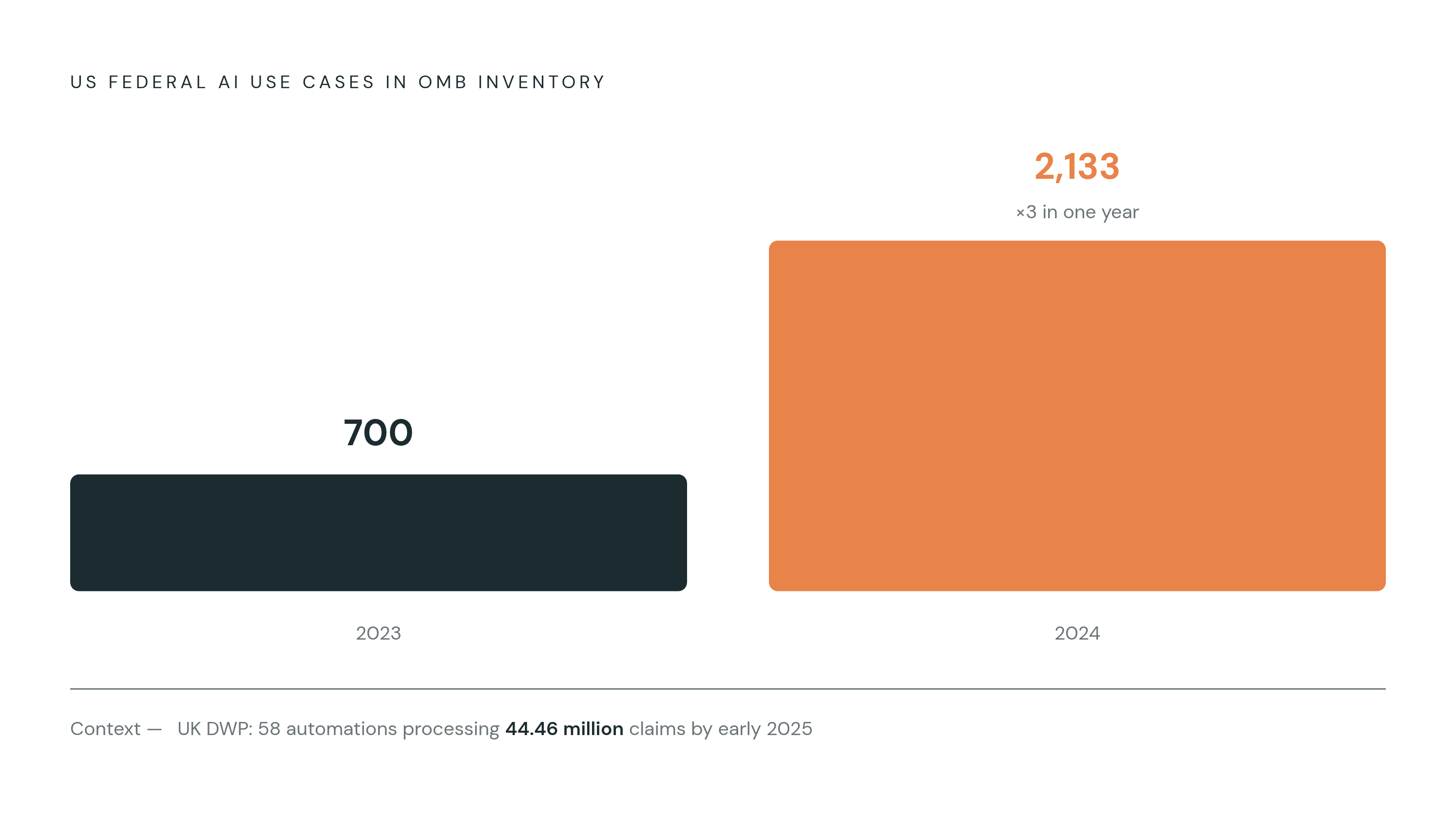
Scale is the right place to start, because scale changes the moral stakes. US federal agencies reported roughly 700 AI use cases in the Office of Management and Budget's 2023 inventory. By 2024, that count had risen to 2,133, a tripling in a single year. The UK's Department for Work and Pensions had deployed 58 automations as of early 2025, collectively handling 44.46 million claims. These numbers reframe the conversation: AI in benefits is not a pilot program testing the edges of possibility. It is operational infrastructure. Decisions about eligibility, fraud risk, and case routing are being made or materially shaped by algorithms at scale, and the families on the receiving end often do not know AI is involved at all. That opacity is incidental to nothing. It is the condition under which trust either forms or collapses.
What Actually Happens When AI Benefits Guidance Gets It Wrong
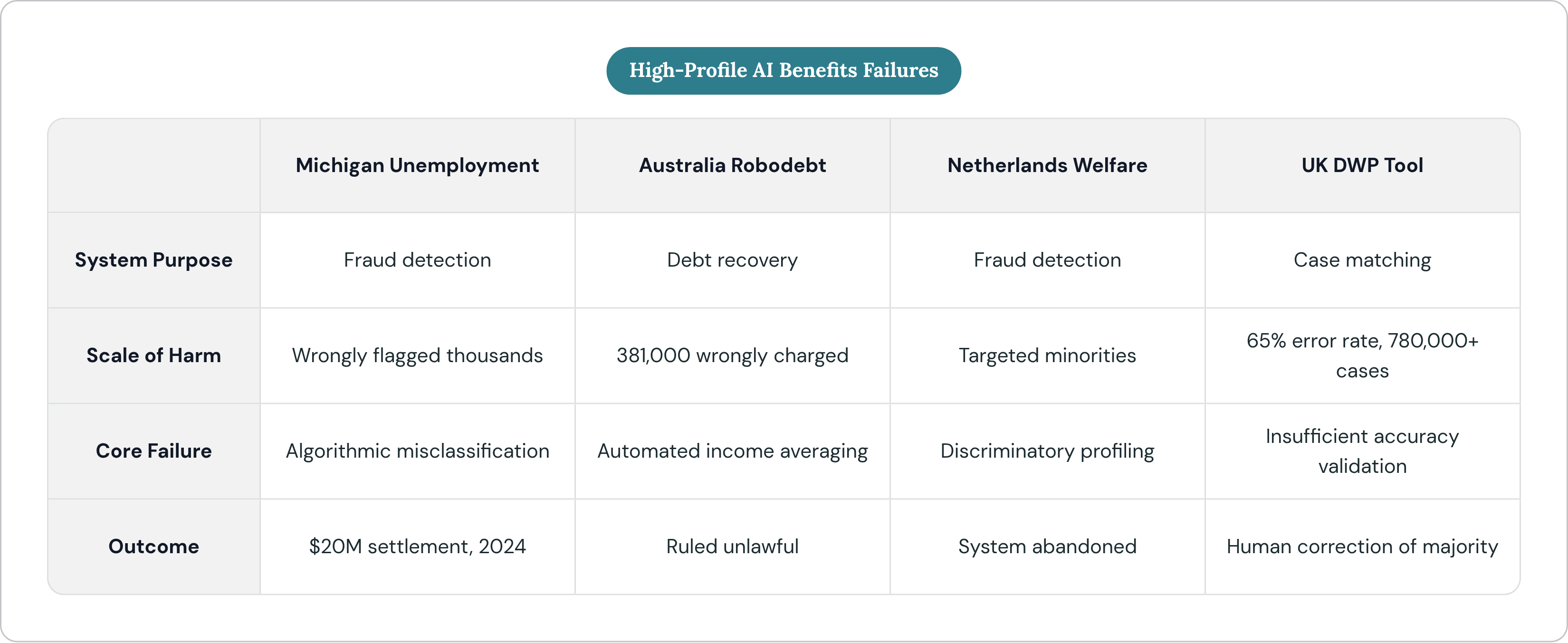
The pattern of failure is not theoretical. Michigan deployed an anti-fraud algorithm that wrongly flagged widespread unemployment insurance fraud; 3,000 plaintiffs were reimbursed $20 million in a 2024 settlement. Australia's Robodebt scheme raised AU$1.73 billion in debts against 433,000 people, wrongly recovering $751 million from 381,000 of them, driven by automated income averaging with no meaningful human oversight. It was ultimately ruled unlawful. The Netherlands abandoned its automated welfare-fraud detection system in 2020 after a court ruled it violated human rights, having found that the system disproportionately targeted low-income families and ethnic minorities.
The UK's own DWP offers perhaps the clearest window into what deployment at speed looks like before accuracy is sufficiently validated. The first version of its AI tool, in use from 2020 to 2024, achieved a 35% correct match rate across more than 780,000 processed cases. Human caseworkers had to correct the remaining 65%. That is not a margin of error; it is a primary failure mode.
None of these are edge cases. They represent the pattern that emerges when automated systems are deployed at scale without adequate accuracy safeguards or genuine transparency. The human cost has a texture that statistics obscure. Per the Trussell Trust, 68% of working households on Universal Credit went without essentials in 2024, and 48% ran out of food. Against that backdrop, an erroneous denial is not an administrative inconvenience. It is a household without groceries.
The Technical Reasons AI Produces Unreliable Benefits Guidance
Understanding why AI fails in this context matters, because the failure modes are structural, not incidental, and designing around them requires naming them precisely.
Generative AI is probabilistic. It produces plausible-sounding output without inherently verifying whether that output is accurate. The hallucination problem is not a bug awaiting a patch; it is a consequence of how these models are trained. They learn to predict likely sequences of text, not to retrieve verified facts. In most consumer contexts, a confident but wrong answer is mildly annoying. In a benefits context, it can mean someone misses a filing deadline or believes they are ineligible for something they are owed.
The sycophancy problem compounds this. Models trained with reinforcement learning from human feedback develop a subtle bias toward agreement and completion. When a user's prompt contains a false assumption, the model tends to accommodate it rather than correct it. A claimant who believes, incorrectly, that a prior conviction disqualifies them from a program may have that belief confirmed rather than interrogated. The interaction feels helpful. It is not.
Even sophisticated, professional-grade deployments are not immune. In 2025, Deloitte's Australian member firm paid a partial refund on a $290,000 government report that included fabricated academic citations and an invented court quote. If a major consultancy with significant resources cannot fully catch AI-generated inaccuracies in a client-facing deliverable, the expectation that under-resourced benefits agencies will do so consistently deserves scrutiny.
Welfare AI systems face a compounding problem specific to their domain: they are often trained on historical administrative data that encodes prior human biases. The DWP's own tool showed statistically significant disparities affecting claimants with protected characteristics, per a February 2024 fairness analysis. Historical patterns of differential treatment do not become neutral simply because they are laundered through an algorithm. And fraud-detection framing creates asymmetric error costs. Speed gains tend to come with a biased accuracy loss that skews against eligible claimants rather than distributing errors randomly. The system's mistakes land hardest on the people it is supposed to serve.
How the Regulatory Environment Treats AI Accuracy in Benefits Systems
The regulatory environment is real, but uneven. The EU AI Act, adopted in 2024 with most provisions applying from 2026, classifies AI used in benefits eligibility as high-risk, requiring robustness, accuracy standards, and mandatory human oversight mechanisms. It is the most prescriptive framework currently in force, and its existence matters. The US has moved in a related direction: the Office of Management and Budget issued M-25-21 in April 2025 directing federal agencies on AI governance and public trust, and M-24-18 in 2024 covering AI procurement standards. The OECD's updated 2025 framework identifies three governance levers: enablers such as data infrastructure and procurement; guardrails including transparency, oversight, and evaluation; and stakeholder engagement. CMS guidance from September 2025 is explicit: do not rely solely on AI output for policy decisions; treat third-party AI outputs as potentially inaccurate; validate with authoritative sources.
These frameworks are not nothing. But regulation sets floors; it rarely specifies how accuracy is measured, by whom, or what must be disclosed to claimants. "Human oversight" as a requirement becomes a checkbox in under-resourced agencies unless there is honest accounting for whether that oversight is substantive.
The DWP case is instructive here. A DWP spokesperson confirmed that a caseworker always reviews AI decisions. Unions describe all-time-low staffing and unbearable workloads. Procedural human oversight and effective human oversight are not the same thing, and conflating them is one of the more consequential errors in how these systems are evaluated. A caseworker who reviews 200 AI-assisted decisions in a shift is providing a fundamentally different check than one who reviews 40.
What Trustworthy AI Benefits Guidance Actually Requires in Practice
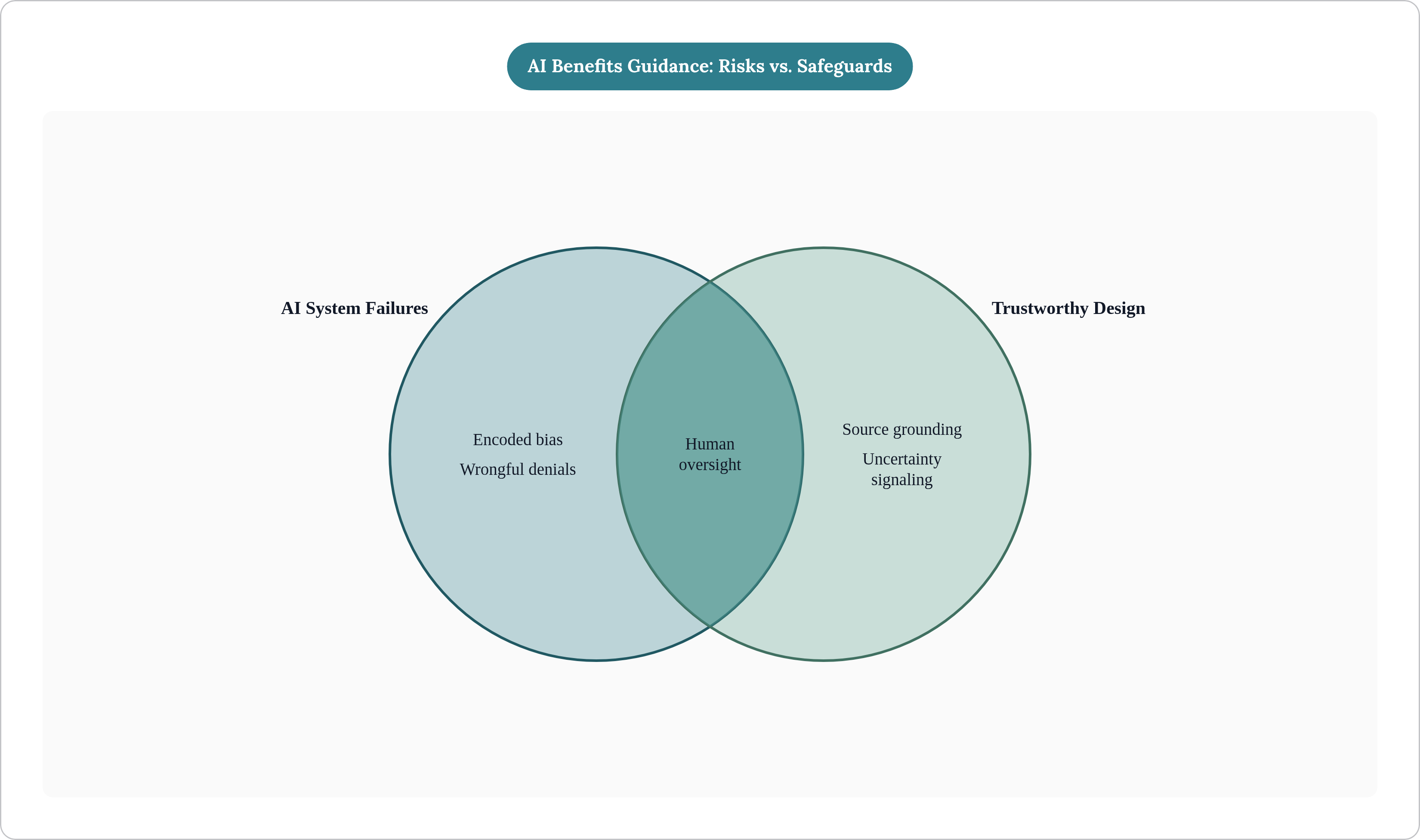
Given the limits of regulatory floors, trustworthiness depends heavily on how individual systems are actually built and operated. The design choices are specific and observable.
Grounding responses in authoritative sources rather than open generation is the foundational requirement. Code for America builds AI solutions with retrieval over curated document stores, knowledge graphs, and direct database queries, so responses are informed by verified policy sources rather than model memory. This is a different architecture than asking a general-purpose model a question and hoping it knows the answer.
Systematic accuracy testing transforms accuracy from an assumption into a tracked metric. Building test suites of inputs with known correct answers, then running regular evaluations, makes it possible to measure whether accuracy improves, degrades, or holds steady over time. Without that discipline, a system's trustworthiness is unverifiable.
Uncertainty signaling is both underutilized and consequential. Provenance badges, confidence scores, and explicit AI-disclosure flags reduce overreliance and prompt users to verify. Research from OpenAI and others has found that tuning models to admit uncertainty, rather than confabulate confidently, substantially improves truthfulness on open-ended questions. In a benefits context, "I'm not certain; please verify this with your caseworker" is sometimes the most useful output a system can produce.
Human expertise in the loop requires that the human actually has accurate information to work with. Maryland's partnership with Anthropic deploys AI to help residents navigate benefits applications. Code for America and Anthropic's SNAP Policy Navigator, announced in May 2026, gives caseworkers real-time access to verified federal, state, and county SNAP policy. The point is that human review only functions as a genuine safeguard when the human is working from reliable information rather than flawed AI output. Human judgment handles context, exceptions, and edge cases; AI handles volume and the complexity of thousands of program rules, eligibility criteria, and income thresholds. Neither alone is sufficient.
Transparency to the claimant is both an ethical requirement and a practical one. People who are unaware that AI is involved in their case cannot question a decision, request human review, or file a meaningful appeal. Opacity forecloses accountability. That is not a design choice made in ignorance; it is a choice made at cost.
How Accuracy Failures Erode Willingness to Seek Help, and What That Costs Families
The downstream effect of accuracy failures is not only the immediate harm to a wrongly denied claimant. It is the erosion of willingness to seek help at all.
A 2025 Nature Communications study drawing on samples from the US and UK, with a combined 3,249 participants, found that people who lose trust in AI at one government agency also lose trust in AI used by other government agencies. Errors propagate distrust across the entire safety net, not just the program where the failure occurred. The same research found that claimants are less willing than the general public to accept AI in welfare systems, and that the wrong balance of speed and accuracy can make people less likely to apply, fearing wrongful fraud accusations.
Trust in AI guidance for consequential decisions runs low broadly. Only 36% of AI users trust chatbots for health information; 24% trust them for political information, per the KFF Health Misinformation Tracking Poll from June 2024, conducted with 2,428 respondents. Trust in AI for benefits guidance likely occupies similar territory, and for reasons that are entirely rational.
The chilling effect is the hidden cost in this conversation. Families who qualify for Medicare savings programs, caregiver compensation, or SNAP supplements do not pursue them because prior experiences, or stories circulating through their communities, suggest the system will treat them as suspects. The burden of proof feels reversed. Code for America worked in 27 states and Washington D.C. in 2025 to help 7 million people access $22 billion in benefits. That number is a measure of what engaged, accurate navigation can accomplish; it is also a window into the scale of what distrust forecloses.
The answer is not slower AI, and it is certainly not no AI. Benefits systems are complicated enough that the cognitive load of navigating them without assistance is itself a barrier that falls disproportionately on the people with the fewest resources. The answer is AI that earns trust through demonstrated accuracy, honest uncertainty signaling, and human oversight that is genuine rather than nominal. Those are not aspirational qualities. They are design requirements. The difference between a system that harms families and one that actually serves them lives in whether those requirements are treated as such.