Health Insurance Options for Full-Time Family Caregivers
Explore spousal coverage, COBRA, Medicaid, and ACA subsidies to bridge the gap.

Joining a Spouse or Partner's Employer Plan: The Fastest and Often Cheapest First Move
For caregivers with a spouse or domestic partner carrying employer-sponsored coverage, this is where the analysis belongs, not because it is guaranteed to work, but because when it does, it is almost the least expensive option. The employer absorbs the bulk of the premium; the caregiver pays only the incremental cost of adding a dependent, which runs substantially below COBRA or an unsubsidized Marketplace plan.
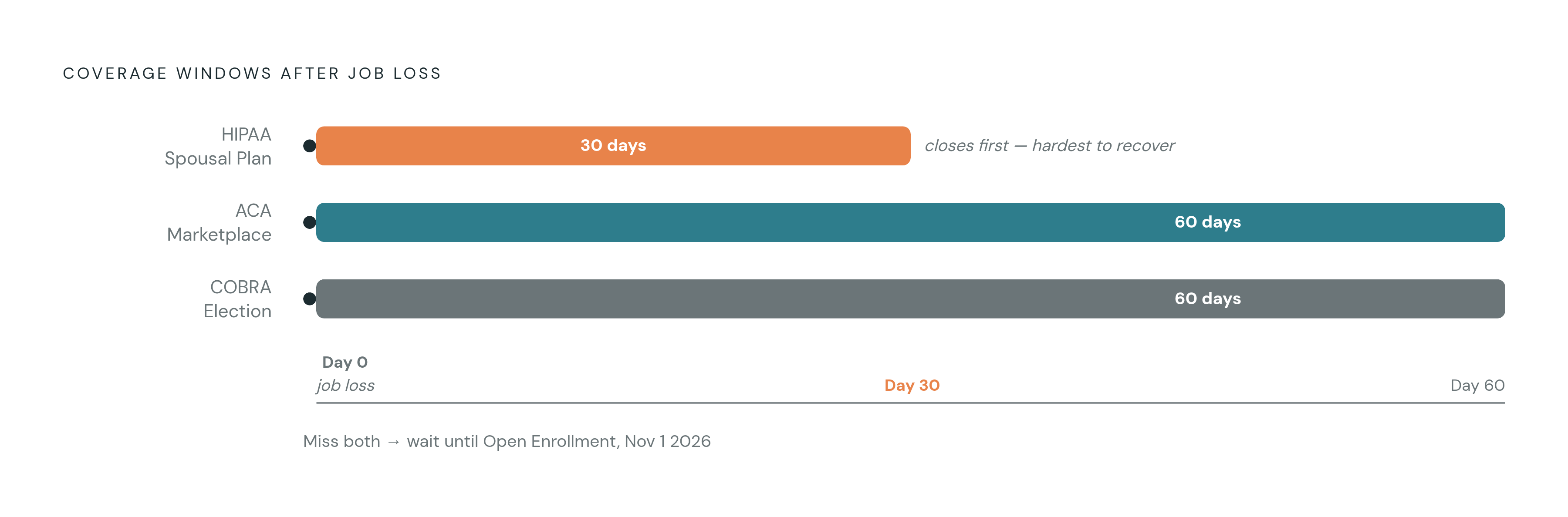
The legal mechanism is HIPAA's special enrollment right. Losing job-based coverage, whether through departure or an hours reduction that eliminates eligibility, triggers a 30-day special enrollment window on the spouse's plan. That window is fixed. Miss it, and you wait for the next open enrollment cycle, potentially months out. The first call after finalizing an employment exit should reach the spouse's HR or benefits administrator the same day.
A few complications undercut the assumption that spousal enrollment is straightforward. No federal law requires employers to offer dependent coverage, though 2025 KFF analysis found 96% of firms with 10 to 199 employees extend it voluntarily, as do virtually all larger employers with benefit programs at all. The more consequential wrinkle is the spousal surcharge or exclusion: an employer charges extra to cover a spouse who has access to their own coverage elsewhere, or excludes that spouse on the same basis. A caregiver who just left employment no longer has access to their own coverage, so the exclusion frequently does not apply, but "frequently" is doing real work in that sentence. Benefits language varies enough that confirming this explicitly is worth a ten-minute phone call before assuming anything.
COBRA: Keeping Your Existing Plan While You Sort Out What Comes Next
COBRA is frequently described as a benefit. It is more precisely a right. Under the Consolidated Omnibus Budget Reconciliation Act, workers at employers with 20 or more employees can continue their existing plan after a qualifying event by paying 102% of the full premium: their prior share, the employer's share, and a 2% administrative fee. For 2025, that typically runs $650 to $750 per month for an individual, around $2,000 per month for a family.
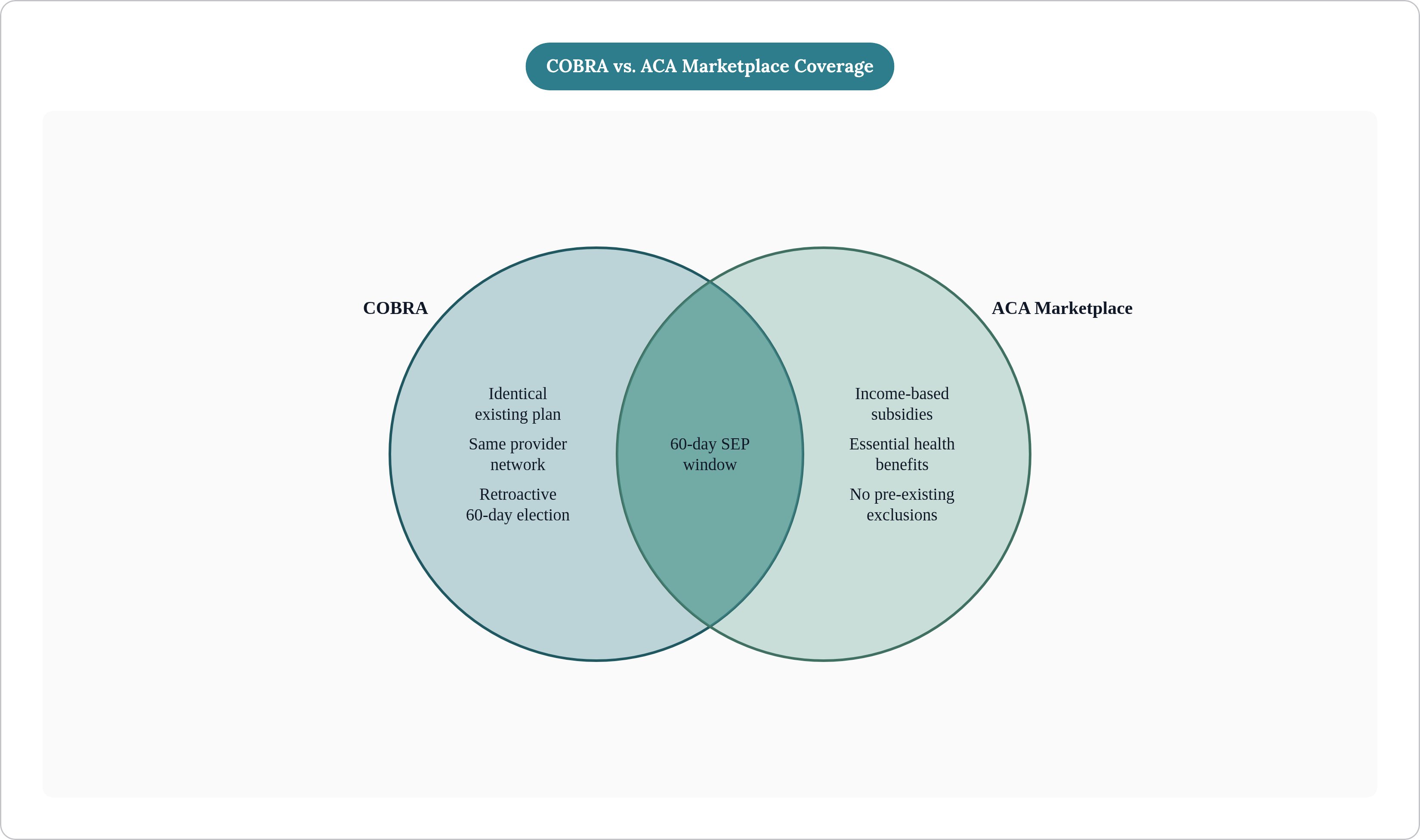
The cost is the obvious liability. The value is continuity. The plan is identical, the network unchanged, no new underwriting, no pre-existing condition review. For a caregiver mid-treatment for a chronic condition, switching plans mid-year means a different formulary, potentially out-of-network providers, a new deductible resetting from zero. There is also a feature most people never deploy strategically: COBRA coverage is retroactive. You have 60 days to elect it, and coverage applies continuously from the qualifying event, which means you can wait to see whether you actually need to file claims before committing to the premium.
That 60-day window overlaps with something worth noting. Losing job-based coverage simultaneously opens a 60-day special enrollment period on the ACA Marketplace. You are not required to elect COBRA before exploring Marketplace options. Comparing costs and networks in parallel, before committing to either, is a better use of those early weeks than defaulting to COBRA because it feels like the natural next step.
COBRA belongs in the analysis primarily as a short-term bridge: most useful when the caregiving stint is expected to last months rather than years, or when continuity of care is a clinical priority. Employers with fewer than 20 employees fall outside federal COBRA's scope, but most states have enacted mini-COBRA laws extending similar rights to smaller employers with varying durations and rules. A caregiver leaving a small employer should verify state law before concluding that continuation coverage is unavailable.
ACA Marketplace Plans, Subsidies, and What Changed in 2026
The ACA Marketplace provides a regulatory floor that matters specifically for caregivers: all plans cover the ten essential health benefits, no plan can exclude a pre-existing condition, and there are no annual or lifetime caps. For someone entering this transition with health conditions already in play, that floor is meaningful in a way that is easy to underestimate until you've watched someone discover their new plan doesn't cover what the old one did.
What makes the Marketplace financially accessible is the premium tax credit, an income-based subsidy paired with cost-sharing reductions for lower-income enrollees. A caregiver who has substantially reduced or eliminated earned income by leaving work may find themselves in a dramatically more favorable subsidy tier than they occupied while employed. The direction of that relationship is simple: lower household income, all else equal, increases subsidy eligibility.
That calculus was considerably more favorable before 2026. Enhanced federal subsidies that had materially reduced premiums across income levels expired at the end of 2025 and were not extended. Caregivers who enrolled under the prior regime and haven't revisited their numbers are operating on assumptions that no longer hold. The Marketplace remains viable, but the numbers need to be recalculated from the current baseline, not the 2024 one.
One structural protection worth noting: ACA age rating rules cap what insurers can charge older enrollees at three times the premium for a 21-year-old. For caregivers in their 50s and 60s, a substantial share of the caregiving population, this constraint provides real protection against rates that would otherwise be prohibitive. It is a ceiling, not a subsidy, but it matters.
Losing job-based coverage opens a 60-day special enrollment window. The next annual open enrollment period begins November 1, 2026. A caregiver who misses the special enrollment window faces a wait.
Medicaid as the Caregiver's Own Coverage, and Where It Stands in 2025
When people discuss Medicaid in the caregiving context, the assumption is nearly that the relevant recipient is the person being cared for. The caregiver's own eligibility gets overlooked, even though approximately 8 million family caregivers, roughly 13% of the total, obtain their own health coverage through Medicaid, according to AARP's 2025 caregiving data.
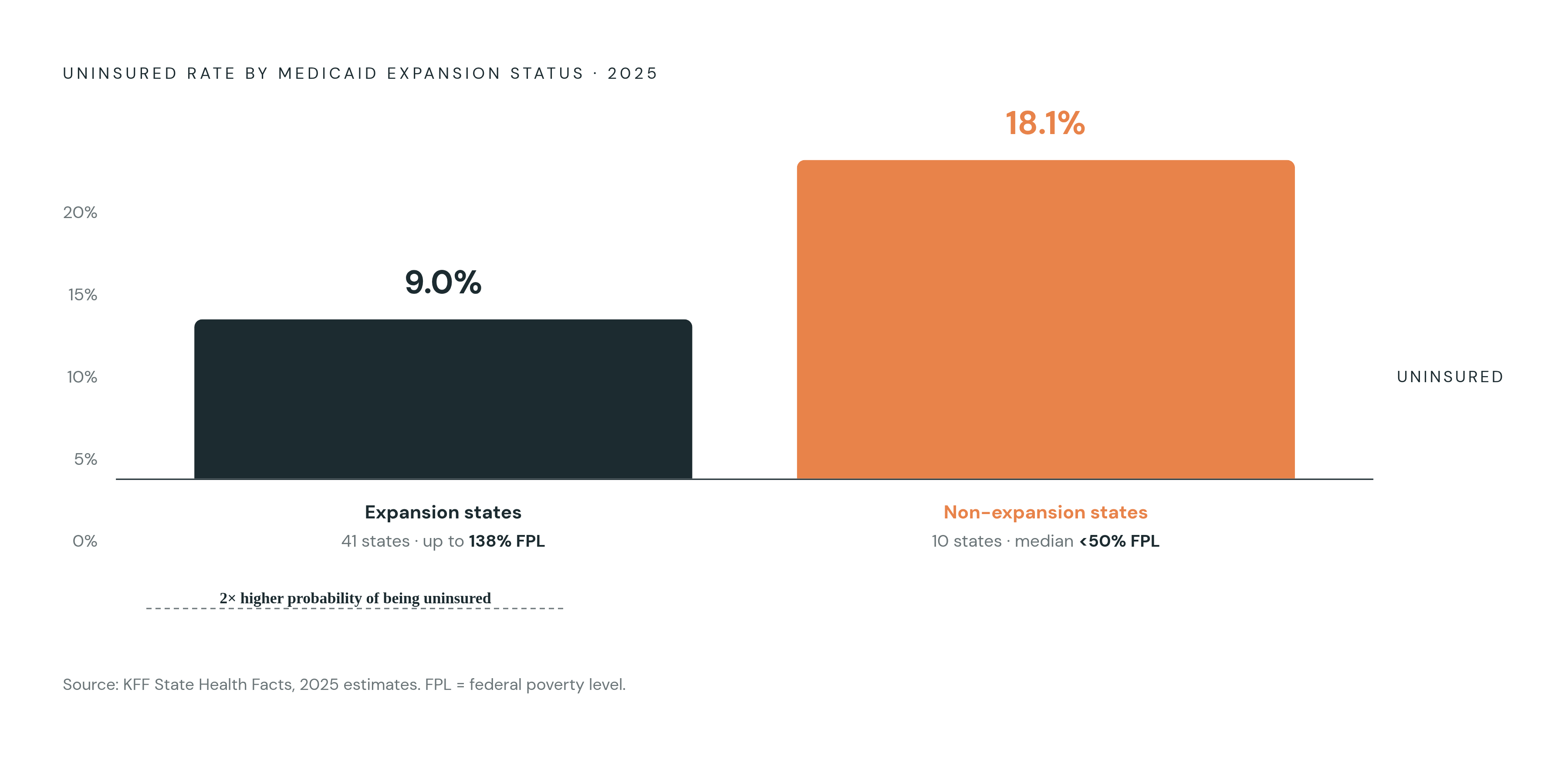
Medicaid eligibility turns on current income, not employment history. A caregiver who was comfortably above the eligibility threshold while employed may qualify after leaving work. In the 40 states and the District of Columbia that expanded Medicaid under the ACA, adults with income up to 138% of the federal poverty level are eligible. In the 10 non-expansion states, thresholds remain far more restrictive, and uninsured rates in those states ran roughly double those in expansion states as of 2025: 18.1% versus 9.0%.
The 2025 federal policy environment introduced significant uncertainty. Federal legislation trimmed nearly $1 trillion from Medicaid over ten years. The Congressional Budget Office projected that Medicaid cuts, exchange eligibility changes, and subsidy expiration combined would leave approximately 14 million more Americans uninsured by 2034. State-specific income thresholds and program parameters have shifted enough that eligibility assumptions from 2023 or 2024 may no longer be accurate.
Where Medicaid eligibility holds, the coverage is comprehensive and comes at little or no premium cost. For caregivers with limited income and real health needs, it is often the most complete option on the table.
Medicaid HCBS Waivers: Programs That Pay the Caregiver and Can Include Health Coverage
This is the option most caregivers never know to ask about, and the one that, when it applies, can change the financial picture more substantially than anything else in this analysis. Medicaid Home- and Community-Based Services waivers exist at the state level and give states flexibility to fund home-based care for individuals who would otherwise require nursing facility-level services. Medicaid paid for two-thirds of home care spending in the United States in 2023; KFF estimates 5.1 million Medicaid enrollees currently use home care services.
The mechanism relevant here is self-direction. Under self-directed programs, a care recipient who qualifies for waiver services can, in many states, designate a family member as their paid caregiver rather than using an agency. All reporting states except Alaska allow some form of self-directed care, and all responding states permit family caregivers to be paid under at least some program structures, according to KFF's 2025 Medicaid home care analysis. In some states, when the caregiver becomes a paid worker within a formal self-direction program, health benefits are included as part of that employment arrangement, though program design varies considerably by state.
Two limitations deserve direct treatment. HCBS waivers are not entitlements. States can cap enrollment and maintain waiting lists; qualifying does not guarantee immediate access, and families may wait months or years. Eligibility also focuses on the care recipient, not the caregiver. The person receiving care must meet the waiver's level-of-care threshold, typically nursing-facility-level assistance. General web searches don't resolve this accurately. Direct outreach to the state Medicaid office is the only reliable starting point. The research is state-specific and time-consuming, but paid caregiving with health benefits is a significant enough upside to justify the effort.
VA Programs for Family Caregivers of Veterans, Including CHAMPVA
The federal government's most comprehensive caregiver support package belongs, by a considerable margin, to the Department of Veterans Affairs. The Program of Comprehensive Assistance for Family Caregivers, PCAFC, provides eligible family caregivers with a monthly stipend paid directly to them, access to CHAMPVA health coverage if they lack other insurance, and mental health counseling. The stipend and the health coverage are independent benefits; neither is contingent on the other.
CHAMPVA is worth isolating because it is frequently conflated with the veteran's own VA health care. CHAMPVA gives the caregiver their own coverage, not derivative coverage through the veteran's plan, and it is substantive coverage, not a courtesy inclusion. For a family caregiver who has left employment and lacks other options, CHAMPVA can function as the primary solution.
The VA published a final rule extending the transition period for legacy PCAFC participants through September 30, 2028, preserving stipend amounts and eligibility for caregivers already enrolled in the legacy program through that date. For caregivers of veterans not yet enrolled or uncertain of their eligibility, the VA's caregiver support line and the va.gov caregiver portal are the practical starting points.
PCAFC is one of the most underutilized benefits in this landscape. Not because it is obscure, but because caregivers who qualify often don't recognize themselves as eligible or don't know the program exists. The eligibility requirement focuses on the veteran's disability status and level of care need, but the program is broad enough that assumptions of ineligibility should be verified rather than accepted. If the person receiving care is a veteran, this is the place to start before approaching anything the private market offers.
Long-Term Care Insurance and State Benefit Funds as Emerging Coverage-Adjacent Income
These mechanisms sit adjacent to the coverage question rather than inside it. They belong in this analysis because they affect the financial equation that determines whether other coverage options are actually affordable, a distinction that matters more as premiums rise.
Long-term care insurance, where the care recipient holds a policy, sometimes includes provisions allowing benefit payments to flow to a family caregiver. The care recipient must typically meet the policy's threshold for activities of daily living or cognitive impairment, and what qualifies, and who can be paid, varies across policies. LTCI covers roughly 5% of total care costs nationwide, so this is a narrow path. For families where a qualifying policy exists, the income it generates can meaningfully offset COBRA premiums or Marketplace costs.
The more structurally significant development is Washington State's WA Cares Fund, the first publicly funded long-term care benefit program of its kind in the United States. Funded by a 0.58% payroll tax on workers, it provides a lifetime benefit of $36,500, inflation-adjusted, available beginning July 1, 2026. That benefit can be used to pay a family member who provides care. New York, Massachusetts, and California have authorized actuarial feasibility studies for similar programs; California has completed its studies and is closest to potential implementation.
Neither LTCI payments nor WA Cares benefits are health insurance. The connection is practical: income from either source can be directed toward premiums or out-of-pocket costs, reducing the burden that makes Marketplace or COBRA coverage prohibitive for families already stretched thin.
How to Choose the Right Path Based on Your Situation
The path that makes sense depends on four variables: household income after leaving work, the spouse or partner's employer benefit structure, the care recipient's eligibility for Medicaid or VA programs, and state of residence. Those variables interact in ways that make any universal prescription impossible, but the decision logic is navigable.
If a spouse or partner carries employer coverage, start there. Verify whether a spousal surcharge or exclusion applies, then enroll within the 30-day HIPAA window. This is likely the lowest-cost option if it is available.
If continuity of care is the clinical priority, or the caregiving horizon is short, or the caregiver is mid-treatment, COBRA preserves networks and buys time. The premium creates its own pressure to transition within 12 to 18 months; plan around that reality.
If household income has dropped substantially, run Marketplace and Medicaid calculations simultaneously. In expansion states, income just above the Medicaid threshold puts a caregiver in subsidy territory; income below it puts them in Medicaid territory. The 2026 Marketplace environment, following the subsidy expiration, makes the Medicaid path more compelling for lower-income caregivers than it was two years ago.
If the care recipient is a Medicaid enrollee meeting nursing-facility-level care criteria, investigate HCBS waiver self-direction. The waiting lists are real, but so is the potential upside. Contact the state Medicaid office directly.
If the person receiving care is a veteran, investigate PCAFC and CHAMPVA before pursuing any private option.
If you live in Washington State, WA Cares is now a functioning resource beginning mid-2026.
What makes this difficult is not the complexity of any individual program. These options are administered by separate federal agencies, state Medicaid offices, employer HR departments, and VA program administrators, none of whom coordinate across jurisdictions to ensure a caregiver finds every option they qualify for. The people navigating this are doing so while managing medications, appointments, and the slow accumulation of caregiving tasks that leave almost no margin for bureaucratic research. The system was not designed as a system. It was built incrementally, by separate legislative bodies with separate mandates, and the gaps between programs are where eligible caregivers most often fall through.
Anyone who established a coverage plan before 2025 and hasn't revisited it should do so. The numbers that plan was built on may simply no longer be accurate.