Caregiver Support Groups and Peer Networks
Isolation is the real crisis: nearly half of caregivers get no support at all.
Why so many caregivers are doing this alone
The numbers have a way of flattening the reality. According to AARP and the National Alliance for Caregiving's 2025 report, roughly 63 million Americans are now providing unpaid care to an adult or child with a disability or health condition, a figure representing nearly one in four adults and a near-50 percent increase since 2015. One in three of those caregivers is under 50. Nearly 30 percent are caught in the so-called sandwich generation, simultaneously supporting children and aging or ill adults. The average caregiver spends 22.8 hours per week in that role; close to 30 percent exceed 30 hours weekly.
What those figures don't convey is the cumulative weight. A 2025 survey by A Place for Mom found that 78 percent of caregivers report burnout and 87 percent report stress or anxiety at some point during their caregiving tenure. One in four reports feeling entirely alone, up from 21 percent just five years earlier. Half report negative financial consequences; one in five says they cannot afford basic needs.
The pattern here isn't a collection of individual failures. It is a structural condition, widespread enough that the more accurate frame is: this is what caregiving does to people, not what particular caregivers are doing wrong. I came to that conclusion slowly, after years of watching capable, resourceful people come apart under the compounding pressure of a role that the formal system treats as invisible until it becomes a crisis.
Why nearly half of caregivers get no support at all
A poll conducted by SeniorLiving.org in October 2024, sampling 1,765 caregivers, found that nearly half receive no meaningful help of any kind: no counseling, no formal support groups, no respite care, no financial assistance. That figure is jarring on its own. It becomes harder to explain when you consider that most of these caregivers are manifestly struggling.
Zhao and colleagues, writing in the Journal of Health and Social Behavior in 2023, found that only 25 percent of caregivers experiencing anxiety or depression had pursued any professional help. The research literature cites a recognizable cluster of barriers: stigma, limited awareness of what resources exist, the raw time pressure of caregiving itself, cost concerns, and, frequently, a care recipient who actively resists outside involvement.
Each of these barriers is real, but they don't all carry equal weight. Time pressure and stigma are particularly hard to move against. Awareness, though, is a solvable problem. Many caregivers who have not joined a support group haven't weighed the option and declined it; they simply don't know where to look, or the options have remained abstract until someone places them in concrete terms. I've seen this repeatedly: a caregiver who has spent two years managing alone, not out of preference, but because no one ever handed them a map.
Geography compounds the problem significantly. Rural caregivers face a distinct and documented set of obstacles: workforce shortages, an inability to locate services even when funding nominally exists, and thinner family backup networks. A 2024 study by Reblin and colleagues in Gerontology & Geriatric Medicine, along with an SSRS/ARCHANGELS survey from 2025, both identified rural caregivers as bearing compounded disadvantage. Distance from services isn't metaphorical; it is literal miles between a caregiver and the nearest in-person group.
The gender dimension is worth naming plainly. Fifty-nine percent of caregivers are women, and the SeniorLiving.org data shows they report higher rates of emotional stress and depression than their male counterparts. That disparity is not incidental. Women disproportionately absorb informal care responsibilities in most households, which means they also disproportionately absorb the emotional cost.
What emerges from all of this is not a portrait of people who have access to support and choose to forgo it. It is a portrait of people navigating a system that presents its resources opaquely, distributes them inequitably, and places the burden of discovery on the person least equipped to go looking.
What support groups actually do, and what the research says about outcomes
A caregiver support group is not therapy, and it does not function as a clinical intervention. What it is, at its best, is a structured peer exchange: a place where people sharing a common circumstance trade coping strategies, set limits together, work through the emotional weight of caregiving, and, often, share practical information about resources and services.
The documented benefits are meaningful, if not transformative. A 2024 narrative review of mHealth and peer support interventions, published via PMC, found improvements across psychological well-being, depression, caregiver strain, and social outcomes. Effect sizes were small to moderate, which in clinical terms means they are real but not dramatic. A support group will not cure burnout. It can reduce it.
What the research also indicates is that format details matter more than most caregivers realize. Longer interventions, specifically those exceeding eight weeks, show stronger outcomes than brief programs. Smaller group sizes, roughly six to ten participants, outperform larger assemblies. Individual session length correlates with benefit. These are not incidental variables; they reflect the underlying mechanism. Sustained, intimate peer engagement builds the relational trust that makes the exchange useful.
A 2024 scoping review published in the Interactive Journal of Medical Research drew a distinction worth sitting with: peer-led groups showed more durable benefits than psychoeducational programs, whose gains tended to be shorter-lived when compared head-to-head. A one-time workshop on managing caregiver stress and an ongoing peer group are not interchangeable. Both have value. They operate at different depths.
In-person vs. online groups, what each format delivers and where it falls short
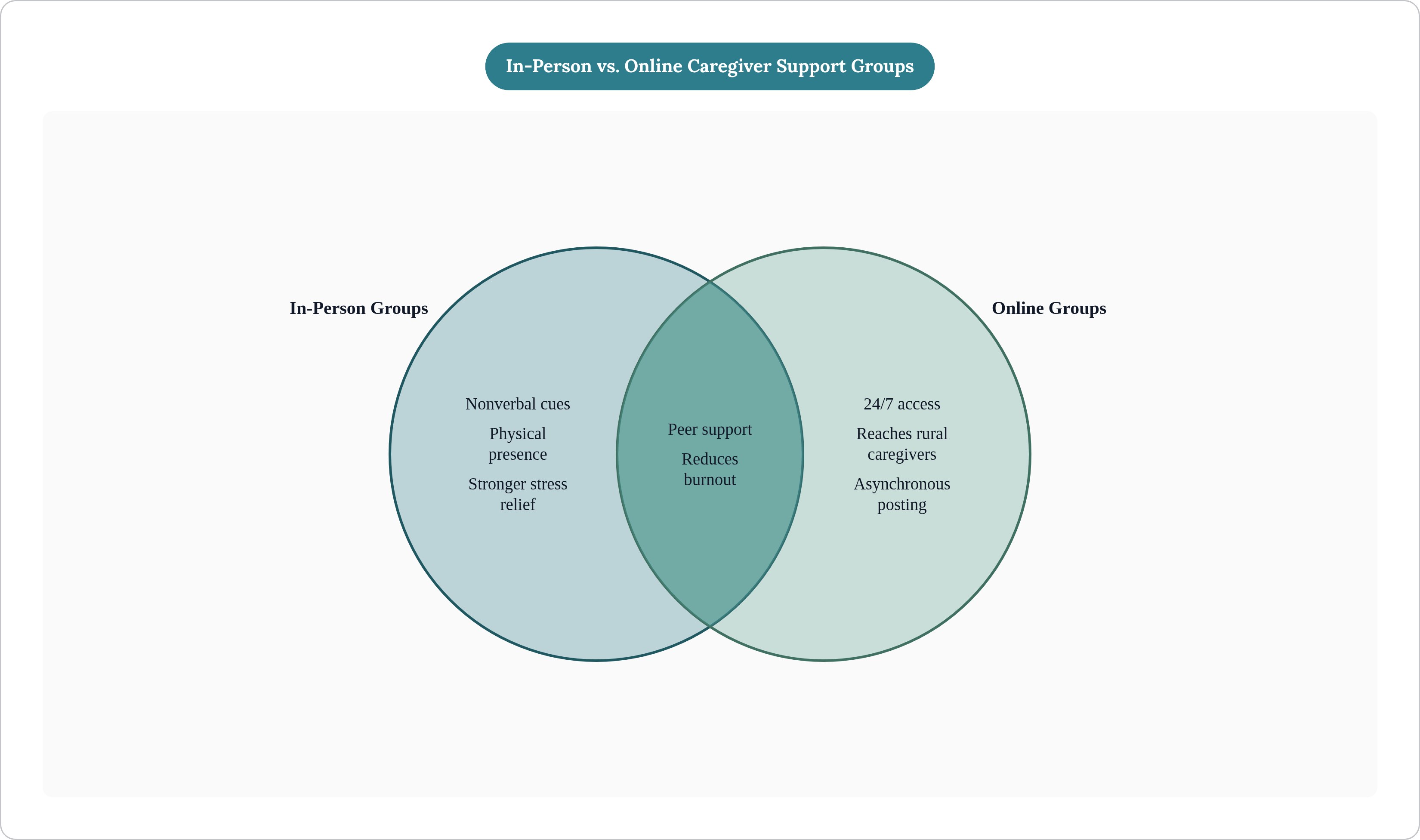
A state-of-the-art narrative review published in PMC confirmed what practitioners in this space have observed for years: all three major delivery formats, in-person, telephone, and online, show documented efficacy. The question is not which one works, but which one works for whom and under what conditions.
Online groups have demonstrated particular effectiveness for dementia caregivers, with Hopwood and colleagues finding reductions in depressive symptoms, perceived stress, and anxiety, alongside improvements in self-efficacy. Systematic reviews have further found that online groups combining peer support with some professional guidance showed the strongest mental health improvements within digital formats.
In-person delivery carries advantages that are harder to quantify but do appear in the research. Under conditions of acute stress, face-to-face emotional support more powerfully boosts positive affect than text-based support. Nonverbal cues, physical presence, and facial expression build trust in ways that digital interaction has not yet replicated. This reflects how the social regulation of stress actually functions in the nervous system, not sentiment.
Online engagement also involves a nuance the research hasn't resolved cleanly. Active participation, posting questions, responding to others, appears to matter meaningfully for some populations. Passive reading and observation may be sufficient for others. The evidence here is notably mixed, which means that a caregiver who lurks in an online community without posting is not necessarily getting nothing from it.
The most consequential advantage of online groups may be the population they reach. Isolated caregivers, rural caregivers, and those who physically cannot leave a care setting are, by definition, least able to access in-person resources. They are also, as the research consistently shows, among the most at risk for adverse outcomes. An online group may be less powerful in some dimensions than its in-person equivalent. For the caregiver who cannot get to an in-person group, it is the option, not a compromise.
The practical framing for anyone trying to choose: the best format is not the one that performs best in research averages. It is the one you can actually use, consistently, over time.
The main types of caregiver support networks and who each one serves
The landscape of available networks is broader than most caregivers realize, which contributes to the paralysis that keeps many from starting. A rough taxonomy helps.
Condition-specific groups are built around the diagnosis of the care recipient, and they tend to be the best fit for caregivers whose demands are highly specific to that condition. The Alzheimer's Association operates peer- and professionally led groups for caregivers, for individuals with early-stage dementia, for children of those with dementia, for LGBTQ+ caregivers, and for other distinct populations, all facilitated by trained individuals. Condition-specific groups work because the shared context narrows the gap between participants; someone caring for a spouse with advanced dementia and someone managing a parent with early-stage Parkinson's are both caregivers, but the day-to-day reality diverges considerably.
Mental health caregiving networks address a population with distinct needs. NAMI's Family Support Group is peer-led, meets weekly to monthly depending on location, and offers many sessions virtually with national availability. It is designed specifically for family members and friends of people with mental health conditions, a group that often finds general caregiver spaces inadequately attuned to the particular dynamics of that role.
General caregiver networks serve people whose care situations don't map cleanly onto a single diagnosis category. The Caregiver Action Network provides free education, peer support, and resources across disease categories and is identified by the UCSF Memory and Aging Center as a primary resource. This is often where caregivers start before they know enough about their situation to seek more specialized support.
Veteran caregiver programs exist within a distinct system. The VA Caregiver Support Program offers mental health support and additional benefits to caregivers providing intensive care to veterans with serious injuries; eligibility criteria apply, and navigating the program requires some effort, but the benefits available are among the most substantive in the space.
Online communities without scheduled meetings offer a different kind of access. ALZConnected, run by the Alzheimer's Association, is a free message board open to anyone affected by dementia. It operates asynchronously, which means a caregiver awake at 2 a.m. after a difficult night can post a question and find it answered by morning.
Local and hybrid options are chronically underestimated. Hospital systems, senior centers, and faith communities run groups that never appear in national directories. These are often worth a direct inquiry to a hospital social work department or a local Area Agency on Aging, particularly for caregivers who want in-person community and have local options.
The organizing logic for anyone searching: start with the condition or population of the person being cared for, then check both national organizations and local systems. The two searches often surface entirely different options.
How to find a group and evaluate whether it fits
The starting points are consistent across most situations: NAMI's group locator, the Alzheimer's Association support group finder, AARP's Community Resource Finder, hospital social work departments, and Area Agencies on Aging. For rural and time-constrained caregivers, national virtual options from NAMI and the Alzheimer's Association are accessible regardless of geography and worth prioritizing first.
Before committing to any group, the relevant questions are more specific than most people think to ask. Is the group peer-led or professionally facilitated? How often does it meet, and how long are sessions? What is the typical group size? Is attendance drop-in or does the program require enrollment and ongoing commitment? These questions matter because, as the research on format suggests, the structural features of a group predict outcomes more reliably than its stated purpose.
Some red flags are worth naming. Groups with no facilitator training, no clear scope, or that have drifted into unstructured complaint sessions can feel emotionally familiar without being useful. The research on group size and duration isn't abstract; it reflects what kind of environment allows for genuine exchange versus what becomes venting without traction. Neither is worthless, but they serve different functions, and a caregiver who needs structured support may not get it from the second kind.
The question of fit deserves more patience than most caregivers grant themselves. Research on group engagement consistently suggests that a single session is rarely enough to evaluate a group. Attending two or three before deciding yields a far more accurate read. What fit actually looks like in practice: a caregiving context meaningfully shared with at least some other members, a format that doesn't require contortion to sustain week over week, and a group culture in which new members are welcomed rather than observed with suspicion.
What peer networks offer beyond emotional support, and what they cannot replace
Peer networks function as informal information systems, and this is an underappreciated part of their value. Caregivers in established groups regularly learn from other members about respite options, local services, and benefit programs they had no idea existed. The formal system, to the extent it informs caregivers at all, tends to do so through channels that assume a level of savvy or initiative many exhausted caregivers don't have bandwidth to deploy. Other caregivers who have already navigated those channels close that gap informally. I have watched someone walk into a group session not knowing that caregiver compensation programs existed in their state and leave with a phone number and a first-hand account of how to apply.
The financial dimension here is significant. AARP estimates the economic value of unpaid family caregiving reached $1.01 trillion in 2024, a figure from their Valuing the Invaluable report. Yet half of caregivers report negative financial impact and one in five cannot meet basic needs. The distance between those two facts, the scale of the contribution and the precarity of those making it, represents a failure of the formal support infrastructure. Knowing another caregiver who has successfully enrolled in a Medicaid-funded compensation program, navigated VA benefits, or accessed a state-level caregiver stipend can be the difference between learning those options exist and never encountering them at all.
The skills dimension is a separate gap that peer groups rarely close. According to AARP/NAC 2025, over 40 percent of caregivers provide high-intensity care and perform complex medical tasks; only 22 percent receive any training to do so. Groups help with the emotional burden of that responsibility but are ill-equipped to teach wound care, medication management, or safe transfer techniques. Emotional support is not a substitute for clinical skills training, and conflating the two leaves a real need unaddressed.
What peer groups also cannot do is enroll caregivers in compensation programs, navigate Medicaid or VA rules on their behalf, or replace clinical mental health care for caregivers whose anxiety or depression has crossed into something more serious. Recall that only 25 percent of caregivers experiencing anxiety or depression seek professional help. A support group is a legitimate, and sometimes powerful, on-ramp toward that help. It is not a ceiling.
Peer networks reduce isolation, build practical knowledge about resources most caregivers wouldn't otherwise find, and create conditions under which the next steps become imaginable. Converting that knowledge into actual benefit access, clinical care, financial relief, and skills training remains work the caregiver still has to do. A good group makes that work feel less impossible. That is a real thing, and it is also not enough on its own.