Area Agencies on Aging Services for Families
Most families don't know Area Agencies on Aging exist until crisis forces the call.
The Scale of Family Caregiving That Makes AAAs Relevant Right Now
Approximately 53 million Americans provide unpaid care to a family member or friend, roughly 42 million of them for an older adult. The average caregiver is 49 years old, still employed, often still raising children. Caregiving doesn't displace a life; it compounds one. AARP estimated in 2026 that the value of this unpaid labor exceeds $1 trillion annually. The system keeping older adults out of institutions runs almost entirely on uncompensated work.
The demographic pressure behind those numbers isn't easing. Roughly 11,400 Americans turn 65 every day through 2027. Some 88% want to age in place, and an estimated 70% will need in-home assistance to do so. Between 2015 and 2020, the caregiver population grew by more than 10 million people.
What clarifies the stakes more than scale is the fragility underneath it: nearly 62% of caregivers report that without supportive services, the person they care for would require nursing home placement. The relationship between sustaining caregivers and keeping older adults in their communities isn't indirect. It's measurable. That's where Area Agencies on Aging enter the picture.
There are roughly 622 of them operating across the United States, each covering a defined geographic territory, each tasked with coordinating services for older adults and their families. Most people have never heard of them. That anonymity is, itself, a structural problem the aging services field hasn't solved.
The Range of Services AAAs Actually Coordinate
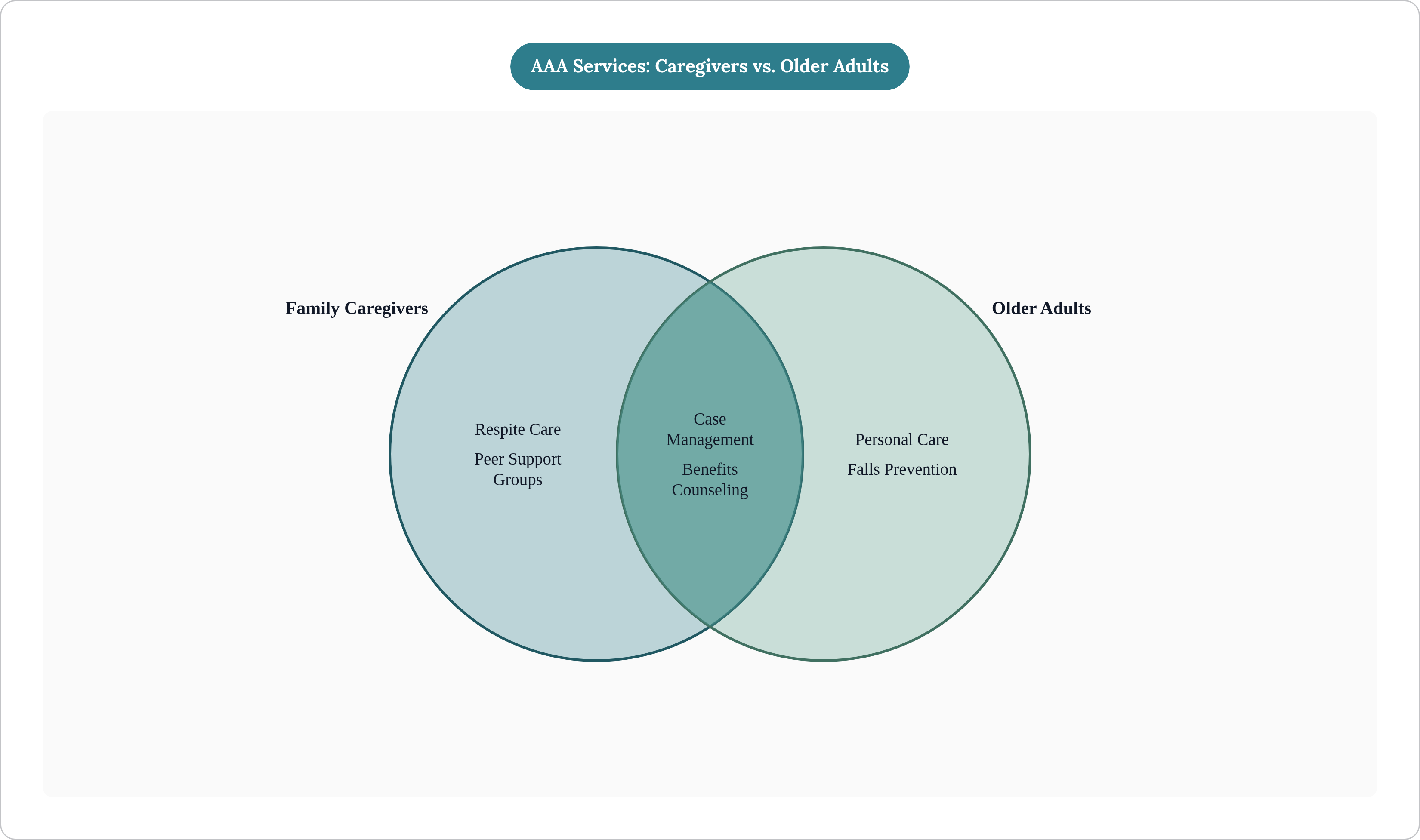
AAAs deliver an average of 28 services to older adults and caregivers in their communities. That number surprises most families, who arrive expecting meal delivery and not much more.
Nutrition services are indeed a core function: home-delivered meals through Meals on Wheels partnerships, congregate dining programs. But the portfolio extends considerably further. In-home support covers homemaker assistance, personal care, and minor home modifications. Transportation coordination includes curb-to-curb and door-to-door options alongside rideshare referrals. Legal services include free and reduced-rate assistance, as well as Long-Term Care Ombudsman services for residents of care facilities.
Case management is among the most strategically significant offerings. According to the Aging and Disability Business Institute's 2024 findings, 64% of AAAs have contracts with healthcare entities to provide case management and care coordination, including screening for long-term services and supports eligibility. That isn't administrative overhead. It is the scaffolding that helps families understand what a person needs, what's available to meet those needs, and how to access it without losing months to dead ends.
Falls prevention programs can look peripheral until you consider that falls are among the leading triggers for nursing home placement. Their inclusion in the AAA portfolio reflects a fundamentally preventive orientation, a logic that distinguishes better-functioning agencies from those simply processing intake.
Benefits counseling appears in AAA service portfolios through State Health Insurance Assistance Program counselors and Medicaid access information. It is a real entry point, though a bounded one, and worth examining carefully later.
What the National Family Caregiver Support Program Specifically Offers Caregivers
The National Family Caregiver Support Program, established in 2000 under Title IIIE of the Older Americans Act, is the dedicated federal mechanism for funding caregiver-specific services through AAAs. For family members who aren't themselves aging but carry the daily weight of supporting someone who is, this is the policy instrument most directly relevant to their situation.
NFCSP-funded services include respite care, individual counseling, peer support groups, caregiver education and training, and emergency assistance. Eligibility is broader than most families expect. Adult family members and informal caregivers 18 and older caring for someone 60 or older qualify; so do caregivers of people with Alzheimer's disease or related dementias at any age; so do grandparents or older relatives, 55 and above, who are raising grandchildren or caring for adults with disabilities.
The reach is real. According to the Administration for Community Living's most recent national survey, Access Assistance Services made more than 1.3 million contacts to caregivers, and Respite Care Services reached more than 604,000 caregivers through nearly 6 million hours of relief. Research on NFCSP-funded services consistently shows reductions in caregiver depression, anxiety, and stress, along with increased capacity to sustain care over time, outcomes that translate directly into delayed or avoided institutional placement.
Respite deserves specific attention because it is frequently both what caregivers most need and what they least know how to ask for. The word itself carries an air of indulgence that does it no favors. What it actually describes is a trained substitute providing temporary care so the primary caregiver can rest, see a doctor, or simply exist outside the caregiving role for a period of time. Chronic caregiver exhaustion is one of the most reliable predictors of nursing home placement. Treating respite as optional rather than structural is a costly misread, one I have watched families make repeatedly before a crisis forces the issue.
The Gap Between What AAAs Offer and What They Can Currently Deliver
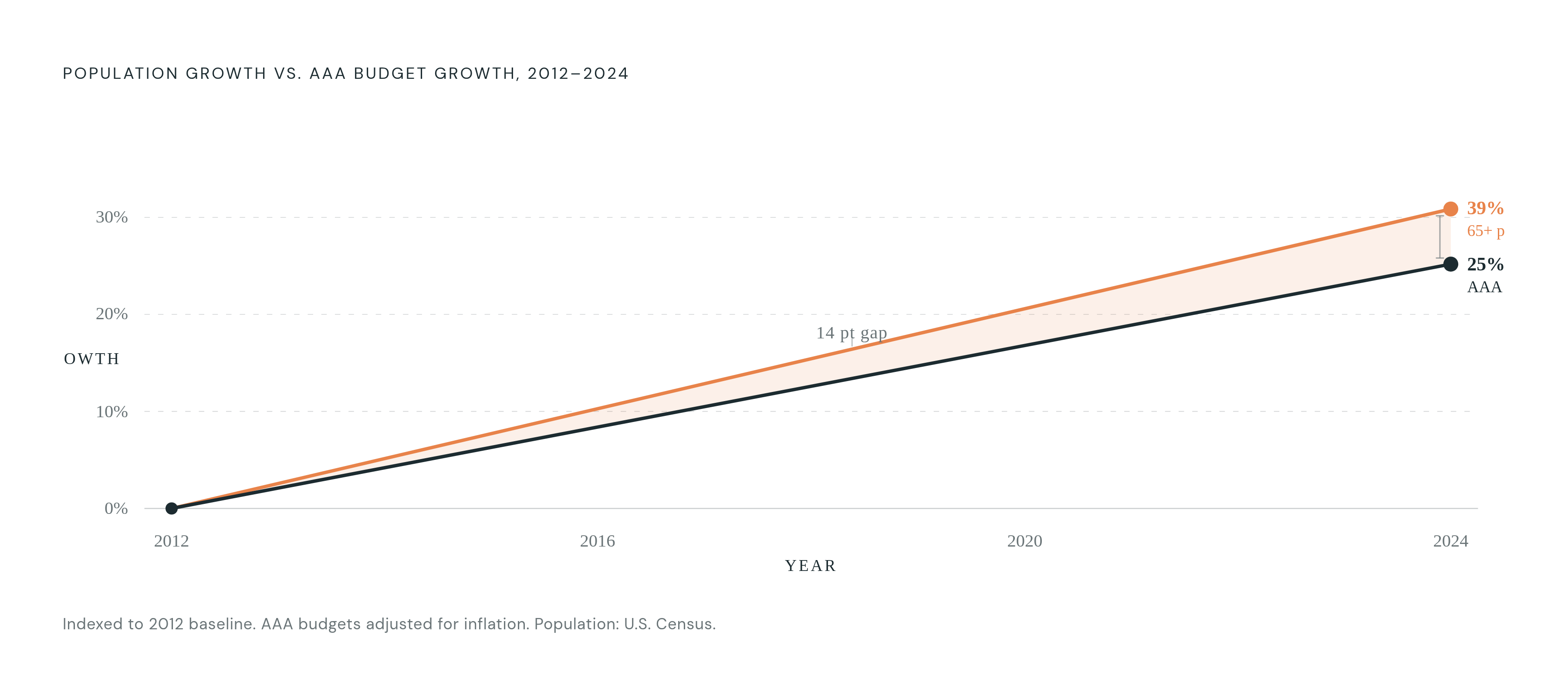
Between 2012 and 2024, the median AAA budget grew 25% adjusted for inflation. Over roughly the same period, the 65-and-older population grew 39%. Those two lines don't converge. According to the 2025 National AAA Survey conducted by USAging and Scripps Gerontology Center, wait lists have accumulated across agencies, with the longest backlogs concentrated in exactly the services most essential to keeping people at home: home-delivered meals, personal care, homemaker and chore services.
OAA funding comprises a median 34% of AAA budgets in 2024. More than one in ten agencies are drawing on reserves to sustain nutrition, case management, and assessment services. Total OAA funding for fiscal year 2025 was $2.372 billion, $392 million below authorized levels.
Here is what that looks like in practice. A family contacts an AAA after a hospitalization, discovers services they qualified for months earlier, and finds the wait list they could have avoided entirely by calling before the crisis. The agency that can respond thoughtfully to a newly diagnosed parent looks very different from the one fielding calls the week someone leaves a hospital. I have seen families assume that because a parent still seems to be managing, there is no urgency in making that call. By the time urgency arrives, options have narrowed. Contacting early, when the situation still feels manageable, preserves choices that emergency-driven outreach often forecloses.
There is also a dimension of unmet need that OAA funding was never designed to address alone. Ninety-four percent of AAAs cite lack of affordable housing as a top challenge in their service area. The populations these agencies serve are navigating overlapping crises, and no single agency, however well-coordinated, resolves all of them.
How AAAs Are Becoming Part of the Broader Healthcare System
A decade ago, a hospital discharge planner referring a patient's family to their local Area Agency on Aging was describing an informal and inconsistent practice. It is increasingly institutional.
According to the Aging and Disability Business Institute's 2024 analysis, 76% of AAAs with healthcare contracts support people with complex care needs, including those at high risk for hospitalization or nursing home placement and those dually eligible for Medicare and Medicaid. As health systems have confronted the reality that medical outcomes are shaped substantially by social determinants, housing instability, food insecurity, isolation, transportation barriers, AAAs have emerged as the community-based partner that hospitals are not structured to replicate and rarely have the relationships to approximate.
In 2019, AAAs averaged 17 formal and informal partnerships with other organizations, including Adult Protective Services, transportation agencies, SHIP, Medicaid partners, and health plans. That network reflects something that takes years to build: accumulated local knowledge of providers, informal supports, and community resources that don't appear in any single database.
For a family managing someone who just left the hospital and now needs meals, medication management, and transportation coordinated simultaneously, this is where AAAs add their most distinctive value. The work is unglamorous. It is also not easily substituted. Any health system that thinks it can replicate those local relationships by standing up a care coordination team from scratch is probably underestimating how long the underlying trust took to accumulate.
How Families Actually Find and Connect With Their Local AAA
The primary entry point is the Eldercare Locator, a public service of the Administration for Community Living, available at eldercare.acl.gov or by phone at 1-800-677-1116. Enter a zip code; it surfaces the local AAA along with aging services in the area.
Aging and Disability Resource Centers function as single points of entry for families navigating long-term care options, providing free, objective counseling and connections to both public and private programs. In many areas they are co-located or administratively linked with the local AAA; in others they operate separately.
A first contact with an AAA typically produces an intake conversation or needs assessment, not an immediate assignment of services. Arriving prepared matters: what tasks have become difficult, what supports are already in place, what the caregiving household can and cannot sustain. The clearer that picture is at the outset, the more productive the intake conversation becomes.
Geography shapes everything here. What a family in a metropolitan county can access differs substantially from what is available in a rural multi-county district. No generalization substitutes for the actual local conversation.
One thing that tends to get lost in how AAAs are described: family members and informal caregivers can request information and services on behalf of the older person they are caring for. The older adult doesn't need to initiate contact. For families navigating cognitive impairment, resistance, or simple overwhelm, that distinction is not a small one.
Where Benefits Counseling Through AAAs Ends and Broader Benefits Navigation Begins
AAAs offer real value in benefits counseling. SHIP counselors embedded in or affiliated with AAAs are trained to help families navigate Medicare, a task more complex than it first appears given the proliferation of plan types and supplemental coverage options. AAA staff can direct families toward Medicaid access information and local assistance programs. For a family encountering these systems for the first time, that is meaningful.
But there is a boundary worth naming honestly, because families who don't understand it often discover it at the wrong moment. AAAs are not structured to help families develop Medicaid qualification strategy, identify the full range of caregiver compensation programs they may be eligible for, or provide personalized enrollment guidance across the broader benefits landscape. No single caseworker can carry all of that for every family in a service area; expecting otherwise sets everyone up for frustration.
The landscape is genuinely layered: Medicare, Medicaid, state waiver programs, caregiver compensation arrangements, local assistance initiatives, each with its own eligibility criteria and application requirements. NFCSP-funded services can help some families avoid the asset spend-down that leads to Medicaid impoverishment, but only if families connect early enough and know which questions to ask, two conditions that are harder to meet than they sound.
The gap between what families qualify for and what they actually receive is, in most cases, not a problem of eligibility. It is a problem of awareness and navigation. AAAs close part of that gap. For families who have never engaged the aging services system before, they are often the right first call. For families managing significant assets, multiple benefit programs, or caregiver compensation arrangements, the AAA conversation is a beginning, not a destination. Whether families understand that distinction before they need it is, in my experience, the variable that determines how much of what they're entitled to they actually receive.