Average Pay Rates for Paid Family Caregivers
Most family caregivers earn $14 to $22 per hour through state programs.
Every year, the conversation about who pays family caregivers circles back to the same frustrated question: where do I even start? I have worked alongside caregivers navigating this system long enough to know that the confusion is not incidental. It is structural. The funding landscape is fragmented by design, shaped by competing federal and state priorities, and the people who most need clarity are typically the least equipped to parse it. This piece is an attempt to map that landscape with care, with numbers attached where the data supports them and qualitative framing where it does not.
The scale of the problem has become undeniable. As of 2025, roughly 63 million Americans provide family care, a figure that represents nearly a 50% increase since 2015, per research from AARP and the National Alliance for Caregiving. Of those, approximately 11 million now receive some form of compensation through Medicaid, the VA, or other state programs. That still leaves the vast majority unpaid. Across 32 states that reported data, fewer than 25% of family caregivers were paid in nearly every state; some states reported figures as low as 10%.
The economic stakes underneath that gap are substantial. AARP's 2026 Valuing the Invaluable report places the economic value of unpaid and underpaid family caregiving at $1.01 trillion in 2024. That figure exceeds total federal, state, and local Medicaid spending that year, which reached $932 billion. These caregivers are, in effect, subsidizing the healthcare system at a scale that most policy conversations studiously avoid. Understanding what paid programs actually pay, and who can reach them, is not an academic exercise. For the majority of caregivers still outside those programs, it is the difference between earning nothing and earning thousands of dollars per month.
What the BLS Wage Floor Means for Family Caregiver Pay
Home health and personal care aides represent the largest single occupation in the United States. As of May 2024, the Bureau of Labor Statistics counted approximately 4 million workers in this category — the closest professional analog to family caregivers. The BLS pegs the median wage for this occupation at $17.21 per hour, which translates to roughly $35,800 annually as of May 2025 data. The lowest 10% earned under $25,600 annually; the highest 10% earned over $44,190.
These figures matter beyond the home health aide workforce itself. Most state Medicaid programs set family caregiver pay rates by anchoring them to local market wages for home care aides. The BLS median is not a target for those programs; it functions more as a ceiling-setter, a reference point against which state administrators calibrate their rates, typically downward. The occupation is also growing fast, with BLS projecting 17% employment growth from 2024 to 2034, well above the national average. That growth trajectory reflects long-term demand pressure that will, eventually, force program funding decisions into sharper relief.
The Overall Range Family Caregivers Can Expect to Earn in 2025
Across Medicaid, VA, and state stipend programs, most family caregivers in 2025 earn between $14 and $22 per hour, depending on their state and the assessed level of care required. Full-time caregivers can realistically expect monthly earnings in the range of $2,400 to $3,800 through these programs. Some states reach $26 per hour in certain counties; others sit near $16. The average Medicaid caregiver rate runs approximately $18 per hour across programs nationally.
One point worth emphasizing: all 50 states plus Washington, D.C. now offer at least one program that pays family members to provide care. No caregiver is categorically excluded by geography alone. The harder distinction is between qualifying for a program and successfully enrolling in one. Those are separate challenges with separate friction points, and conflating them leads caregivers to stop looking before they should.
How Medicaid HCBS Waivers and Self-Direction Programs Work and What They Pay
Medicaid pays family caregivers primarily through two overlapping mechanisms: Home and Community-Based Services waivers and self-directed care programs. The self-direction model is the operative one for family caregivers. It allows the care recipient, rather than a state-assigned agency, to select their own provider, including a family member. That design choice is what opens the door.
Hourly wages under HCBS waivers typically fall between $12 and $18, calibrated to the care recipient's assessed needs. A January 2026 analysis by KFF, examining 34 states that reported time-based payment rates for personal care providers, found that more than half paid less than $20 per hour. All states surveyed allow payments to family and friends through at least one waiver program. Forty-four states permit payments to legally responsible relatives, including spouses and parents of minor children, through waiver programs.
Eligibility has two distinct gates, and both must open. On the recipient side, each state sets its own income maximum for HCBS applicants; these ranged from $914 to $2,742 per month in 2024. Functional eligibility, meaning the level of care need required to qualify, varies as well. On the caregiver side, relationship restrictions add another layer. Pennsylvania's Aging Waiver, for example, excludes spouses; New Mexico's program permits payment to both spouses and adult children. Waiting lists are common. The program may exist, the recipient may qualify, and the caregiver may still be held at the door for months.
The practical instruction here is unglamorous but important: check both eligibility gates before assuming the door is open or closed.
How Much Pay Varies by State, With Specific Examples
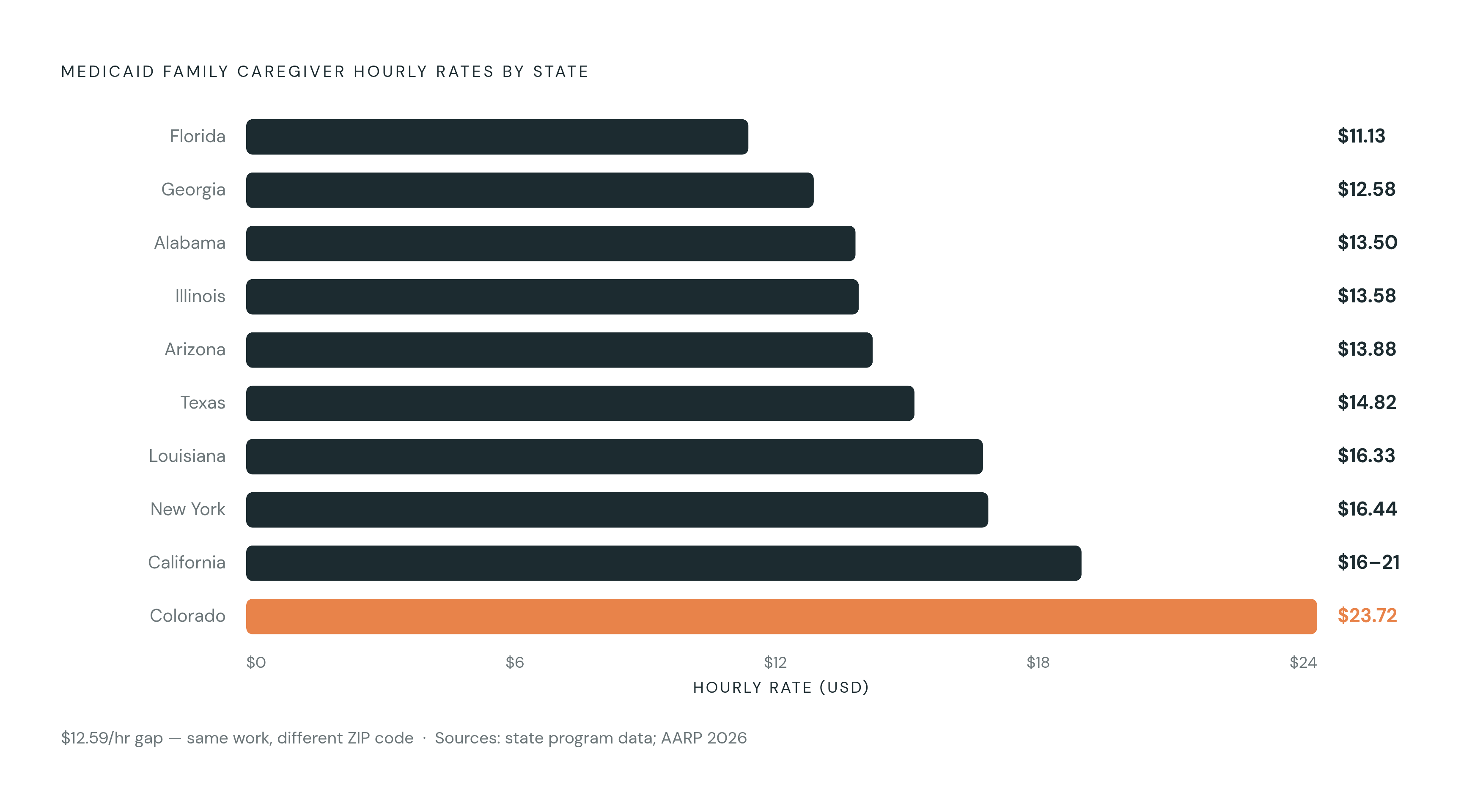
State-level variation in family caregiver pay is significant enough to function almost as a separate policy reality. As of September 2024 data from Best Care, Medicaid rates for family caregivers included California at $15.54 per hour, New York at $16.44, Texas at $14.82, Florida at $11.13, Illinois at $13.58, Georgia at $12.58, Arizona at $13.88, and Alabama at $13.50.
California's In-Home Supportive Services program, however, operates above that baseline. In 2025, IHSS pays $16 to $21 per hour depending on county, with San Francisco and Santa Clara counties already exceeding $22. The state's internal variation mirrors the national pattern in miniature.
Broader market context reinforces the geographic disparity. Posted market rates from January 2026 data show Colorado averaging $23.72 per hour; Louisiana averages $16.33. AARP's 2026 Valuing the Invaluable report frames this differently but reaches a similar conclusion: the imputed value of caregiving labor is roughly $14.12 per hour in Louisiana and approximately $27.05 per hour in Washington state, a spread that reflects how differently states price identical work.
Several factors drive this divergence: cost of living, state Medicaid budget allocations, the degree of HCBS expansion, and local labor market rates for home care aides. The implication for caregivers is direct. Two people doing the same tasks for recipients with equivalent needs can earn $5 to $10 more or less per hour based solely on their ZIP code. Geography is the single most powerful lever on take-home pay, and it is entirely outside a caregiver's control.
What the VA Pays Caregivers of Veterans, and Who Qualifies
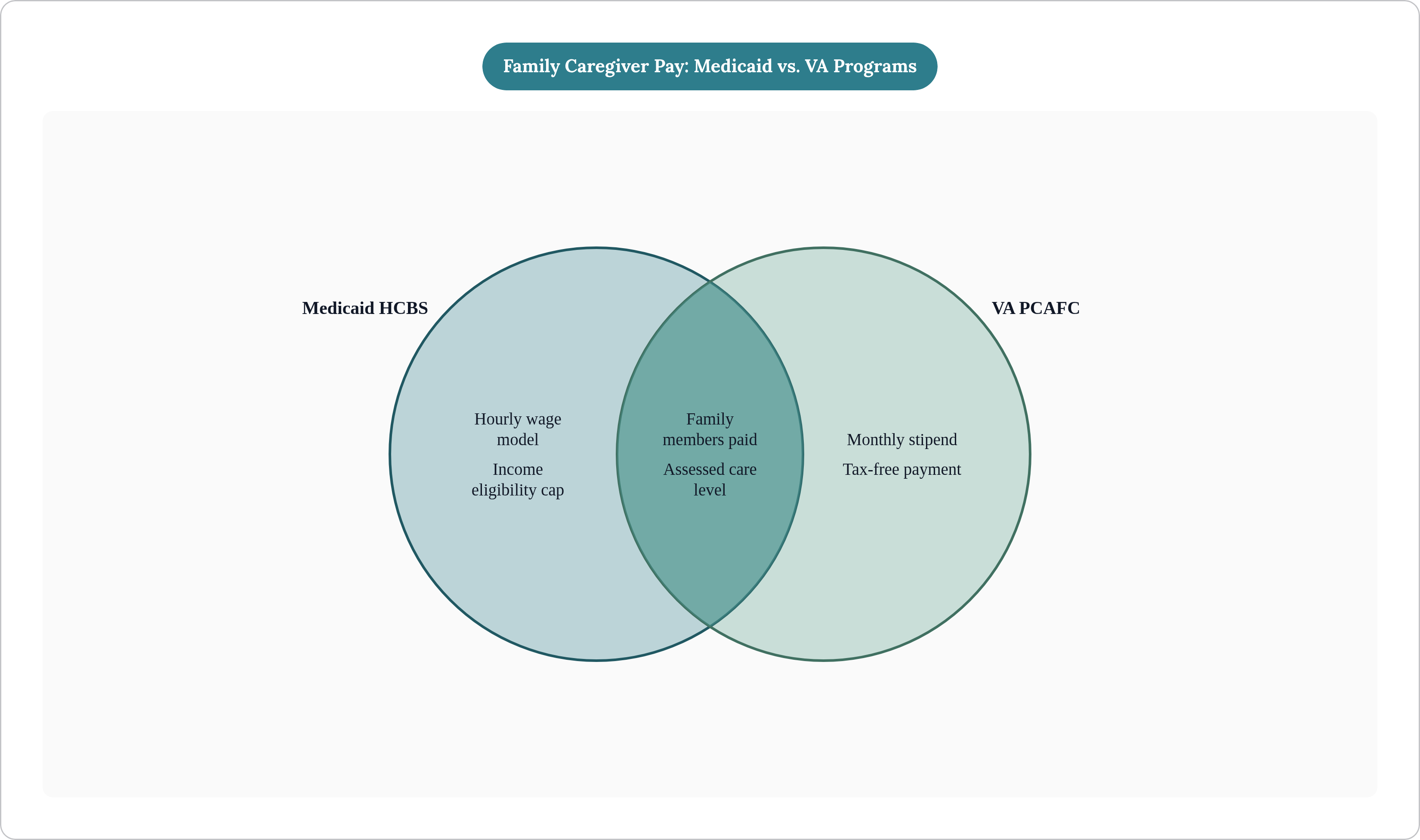
The VA's Program of Comprehensive Assistance for Family Caregivers operates on a different architecture than Medicaid. Rather than an hourly wage, PCAFC pays a tax-free monthly stipend. In 2026, that stipend ranges from approximately $1,898 to $3,792 per month, depending on the veteran's locality and the assessed level of care required.
The rate is calculated from the OPM General Schedule GS-4 Step 1 annual rate for the veteran's area, divided by 12. Level 1 care equals 62.5% of that base; Level 2 (higher-intensity need) equals 100%. The monthly structure, rather than an hourly one, has a meaningful practical advantage for caregivers providing intensive or around-the-clock support, where tracking discrete hours becomes unwieldy and the care relationship defies a shift-based model.
A separate VA pathway, Veterans Directed Home and Community Based Services, takes the more conventional hourly approach, paying approximately $8.50 to $20.00 per hour adjusted for local cost of living. VD-HCBS tends to suit caregivers providing more discrete, scheduled assistance rather than continuous oversight.
PCAFC eligibility has expanded in recent years. The program now accepts applicants caring for veterans injured in any service era, a meaningful broadening from its earlier post-9/11 limitation. Eligibility still turns on whether the veteran's injury is service-connected and whether the care need meets a defined threshold. The caregiver must also satisfy VA training and residency requirements. These are not trivial hurdles, but they are navigable, and the stipend figures make PCAFC among the more financially meaningful programs available to eligible families.
Other Payment Sources: State Paid Family Leave, Private Insurance, and Their Limits
Two additional payment mechanisms appear frequently in conversations about caregiver compensation, and both require precise framing. State paid family leave and private long-term care insurance each fill a real but narrow function. Neither substitutes for Medicaid or VA programs as an ongoing income source for most caregivers.
State paid family leave provides wage replacement, not a caregiving wage, when an employed worker takes leave to care for a seriously ill family member. Only 11 states plus Washington, D.C. have enacted these laws, with Delaware, Maine, Maryland, and Minnesota expected to follow in 2025 and 2026. California's PFL program, as of January 1, 2025, covers 70% to 90% of wages for new claims depending on income level. That is meaningful protection for a working caregiver bridging a leave period — not a substitute for a sustained payment program.
Private long-term care insurance policies with consumer-directed riders can reimburse family caregivers roughly $15 to $20 per hour up to a monthly or lifetime cap. The limiting factor is penetration: only about 3% of Americans own an LTCI policy. Ownership alone does not guarantee family caregiver payments, either. Policy language determines whether informal or family caregivers are eligible; some policies restrict payment to formal agency providers only. A caregiver whose parent holds a policy should read that policy before assuming it applies.
What Actually Determines How Much an Individual Caregiver Earns
The factors that determine a caregiver's take-home pay layer on top of each other in ways that are not always intuitive.
Geography is primary, for reasons already established. Funding source is the second lever: Medicaid waivers, VA stipends, state stipend programs, and private insurance each use different rate-setting logic and caps. The level of care assessed for the recipient matters directly, because more complex medical or ADL needs typically unlock higher pay rates or authorize more weekly hours.
The caregiver's relationship to the recipient adds friction in some states but not others. Spousal exclusions remain in effect in certain programs; legal guardianship arrangements introduce additional complexity. Training and credentials can shift rates upward in programs that reward them. Some states pay more, or authorize more hours, when a family caregiver holds relevant certifications.
One variable that catches caregivers off guard is the gap between hours worked and hours authorized. Medicaid programs authorize a specific number of paid hours per week based on the recipient's functional assessment. A caregiver providing 40 hours of care per week may be authorized, and therefore compensated, for only 20. That delta matters enormously to household finances and is rarely explained clearly at enrollment.
Finally, state budget decisions shape rates and availability from year to year. As KFF noted in its January 2026 analysis, most home care programs are optional for states. Funding levels reflect annual budget priorities alongside care need. Rates are not fixed; they respond to fiscal pressure.
The Financial Pressure on Caregivers Who Haven't Found a Paid Program Yet
The AARP and National Alliance for Caregiving's 2025 Caregiving in the US report documents the financial reality for caregivers outside paid programs in uncomfortable detail. Half of caregivers report a negative financial impact from caregiving. One in five cannot afford basic needs, including food. A quarter are taking on debt. Approximately 40% reduce their employment to make time for caregiving, compounding the income loss. Average out-of-pocket caregiving expenses run approximately $7,200 per year per family caregiver. One in five caregivers also reports poor health, which compounds the financial toll through its own downstream costs.
The arithmetic is instructive. A caregiver earning $18 per hour for 20 authorized hours per week brings in roughly $1,440 per month — a material offset against $7,200 in annual out-of-pocket costs, not a solution, but a real one. The barrier is rarely categorical ineligibility. More often it is the complexity of the application process, waiting lists, and a lack of knowledge about which program applies.
That last point may be the most consequential. The trillion-dollar value embedded in unpaid family care is not abstract. It is expressed in the exhaustion and debt of individuals who do not yet know they might qualify for compensation.
How to Find Out Which Program Applies to Your Situation and Take the Next Step
The discovery process should begin with the care recipient, not the caregiver. The recipient's Medicaid eligibility, VA service-connection status, or private insurance coverage determines which door opens first. That sequencing matters because applicants who start on the wrong side of the eligibility structure lose time and energy.
Within Medicaid, the program type matters as much as the state. State plan personal care programs, HCBS waivers, and Consumer Directed programs each carry different waiting lists, rate structures, and family-member rules. Understanding which type exists in a given state, and which is currently accepting applicants, is a distinct research task.
Relationship restrictions require verification before applying, not after. Spousal exclusions and legally-responsible-relative rules vary enough across states that assuming permissiveness is a mistake. A phone call to the state Medicaid office to confirm family-member eligibility is a better first step than a completed application that hits a wall.
For VA caregivers, the program selection question is meaningful: PCAFC suits intensive, continuous care situations and pays a monthly stipend; VD-HCBS fits a more flexible, scheduled model and pays hourly. Which program fits depends on the veteran's care needs and the caregiver's circumstances.
Documentation deserves emphasis. Assessments that determine authorized hours and corresponding pay rates are built on documented care need. Caregivers who record hours and care tasks before the assessment have stronger records to present — thorough documentation supports a higher assessment; the absence of it rarely does.
One policy risk warrants explicit mention. KFF's January 2026 analysis notes that the 2025 reconciliation law is projected to reduce federal Medicaid spending by $911 billion over a decade. Home care programs, being optional for states, are among the most exposed categories in that reduction scenario. That exposure is a reason to enroll sooner rather than later; programs that exist today may be contracted, consolidated, or capped in ways that affect new applicants more than enrolled ones.
Tools that screen across Medicaid, VA, and state programs simultaneously can substantially reduce the time needed to identify the applicable program. Navigating each program individually is possible — but slower, and in this context, speed has financial value.