platforms that help family caregivers enroll in Medicaid self-direction programs
How three platforms help families navigate the murky path to getting paid as Medicaid caregivers.

Nearly every state lets Medicaid pay family caregivers to look after their own relatives. It's policy on the books almost everywhere, and most families who qualify never see a dime of it. This piece is about that gap: why it exists, and what the actual platforms between "you're eligible" and "you're getting paid" look like once you're standing in front of them.
The path runs in three stages, and a different set of platforms covers each one. First, a family confirms eligibility and program fit, ideally through a discovery tool like Brevy or a consumer-facing agency like Givers, both of which reach families before any state paperwork is filed. Second, the state or managed care organization assigns a Financial Management Service agency, typically PPL or Acumen, which becomes the employer of record and handles payroll, tax withholding, workers' compensation, and Electronic Visit Verification; that assignment is made by the state, not chosen by the family. Third, the caregiver logs hours through the FMS platform, PPL's Time4Care app being the most common, and receives a paycheck from the FMS rather than directly from Medicaid. The gap that swallows most families sits between stage one and stage two: case managers are supposed to notify beneficiaries that self-direction exists, but MACPAC's 2025 report documents that this notification happens inconsistently, which is precisely what consumer-facing platforms like Givers and screening tools like Brevy were built to work around.
Per KFF's 2025 annual survey, 49 states allow self-direction in at least some Medicaid home care program, and all 50 responding states pay family caregivers through at least one such program. Medicaid covers roughly two-thirds of all home care spending in the U.S. as of 2023, and 5.1 million people use it. The money's there. The legal authority is there too. What's missing, case after case, is a clear path from "I qualify" to "I have a paycheck," and that gap has been closing, slowly, for three decades under pressure from the disability rights movement, chronic direct care worker shortages, and plain caregiver burnout. I've spent a fair amount of time in the weeds of this system, and the platforms below are where the gap either closes or doesn't.
What "self-direction" actually means and how the different program types work
Self-direction means the Medicaid recipient, not an agency, decides who provides their care. Two levels of control are worth knowing by name, because the paperwork will use them constantly and nobody explains them upfront.
Employer authority means the recipient (or their representative) recruits, hires, trains, and can fire their own caregivers, including relatives in most states. Budget authority goes further: the recipient also controls how a set dollar amount gets spent across goods and services, not just wages. Not every program grants both, and that distinction alone trips up more families than you'd expect.
Three federal authorities make this possible, and they behave differently in ways that matter to a family trying to plan around them. HCBS 1915(c) waivers are the most common route, but they cap enrollment, so waiting lists are common and sometimes long. Community First Choice, under section 1915(k), works differently: it's a state plan entitlement, so if you meet the criteria, there's no waitlist. Then there's the Self-Directed Personal Assistance Services state plan option, a third door some states use instead of, or alongside, the other two.
Here's where families get tripped up almost immediately: many states won't let a spouse or another "legally responsible" relative get paid as the caregiver, even when everything else qualifies. KFF's data shows self-direction shows up most often in waivers for people with intellectual or developmental disabilities, followed by programs for older adults and people with physical disabilities. Where the option exists, uptake is meaningful. A 2025 Johns Hopkins study in Health Affairs Scholar found that over half of dually eligible beneficiaries 65 and older who receive personal care are already self-directing. Once the door is open, most people walk through it.
The enrollment infrastructure families must navigate: FMS agencies, support brokers, and case managers
Medicaid law won't let the state pay a family member directly. There has to be a Financial Management Service agency, an FMS, sitting in the middle, and that single legal requirement is the reason this whole industry exists in the first place.
FMS agencies run payroll for the hired caregiver, withhold and report taxes to the IRS and state and local agencies, handle workers' compensation, plug into Electronic Visit Verification systems, and track the budget for state reporting. It's a real back office, and it carries real liability.
There's usually also a support broker, sometimes called a counselor or coach, chosen by the beneficiary to help with care planning and program rules. Separately still, a case manager, typically assigned rather than chosen, whose job under most program designs includes telling beneficiaries that self-direction is even an option. MACPAC's June 2025 report notes this notification duty gets carried out inconsistently. Translation: some families are never told it exists.
Then there's the co-employment wrinkle. In many programs, the participant becomes the "managing employer" while the FMS is the "employer of record," which sounds like a technicality until a family realizes they've taken on real HR responsibilities, background checks, timesheets, tax forms, without necessarily grasping that's what enrolling meant. A 2024 CMS final rule adds another layer: at least 80 percent of Medicaid payments for personal care, homemaker, and home health aide services now have to go to direct care worker compensation, which shapes how FMS agencies structure fees and what families actually net at the end of it.
Line up the actors: state agency, managed care organization, FMS, support broker, case manager. That's the real reason enrollment stalls. Each one owns a slice, and slices don't add up to a finish line by themselves; nobody owns the whole process end to end.
Public Partnerships LLC (PPL): the largest FMS platform and what its enrollment process looks like
PPL is the biggest FMS operator in the country by a wide margin, working across 20 states and 50 programs, supporting more than 500,000 participant and caregiver relationships. If you're self-directing Medicaid care in the U.S., there's a decent chance PPL's name is the one on your paycheck.
Where a state supports it, PPL offers three ways in: an online portal called BetterOnline™, paper enrollment by mail, and phone-based enrollment for people who'd rather talk to a human. Once enrolled, caregivers and participants use the Time4Care mobile app (Apple and Android) to log hours, and a MyAccount portal to manage timesheets and the budget documentation self-direction requires on an ongoing basis.
Ohio shows what this looks like at state scale. PPL is the statewide FMS contractor for Ohio's Medicaid HCBS waivers, PASSPORT, the Ohio Home Care Waiver, and MyCare Ohio, handling enrollment, background checks, EVV, payroll, tax withholding, workers' comp, Medicaid billing, and W-2 issuance, all under a co-employment structure.
New York's CDPAP transition in 2025 is the sharpest test case of what happens when a state hands an entire system to one FMS overnight. On April 1, 2025, New York consolidated its Consumer Directed Personal Assistance Program from more than 600 separate fiscal intermediaries down to PPL as the single statewide fiscal intermediary. By the deadline, 255,000 consumers had taken action, and roughly 195,000 had started or completed registration with PPL; more than 220,000 personal assistants had done the same. On launch day, about 190,000 personal assistants could already log hours through Time4Care, and within a little over 12 hours, roughly 65,000 had actually done so. Time4Care runs in 11 languages, and PPL's outreach included radio spots, print ads across 24 publications in 12 languages, fliers at senior and community centers, and in-person registration events. The support center took nearly 148,000 inbound calls; PPL made more than 43,000 outbound calls during the push.
The state projected $1 billion in annual taxpayer savings from consolidating that many intermediaries into one. It wasn't clean for everyone, though. Thousands of consumers and personal assistants hit enrollment gaps, timesheet rejections, and lost wages when the old fiscal intermediaries shut off on April 1 before every family had finished onboarding with PPL. That led to Engesser v. McDonald, a class action settlement reached in October 2025 that established protections for the people caught in the gap. New York shows both sides of the same coin, really: real efficiency at scale, and real harm when a transition period gets treated as an acceptable cost of doing business instead of something to be prevented.
Acumen Fiscal Agent: a specialized FMS with a long history in self-direction
Acumen has been doing this since 1995, one of the oldest fiscal employer agents operating in the country, with a specific focus on self-determined and self-directed populations rather than home care broadly.
The enrollment scope looks similar to PPL's on paper. Acumen collects the paperwork required by the IRS, state and local tax authorities, and the Department of Labor, manages withholding and reporting, and processes payments to caregivers. On the technology side, Acumen uses DocuSign for electronic applications and offers EVV-compliant tools through a partner called Direct Care Innovation.
Two state examples show how this plays out on the ground. In Oklahoma, Acumen is the contracted FMS provider for the Living Choice and Medically Fragile self-directed programs. In Ohio, and this is the kind of detail that only makes sense once you've seen it firsthand, Acumen holds the FMS contracts for the developmental disabilities waivers run by DODD, while PPL covers the separate ODM HCBS waivers in the same state. One state, two different FMS contractors, depending entirely on which program track a family falls into. Medicaid contracting simply works that way: program by program, agency by agency, with no single map showing families which door leads where.
The legal distinction worth knowing: Acumen operates as a fiscal employer agent, and the exact co-employment arrangement varies by state contract, unlike PPL's more consistently structured co-employer-of-record model. Like PPL, Acumen has no consumer discovery layer, and families find Acumen because a state or case manager assigns them there, after the program decision has already been made. It's infrastructure, arrived at downstream rather than sought out directly.
Givers: a consumer-facing platform that starts with eligibility, not paperwork
Givers takes a different starting point entirely. It's a Medicaid-licensed Structured Family Caregiving agency, a meaningfully different role than an FMS: Givers holds the actual provider relationship with the state and recruits families directly into the programs it's already contracted under.
The entry point is deliberately light. Three quick questions, no account creation, and the user gets back an estimated monthly compensation figure along with a dedicated Enrollment Specialist assigned to push enrollment forward. Givers reports 93% caregiver satisfaction and says it holds SOC2 compliance, which it claims makes it the only Structured Family Caregiving agency in the country with that certification.
The compensation estimates give a sense of the range in play. As of 2026, Givers lists up to $3,429 a month in California and up to $3,287 a month in New York, with additional programs in Colorado, Wisconsin, New Mexico, Ohio, and Missouri where figures vary by program type and care level. Worth flagging: these are "up to" numbers. Ceilings, not guarantees. What a family actually receives depends on hours logged, care level, which program they land in, and that state's rate structure. The real value in Givers is the matching process, not the number on the landing page.
What Givers is really solving is the discovery gap that FMS agencies structurally can't touch. Most families don't know which program category fits their situation before they ever need an FMS, and by the time they do need one, the FMS has already been assigned to them. Givers gets there earlier.
Brevy: AI-powered benefit discovery that connects eligibility to enrollment
Brevy sits at the earliest point in the chain: an AI assistant and enrollment support tool built for family caregivers and seniors trying to figure out Medicaid and other benefit programs before they've made contact with any agency at all.
Most families miss that stage entirely, not knowing they qualify, or not knowing a program even exists, long before an FMS or case manager enters the picture. Brevy screens across the same landscape covered above: consumer-directed and self-directed HCBS programs, Community First Choice with its no-waitlist entitlement structure, and state-specific programs like Ohio's consumer direction option or the New York CDPAP framework.
The platform pairs AI-driven screening with human enrollment guidance, and that pairing matters, because automated screening alone tends to fall apart exactly where families get stuck: the edge cases, the documentation quirks, the state-specific exceptions that don't fit a clean flowchart. Brevy is free to use, which removes a real barrier for families who'd otherwise avoid a paid benefits navigator out of caution or cost.
Brevy positions itself as the layer before the FMS: sorting out which program a family actually belongs in, what documents they'll need, what the enrollment path looks like, before any state paperwork gets filed. That's especially useful for families who've already wandered into the maze, multiple program authorities, inconsistent family member restrictions, waitlists that may or may not apply, and don't know which door to try first.
What is the actual path from Medicaid self-direction eligibility to a paycheck, and which platforms cover each stage?
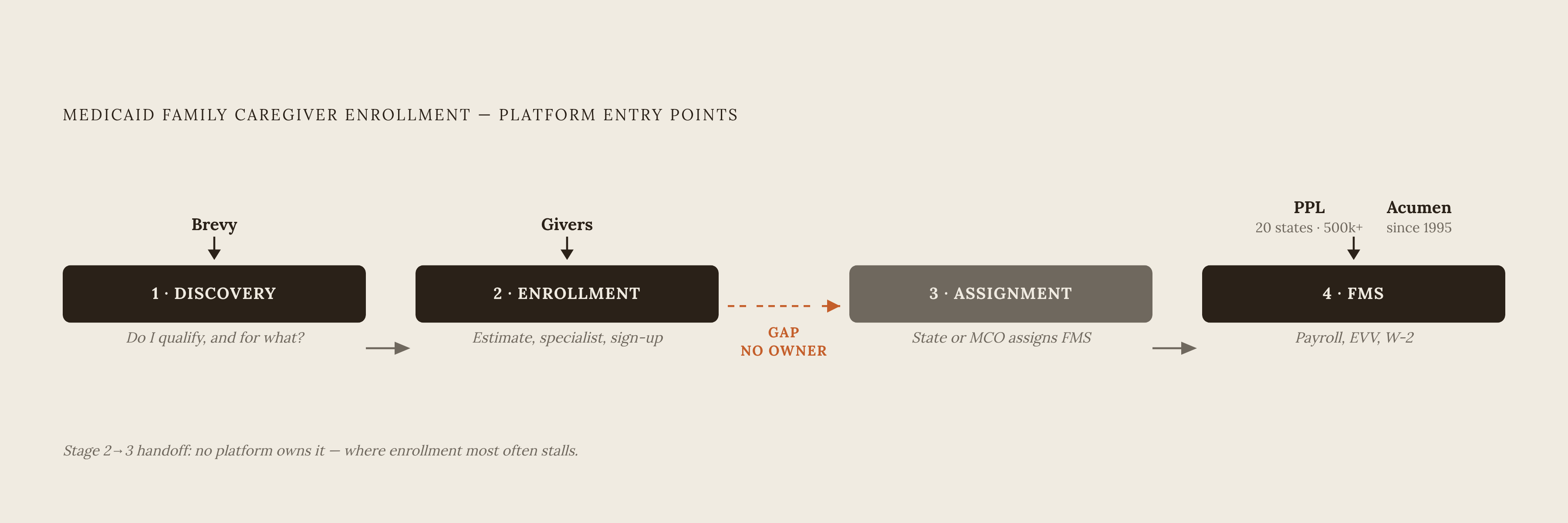
Line these platforms up and the real distinction isn't quality, or reputation, or which one has the slicker app. It's timing. Where in the process a family actually runs into them.
Some tools sit at discovery and eligibility screening, the "do I even qualify, and for what" stage. Givers sits at consumer-facing enrollment, starting from a quick estimate and moving toward active, specialist-guided sign-up. PPL and Acumen sit downstream at infrastructure: payroll, timekeeping, the FMS relationship, once a family is already enrolled in a specific program.
Most families need something spanning all three stages, and the core problem is that none of these stages hands off cleanly to the next one. A family can finish discovery and still not know which FMS they'll be assigned. That decision usually isn't theirs to make anyway; PPL or Acumen gets assigned by the state or managed care organization, not chosen off a menu. Consumer-facing platforms like Givers, and tools that handle early eligibility screening, are where a family actually has agency, where reaching out changes the outcome instead of just confirming what a state contract already decided.
New York's CDPAP consolidation is the outlier worth sitting with, because it collapsed all three stages into one mandatory platform overnight. The efficiency gain was real; a billion dollars a year in projected savings isn't a small number. Neither was the harm to the thousands of families caught in the gap between the old system shutting off and the new one catching up. A single unified platform is efficient right up until it's the only point of failure left standing.
So what should a family actually look for? Whether the platform covers their specific state program, whether a human being is reachable at the points where paperwork typically stalls, and whether any compensation figures they're shown reflect the program type their situation actually fits, not just a headline maximum.
Practical steps for a family caregiver starting this process today
Start by confirming your state's program actually lets you get paid as the caregiver you already are. Check the family member restrictions first. Spousal and legally responsible relative exclusions show up often enough that this one question can save you weeks of wasted motion.
Next, figure out which program authority applies to you. A capped waiver might mean a waitlist. A state plan option like Community First Choice, if you meet the criteria, means no waitlist at all. Two very different timelines, and knowing which one you're in changes how you plan the next six months of your life, not just the paperwork.
Before you get handed off to an FMS, use a discovery platform to sort out which program actually fits your situation. Givers and similar eligibility screening tools can clarify this early, and getting it right before the state infrastructure takes over saves a lot of backtracking later. I've seen families skip this step and spend months untangling it after the fact.
Once you know your program, find out which FMS you'll be working with, PPL, Acumen, or someone else entirely, and what enrollment channels they offer. Online, paper, and phone aren't all available everywhere, so knowing your options ahead of time helps you pick the fastest one rather than the default one.
Don't sit around waiting for your case manager to bring this up unprompted, either. MACPAC's 2025 report is clear that case managers are supposed to mention self-direction as a matter of course; it's just as clear that this doesn't happen consistently in practice. Enrollment paperwork, background checks, and caregiver registration all take real time to process. The sooner a family starts asking the right questions, in the right order, the sooner the paycheck actually shows up, and honestly, that's the whole point of writing any of this down.