Tools That Help Family Caregivers Check Medicaid and Medicare Eligibility and Enroll in Benefits
Navigators help families find thousands in overlooked benefits.

Family caregivers leave Medicaid and Medicare money on the table because the system that determines who qualifies is genuinely hard to read. Income thresholds shift by state, program names overlap in ways that confuse even seasoned social workers, and the application route that works for one family stalls out for another. This piece maps the tools, calculators, and enrollment pathways built to cut through that confusion, and it shows where those tools still fall short of getting someone actually enrolled.
Consider the scale of the misunderstanding first. Roughly 41% of Americans believe Medicare covers long-term nursing home stays, and that single false belief causes eligible families to delay or skip Medicaid applications entirely because they assume Medicare already has them covered. Meanwhile an estimated 52% of Americans over 65 will need a high level of long-term care before they die, and most of them have not saved or planned for it. Two federal programs, two different purposes, one enormous point of confusion sitting between them. Medicare is age- or disability-based and federally run; it does not pay for custodial care like bathing, dressing, or meal prep, and it does not pay a family member to serve as a home health aide. Medicaid is income- and asset-tested, administered state by state, and it is the only federal path through which a family caregiver can actually get paid for that work. Qualifying for both, called dual eligibility, can save a household thousands of dollars a year, but coordinating two programs with different rules adds a layer of complexity most families never navigate alone. Everything that follows exists because the system was not built to make this easy.
What the 2026 cost landscape looks like before families start screening tools
Before running a single eligibility calculator, it helps to know what the baseline numbers actually are, because a tool's output means nothing without them.
Medicare Part B's standard monthly premium climbed from $185 to $202.90 in 2026, just under a 10% jump, with an annual deductible of $283. Part A's inpatient hospital deductible rose from $1,676 to $1,736 per benefit period; these are not calendar-year deductibles, so a parent hospitalized twice in one year for unrelated events could face that deductible more than once. Part D now caps out-of-pocket drug spending at $2,100 for 2026, after which covered medications cost nothing for the rest of the year, and the deductible ceiling is $615.
Higher earners face another wrinkle. IRMAA surcharges, the income-related monthly adjustment amount tacked onto Part B and Part D premiums, now kick in at $109,000 in individual income, up from $106,000 in 2025. That threshold matters directly for caregivers managing a parent whose retirement income or pension pushes them just over the line.
On the Medicaid side, the 2026 rules of thumb for long-term care eligibility run like this: HCBS Waiver applicants generally face a $2,982 monthly income limit and a $2,000 asset limit, while Regular Medicaid or State Plan coverage uses a lower income bar, either $994 or $1,330 a month depending on the state and category, with the same $2,000 asset ceiling. Medicare Savings Programs, which help lower-income beneficiaries cover Medicare premiums and cost-sharing, carry their own asset limits for 2026: $9,950 for an individual and $14,910 for a couple, with the primary home, one vehicle, personal belongings, and life insurance policies under $1,500 face value excluded from that count.
None of these numbers are secret. But a family that doesn't know them before opening a screening tool has no way to judge whether the tool's answer sounds right. That context is what makes every calculator result that follows legible instead of just another number on a screen.
Official government portals: where to start and what they can and cannot do
Two federal entry points anchor the whole system. HealthCare.gov and Medicaid.gov accept Medicaid and CHIP applications year-round, and where a state runs its own portal, the federal site routes the applicant there; if it detects likely eligibility, it forwards that information to the state agency securely. Applicants can also go straight to a state Medicaid agency online, by phone, or in person, and most states are required to process an application within 45 days, extended to 90 days when disability determination is part of the case. Approved coverage can often be backdated to the first day of the application month, which matters more than it sounds like it should when a family is staring down a hospital bill that landed mid-application.
For Medicare specifically, the Medicare Plan Finder at Medicare.gov/plan-compare is the official CMS tool for comparing Medicare Advantage (Part C) and Part D plans side by side: premiums, deductibles, drug formularies, Star Ratings, all in one place. As of October 1, ahead of the open enrollment window running October 15 through December 7, the tool now posts in-network provider directories for many Medicare Advantage plans, so a caregiver can check whether a parent's cardiologist is actually in-network before locking in a plan for the year.
But how does this actually help someone in the middle of the process? Plan Finder delivers data, not guidance. Dozens of plans, each with a different cost structure and network, can be just as disorienting laid out in a comparison table as they were scattered across mailers and phone calls. First-time enrollees in particular tend to freeze in front of that much unfiltered information.
One practical fix belongs in every family's prep work regardless of which portal they use: gather proof of identity, proof of state residency, proof of income, and documentation of household composition before starting any application. Missing one of these four is the single most common reason applications stall.
Government portals confirm eligibility once a family already knows what to apply for, and they accept the paperwork. What they don't do is tell a caregiver about the five programs they never knew existed. That's a different job, and it belongs to the screening tools covered next.
Free screening tools that surface programs caregivers didn't know to look for
NCOA's BenefitsCheckUp, found at BenefitsCheckUp.org, has been running since 2001. It's free, confidential, and has helped millions of users identify billions of dollars in benefits across programs including SNAP, Medicare Savings Programs, the Part D Low Income Subsidy (commonly called Extra Help), and the Low-Income Home Energy Assistance Program, alongside a range of other public and private benefits. It isn't an application itself; it surfaces eligibility signals and hands over contact information for whichever agency administers the program, and a quick anonymous postal-code search is available for families who want a fast read before committing to the full questionnaire.
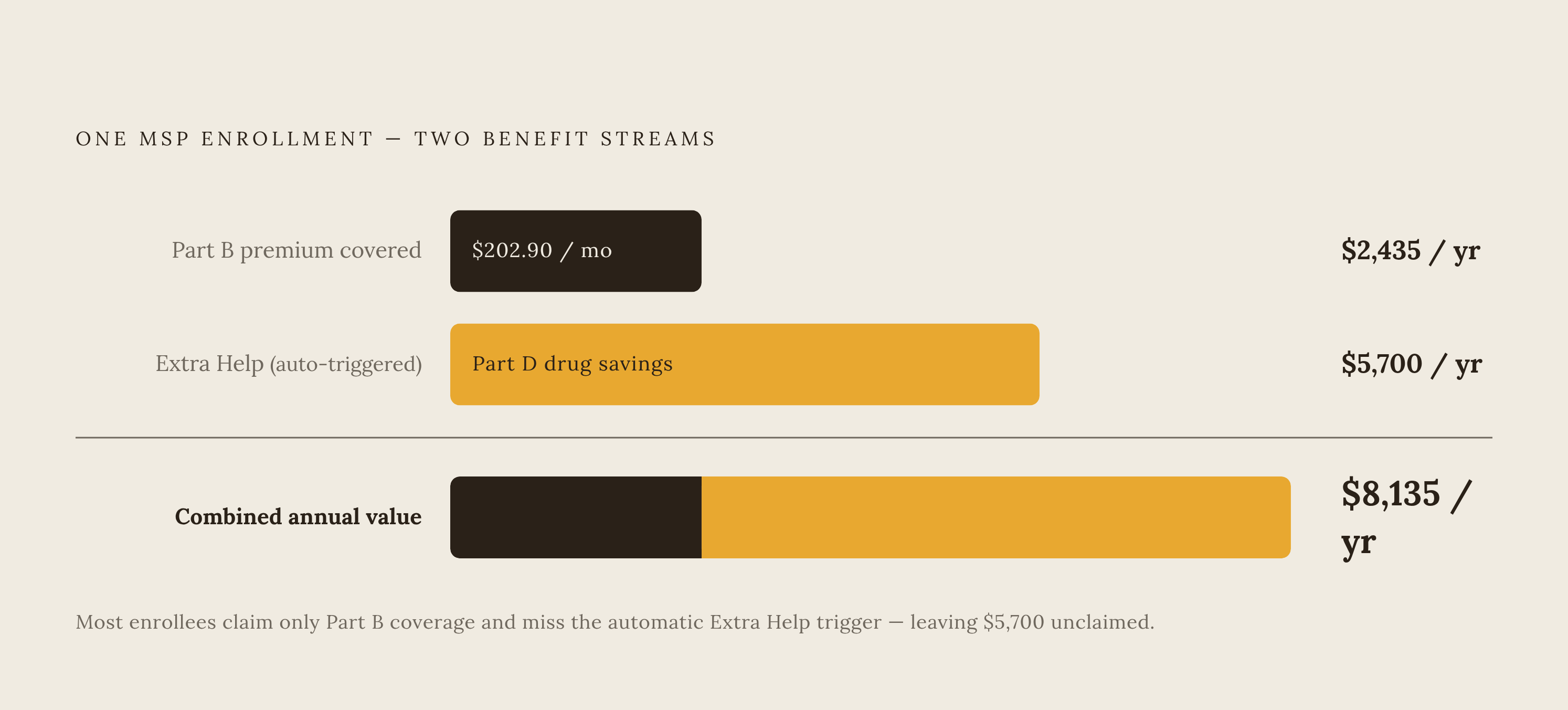
The dollar value here is concrete enough to spell out. Three of the four Medicare Savings Program tiers cover the full $202.90 monthly Part B premium, which works out to more than $2,400 a year back in a household's pocket. And MSP enrollment automatically triggers Extra Help eligibility, which the Social Security Administration estimates is worth around $5,700 annually in prescription drug savings. One enrollment, two benefits, stacked. NCOA's Center for Economic Well-Being also holds the federal designation as the National Center for Benefits Outreach and Enrollment, funded through MIPPA money via a federal agency for community living. Administration for Community Living, whose institutional backing matters when deciding whether to trust a free online tool with a parent's financial details.
MedicaidPlanningAssistance.org, run by the American Council on Aging, offers an eligibility test built specifically for people 65 and older checking Medicaid long-term care eligibility. It asks about the applicant's income and countable assets, and the spouse's if there is one, using 2026 financial criteria that get updated as individual states revise their own thresholds throughout the year. The output isn't just a yes or no. It gives a projected eligibility status and a recommendation on the most cost-effective way to apply: going straight to the state agency, working with a Certified Medicaid Planner, or bringing in an Elder Law Attorney. For a family trying to figure out whether a parent fits into a state waiver program, this is a reasonable first stop.
MedicaidEligibilityCalculator.com takes a narrower, faster approach: free, state-specific, results in minutes. It was last updated in July 2026 using the 2026 Federal Poverty Guidelines published by CMS.gov. The results are estimates. Final eligibility still runs through the state Medicaid agency, and no online calculator substitutes for that review.
BenefitsUSA.org offers a suite of tools covering several major program areas, and its screener is designed to help caregivers identify relevant programs for a parent's situation. As noted above, Extra Help alone is estimated to be worth around $5,700 a year in Part D savings.
None of these four charge anything, none require a commitment to actually apply, and all of them include programs that the official Medicare and Medicaid portals never proactively mention. They're discovery tools. They tell a family what exists. Newer AI-powered eligibility and enrollment platforms are starting to layer guided enrollment steps and human backup on top of that same screening function, which starts to close the gap between "you may qualify" and someone actually being enrolled, a gap that pure screening tools were never designed to close on their own.
Medicaid pathways that pay family caregivers, and the eligibility rules that govern them
Medicare does not pay a family member to provide home health care. That bears repeating because the misconception is common and expensive. Paid family caregiving runs almost entirely through Medicaid, though VA programs, certain state-funded initiatives, and some Medicare Advantage plans can offer compensation in narrower circumstances.
Every state and one additional jurisdiction offers some version of a consumer-directed, or participant-directed, Medicaid personal care program, where the person receiving care chooses their own caregiver, and that caregiver can often be a relative. Three structures dominate. Medicaid State Plan personal care programs form a baseline layer of this system in many states. Home and Community Based Services waivers, known as 1915(c) Waivers, are state-specific, capped in how many people they can enroll, and frequently come with waiting lists. Structured Family Caregiving, or SFC, is a distinct benefit with its own rulebook, and as of 2026 it's available in eleven states: Connecticut, Georgia, Indiana, Louisiana, Massachusetts, Missouri, Nevada, North Carolina, Ohio, Rhode Island, and South Dakota. North Dakota runs a comparable program under a different name, Family Personal Care.
SFC has particular mechanics. The caregiver and care recipient must live together, in one of their own homes. The caregiver typically becomes a contractor or employee of a home health agency, and Medicaid pays that agency a daily stipend, of which somewhere between 50% and 65% passes through to the caregiver. South Dakota's 2026 rates, effective July 1, run from a base of $82.00 a day up to $114.81 a day at the highest tier, with a guaranteed minimum of 50% reaching the caregiver. Missouri pays $110.33 a day, and its agencies are barred from keeping more than 35%, so the caregiver's floor is 65%. These are enrollment-capped programs, so waiting lists build once slots fill, the same constraint that shapes HCBS waivers.
Spousal eligibility trips up a lot of families. Most HCBS waivers and many State Plan programs exclude spouses from being paid caregivers. But that's not universal: a growing number of states permit spousal payment, so the honest answer is to check the specific state rather than assume exclusion by default. SFC programs split the same way, some states prohibiting spouse caregivers, others allowing it, governed entirely by state-specific rules.
On the care recipient's side, HCBS and SFC eligibility generally requires income under $2,982 a month and assets under $2,000, along with a documented need for nursing-facility level of care, confirmed through a clinical assessment rather than self-report. The Caretaker Child Exception is a Medicaid rule that may be relevant when an adult child has lived with and cared for a parent. It's exactly the kind of provision a standard screening tool won't ask about unless a caregiver already knows to look for it.
What a Pennsylvania eligibility checklist shows about how two-sided qualification works
Pennsylvania's paid family caregiver pathway runs through Community HealthChoices, or CHC, its Medicaid managed long-term services and supports program. Two separate eligibility tests have to be passed at once, not one or the other, and that dual structure is a pattern most states share in some form.
The medical or functional test requires that the care recipient need nursing-facility level of care, or ongoing help with activities of daily living such as bathing, dressing, eating, transferring, toileting, or managing medications. A clinical assessment during the application confirms this, so it isn't a matter of the family simply asserting need.
The financial test for 2026 sets a single applicant's income limit at $2,982 a month, with an asset limit governed by the state's specific rules. For married couples where both spouses apply, each is held to the same $2,982 monthly limit, with asset limits governed by state-specific rules. Community spouse resource allowance protections kick in when only one spouse in a marriage is applying, shielding some assets for the spouse who isn't. And every application faces a five-year look-back period: a large gift or asset transfer made in the five years before applying can trigger a penalty period that delays coverage, so flagging any major transfers before filing saves real time later.
Then there's the caregiver-side eligibility, which families tend to misjudge more than the financial side. Adult children, siblings, grandchildren, grandparents, aunts, uncles, nieces, nephews, cousins, and close friends chosen by the care recipient can generally be paid. Spouses generally cannot, and neither can legal guardians, representative payees, or someone acting purely in a power-of-attorney capacity. Beyond the relationship requirement, the caregiver has to be 18 or older, legally allowed to work in the country, able to pass a criminal background check, and willing to complete required training before any paid hours start.
Documentation runs in parallel on the care recipient's side too: proof of identity, a Social Security number, income documentation like Social Security or pension statements, asset documentation such as bank statements or property records, and medical records supporting the level-of-care determination.
What does this really tell a family in a different state? The lesson generalizes even where Pennsylvania's specific numbers don't: one missing document, on either side of the application, stalls the entire process, and gathering paperwork before filing is the most controllable factor in how fast an application moves. Landing slightly above an income or asset limit isn't an automatic disqualification. Planning strategies exist for exactly that situation, and the right time to bring in experienced help is when the numbers are borderline.
Human counseling networks that fill the gaps tools leave
Calculators and screeners answer questions a family already knows how to ask. State Health Insurance Assistance Programs, or SHIPs, exist for the questions nobody thought to ask yet. Every state runs a SHIP, offering free one-on-one Medicare counseling, reachable through a single national number, 877-839-2675.
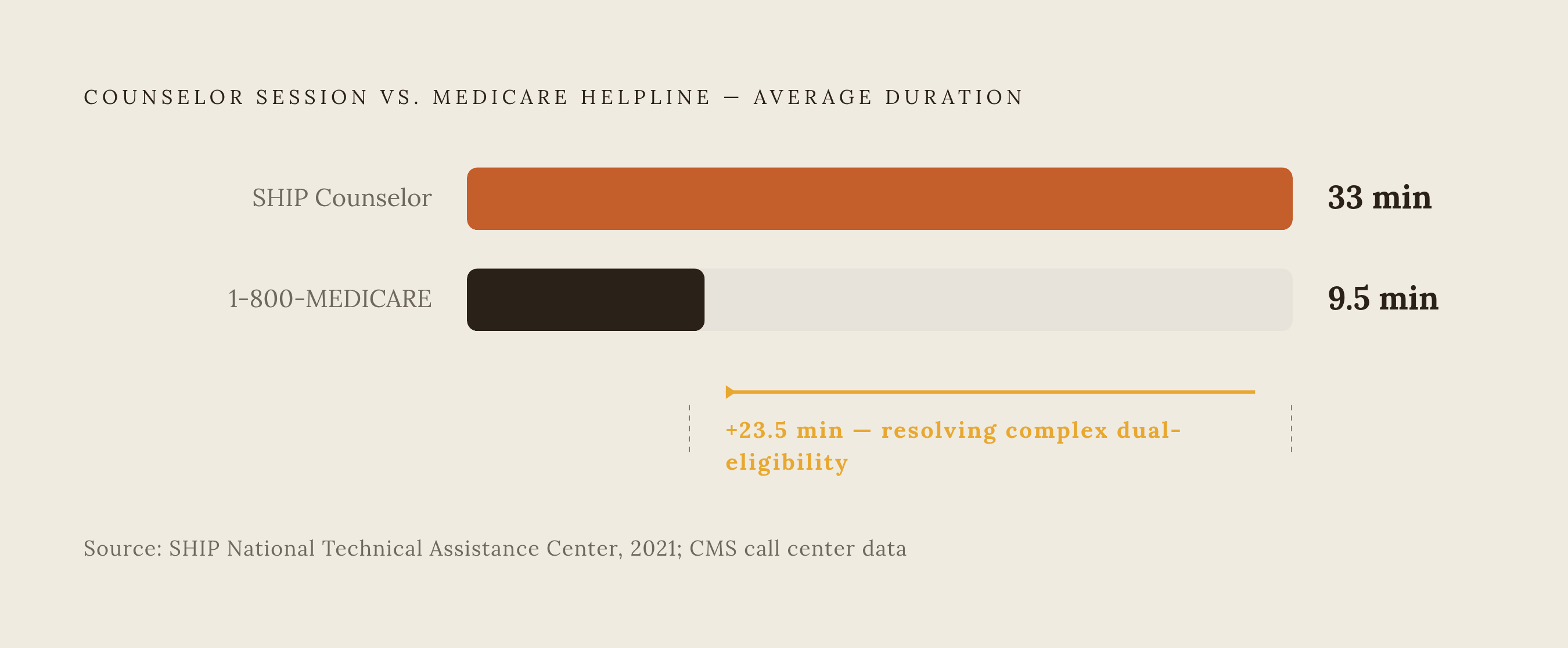
In 2022, SHIPs served roughly 4.3 million Medicare beneficiaries, family members, and caregivers, with about 1.7 million of them receiving direct one-on-one counseling, either in person or by phone. The depth of that contact is the real differentiator. In 2021, SHIP counselors spent an average of 33 minutes per one-on-one session, against an average of 9.5 minutes on a typical 1-800-MEDICARE call. That gap, 33 minutes versus 9.5, is roughly the difference between working through a complicated dual-eligibility question with someone who has time to listen, and getting a quick answer to a question that was simple enough to fit in ten minutes.
Screening tools are precise about what they can surface. They're free, fast, and they catch programs families never would have found searching on their own. But a tool can't sit with someone for half an hour and untangle why their late father's income looks like it disqualifies him from a waiver he actually qualifies for once his medical expenses are counted correctly. That's the gap a SHIP counselor is built to fill, and it's the reason no single tool in this landscape, however well-built, replaces a person on the other end of the phone who has done this before.