Dual Eligibility for Medicare and Medicaid
Most dual-eligible beneficiaries don't realize what their coverage actually includes.

Dual eligibility is one of those topics that rewards the people who take the time to understand it and quietly penalizes everyone else. In nearly two decades of working around Medicare and Medicaid policy, the pattern I've watched repeat itself is the same: a family assumes their parent or spouse is "covered" because they have both Medicare and Medicaid, and then discovers, often at the worst possible moment, that "covered" meant something far more limited than they believed. The gap between what dual eligibility can provide and what most families actually access is not a matter of eligibility. It is a matter of comprehension.
The starting point matters: dual eligibility is not a third program. It is the simultaneous enrollment in two existing programs, Medicare and Medicaid, each with its own entry requirements. Medicare covers people 65 and older, or those under 65 with a qualifying disability such as end-stage renal disease or ALS. Medicaid covers people with low incomes and limited assets, administered at the state level, which means income thresholds are not uniform across the country. Holding both is what creates dual status. As of 2025, 11.9 million people hold that status, according to KFF. That is not a niche population. That is a substantial and growing share of the people Medicare serves, and it spans a far wider range of families than most people assume when they picture who this affects.
The Two Tiers and What Actually Separates Them
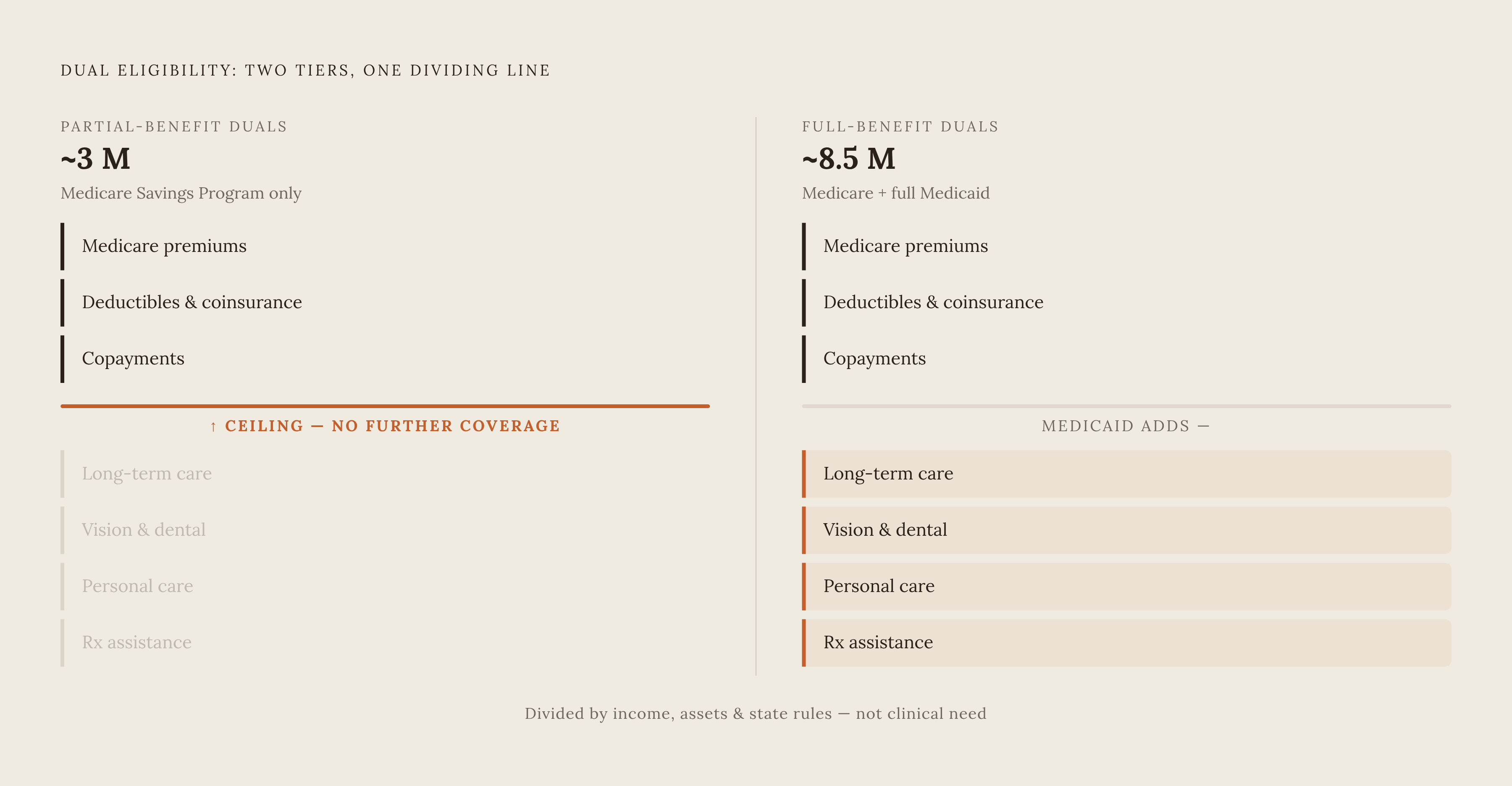
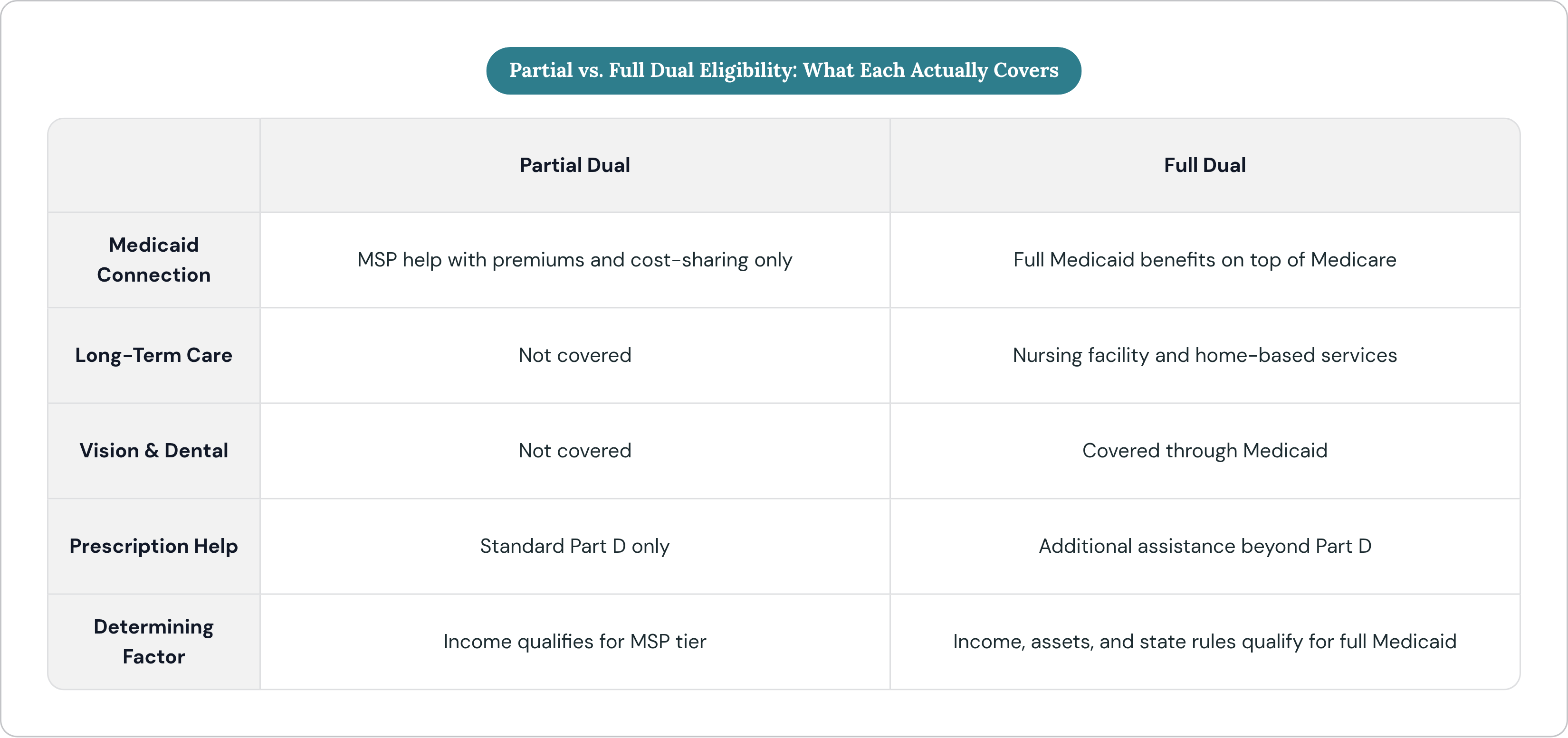
The 11.9 million split into two categories that carry very different practical consequences. Approximately 8.5 million are full-benefit duals, meaning they qualify for Medicaid benefits beyond what Medicare covers. The remaining roughly 3 million are partial-benefit duals, meaning their Medicaid connection goes only as far as help with Medicare premiums and cost-sharing through Medicare Savings Programs.
The distinction is not clinical. It is not about how sick someone is or how many conditions they manage. It is about how deeply they qualify for Medicaid, which turns on income, assets, and the rules of the state where they live.
Partial duals access Medicare Savings Programs, of which there are four distinct tiers: the Qualified Medicare Beneficiary program, the Specified Low-Income Medicare Beneficiary program, the Qualifying Individual program, and the Qualified Disabled and Working Individuals program. Each carries different income thresholds and coverage levels. At the most protective tier, an MSP can cover Part A premiums, Part B premiums, and the deductibles, coinsurance, and copayments that Medicare leaves behind. That is meaningful financial relief. But the benefit package stops there, and many families do not realize it has stopped.
Full-benefit duals access what Medicaid adds on top of Medicare: long-term care services, both in nursing facilities and through home and community-based programs that Medicare will not pay for; vision and dental coverage, which standard Medicare excludes; prescription drug assistance beyond Part D; and personal care and supportive services. These are not supplementary amenities. For someone managing a progressive illness or functional decline, long-term services and supports can be the difference between staying home and institutional placement.
The threshold between partial and full is where the real stakes concentrate. A family managing a loved one's care who assumes dual eligibility means full coverage, when the person is actually a partial dual, is missing an entire stratum of potential benefits. That is not a hypothetical. It is, in my experience, the most common and consequential misunderstanding in this space.
Who Is Actually Dual Eligible and Why the Population Looks the Way It Does
The demographic profile of dual eligibles is worth sitting with, because it challenges the intuitive picture most people carry.
First, age. The dual-eligible population skews younger than the general Medicare population. According to MedPAC data from July 2024, 37% of dual-eligible individuals were under 65 with a disability in 2021. Medicare's disability pathway, not the aging pathway, is a major on-ramp to dual status. The image of a dual eligible as an elderly nursing home resident is accurate for a portion of the population, but it is not the defining portrait.
Second, income. Nearly 9 in 10 dual-eligible individuals live on annual incomes below $20,000, with 87% falling below that threshold, according to data cited in a January 2024 analysis from a legal aid and Medicaid policy organization. That level of income leaves essentially no margin for uncovered care costs, which is precisely why the tier distinction matters so acutely.
Third, race and ethnicity. KFF's 2025 data shows that 52% of dual eligibles are people of color, compared with 18% of Medicare beneficiaries without Medicaid. That disparity does not emerge from the programs themselves. It reflects the broader structural inequities in wealth accumulation and health outcomes that determine who arrives at this intersection of low income and significant medical need.
Fourth, health burden. Dual eligibles are substantially sicker than the non-dual Medicare population. Forty-four percent report fair or poor health, compared to 14% of non-duals. Forty-eight percent have at least one limitation in an activity of daily living, versus 21% of non-duals. Thirty-six percent report cognitive impairment, compared to 12% of non-duals. Nearly 40% use long-term services and supports. These are not people who ended up in this situation through minor financial misfortune. They are people managing serious, chronic, often disabling conditions on incomes that leave them structurally dependent on the benefit programs meant to serve them.
Finally, geography. State variation is pronounced. KFF's 2025 data indicates that dual eligibles represent 30% or more of all Medicare beneficiaries in jurisdictions like the District of Columbia, New York, Connecticut, and Louisiana, but only around 11% in Utah. Where someone lives determines not just their likelihood of qualifying, but what is available to them once they do.
How the Two Programs Divide the Bill, and What Happens When They Don't Talk to Each Other
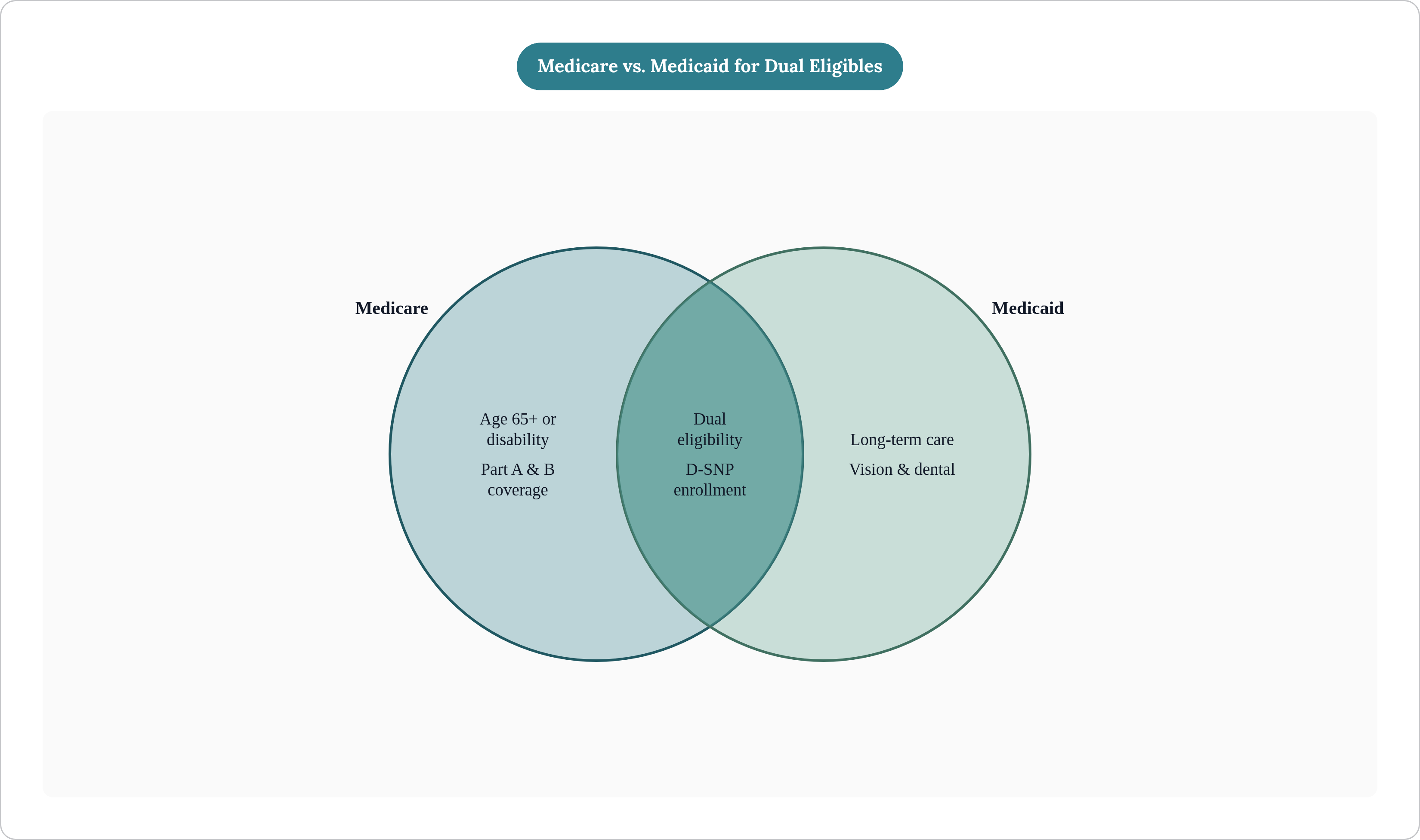
The coordination rule is straightforward in principle: Medicare pays first for services both programs cover, and Medicaid wraps around what Medicare leaves unpaid. For services Medicare does not cover at all, such as long-term care, vision, and dental, Medicaid is simply the sole payer, with no coordination required because Medicare never enters the picture.
The structural problem is that these two programs were designed separately, have never been fully unified, and operate under different federal and state rules. That architecture has practical consequences that compound at the individual level.
Providers who understand Medicare may not understand Medicaid, and vice versa. Benefit counselors often know one system well and the other inadequately. Care coordination fails when no single entity holds the full picture of what a person is entitled to and receiving across both benefit streams. The result is care fragmentation: medication mismanagement, missed services, and preventable hospitalizations that accumulate precisely because the handoffs between systems don't work.
The spending data makes the consequence visible. According to KFF's 2025 figures, traditional Medicare spending per person averages $24,811 for full-benefit duals, compared to $10,413 for beneficiaries without Medicaid. The gap reflects higher underlying need, but it also reflects the cost of a system that is not preventing high-cost crises for the people most vulnerable to them. MedPAC's July 2024 analysis sharpens that point further: the costliest 5% of dual-eligible beneficiaries accounted for 45% of Medicare spending and 36% of total spending on dual eligibles in 2021. When a small fraction of a population is generating nearly half the program's expenditures, the system is failing to function as a preventive or coordinating structure. It is functioning as a crisis-response mechanism.
D-SNPs as the Main Vehicle for Coordinated Coverage
Dual Eligible Special Needs Plans are Medicare Advantage plans specifically authorized to serve dual eligibles and, at higher tiers of integration, to coordinate Medicare and Medicaid benefits in ways that traditional fee-for-service cannot. Enrollment has grown sharply over the past several years, reaching more than 6.0 million enrollees in 2026, up from 2.2 million in 2018, according to the National Council on Aging. That trajectory reflects both the inadequacy of uncoordinated coverage and the demand for something better.
The important caveat is that "D-SNP" is not a uniform designation. Three tiers of integration exist, and the differences between them are not cosmetic.
Coordination-only D-SNPs meet baseline federal requirements but do not deeply integrate Medicaid. They are the floor, not the ceiling. Highly Integrated Dual Eligible Special Needs Plans, called HIDE-SNPs, represent a middle tier that began in 2021; according to a December 2024 analysis published through the Gerontological Society of America and NIH-affiliated research, nearly 30% of dual eligibles are now enrolled in this tier. Fully Integrated Dual Eligible Special Needs Plans, called FIDE-SNPs, are the most stringent: they must contract directly with the state Medicaid agency and cover at least 90 days of nursing facility services. As of January 2025, CMS requires FIDE-SNPs to operate with exclusively aligned enrollment, meaning a person's Medicare and Medicaid coverage runs through the same plan.
What aligned enrollment actually changes for someone navigating this system is substantial: one integrated provider directory, one ID card, one call center for questions spanning both programs, one care coordinator managing both benefit streams, and one unified appeals and grievance process. For a person managing multiple chronic conditions on a limited income, the difference between that structure and managing two separate bureaucracies is not administrative convenience. It is access.
D-SNPs are not universally available. As of early 2026, they are offered in 46 states and the District of Columbia, but absent from Alaska, Illinois, New Hampshire, and Vermont, according to Justice in Aging. Default enrollment pathways, which allow eligible individuals to be passively enrolled rather than requiring active application, had been approved by CMS as of March 2025 for 76 plans across 15 states and Puerto Rico. Coverage remains patchy.
The label "D-SNP" alone does not tell a beneficiary what they are actually getting. A partial dual enrolling in a coordination-only D-SNP has a meaningfully different experience than a full dual enrolled in a FIDE-SNP. The plan type matters. The integration tier matters. Understanding which category a plan falls into is not optional due diligence. It is the central question.
Finding Your Tier and Completing Enrollment
The first question to answer is which tier applies: partial dual or full dual. That single determination shapes whether the goal is MSP enrollment, full Medicaid enrollment, or both.
For MSP eligibility, the path runs through the state Medicaid agency. Income and asset limits vary by state and by which of the four MSP tiers is being assessed. For someone already enrolled in Medicare with low income who has never applied for Medicaid, MSP eligibility is worth checking separately; MSP participation does not require full Medicaid qualification, and many people who would qualify have never applied.
For full Medicaid eligibility, the application goes through the state Medicaid office or through Healthcare.gov. Access to long-term services and supports often requires a functional assessment on top of income qualification, meaning income alone does not determine LTSS access. The financial gate and the functional gate are separate.
Once dual status is confirmed, navigating D-SNP options requires comparing plans at the integration-tier level, not just by premium or provider network. Whether a plan carries aligned Medicaid enrollment is a material question. Whether it is a FIDE-SNP, a HIDE-SNP, or a coordination-only plan determines what coordination actually looks like in practice. Dual eligibles also have special enrollment periods that are not tied to the standard Medicare open enrollment windows, which means there are more opportunities to make changes than most beneficiaries realize.
The observation here, grounded in years of watching families navigate this, is that the system was not designed to be navigated by individuals working alone. The complexity is structural, not incidental. Benefit counselors and SHIP counselors can help surface programs a person qualifies for that they would not locate independently. Some free enrollment services exist specifically for this opacity, helping people check eligibility for programs like Medicare Savings Programs and caregiver payment programs and connecting them with live enrollment specialists to complete the process, precisely because the gap between qualifying and actually enrolling is where most benefits are lost.
Dual eligibility does not self-execute. Qualifying is the precondition. Enrollment is the work. And for a population managing serious illness on income that leaves no margin for error, the difference between knowing that and failing to know it is not academic.