Medi-Cal vs Medicaid Differences for Long-Term Care
California's long-term care programs differ vastly in eligibility, coverage, and guaranteed access.

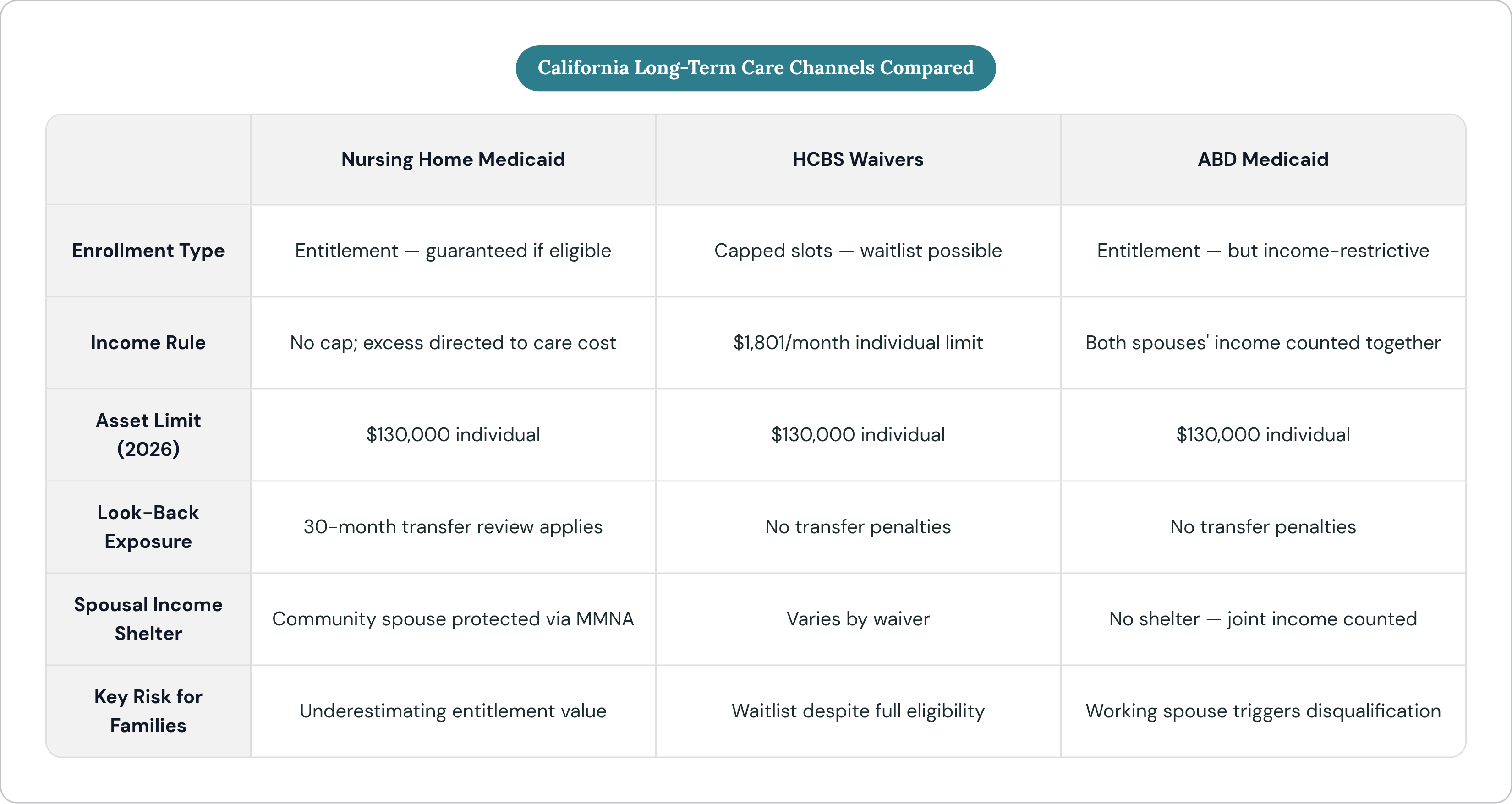
Most families arrive at Medi-Cal long-term care with one question: will the state pay for this? The answer is almost always "it depends," and what it depends on is which of three program channels applies. The channel determines covered settings, asset rules, income rules, and whether enrollment is guaranteed or contingent on a waitlist.
Nursing Home Medicaid is an entitlement. Meet the financial and functional criteria, and coverage is guaranteed. No slots, no waitlist, no cap. Home and Community-Based Services waivers work the opposite way: enrollment slots are legislatively capped, and an applicant who clears every eligibility hurdle may still wait months or years for an opening. Aged, Blind, and Disabled Medicaid is the most income-restrictive of the three; it counts both spouses' incomes together when only one spouse applies, which creates a trap families rarely see coming until they're already in it.
That entitlement distinction is what families most consistently underestimate. Clearing the financial eligibility process for an HCBS waiver means clearing one gate. There may be another gate, and it may take considerably longer to open. The legal guarantee attached to nursing home coverage does not transfer to community-based alternatives, even when those alternatives are clinically appropriate and, notably, cheaper for the state to fund. If community-based care is both clinically appropriate and cheaper, why does the legal guarantee stop at the nursing home door? The answer lies in how these three channels were originally structured, and understanding that structure is essential before any family commits to an application pathway.
All three programs serve the same broad population: Californians who are 65 or older, blind, or living with qualifying disabilities. This is not a general low-income benefit. The eligibility logic assumes significant functional need, and the program channel shapes not just what is covered but how assets and income are measured. Families navigating this without guidance frequently apply to the wrong channel, and discovering that error at the county office costs weeks they cannot afford.
California's Home Care Programs and How They Differ from What Most States Offer
In-Home Supportive Services, known as IHSS, is the program that most distinguishes California's long-term care architecture from almost any other state's. It is a statewide Medi-Cal entitlement covering personal care and homemaker services for seniors and people with disabilities who would otherwise face nursing home placement. Participants can self-direct their care, including hiring family members or close friends as paid caregivers. That provision is not incidental. For families already providing unpaid support, it is often the most consequential feature of the program, and most of them remain unaware it exists until well after the point when they should have applied.
The scale of IHSS commands attention. The program was projected to serve hundreds of thousands of Californians in fiscal year 2026-27. Spending grew from roughly $8 billion in 2015-16 to a projected nearly $29 billion in 2025-26. That trajectory attracted federal scrutiny and sustained debate about program integrity. California's defense has been a cost-offset argument: IHSS prevents nursing facility placement, which is estimated to cost between $22,000 and over $150,000 more per person annually. The directional logic holds. But a spending curve of that slope warrants harder scrutiny than the cost-offset argument alone provides, and the state has not fully resolved that tension.
California also operates several other home and community-based programs alongside IHSS. The Assisted Living Waiver covers services in assisted living and memory care settings; it carries a waitlist and is not available statewide. Community-Based Adult Services provides daytime care and supervision at adult day health centers, but only in approximately 28 of California's 58 counties. The Multipurpose Senior Services Program covers home modifications, personal emergency response, and homemaker services for seniors.
Set that against the national picture and the contrast is not subtle. California's institutional nursing facility budget runs roughly $7 to $8 billion annually; IHSS at $28.5 billion dwarfs it. Self-direction provisions exist in other states but typically in narrower form, with more restrictions on who qualifies as an eligible caregiver. A family reading about home care Medicaid in a national guide and assuming California follows the same model is likely working from a premise that will mislead every decision that follows.
How California's Asset Limit Went from $2,000 to Zero and Back — and Where It Lands in 2026 and 2027
The asset limit history of the past four years in California is, in effect, a policy experiment the state ran on itself. The results were instructive, if not entirely what the architects anticipated.
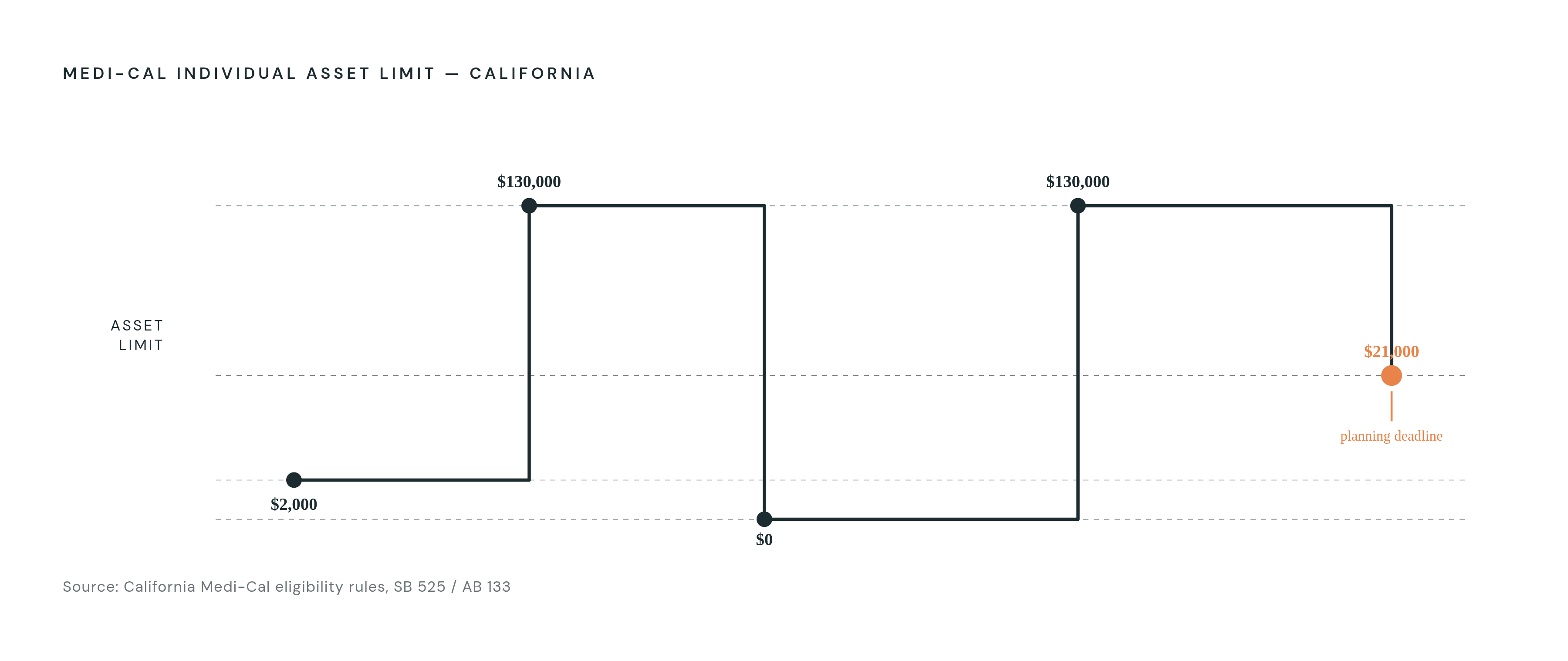
The national baseline for long-term care Medicaid in 2026 is a very low individual asset limit. California started there. In July 2022, the state raised the individual limit to $130,000 as part of a phased expansion. Then, in January 2024, California became the first state in the country to eliminate its asset test entirely for all Medi-Cal enrollees, making income the sole determinant of eligibility.
That elimination drove enrollment and expenditures beyond projections. The policy was reversed. Effective January 1, 2026, the asset limit was reinstated for non-MAGI Medi-Cal programs at $130,000 for an individual, $195,000 for a couple, with $65,000 per additional household member. Compared to New York's $32,396 single-applicant limit or Illinois's $17,500, California at $130,000 remains considerably more permissive than the national norm.
That picture changes materially on July 1, 2027. The $130,000 individual limit is scheduled to drop to $21,000, with $31,000 for two people and $1,550 per additional household member. For a household with savings above $21,000, the interval between now and mid-2027 is a real planning window, not a theoretical one. Waiting past that date will expose families to disqualification that the 2024 and 2025 rules would have made entirely moot.
It is also worth sitting with a counterpoint the expansion advocates never quite answered: broader eligibility does not automatically produce better care. From 2015 to 2024, nursing home staffing in California declined from 4.54 to 4.39 nurse staff hours per resident per day, while deficiencies per facility rose from 10.5 to 16.7. Whether that reflects funding priorities, workforce dynamics, or regulatory gaps is not easily attributable, but it complicates any clean narrative of California as a national model. Access and quality are related variables; they are not the same one.
How California Measures Income for Long-Term Care Eligibility — and What the Share of Cost Pathway Means in Practice
Income rules diverge by program channel in ways that remain invisible until the moment they matter most.
The national baseline for Nursing Home Medicaid and HCBS Waivers in most states in 2026 is $2,982 per month for an individual. ABD Medicaid limits generally range from roughly $994 to $1,803 per month depending on the state. California's structure varies by channel. Nursing Home Medicaid carries no monthly income cap; income above the applicable threshold is directed toward the cost of care rather than disqualifying the applicant. HCBS Waivers apply a limit of $1,801 per month for an individual, effective April 2025 through March 2026. IHSS uses $1,836 per month for a single applicant and $2,490 per month for a couple, effective April 2026.
Nursing home residents retain a Personal Needs Allowance of just a few dozen dollars per month, which sits at the low end of the national range of roughly $30 to $200. Everything else flows to the state as a contribution toward care costs.
The more significant structural distinction is how California handles applicants whose income exceeds program limits. California is not a Miller Trust state. In states that require them, also called Qualified Income Trusts, an applicant over the income threshold must establish an attorney-drafted trust instrument to channel excess income and achieve eligibility. California uses a Medically Needy/Share of Cost pathway instead: a Maintenance Need Allowance of $600 for an individual and $934 for a couple in 2026 is subtracted from countable monthly income. The remainder is the Share of Cost. Once that amount is spent on qualifying medical expenses in a given month, Medi-Cal covers the balance.
The practical consequence is reduced legal complexity. No trust is required, and no attorney is strictly necessary to clear an income threshold. For a family managing an acute placement decision under time pressure, that structural simplicity matters more than it may appear on paper.
ABD Medicaid's joint-income rule creates a different kind of friction, and it tends to surface after families have already committed to a channel. When only one spouse applies under ABD, both spouses' incomes are counted together. A community spouse who is still working or drawing a pension can inadvertently push the applying spouse over the threshold, without access to the income shelter that nursing home Medicaid's spousal protections would provide. This is simultaneously an income problem and a channel-selection problem, which is part of why it is so persistently costly when it gets missed.
California's 30-Month Look-Back — Why It's Shorter Than Every Other State's, and Who It Actually Applies To
Federal Medicaid law imposes a 60-month look-back period on asset transfers for 49 states and Washington D.C. Any transfer below fair market value within that window can trigger a penalty period of ineligibility for nursing home coverage. California's look-back is 30 months, half the federal standard, and it applies to a narrower population than most families expect.
The California look-back applies only to institutional nursing facility applicants. Californians seeking HCBS waiver benefits, including IHSS, the Assisted Living Waiver, MSSP, and self-determination programs, face no transfer penalties under California's rules. That is a materially different risk profile than most other states, where the look-back covers community care applicants as well.
There is also a gap in the look-back's recent history that some families still fail to fully appreciate. The 2024 asset test elimination effectively rendered transfer penalties obsolete through the end of 2025. The look-back was reinstated January 1, 2026. Transfers made during 2024 and 2025, regardless of amount, will not trigger a penalty period. That window closed, but assets moved within it are protected.
The reinstatement is phased. Beginning February 1, 2026, Medi-Cal examines one month back. The window extends by one month each subsequent month, reaching the full 30 months in July 2028. A family planning nursing home entry in 2026 is operating under a look-back that is still short but lengthening, and the exposure grows with each passing month.
California also maintains a de minimis protection most states do not: transfers below the monthly average private-pay nursing home rate, $14,440 in 2026, are not penalized. Most states penalize any below-fair-market-value transfer regardless of size.
One planning error recurs often enough to name directly. Families conflate the IRS annual gift exclusion with Medicaid protection. In 2026, the IRS permits gifts of up to $19,000 per recipient without federal gift tax consequences. That figure has no bearing on Medi-Cal eligibility. A transfer invisible to the IRS can still trigger a penalty period, and this assumption has produced real coverage gaps for families at exactly the moment they needed coverage most. The two frameworks are parallel, not connected, and conflating them is an expensive mistake.
What Spousal Protections Look Like Under Medi-Cal Compared to National Medicaid Standards
Federal Medicaid law sets a floor for spousal protections, designed to prevent nursing home enrollment by one spouse from leaving the other financially destitute. California applies those protections and sets its own figures within the federal parameters.
The community spouse is entitled to retain assets through the Community Spouse Resource Allowance. At California's reinstated $130,000 individual limit, couples can retain up to $195,000 combined in countable assets. That ceiling is far more protective than the $2,000-per-individual floor most states apply, and it reflects a long-standing orientation in California's policy toward preserving the community spouse's financial stability.
Income protection for the community spouse operates through the Monthly Maintenance Needs Allowance, which sets the minimum income the community spouse is entitled to receive. The federal minimum for 2026 is approximately $2,644; the federal maximum is approximately $4,118. California's specific figure falls within that range, though the state does not always publish it in a form families can locate without professional assistance.
ABD Medicaid runs counter to this framework in a way that catches people off guard. Under ABD, when only one spouse applies, both spouses' incomes are counted together against a single limit. A community spouse still working or receiving pension income can push the applying spouse over the threshold, without access to the income shelter that nursing home Medicaid's protections provide. Applying to the wrong program channel does not merely delay enrollment; in these situations, it can block it entirely.
For families with relatives in states like Texas, Florida, or New York comparing notes across state lines, the comparison is not clean. California's asset floors are higher, its income pathway is structurally simpler, and the planning considerations that apply in another state may address entirely the wrong problem in California. Interstate comparisons tend to produce more confusion than clarity, and I've watched families act on them confidently and expensively.
How California's Enrollment Pathways Work and Where Families Get Stuck
The application process for Medi-Cal long-term care is not unified. Nursing Home Medicaid applications run through the county. HCBS waivers and IHSS have separate intake processes. There is no single portal covering all long-term care programs simultaneously, and the fragmentation creates genuine friction even for applicants who qualify without ambiguity.
IHSS intake involves two determinations running in parallel, both of which must succeed. A county social worker assesses functional need. A separate financial eligibility review runs on its own timeline. Clearing one does not guarantee the other, and families who assume otherwise lose weeks they rarely have to spare.
Waitlists are structural, not exceptional. The Assisted Living Waiver operates with a waitlist. Community-Based Adult Services is geographically uneven, available in roughly 28 of 58 counties. Demonstrating eligibility does not produce access to the preferred care setting on a preferred timeline. That reality collides persistently with how families actually approach applications: a specific placement already arranged, a move-in date already set, and an assumption that eligibility translates to access. It often falls short.
Several errors recur at a rate that warrants naming them plainly. Applying to the wrong program channel is among the most consequential, particularly the ABD versus nursing home Medicaid confusion. Misreading the 2026 asset limit reinstatement is another; families who waited through 2024 and 2025 under the zero-asset-test assumption are discovering the test has been back in place since January. The 2027 tightening is even less visible to families planning more than a year out.
The IRS gift exclusion confusion reappears at application time in a particularly costly form. An applicant discloses prior transfers they believed were tax-compliant, only to discover that Medi-Cal's analysis runs entirely independent of what the IRS permits. Penalty periods fall on families who genuinely believed the two frameworks were interchangeable. They are not.
Perhaps the least visible missed opportunity in the entire system involves the IHSS family caregiver pathway. Many families already providing unpaid in-home support to a relative are unaware that IHSS allows them to be paid as authorized providers. That omission represents a missed financial resource for the caregiver and a missed care arrangement for the applicant, both of which are addressable through a single enrollment decision that, far too often, no one flags.
California's long-term services and supports budget runs into the tens of billions annually. The eligibility navigation infrastructure available to most applicants does not come close to matching that scale. The rules are specific and shifting, and the consequences of getting them wrong land squarely on the family. I have seen families absorb penalty periods, lose waiver windows, and get locked into the wrong channel because they were working from outdated information or no information at all. The system did not fail them through malice; it failed them through accumulated complexity that outpaced the support available to navigate it.