Medicaid Programs That Pay Family Caregivers
Medicaid allows states to pay family members for caregiving through self-directed programs.
Why Medicaid, Not Medicare, Is the Program That Actually Pays for Home Care
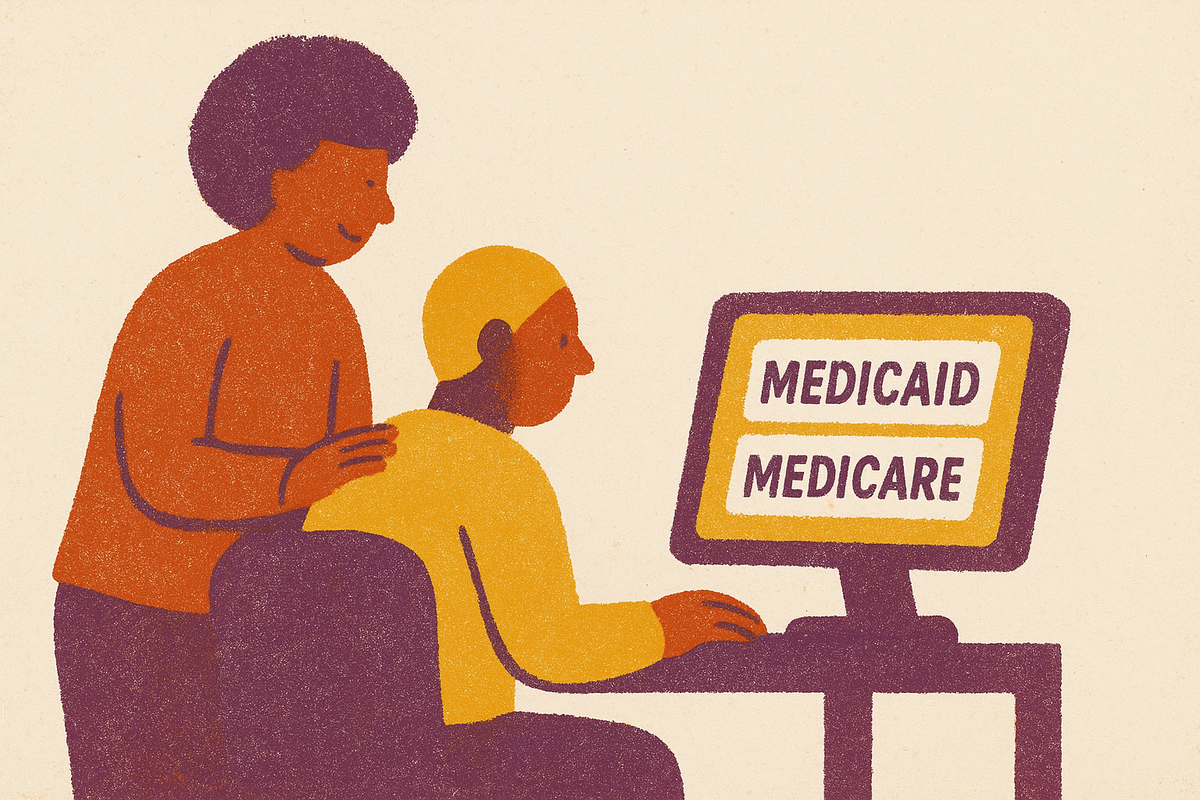
Most families carry a reasonable assumption into this conversation: Medicare, the federal health program everyone has heard of, covers sustained home care. It does not. Medicare pays for short-term skilled nursing or therapy following a qualifying hospitalization. Bathing, dressing, daily supervision — the kind of work that consumes a family caregiver's actual hours and years — none of that falls within Medicare's scope. Families learn this distinction with regularity only after a crisis has already landed.
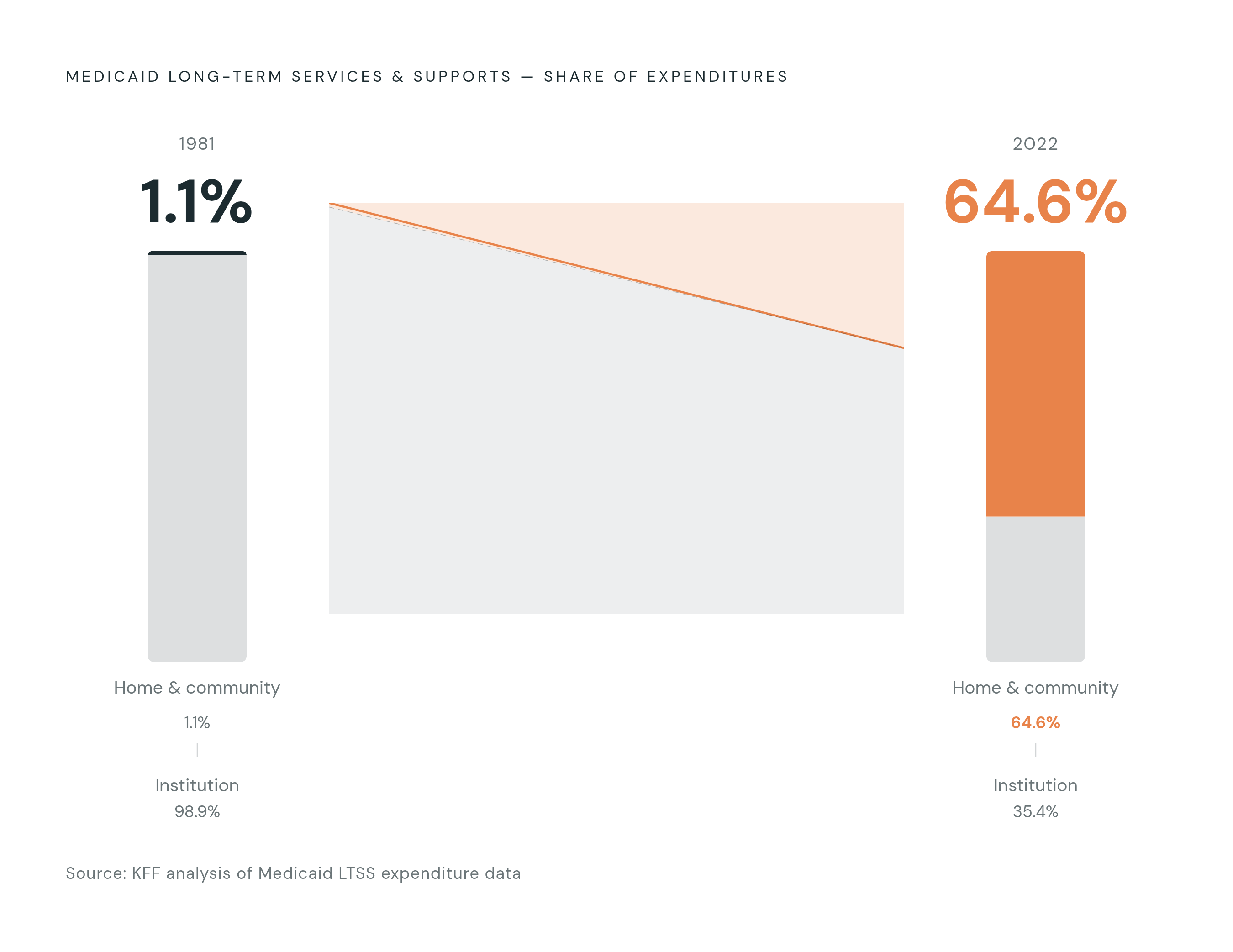
Medicaid is the actual payer. According to KFF, Medicaid covered roughly two-thirds of home care spending in the United States in 2022. That scale reflects four decades of deliberate reorientation: home and community-based services were just 1.1% of Medicaid long-term services and supports expenditures in 1981; by 2022, that share had grown to 64.6%. The system moved, incrementally but fundamentally, toward keeping people in their homes.
Approximately 4.5 million people use Medicaid home care, per KFF estimates, representing only about 5% of all Medicaid enrollees yet accounting for roughly 29% of total Medicaid spending. States notice those numbers. Eligibility is gated carefully, program designs vary substantially, and the administrative infrastructure is dense.
Here is the structural fact that makes everything else difficult: Medicaid operates under a federal framework but is administered at the state level. The federal government sets baseline rules and shares the cost; states design their own programs within those parameters, set their own eligibility thresholds within federal floors, and decide which optional benefits to offer. "Medicaid home care" is not one program. It is a category containing dozens of distinct state-level programs, each with its own application process, payment rates, and eligibility conditions. Every piece of information a family finds online about Medicaid home care may be accurate for some state and irrelevant for theirs.
What Self-Direction Means and Why It Is the Mechanism That Makes Family Caregiver Pay Possible
In a standard agency-based arrangement, the person receiving care has little say in who comes through the door. An agency contracts with Medicaid, assigns a worker, and manages the employment relationship. The recipient is a service recipient, not an employer. Self-direction inverts that entirely.
Under a self-directed model, the person receiving care — or a designated representative — becomes the employer of record, with authority to hire, train, schedule, supervise, and dismiss their caregiver. That caregiver can be a family member, a friend, someone who is already there. The care relationship does not have to change; what changes is its payment status.
This model did not emerge from a federal bureaucracy. It grew out of the disability rights movement, which argued, persuasively and over many years, that disabled individuals were best positioned to direct their own support arrangements. Early consumer-directed demonstration programs, funded by the Robert Wood Johnson Foundation across 19 states, built the evidence base that eventually persuaded Congress and CMS to authorize self-direction at scale. The COVID-19 pandemic accelerated expansion further: CMS granted states greater flexibility under self-direction waivers to address workforce shortages and safety concerns, and many of those flexibilities have remained in place.
All 50 states and the District of Columbia now offer some form of Medicaid-funded consumer-directed personal care assistance. KFF's 2025 survey found that all reporting states except Alaska allow self-direction in at least some circumstances. For a caregiver who has been providing unpaid care for months or years, a formal compensated arrangement is — in most states — a genuine possibility within the same Medicaid program the care recipient may already be using.
How Medicaid State Plan Personal Care Programs Work and Who Can Access Them
Within Medicaid's broader structure, two main pathways fund home care: state plan services and waiver programs. State plan personal care services are part of a state's standard Medicaid benefit. No special waiver is required; no separate federal approval process gates access. The practical consequence shows up most sharply in waiting lists, addressed later, but the access point itself is meaningfully simpler.
Three specific state plan authorities enable family caregiver payment: the Home and Community-Based Services State Plan Option, the Community First Choice Option, and the Self-Directed Personal Assistance Services State Plan Option. Each gives states a vehicle for offering consumer-directed personal care within their standard benefit package. Under any of them, an enrollee who self-directs can select and manage their own caregiver, including an adult child or other relative.
Spousal payment under state plans is more complicated. More states permit it than they did a decade ago, but restrictions remain common and the rules differ state to state. The practical instinct is often to assume prohibition and move on — an instinct that is frequently wrong, and wrong in a way that costs families real money. Verification against the specific state's current program rules is the necessary step.
Basic eligibility requires that the care recipient be Medicaid-enrolled and demonstrate functional need for assistance with activities of daily living. In 2024, state income thresholds for Medicaid eligibility ranged from $914 to $2,742 per month for an individual, reflecting the latitude states retain within federal parameters.
California's In-Home Supportive Services program illustrates what a large state plan personal care program looks like in practice. Roughly 600,000 Californians used IHSS as of 2024, making it one of the largest programs of its kind in the country. Adult children, parents, and other relatives can be paid as providers; spouses can be paid in certain circumstances. The program is administered through counties but governed by state rules and funded jointly by state and federal Medicaid dollars.
How 1915(c) HCBS Waivers Work, What They Cover, and the Income and Asset Rules That Govern Eligibility
Section 1915(c) of the Social Security Act, added by Congress in 1981, authorizes states to use federal Medicaid dollars to fund long-term care in home and community settings rather than nursing facilities. It was the legislative mechanism that made the shift toward community-based care financially viable for states, and it remains the primary vehicle for specialized HCBS programs across the country.
There are approximately 257 active HCBS waiver programs nationwide; states can operate as many as they choose, typically organizing them by population: older adults, people with physical disabilities, people with intellectual or developmental disabilities, people with traumatic brain injuries, and so on. Each waiver is a distinct program with its own eligibility criteria, service array, and enrollment capacity.
Two eligibility gates define waiver access. First, the person receiving care must meet a level-of-care requirement: they would require institutional placement, typically nursing facility care, without HCBS. That bar is not low — it screens for genuine medical and functional need, and families who assume they qualify without a formal assessment sometimes discover otherwise. Second, financial eligibility applies: in 2026, the income threshold is set at 300% of the SSI rate, equaling $2,982 per month for an individual, with an asset limit generally set at $2,000 in countable resources. For many families, a spend-down of assets is required before eligibility can be established.
The cost-neutrality requirement is less visible to applicants but shapes the entire program structure. States must demonstrate that average per-capita HCBS expenditures do not exceed what institutional care would have cost. This constraint explains why waiver programs cap enrollment, why waiting lists exist, and why states design benefit packages carefully rather than offering open-ended coverage. It is a genuine fiscal guardrail.
KFF's 2025 survey found that all responding states allow waiver payments to family members and friends. Forty-four states permit paying "legally responsible relatives," a category that generally includes spouses. Even so, 67.6% of 1915(c) waivers include provisions that effectively exclude spouses, though the list of states allowing spousal payment has grown substantially. The landscape has shifted; verifying the current rules for a specific state's specific waiver remains essential.
Payments to family caregivers are most common under waivers serving people with intellectual or developmental disabilities. Those waivers also carry the longest waiting lists.
New York's Consumer Directed Personal Assistance Program illustrates the waiver model at scale. Beneficiaries direct their own personal assistance, and adult children and friends can be employed as caregivers. Spouses, however, are explicitly prohibited under CDPAP's rules. That single design choice can upend months of planning for families who assumed a waiver's availability in their state translated to access for their specific situation.
What Structured Family Caregiving Offers and Where It Is Available
Structured Family Caregiving occupies a distinct position in the Medicaid home care landscape. It is neither a standard hourly wage arrangement nor a self-directed budget. It is a daily stipend model, available in 11 states as of 2025: Connecticut, Georgia, Indiana, Louisiana, Massachusetts, Missouri, Nevada, North Carolina, Ohio, Rhode Island, and South Dakota.
The mechanics are specific. Medicaid pays a contracted provider agency a daily rate. The agency passes between 50% and 65% of that rate to the caregiver and retains the remainder to fund coordination services, including a nurse and care coordinator who conduct home visits roughly monthly. The caregiver must live with the care recipient and provides supervision, personal care assistance, and homemaker services.
Payment rates vary by state, sometimes considerably. The American Council on Aging reports that most SFC states paid caregivers roughly $40 to $70 per day in 2025. South Dakota tiers its rates by care level, ranging from $82.00 to $114.81 per day effective July 1, 2026, with a minimum 50% passed to the caregiver. Missouri pays $103.80 per day effective July 1, 2025, with caregivers receiving at least 65% of that amount. At the higher end of those ranges, the daily stipend becomes meaningful income.
One distinction often buried in program descriptions: SFC stipends are generally tax-free. An hourly Medicaid wage is taxable earned income; an SFC stipend is not, which affects both net income and eligibility for programs tied to earned income thresholds. For a caregiver deciding between SFC and a self-directed hourly arrangement, that arithmetic is worth running before committing to either.
State eligibility conditions add meaningful variation, and some of it is restrictive enough to surprise families who assumed availability meant access. Missouri restricts SFC to recipients with Alzheimer's disease or a related dementia. Georgia requires that the caregiver be unable to work outside the home due to caregiving responsibilities, effectively limiting access to caregivers who have already committed fully to the role. These restrictions reflect deliberate state policy choices about which populations and caregiving arrangements to prioritize. A family in one of these states that meets the general SFC criteria but not these specific conditions may need to pursue a different pathway entirely.
The agency oversight model that defines SFC is both its feature and its constraint. Caregivers receive professional coordination support, which many find genuinely useful when managing complex medical conditions. In exchange, they operate within an agency relationship rather than fully directing their own arrangement. For families who want that coordination, the tradeoff may be worthwhile. For those who want full autonomy, a self-directed waiver or state plan option will fit better.
What Family Caregivers Are Typically Paid Across Programs and States
Medicaid self-directed programs generally pay family caregivers between $13 and $25 per hour, depending on the state and program. The Bureau of Labor Statistics reported that home health and personal care aides earned nearly $17 per hour in 2024. Family caregivers paid through Medicaid are compensated in roughly the same range as formal home care workers in the professional labor market, which is not always what families expect when they first encounter the number.
California's IHSS paid between $16 and $20.50 per hour in 2025, with the rate varying by county. New York's programs paid between $15 and $21 per hour depending on the area and program structure. For a caregiver providing 20 to 40 hours of care per week, the annual income at those rates is substantial, not supplemental.
Several factors move the rate within a given state. Cost of living informs state-level rate-setting. Program type matters: state plan programs and waivers may pay differently for the same services. Level of care required can affect authorized hours and, in some states, the rate itself. Caregiver training credentials shift compensation upward in certain programs.
KFF's 2025 survey found that 41 states allow enrollees to set their caregiver's payment rate within an approved range, and 39 states allow enrollees to allocate funds across authorized services. Self-directors are not simply accepting a fixed offer; they have genuine budgetary agency within the program's structure.
One limitation of SFC's per-diem model deserves direct treatment. For caregivers providing many hours of daily care, the daily stipend can translate to an effective hourly rate below minimum wage. A caregiver providing 16 hours of daily supervision in a state that passes through $45 per day is earning less than $3 per hour in effective terms. Running that arithmetic before committing to SFC — particularly for families managing high-acuity care needs — is not optional.
The Waiting List Problem That Sits Between Eligibility and Actual Enrollment
Eligibility and enrollment are not the same. A family can meet every financial and functional threshold for a waiver program and still wait years before receiving a dollar of compensation. Waiver programs have enrollment caps. State plan personal care programs generally do not. That structural difference is one of the most consequential in the entire Medicaid home care landscape — and one that families in crisis rarely have time to learn before they need to act on it.
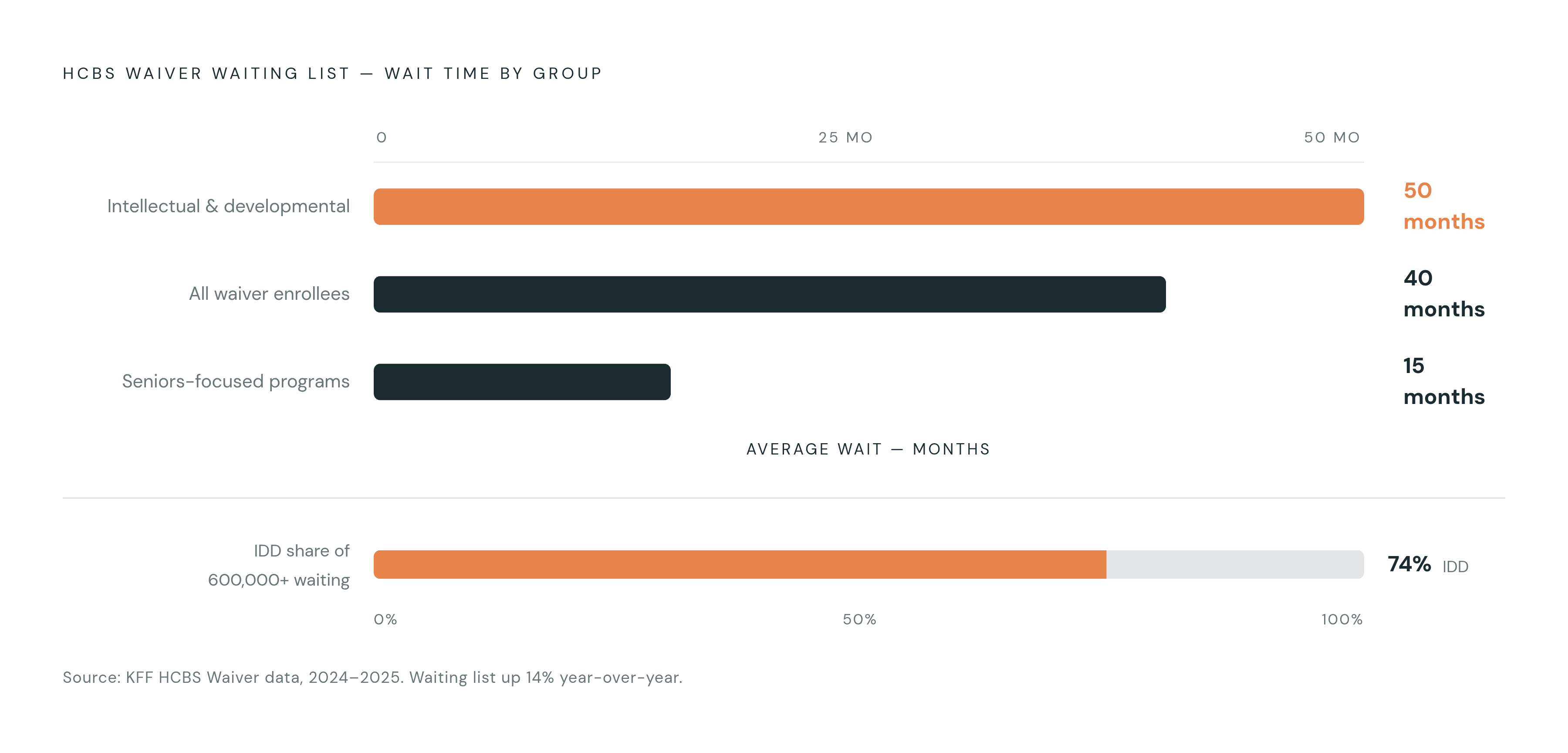
Total enrollment on waiver waiting and interest lists increased 14% between 2024 and 2025 and now exceeds 600,000 people, according to KFF's 2025 survey. In 2024, beneficiaries waited an average of 40 months before accessing waiver care, up from 36 months the prior year. For individuals with disabilities, the average wait stretched to roughly 50 months. People with intellectual and developmental disabilities make up approximately 74% of the total waiver waiting list population. That concentration explains why those programs, despite offering some of the most robust family caregiver payment options, are so difficult to enter quickly.
For programs targeting seniors specifically, the average wait in 2025 was 15 months. Still a meaningful delay for families managing immediate caregiving demands, but a different order of magnitude.
A 2024 CMS rule will require states to publicly report waiting list counts and average wait times beginning in July 2027. That transparency will be genuinely useful — but it does not yet exist in any standardized, comparable form, meaning families are currently making decisions with incomplete information about how long a given queue actually is.
The practical implication is direct: where both a state plan personal care option and a waiver program are available, applying to both simultaneously is often the most rational course. A state plan benefit, if available without a waiting list, provides immediate access. A waiver application, filed on the same day, starts the clock on what may be a long queue for a richer benefit package. Neither application precludes the other.
How a Caregiver Identifies Which Program Applies to Their Situation
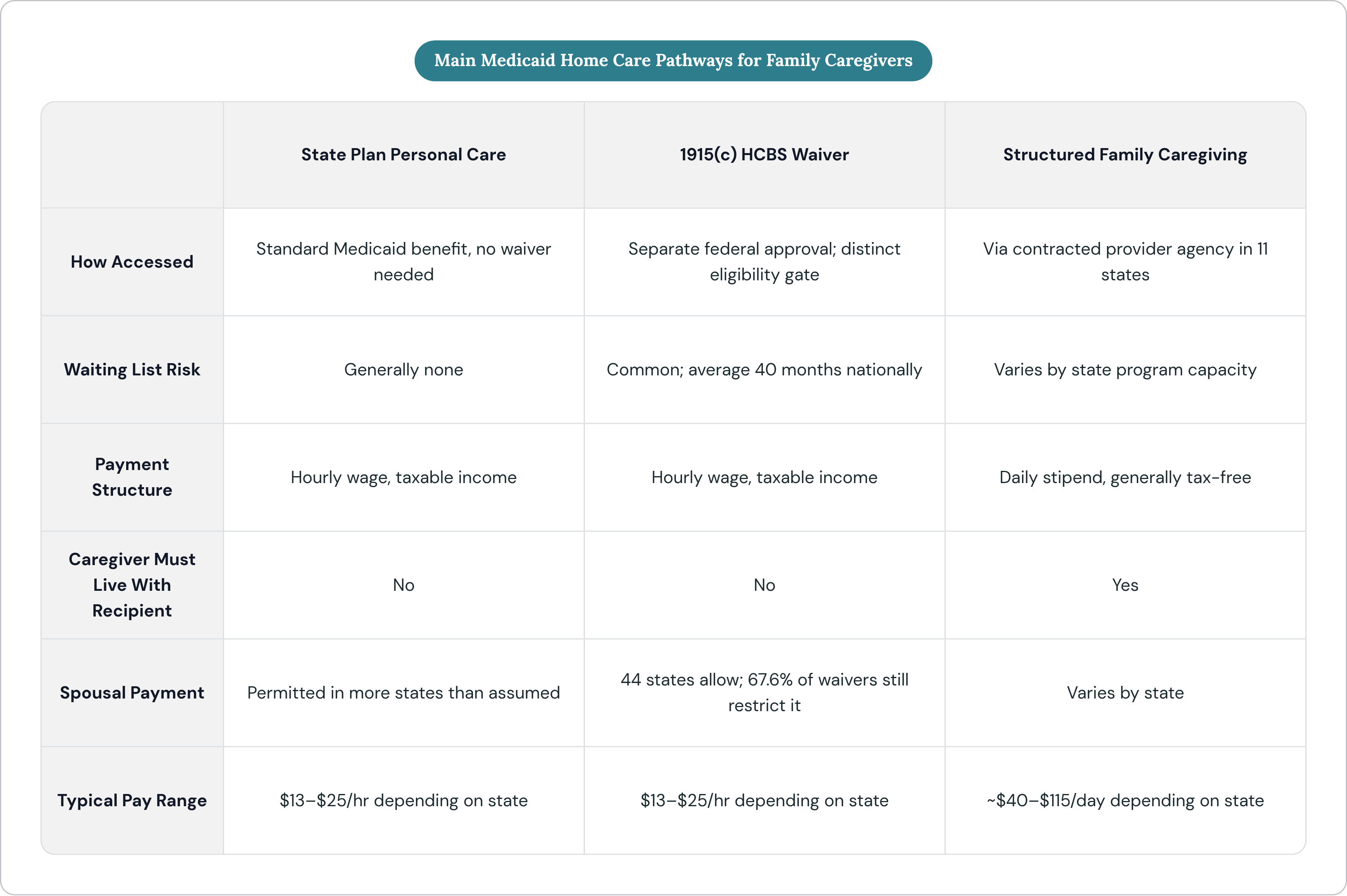
Four factors converge to determine which program, or programs, applies to any given family: the state the family lives in, the care recipient's Medicaid eligibility and specific diagnosis, the caregiver's relationship to the recipient, and whether the caregiver lives with the recipient. No single factor is sufficient on its own, and the interaction between them is where most families get stuck.
Spouse caregivers face the most variable landscape. The common assumption that Medicaid prohibits spousal payment is outdated in many states; 44 states now permit paying legally responsible relatives under at least some waivers. A spousal caregiver's first move is not to accept a prohibition but to verify the current rules for the specific state and specific waiver program under consideration. State plan options may also permit spousal payment, with program-specific conditions.
Adult children have the broadest access. Most states permit payment of adult child caregivers under both waiver and state plan programs. IHSS in California and CDPAP in New York represent two of the largest such programs in the country and demonstrate how differently two states can implement the same federal authority. An adult child in California operates within a county-administered, state-supervised system with county-specific wage rates. An adult child in New York operates within a beneficiary-directed model with distinct rate structures and an explicit spousal exclusion. Same federal framework, meaningfully different programs.
Caregivers in one of the 11 SFC states who live with the recipient and provide substantial daily supervision should assess SFC alongside other options, with close attention to the tax status of the stipend and the effective hourly rate given the actual hours of care provided. The agency oversight structure and reduced self-direction are real tradeoffs.
If the care recipient has an intellectual or developmental disability, waiver programs are disproportionately the access point, and the waiting list is likely to be long. Applying early is not a precautionary gesture; the data on average wait times make it a functional necessity.
One additional tool deserves mention, though it is distinct from the payment programs described above. The Caretaker Child Exception is a Medicaid estate planning provision, not a compensation program. It allows an adult child who lived with and cared for a parent for at least two years, thereby delaying institutionalization, to inherit the parent's home without Medicaid estate recovery. It does not pay the caregiver during the caregiving period. It does protect an asset that might otherwise be consumed by Medicaid's estate recovery process after the parent's death. For families navigating both compensation questions and estate questions, understanding this exception matters.
AARP estimates $600 billion in unpaid family caregiving annually. That number persists not because compensated alternatives are unavailable, but because finding them requires state-specific research, relationship verification, simultaneous applications, and patience with timelines that rarely align with caregiving realities. The system is navigable, and it rewards the people who go looking, whether through a state's own Medicaid office, an elder law attorney, or Brevy, a free service that helps families check eligibility for and enroll in Medicaid and caregiver payment programs, before they are desperate enough to accept whatever they are first told.