Legal Documents Every Family Caregiver Needs
Essential documents prevent costly guardianship battles when planning time runs out.

Legal capacity means, in plain terms, that a person understands what they are signing and can appreciate the consequences of that decision. Once it's gone, most of these documents can no longer be voluntarily created. What remains is a system designed to work around the absence of planning, and it is considerably less forgiving.
The core documents a family caregiver needs in place before a parent loses mental capacity are a durable financial power of attorney, a healthcare power of attorney (or healthcare proxy), a HIPAA authorization form, and an advance directive that includes a living will. The durable financial POA lets a named agent pay bills, access accounts, and handle financial affairs, and it must be durable specifically because a general POA lapses the moment the principal becomes incapacitated. The healthcare POA authorizes someone to direct or refuse medical treatment, choose care settings, and make decisions about organ donation, while the advance directive records the care recipient's own wishes about interventions such as resuscitation and mechanical ventilation, shifting end-of-life decisions from speculation to documentation. If these documents are not executed while the parent still has legal capacity, meaning the ability to understand what they are signing and appreciate the consequences, most of them can no longer be voluntarily created, leaving a system designed to work around the absence of planning that is considerably less forgiving.
The threshold is more contested than families expect. A dementia diagnosis does not automatically eliminate capacity. Someone with mild cognitive impairment can still legally execute a power of attorney. Conversely, a person may appear fully lucid in conversation and still lack the specific understanding required for a particular document. The window can close gradually, without any single obvious moment, until a document gets challenged in probate court and everyone realizes they waited too long.
A 2024 AARP survey found that nearly 60 percent of Americans over 50 lack essential estate planning documents. Caring.com's 2024 Wills and Estate Planning Study puts the share of Americans without a will at approximately 67 percent. That's not indifference. The same avoidance delays every uncomfortable planning conversation: the belief that the situation isn't serious enough yet, that there's still time.
There usually is time, until there isn't.
What Does a Durable Financial Power of Attorney Do, and Why Does It Have to Be Durable?
A financial power of attorney authorizes a designated agent to manage the care recipient's financial affairs: paying bills, accessing accounts, filing taxes, handling investments. The word "durable" is the critical modifier. A general power of attorney lapses the moment the principal becomes mentally incapacitated. A durable financial POA survives incapacity, which is precisely when it matters.
Agents routinely misunderstand the scope of what they've been given. A durable POA provides ongoing, broad authority; a limited POA restricts it to specific tasks or timeframes. But even a broad durable POA won't allow an agent to change the care recipient's will, and most do not, by default, grant authority to alter trusts or modify beneficiary designations on life insurance or retirement accounts. That last point surprises people every time. Broad authority and comprehensive authority are not synonyms. But what if the agent assumes they are? That assumption is where costly mistakes begin.
State-specific requirements vary enough that a document failing to meet them may be rejected outright by a bank. Working with an elder law attorney is worth the investment. A healthcare POA, by contrast, can often be executed without legal counsel in many states, but the financial instrument is where institutional gatekeeping is most aggressive.
The record-keeping obligations attached to this role are significant and underappreciated. An agent must keep separate accounts, maintain receipts, and avoid any commingling of funds with their own. Unintentional mismanagement can still expose an agent to accusations of financial exploitation. Without this document in place, a caregiver providing daily hands-on care has no legal standing to pay a parent's mortgage or speak to a financial institution on their behalf. That gap surfaces at the worst possible moments — not hypothetically, but in the specific, grinding reality of trying to keep someone's life administered while they can no longer do it themselves.
Healthcare Power of Attorney and Health Care Proxy: Who Speaks When the Patient Cannot
A healthcare power of attorney and a financial power of attorney are separate documents in virtually every state, even when the same person holds both roles. An agent's authority under a healthcare POA is specifically tied to medical decisions and typically activates only upon the patient's incapacity.
The scope of that authority is broad: directing or refusing interventions, stopping treatment, consenting to surgery, selecting care settings, making decisions about organ donation. Without a named proxy, medical decision-making defaults to a spouse or nearest blood relative, a process governed by state statute and not by the patient's actual values. Unmarried partners, regardless of the length or depth of the relationship, can be legally excluded from those decisions entirely. That outcome is not an edge case; it happens with enough regularity that it warrants being stated plainly.
Forms are state-specific. The named agent must be at least 18 in most states, 19 in Alabama and Nebraska, and of sound mind. Copies should go to the named agent, treating physicians, and any facility where the patient regularly receives care.
Naming a proxy is only half the job. The named person needs to know the care recipient's values well enough to apply them to situations the document couldn't anticipate. What trade-offs would this person accept? What does quality of life actually mean to them? A healthcare POA can authorize someone to make decisions; it can't tell them what the right ones are. Those conversations feel premature until, suddenly, they're overdue. Most families wait for a crisis to have them, which is precisely the wrong moment.
The HIPAA Authorization Form That Caregivers Routinely Overlook
HIPAA's privacy provisions restrict physicians, hospitals, and other covered providers from sharing patient information with family members, including adult children, without explicit patient authorization. Providers retain some discretion to share information with family members actively involved in a patient's care, particularly when the patient is present and does not object. That discretion is not a guarantee, and it evaporates when a caregiver is trying to access records remotely or dispute a billing error.
It is also worth considering the gap that catches people off guard: a healthcare POA covers medical decision-making during incapacity. It does not automatically grant access to records, test results, or provider conversations when the patient is still conscious and capable of communicating. Elder law attorney Harry S. Margolis recommends building the HIPAA release directly into the healthcare proxy or POA document rather than treating it as a separate administrative task, a practical suggestion that closes the gap before it becomes a problem.
I've watched this play out more than once: a caregiver who accompanies a parent to every appointment, manages medications, coordinates care across multiple providers, gets turned away at the front desk when asking for lab results. It's a small indignity with large consequences. Involvement and legal authorization are different things, and the front desk doesn't care how many hours you've put in.
Many providers maintain their own authorization forms that can be completed during an office visit. Authorization is typically provider-specific, so it should be updated when the patient changes physicians or health systems. Small administrative step, outsized reduction in friction.
Living Wills and Advance Directives: Recording the Care Recipient's Own Voice Before It's Gone
A living will states, in writing, which medical treatments a person does or does not want if they become unable to communicate. The decisions it most commonly addresses are resuscitation, mechanical ventilation, and artificial nutrition. The terminology is inconsistently used even in clinical and legal settings: "living will" and "advance directive" are often treated as interchangeable, but a living will is typically one component of a broader advance directive, which may also name a healthcare agent and express wishes about organ donation, pain management, and palliative care priorities.
The default in American medical practice, absent documented wishes, is maximum intervention: resuscitation, intubation, feeding tubes, continued aggressive treatment. That default reflects legal and institutional caution, not a judgment about what any individual patient would want. An advance directive is the mechanism by which a person opts out of that default, on their own terms, while they still can.
When a living will and a healthcare proxy agent's judgment conflict, the living will generally governs. This makes sense: it represents the patient's own competent decision, not a surrogate's interpretation. Research cited by LegalZoom found that 57 percent of end-of-life caregivers report family conflict, particularly when the decision-maker doesn't know the dying person's wishes. A written directive doesn't eliminate conflict, but it shifts the terrain from speculation to documentation.
Completion rates remain troublingly low. A Health Affairs meta-analysis drawing on nearly 800,000 individuals across 150 studies found that only 36.7 percent of adults had completed an advance directive, including 29.3 percent with living wills. These documents are not exclusively for older adults. The Mayo Clinic and the National Institute on Aging both recommend that all adults have one, because accidents and sudden illness do not discriminate by age. Medicare covers advance care planning as a billable component of the annual wellness visit, which gives caregivers a concrete entry point when encouraging the person they support to complete one.
POLST and MOLST Forms: Medical Orders for People Already Facing Serious Illness
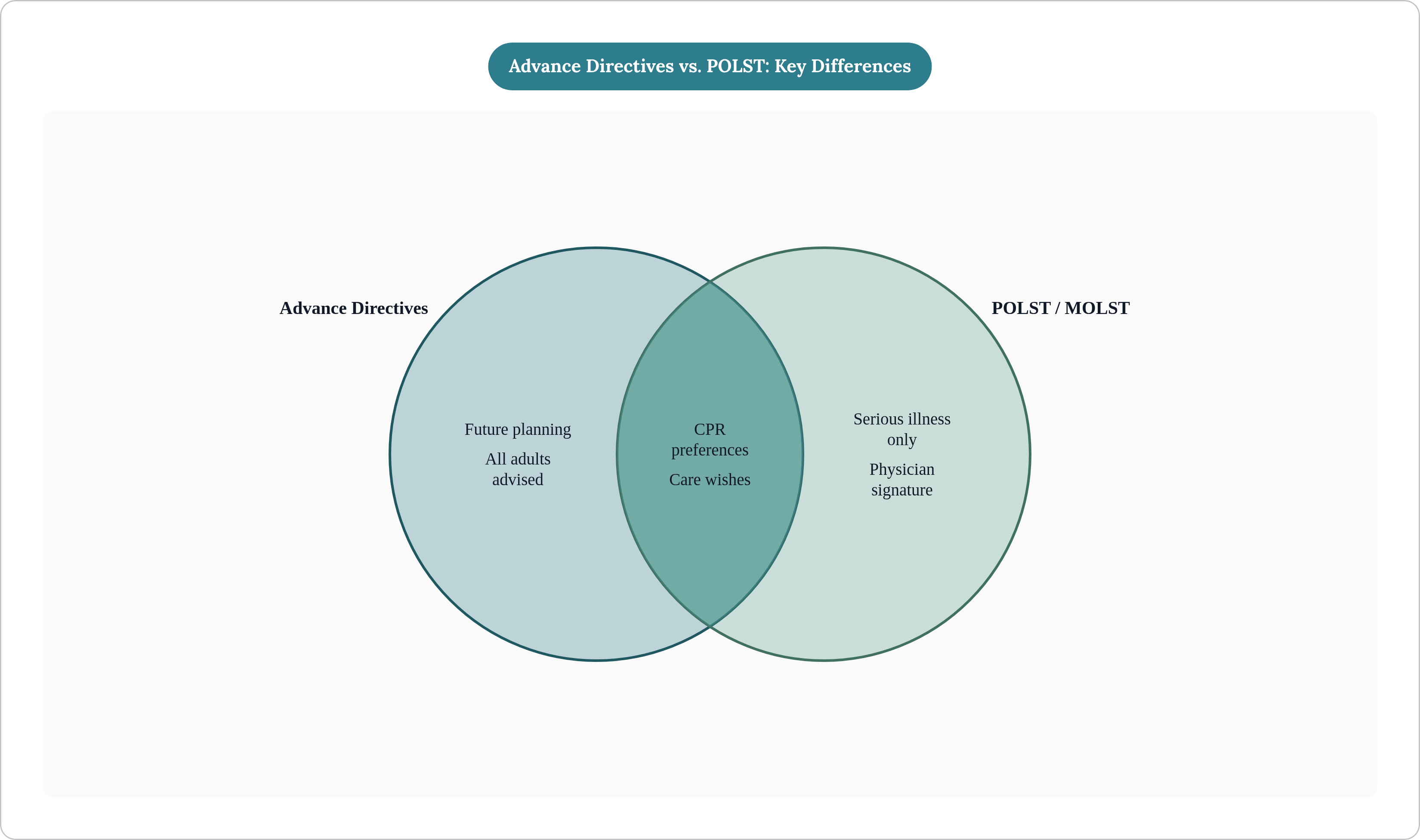
POLST (Physician Orders for Life-Sustaining Treatment) and MOLST (Medical Orders for Life-Sustaining Treatment) are frequently conflated with advance directives. They are not advance directives. They are signed medical orders, and that distinction is operationally significant in ways families rarely appreciate until it matters.
Because they carry a physician's signature, these forms are followed immediately by emergency responders, hospital staff, and care facility personnel, without requiring a clinician to interpret or translate them first. An advance directive instructs; a POLST orders. In an emergency, that difference determines what happens in the first minutes of response, when interpretation is a luxury no one has.
These forms are designed for people with advanced, progressive illness, serious frailty, or limited life expectancy. Clinicians often use a rough heuristic: a POLST conversation is appropriate when a physician would not be surprised if the patient died within the next year. The form is more granular than most advance directives, addressing CPR, intubation, artificial nutrition, antibiotic use, and hospitalization preferences in specific, actionable terms.
Portability is a defining feature. The POLST travels with the patient across home, hospital, nursing facility, and hospice settings. In a home setting it should be physically accessible, often posted near the front door, so that emergency responders can locate it without searching. Forms vary by state in both name and exact structure; the correct form for a given jurisdiction is best confirmed through the treating physician.
For caregivers who have just walked out of an appointment where a serious diagnosis was delivered, facilitating this conversation with the treating physician is among the most concrete things they can do next. Not the most comfortable. The most concrete.
Documents Caregivers Need for Themselves, Not Just the Person They Care for
Caregivers are often so absorbed in organizing documents for the person they support that their own go unaddressed entirely. This is understandable and also a mistake with real consequences. According to the 2025 AARP/NAC report, 11 percent of caregivers have left paid employment to provide care, with average annual lost income estimated at $21,500. A caregiver who becomes ill or incapacitated without their own legal documents in order creates a secondary crisis for the person who depends on them.
The caregiver's own checklist mirrors the one for the care recipient: a durable financial power of attorney, a healthcare proxy, and an advance directive. For caregivers with minor children, a will that names a guardian is not optional. The 29 percent of caregivers in the sandwich generation, simultaneously supporting aging parents and raising children, face legal exposure running in both directions simultaneously.
For caregivers providing compensated care through state or VA programs, the documentation of that role carries additional weight. Caregiver agreements, sometimes called personal care agreements, are written contracts between family members when one provides paid care. They establish the legitimacy of payments, protect against Medicaid look-back scrutiny, and formalize arrangements that are otherwise legally vulnerable. Employment records and caregiver agreements affect eligibility for programs and tax treatment in ways that are difficult to correct retroactively. The caregiver who handles this in year one is in a fundamentally different position than the one who tries to reconstruct it in year four, and the gap between those two positions is not small.
How to Organize, Store, and Share These Documents So They Work When Needed
The most common failure mode is not failing to create the documents. It's creating them and then making them inaccessible. A durable power of attorney locked in a safe deposit box no one else can open, or a healthcare proxy saved on a password-protected computer, is functionally useless in an emergency. The document's legal validity is irrelevant if no one can find it.
Each key person in the care network should hold a copy: the named agent or agents, the primary physician, any hospital where care is regularly received, and one accessible location in the home. Some states maintain registries for advance directives; confirming whether the relevant state has one, and registering accordingly, costs nothing and eliminates one retrieval problem entirely.
A one-page summary sheet attached to the full document set is worth the thirty minutes it takes to create. It should list what documents exist, where the originals are stored, and who holds copies. The goal is that someone operating under acute stress can grasp the situation without reading an entire legal document first, because that is the condition under which these documents get used.
The set should be reviewed whenever the care recipient's condition changes significantly, when a named agent becomes unavailable, and after major life events such as divorce or remarriage. A document naming someone who has since died or become incapacitated is often as useless as no document at all.
One point that surfaces late in too many conversations: documents like a financial DPOA and a caregiver agreement are frequently prerequisites for enrolling in Medicaid waiver programs, VA caregiver benefits, and state-funded caregiver compensation. That raises an important question families rarely ask until it's too late: are the documents already in place, or will they be assembled under pressure at exactly the moment an application is pending? Families who have these in order before applying tend to find doors open; families who lack them tend to find out what they're missing at exactly the moment they can least afford the delay. The paperwork is never the interesting part of caregiving. It is, however, the part that determines what resources are available for everything else.