Advance Care Planning vs Estate Planning Differences
Wills handle assets after death; advance directives guide medical decisions during life.

Estate planning, in the common imagination, means a will. In practice, a comprehensive estate plan involves several instruments that do materially different work, and conflating them is how families end up with a false sense of security.
A will directs asset distribution, names an executor, and designates beneficiaries, but it operates entirely after death and passes through probate before it produces any legal effect. A trust transfers assets outside probate and gives the grantor considerable control over how and when beneficiaries receive property; depending on structure, it can also address incapacity during life. A financial power of attorney, often overlooked relative to the will, is actually the most immediately operational document in the set: it authorizes an agent to handle banking, investment, and property transactions if you become incapacitated, without requiring court intervention. Then there are beneficiary designations on retirement accounts and life insurance policies, which pass assets entirely outside the will and outside probate. Misalignment between those designations and the broader estate plan is among the most common oversights practitioners encounter. It surfaces at exactly the wrong moment.
Advance care planning is less a document than a process. The National Institute on Aging describes it as an ongoing series of communications among patient, family, and healthcare providers about future medical preferences, calibrated for situations where serious illness or incapacity makes real-time decision-making impossible. The documents that formalize this process are distinct from each other in ways that matter enormously. A living will records specific treatment preferences, covering scenarios like mechanical ventilation, artificial nutrition, or resuscitation, for circumstances in which the patient cannot speak. A healthcare power of attorney, sometimes called a healthcare proxy, appoints someone to make the full range of medical decisions when you cannot communicate; this authority is not limited to end-of-life situations, which is a persistent and consequential misconception. POLST and MOLST orders (Physician Orders for Life-Sustaining Treatment and Medical Orders for Life-Sustaining Treatment, respectively) are portable medical orders designed to travel with a patient across care settings: hospital, nursing home, hospice, home. These are physician orders, not statements of preference, which gives them a different legal and operational status than a living will.
One clarification worth making explicit: a living will is one specific type of advance directive, not a synonym for the broader category. The terms are frequently conflated, and the conflation matters when someone believes their documents are in order but has only a living will without a named healthcare proxy, or vice versa. Half a system, with no way to know it.
A will contains no medical instructions. Only an advance directive ensures treatment preferences are legally recorded in a form healthcare providers can act on. Which raises a question worth sitting with: if someone has spent years carefully building an estate plan, have they also addressed what happens to them before death?
Where the Two Plans Share the Same Ground
The two domains converge in one specific window: the period of incapacity, when you are alive but cannot direct your own affairs. In that window, both a financial power of attorney and a healthcare proxy are active instruments. These documents can sit within either plan conceptually, but the more important point is whether they exist at all. Missing from either plan, the gap is identical.
The same individual can, and often does, serve as both healthcare proxy and financial power of attorney. During a medical crisis, having one person authorized to speak across both domains simplifies coordination considerably. A hospitalization that requires simultaneous medical decisions and the management of bills and accounts becomes logistically cleaner when a single trusted person holds both authorities. That concentration of authority is worth examining carefully, though, because it places significant power in one set of hands, and not every family dynamic supports that arrangement, however much everyone would like to believe otherwise.
The boundary that matters most is this: power of attorney authority ends at death. The moment a principal dies, a financial POA is void. What governs from that point forward is the will, the trust, and the beneficiary designations. Advance care planning documents are instruments for life; wills and trusts are primarily instruments for death. A family that has only an estate plan but no advance directives has addressed death but not incapacity. That is the gap most families do not see until they are standing in it.
How Few Families Have Either Plan in Place
The empirical picture is consistent across multiple data sources, and it is not encouraging. A September 2025 Pew Research Center survey of 8,750 U.S. adults found that roughly three in ten have a will, and approximately the same share have a living will or advance directive. A 2025 Trust & Will report surveying 10,000 adults found that 55% have no estate documents whatsoever. The Pew data also illustrates a striking age gradient: 81% of Americans over 72 have a will, compared to 27% of those between 25 and 54. Planning becomes urgent for most people only when death feels proximate, which is precisely when the window for thoughtful preparation has narrowed.
Advance directive adoption tracks closely. Health Affairs has reported that only about one in three U.S. adults has any form of advance directive in place. Research published in the American Bar Association's Bifocal journal found that having a will is highly predictive of having an advance directive; the two documents tend to travel together, and when one is absent, the other usually is too. This co-movement suggests that the barrier is less about any specific document and more about a broader reluctance to treat future incapacity and death as planning problems at all.
Race and income compound these gaps in ways the aggregate numbers obscure. The 2025 Pew data shows that White Americans are meaningfully more likely to have a will than Black or Hispanic Americans. Lower advance care planning rates among Black older adults in particular are associated with documented mistrust of the healthcare system and disparities in health literacy, both structural problems, not individual failures. The 2025 Trust & Will report found that households earning over $1 million are roughly twice as likely to have a will compared to households earning under $25,000. Access to estate planning has long been, in significant part, a function of access to legal counsel, and that fact does not become less uncomfortable the more plainly it is stated.
What Happens to Families When These Documents Are Missing
The consequences of absent estate documents are procedural and financial. Dying without a will triggers intestate succession: assets are distributed according to state law, not personal preference, and the state's assumptions about family structure may bear no resemblance to actual relationships. Probate can consume a meaningful share of an estate's value and delay distributions for months or years, depending on jurisdiction and complexity.
The consequences of absent advance directives are harder to quantify but more immediately personal. Without documented preferences, medical decisions default to a state-determined surrogate hierarchy, typically spouse, then adult children, then parents, then siblings. That default order may not reflect actual trust, relationship quality, or the texture of a family that outsiders cannot see. Research has found that 57% of end-of-life caregivers report family conflict when the patient's wishes are unclear, and that conflict falls most heavily on whoever is designated as surrogate, who must carry choices made without any guidance.
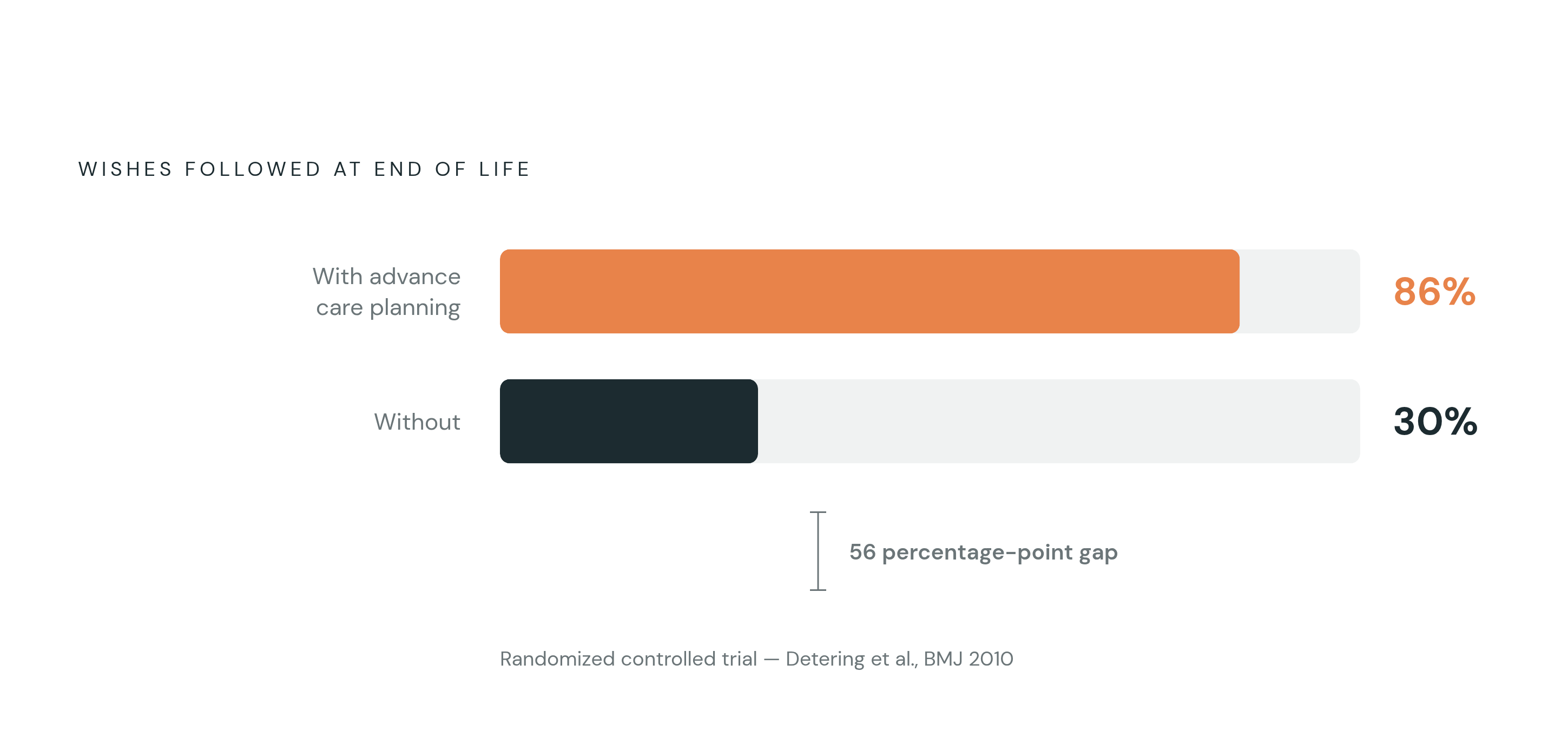
A landmark randomized controlled trial found that when advance care planning was in place, end-of-life wishes were followed in 86% of cases, compared to 30% in the control group. The distance between those numbers represents the practical cost of not planning, measured in fidelity to what the patient actually wanted. But consider the family that believes they have planned sufficiently: conversations had, preferences expressed, wishes understood, and no documents to back any of it up. That gap between intention and legal instrument is exactly where the 86% and the 30% diverge.
For families navigating active caregiving alongside these questions, absent documents create a further complication. Documented authority is frequently a prerequisite for accessing Medicaid applications, caregiver compensation programs, and other benefits that require someone to act legally on a loved one's behalf. A family member without a valid power of attorney may find themselves frozen out of processes they are trying desperately to help with, at precisely the moment help is most needed.
Why State Law Makes Document Validity More Fragile Than Most People Realize
There is no federal standard governing either advance directives or estate documents. Each state sets its own requirements for witness signatures, notarization, and the scope of decisions the documents are permitted to cover. For people who move frequently, own property in multiple states, or spend significant time across state lines, this is not a technicality.
California requires either notarization or two adult witnesses for a valid advance directive. New York separates the healthcare proxy designation from specific treatment instructions into two distinct documents. Texas offers a statutory form but permits custom language if it satisfies legal criteria. A directive validly executed in one state may not be recognized in another, a real and underappreciated risk for people who relocate after retirement or travel seasonally.
Estate planning faces similar fragmentation. Intestacy laws differ by state, which means the consequences of dying without a will are unpredictable without knowing the specific hierarchy your state has established. A spousal share in one state may look nothing like a spousal share in another.
POLST and MOLST orders carry a portability advantage that standard advance directives lack: they are designed to travel with the patient across care settings, so that a patient moving from a hospital to a skilled nursing facility to home hospice does not lose the operative effect of her documented preferences at each transition. Even so, form requirements vary by state, and a POLST completed in one state may require re-execution in another.
Any existing documents should be reviewed when someone moves to a new state, reviewed by an attorney familiar with local requirements rather than assumed to carry over automatically. That step is easy to defer and expensive to skip.
How to Think About Which Documents Belong in Which Plan, and in What Order to Get Them
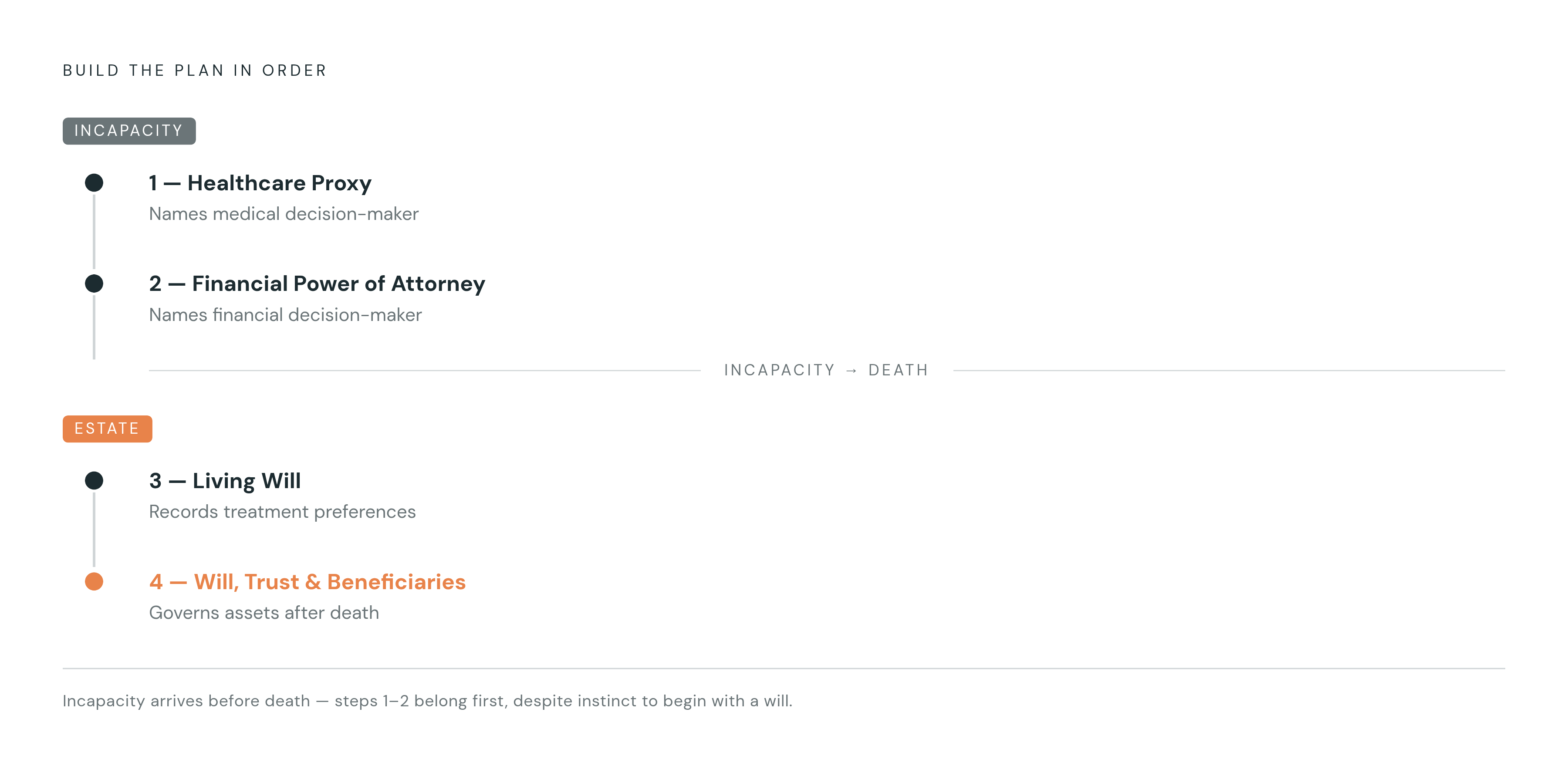
Most people, when they finally engage with planning, reach for a will first. That instinct is understandable but probably backward. Incapacity can arrive long before death does, and the documents governing incapacity are the ones most immediately relevant to adults at any age. Death is the feared outcome; incapacity is the statistically more likely first arrival.
Start with the two incapacity documents. A healthcare proxy names the person authorized to make medical decisions when you cannot communicate; it is the single most consequential document in an advance care planning context. A financial power of attorney names the person authorized to manage money, pay bills, and conduct property transactions. Together, these two instruments address the most immediate vulnerability: a sudden illness or accident that leaves you alive but unable to direct your own affairs. They are as relevant to a 32-year-old with no assets as to a 70-year-old with a complex estate.
Add a living will to capture specific treatment preferences. Without written guidance, the healthcare proxy must make judgment calls about preferences they may never have discussed with you. A living will transforms that dynamic; instead of guessing, the proxy is interpreting. The two documents work together, and neither is fully adequate without the other.
Build the estate layer once the incapacity documents are in place. A will addresses what happens to assets after death and should align with any trust structures and beneficiary designations. Beneficiary designations on retirement accounts and life insurance policies pass outside the will entirely; reviewing and updating them is one of the simplest and highest-leverage steps in estate planning, and it is frequently deferred until misalignment has already become a problem. A trust adds probate avoidance and distribution control, but it is not a universal necessity; the circumstances that warrant one depend on asset complexity, family structure, and state-specific probate considerations.
Who holds each role also deserves real thought. Naming the same person as both healthcare proxy and financial power of attorney simplifies coordination, but concentrates authority significantly. Whether that makes sense depends on the trust and capability of the individual, the dynamics of the family involved, and whether there are circumstances in which a check on that authority would be valuable. These are not comfortable conversations, which is probably why they happen so rarely.
For families managing active caregiving alongside planning, documented authority is not merely a legal formality. A valid power of attorney or healthcare proxy is frequently a threshold requirement for accessing caregiver compensation programs, initiating Medicaid applications, and conducting financial transactions on behalf of a loved one. Planning, in this context, is not only about the future; it is about unlocking access to resources that exist right now.
Both plans should be revisited after major life changes: a move to a new state, a significant health diagnosis, a marriage, a divorce, a death in the family. Documents that were accurate and valid at execution can become inaccurate, legally stale, or misaligned with current preferences without any single dramatic failure, simply through the accumulation of change over time. A set of documents, checked periodically against a life that keeps moving, reflecting who you actually trust and what you actually want now: that is the thing worth building toward.