Aging in Place Technology and Home Modifications
Eighty percent of falls happen in one room, making home modifications predictable and preventable.
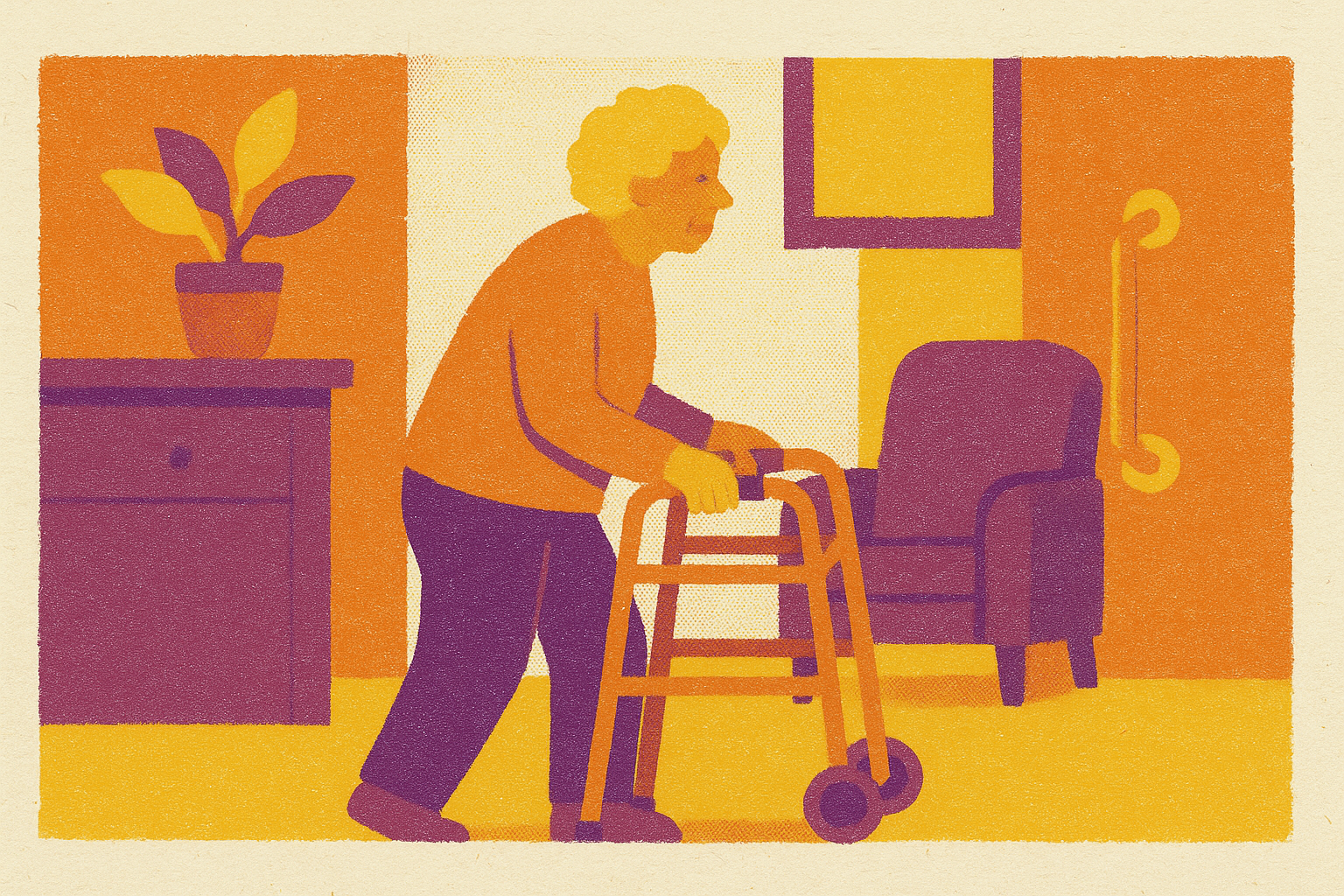
More than 14 million adults 65 and older fall each year, roughly one in four, generating over 3 million emergency room visits annually, according to the CDC. The death rate from falls in this age group rose 21% between 2018 and 2024. Aggregate medical costs exceed $50 billion per year.
None of that is trending in a favorable direction, and none of it surprised me once I understood where falls actually happen.
Eighty percent of home falls occur in the bathroom. That single data point reframes the entire problem. This is not a story about random misfortune distributed evenly across daily life; it is a story about predictable hazards concentrated in predictable places. Which means it is also a story about prevention, because environments can be changed in ways that luck cannot.
I kept returning to this early on: if falls follow patterns, and the evidence is pretty clear that they do, then the home is not merely a backdrop to the problem. It is the primary lever. Treating home modification as a comfort project, or a cosmetic gesture toward an aging parent's dignity, is a category error with real clinical consequences. Under-scoped responses to this kind of predictable, patterned risk do not hold.
Where to Start with Home Modifications: What Changes Matter Most and What They Cost
The Bathroom First
The fall data does not suggest starting in the bathroom; it insists on it. The most frequently installed modification is the grab bar, with NAHB CAPS program data showing 93% of remodelers reporting installations in the past year. An installed pair runs around $150 at the entry level. A full accessible bathroom remodel can reach $40,750 depending on scope and market, with Zonda's 2024 Cost vs. Value Report placing resale return at roughly 49%. Houzz's 2025 data shows 68% of bathroom renovators now factor accessibility into planning, up four points year over year.
Walk-in tubs range from $3,000 to $10,000. Roll-in showers and non-slip tile are common at the more modest end. But here is where I would push back against the checklist mentality: the right modifications depend on the actual risk profile of the person living there, not a generalized menu of products. An occupational therapist evaluation before any contractor conversation is often the highest-return first expenditure in this process. I say that having watched well-intentioned renovations sail past the actual hazard entirely, spending real money to solve the wrong problem.
Beyond the Bathroom
Entryways are the second priority. A no-step entry or ramp is among the first features forward-thinking builders now incorporate as standard practice, though that shift is more recent than it should be. Stairlifts run $3,000 to $5,000 for a straight run. A more anticipatory option, one I find underutilized, is the stackable closet: positioned at each floor level, it preserves the structural option to install a future in-home elevator without opening walls. That costs almost nothing at construction and can avoid a five-figure expense later.
Kitchen modifications focus on counter height flexibility and clearance for those working seated. AARP's 2024 data shows 39% of those actively planning modifications expect to add accessible kitchen features. Doorway widening to 36 inches, the standard for wheelchair and walker access, typically folds into a larger retrofit rather than standing alone as a project.
The full cost spectrum runs from roughly $150 at the grab bar end to well over $100,000 for whole-home retrofits, with most projects landing between $3,000 and $15,000. AARP's 2024 survey found 43% of adults 50 and older plan to make modifications for future needs; of those, 72% expect to prioritize bathroom work and 71% anticipate larger structural projects. The intent is present and consistent. Execution is where it stalls, and that gap deserves more scrutiny than it typically receives.
Why Universal Design Costs Far Less Than Retrofitting the Same Features Later
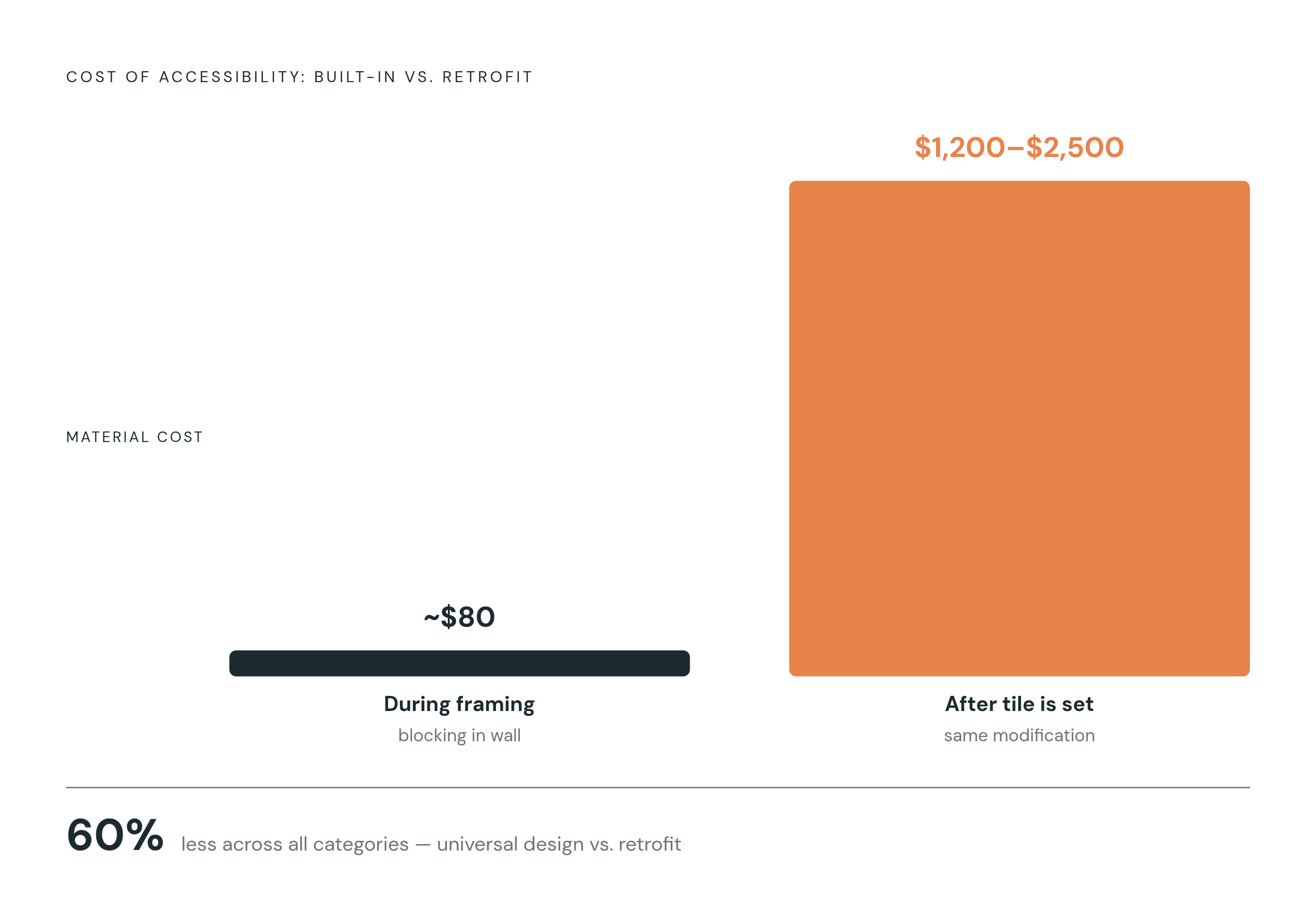
Universal design means embedding accessibility before the walls close and the tile sets. Retrofit means modifying after barriers have already materialized. The cost difference between these two paths is not a minor line-item variance; it compounds across multiple systems in ways that reliably catch families off guard.
One concrete illustration: blocking inside a bathroom wall, the lumber framing that allows a grab bar to be anchored securely at any point along the surface, costs roughly $80 in materials during framing. After tile is in place, the same modification costs $1,200 to $2,500. Across modification categories, the cost of universal design is estimated at roughly 60% less than equivalent retrofitting. That is an argument for treating accessibility as infrastructure from the outset, not as accommodation appended after the fact.
Seventy-six percent of remodelers report increased demand for aging-in-place renovations over the past five years. The aesthetic objection that once suppressed uptake, the institutional look historically associated with grab bars and walk-in tubs, is losing ground as manufacturers respond with products that integrate into contemporary design rather than announcing themselves as medical equipment. That shift matters. Design stigma was a real barrier, not a polite fiction, and its erosion opens space that previously was closed off entirely.
Anyone building new or undertaking a major renovation has a window to embed accessibility at minimal marginal cost. That window closes when construction does, and the expense shows up years later as something that was entirely avoidable.
How to Find a Contractor Who Actually Knows This Work
Most general contractors are not trained in aging-in-place work, and that gap is consequential. Accessible design involves specific building code requirements, functional considerations particular to reduced mobility, and occasional coordination with healthcare providers in ways general residential construction simply does not require. The relevant credential is CAPS: Certified Aging-in-Place Specialist, administered by the National Association of Home Builders. Certification requires three courses covering accessible design, building codes, and the functional needs of older and disabled adults, along with an ethics agreement. Approximately 7,000 active CAPS professionals are working in the United States as of 2026. The NAHB website maintains a searchable directory by zip code.
The occupational therapist belongs in this conversation as well, and often before the contractor enters it. An OT can conduct a formal home assessment, identify specific risk factors and modification priorities, and produce documentation that informs both contractor scope and any insurance or benefit program applications. The sequence that actually works: assessment first, specification second, contractor engagement third. Leading with a contractor and working backward is a reliable path to over-building in some areas while missing critical ones entirely. I have watched it go wrong in both directions. Neither version is cheap.
The Technology Layer: What Each Category of Aging-in-Place Tech Actually Does
AARP and CTA's January 2025 joint research found that 80% of older Americans currently own at least one type of technology that enables aging at home, averaging seven devices per person. The image of older adults as technology-resistant has been empirically outdated for some time. The more accurate picture is a population already embedded in a technology ecosystem, with specific unmet needs the market is actively, if unevenly, trying to address.
Smart Home Devices and Voice Assistants
About half of American seniors own at least one smart home device, with voice-controlled assistants being the most common. The core aging-in-place function is hands-free control: lights, locks, thermostats, and appliances operated without requiring physical navigation across the home. For someone managing reduced mobility or balance concerns, eliminating unnecessary trips across a room is not a trivial benefit. Smart thermostats and video doorbells are the next most widely owned devices in this category.
Wearables and Health Monitoring
The current generation of wearables bears little resemblance to the fitness trackers of a decade ago. Modern devices track heart rate, detect falls, and analyze sleep patterns. Apple Watch's fall detection did something genuinely important for this category: it normalized the smartwatch as a serious safety device through a platform people already wanted for other reasons, sidestepping the stigma that dedicated medical alert devices had accumulated over decades. Stigma has quietly killed more than a few otherwise capable products in this space, and any technology that routes around it deserves credit for that.
Remote patient monitoring is projected to reach 70 million users by the end of 2025. In-home monitoring has extended beyond wearables into passive systems, including smart scales, mattress sensors, and chair sensors that collect health data without requiring the older adult to remember to put anything on. That passivity is structurally significant. Behavior change is the hardest variable to manage in any health intervention; systems that remove the requirement for it hold a meaningful advantage over those that depend on it.
Personal Emergency Response Systems
The traditional PERS pendant was the first generation of consumer aging-in-place technology, and it carried a stigma problem nearly from the start. The standalone pendant category is maturing, and PERS vendors are migrating toward the reimbursed remote patient monitoring space as a result. The more consequential evolution is the shift from dedicated pendant to smartwatch: worn consistently, integrated with broader health data, and considerably less stigmatized in daily use. The device an older adult will actually wear is more valuable than the one with superior specs that lives in a drawer.
Telehealth
Pandemic-era telehealth adoption has proved stickier than many analysts anticipated. Most Medicare Advantage plans now include telehealth as a standard benefit. The aging-in-place relevance is direct: reduced transportation requirements for routine care. Access via smartphones, tablets, or television sets means telehealth is compatible with devices already in most older adults' homes, which probably explains why retention has held up better than skeptics predicted.
AI and Predictive Monitoring
Artificial intelligence is no longer a distinct product category in aging-in-place technology; it is a layer embedded across all the categories above. The more consequential development is the shift in function from reactive to predictive. Detecting a fall after it occurs is useful. Flagging elevated fall risk before a fall occurs is a different order of capability, and the distinction is not semantic. Sage's $65 million raise from Goldman Sachs specifically to develop AI-based fall prediction, reported by Aging and Health Technology Watch in 2025, signals that serious capital is following that premise.
Robotics
Robotics appears prominently on the 2025 AgeTech Market Map as a leading growth segment, but its current role in mainstream aging-in-place practice remains limited. The persistent criticism from practitioners and researchers is that products in this space have been designed for caregiver convenience rather than the expressed preferences of older adults, a distinction the field has not yet resolved. Ethical questions around privacy and workforce displacement remain open. Worth tracking; not yet part of a practical implementation sequence.
Why Older Adults Are Adopting Technology Faster Than the Industry Expected
AARP's 2025 Tech Trends report found that adults 50 and older now use technology products at the same rate as younger adults. Sixty-six percent describe technology as enriching their lives and making aging easier. Among adults 80 and older, the share reporting that technology enables a healthy life rose from 39% in 2024 to 46% in 2025, a seven-point shift in a single year among the cohort historically most resistant to adoption.
I find the most compelling explanation is that the value proposition for this group is simply more concrete than it is for almost anyone else. Technology that keeps someone in their own home, near their community and their routines, carries stakes a younger user rarely feels with comparable urgency. The product has a job to do and they know exactly what it is.
Over half of older adults express high likelihood of purchasing additional aging-at-home technologies, per the AARP and CTA January 2025 research. The categories they are actively considering include connected medical alert devices, digital hearing aids, and remote monitoring for blood pressure and glucose. This is demand-driven adoption, not market-manufactured interest. That distinction matters for anyone trying to assess where the sector is actually headed rather than where companies wish it would go.
The Real Barriers: Cost, Design, and the Confidence Gap
Enthusiasm for aging in place should not be read as an absence of friction. The barriers are structural, and they interact in ways that compound.
Cost is the most consistent obstacle. Sixty-seven percent of seniors said rising living costs made aging in place harder in 2024. Forty-three percent of adults 50 to 80 are not confident they could afford long-term care or in-home support if needed. Financial assistance infrastructure exists but is fragmented in ways that defeat most families without professional navigation support. Medicaid waivers in many states cover home modifications; some Medicare Advantage plans now include certain home safety modifications as supplemental benefits; Area Agencies on Aging and state programs offer grants and low-interest loans; Veterans Affairs covers modifications for eligible veterans. Accessing any of this requires time, knowledge, and persistence that most households cannot reliably supply, and the people who most need help are often least positioned to navigate the process. That is a real structural problem, not a minor implementation detail.
The design problem operates differently but compounds the first. Sixty-four percent of adults 50 and older do not feel that technology was designed with them in mind, and they are largely correct. Interfaces and workflows built for younger users create friction that produces abandonment, regardless of the underlying technology's capabilities. This is a product development failure, not a literacy problem, and the sector has been slow to own that distinction.
There is also a labor shortage that rarely receives adequate attention in these conversations. A national shortage of care workers projected to reach 151,000 by 2030 and 355,000 by 2040 means the human caregiving infrastructure available to support aging in place is contracting precisely as demand grows. Technology investment is accelerating partly from genuine enthusiasm for the category, and partly because the alternative, human care at adequate scale, is a trajectory current workforce projections cannot support. Those two pressures are not in conflict; they are converging on the same conclusion from different starting points, and that convergence has real implications for how quickly the sector needs to mature.
How Modifications and Technology Work Together, and How to Sequence Them
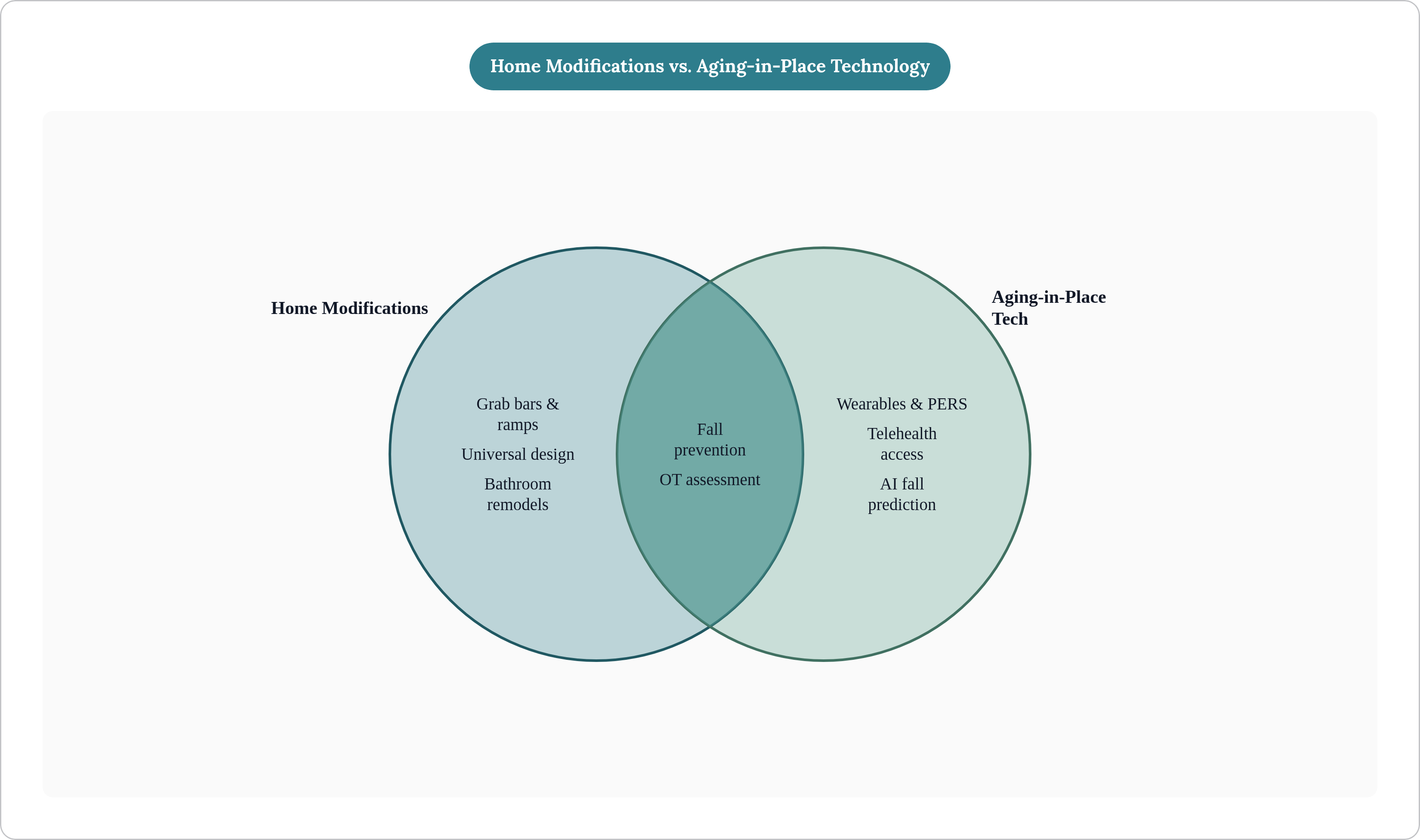
Modifications reduce physical barriers; technology adds monitoring, communication, and response capability. Neither is sufficient alone. A well-modified home with no monitoring leaves a meaningful gap in early detection. A well-monitored home with dangerous bathrooms and inaccessible entries is instrumented risk, not managed risk. That distinction sounds tidy when stated plainly, but I have seen it overlooked in both directions more times than I can count.
The sequencing that tends to work: begin with a professional home safety assessment, ideally conducted by an occupational therapist, before any money changes hands. Address the highest-risk physical hazards first: bathroom, entry, stairs. Then add passive monitoring technology, systems that require no behavior change from the older adult, before introducing active-use devices that depend on consistent engagement. Voice control and smart home integration follow, reducing navigation demands once physical barriers are resolved. Wearables and telehealth layer in as health conditions and care coordination needs evolve over time.
The financial logic of early action applies to technology infrastructure the same way it applies to structural modifications. Integrating smart wiring, hub infrastructure, and sensor capacity during a renovation costs considerably less than retrofitting it once walls are finished.
The goal is not a maximally equipped home. It is a home calibrated to the actual risk profile, habits, and needs of the person living in it. Fifty-five percent of caregivers already use one or more forms of technology to coordinate caregiving responsibilities, according to AARP's 2025 data. The technology layer is increasingly serving the broader care household, not just the older adult at its center, which has real implications for how families plan, how contractors scope projects, and how product developers define their user.