Veterans Benefits That Compensate Family Caregivers
Five distinct VA programs offer caregiver compensation through different eligibility paths.

Why There Is No Single VA Caregiver Benefit, and How the Programs Fit Together
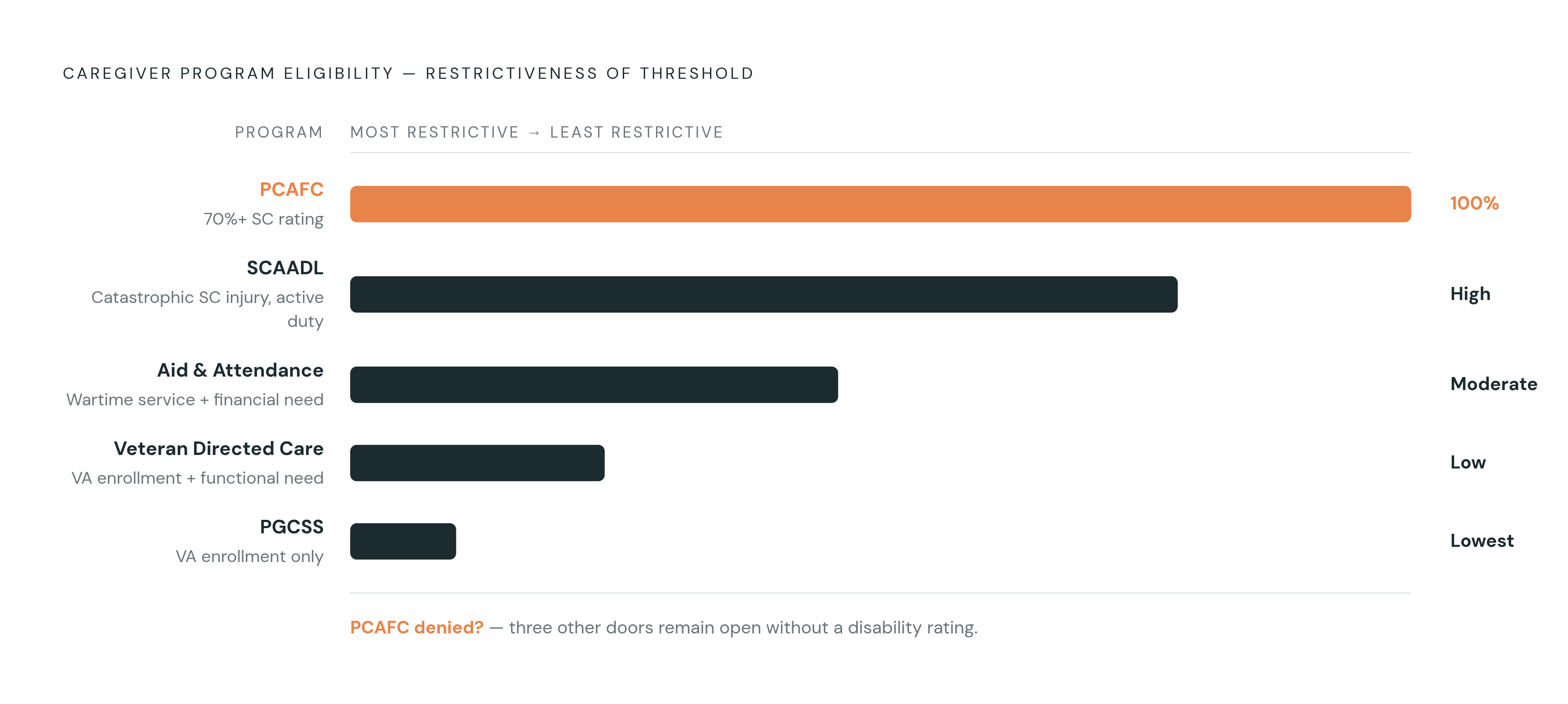
No unified caregiver compensation program exists. What exists instead is a layered set of programs created at different legislative moments, for different policy purposes, with eligibility structures that plainly reflect those origins. Some pay the caregiver directly. Some pay the veteran, who then compensates the caregiver. One is administered by the Department of Defense rather than the VA.
Eligibility criteria diverge in ways that carry practical weight. Some programs require a service-connected disability rating at a specific threshold. Others are pension-based, requiring only wartime service and financial need, with no rating. Some are geographically constrained. Some require formal clinical assessments; others require only VA enrollment. The caregiver's relationship to the veteran — spouse, adult child, or extended family member — determines eligibility differently across programs.
Here is the distinction that reshapes everything else. PCAFC, the Program of Comprehensive Assistance for Family Caregivers, requires a 70% or higher service-connected disability rating. Aid and Attendance requires no service-connected rating at all. A caregiver who doesn't clear PCAFC's threshold may still qualify for Aid and Attendance, Veteran Directed Care, or both. Stopping after one rejection is exactly what the complexity of this system seems designed to encourage.
Why do programs ostensibly serving the same population diverge so sharply in their eligibility rules? Because they were created separately, through separate legislation, and grafted onto a bureaucratic structure never designed to hold them as a coherent whole. Understanding that history is what allows a family to navigate it without losing ground.
The five programs covered here are PCAFC, the Program of General Caregiver Support Services (PGCSS), Aid and Attendance, Veteran Directed Care (VDC), and SCAADL (Special Compensation for Assistance with Activities of Daily Living). How they relate to each other is as important as how each works individually.
The PCAFC Stipend: Who Qualifies, How Much It Pays, and What Else It Includes
PCAFC is the most comprehensive caregiver compensation program the VA administers, and also the most selective. Knowing its eligibility floor before investing in an application is not optional.
Veteran eligibility. The veteran must hold a VA disability rating of 70% or higher and must have been discharged from military service. Beyond the rating, the veteran must require personal care services for at least six continuous months, established through at least one of three clinical grounds: inability to perform activities of daily living without assistance; need for supervision or protection due to neurological or other impairment; or need for regular instruction or supervision without which daily functioning would be seriously impaired.
Caregiver eligibility. The caregiver must be at least 18 years old and must be a family or extended family member, or someone willing to live with the veteran. One Primary Family Caregiver and up to two Secondary Family Caregivers can be designated. Secondary caregivers provide backup support but do not receive the monthly stipend.
What the stipend pays. The stipend is calculated from the Office of Personnel Management GS-4, Step 1 annual rate for the veteran's locality, divided by 12. Two levels exist: Level One pays 62.5% of that monthly rate; Level Two, reserved for veterans who cannot self-sustain in the community, pays 100%. Monthly stipends ranged roughly from $1,750 to $3,200 in 2024, adjusted regionally and updated annually. The payment is tax-free and goes directly to the caregiver.
Benefits beyond the stipend. The stipend is significant, but the full benefit package is broader. Primary Family Caregivers also receive CHAMPVA health coverage if not otherwise insured, at least 30 days of respite care annually, free legal and financial planning assistance, telehealth therapy through the Virtual Psychotherapy Program for Caregivers, and access to military commissaries and exchanges. Comparing programs on stipend dollars alone misses this. A caregiver who already has employer-sponsored coverage, though, needs to run a different calculation: the relative weight of non-stipend benefits shifts considerably, and the comparison against Aid and Attendance or VDC may look quite different.
Scale and era eligibility. The VA MISSION Act of 2018 mandated phased expansion across service eras. Phase II opened on October 1, 2022, extending eligibility to veterans who served after May 7, 1975, and before September 11, 2001. All service eras are now eligible. In FY 2025, approximately 98,000 caregivers were enrolled in PCAFC, and the VA obligated $2.6 billion to implement the program, per GAO-26-108070.
How to Apply for PCAFC and What to Expect After Submission
The application is a joint submission. The veteran and each caregiver applicant must complete and sign VA Form 10-10CG together; a caregiver cannot apply independently. Three submission routes exist: online at VA.gov, which tends to be fastest; by mail to the Health Eligibility Center in Atlanta; or in person through the Caregiver Support Coordinator at the local VA medical center.
After submission, the VA conducts a home visit and clinical assessment to evaluate the veteran's care needs and confirm caregiver eligibility. Caregivers must also complete required training before benefits activate. Neither step is perfunctory, and both take time. Families who underestimate the gap between application and first stipend payment often absorb that window out of pocket — a point the VA's program literature does not emphasize.
Eligibility is reassessed periodically. Under the current structure, reassessments occur annually. Proposed rules published in December 2024 would reduce this to no more than every two years, easing the administrative burden on enrolled families. A September 2025 final rule extended the transition period for legacy participants through September 30, 2028, protecting them from stipend reductions during reassessment through that date, with certain exceptions.
What PCAFC Does Not Cover, and Where PGCSS Fills the Gap
PCAFC's 70% rating requirement and six-month personal care threshold are deliberate features, and also exclusionary ones. Many caregivers support veterans who fall short of that bar: the rating may be lower, the functional need may not have been clinically established over the required duration, or the veteran simply hasn't engaged the VA system sufficiently to generate supporting documentation. The care being provided may be identical to what a PCAFC-enrolled family is doing. The rating number is different.
The Program of General Caregiver Support Services addresses that gap, though without a stipend. PGCSS is open to caregivers of any veteran enrolled in VA health care, regardless of era or disability rating. It provides skills training, one-on-one coaching, group and peer support, mobile support, self-care resources, telehealth options, and referrals to VA and community resources.
For families who will never qualify for PCAFC, PGCSS may be the most meaningful VA support available. For families actively pursuing PCAFC eligibility, it can build caregiver capacity and documentation during the period before formal enrollment. Participation in PGCSS forecloses nothing; a family using it now is not trading away future access to PCAFC or Aid and Attendance. Both programs are administered through the VA Caregiver Support Program, which means the same Caregiver Support Coordinator at a VA medical center can assess eligibility for both simultaneously, with no separate intake required.
Aid and Attendance: The Pension-Based Benefit That Can Pay Family Members for Home Care
Aid and Attendance is an enhancement to VA pension, not a stand-alone program. It is available to wartime veterans and surviving spouses who need help with daily living activities, and it requires no service-connected disability rating. That eligibility structure reaches a substantially different population than PCAFC does.
The 2025 monthly benefit rates, effective December 1, 2024, following a 2.5% cost-of-living adjustment: $1,515 per month for a surviving spouse; $2,358 per month for a single veteran; $2,795 per month for a married veteran; and $3,740 per month for two veterans married to each other. These are meaningful figures. The payment structure, though, differs from PCAFC's in a way families need to understand before building it into their planning.
The payment goes to the veteran or surviving spouse, not directly to the caregiver. The mechanism for family compensation runs through unreimbursed medical expenses in the pension calculation. Payments made to a non-licensed family member — an adult child or sibling — for help with activities of daily living are treated as deductible medical expenses, which reduces the veteran's countable income and effectively enables the benefit to cover that family caregiver's pay. It is an indirect route, but a real one that families miss regularly — tracing the logic through the pension calculation is not intuitive.
One significant constraint: spouses cannot be compensated as caregivers under Aid and Attendance. Adult children and other family members can. PCAFC, by contrast, explicitly allows spousal caregivers to receive the stipend. A spousal caregiver evaluating both programs should sit with that asymmetry before assuming the pathways are interchangeable, because they are not.
Only about a quarter of eligible seniors apply, according to estimates cited by A Place for Mom. Complexity and low awareness drive that underutilization. Aid and Attendance does not include CHAMPVA, respite care, or caregiver training; it is narrower in scope than the PCAFC package. For families who cannot clear PCAFC's service-connection threshold, it may be the primary compensation mechanism within reach.
Veteran Directed Care: The Flexible Budget Option That Lets Veterans Hire Family
Veteran Directed Care takes a structurally different approach. Rather than paying a caregiver according to a formula, it gives eligible veterans an individualized monthly budget to direct toward the assistance they need, including hiring family members directly. Spouses, adult children, and grandchildren are all explicitly eligible to be hired.
Caregiver pay under VDC is hourly, set nationally by the VA and adjusted locally, with a reported range of approximately $8 to $21 per hour. The program is available to veterans of all ages enrolled in VA's medical benefits package who need skilled services or assistance with daily living activities. No specific disability rating is required.
Geographic availability is a genuine constraint. As of February 2024, VDC operates in 43 states plus Washington, D.C. A program unavailable in your state is simply not an option.
The flexible budget can also fund assistive equipment or other purchases supporting the veteran's independence, not only caregiver wages. This makes VDC structurally distinct from every other program described here: the veteran controls resource allocation rather than the VA directing payment to a designated caregiver. Whether that is an advantage depends on the situation. For families in which the veteran's cognitive or functional impairment limits decision-making capacity, that same structure may become a burden rather than a benefit. Which situation applies is worth examining honestly before treating veteran-directed control as inherently preferable.
VDC is administered through Area Agencies on Aging and similar community partners, not directly through VA medical centers. The application runs through the veteran's VA social worker, who coordinates with local partners, rather than through the Caregiver Support Coordinator who handles PCAFC. Conflating these pathways costs time.
SCAADL: The DoD Compensation That Applies Before, and Briefly After, Separation from Service
SCAADL is the outlier in this landscape: a Department of Defense program, not a VA program, authorized by the FY 2010 National Defense Authorization Act. It applies to active-duty service members with permanent, catastrophic service-connected illnesses or injuries requiring a home health aide for non-medical care and support.
Payment goes to the service member, not the caregiver. The amount is based on the Bureau of Labor Statistics 75th-percentile hourly wage for a home health aide in the service member's geographic area, structured across three tiers reflecting care complexity. Families providing intensive care during active duty can receive real compensation through this mechanism, though navigating tier determinations requires working through military branch benefits offices or Wounded Warrior programs.
The transition from active duty is where families most consistently lose money. SCAADL can continue for up to 90 days after separation or retirement. It does not automatically convert to VA PCAFC benefits. A separate VA Form 10-10CG application is required, and PCAFC has its own assessment timeline. A family that waits until separation to begin that process may face a period with neither benefit active, a gap that is entirely preventable. Filing the 10-10CG before or immediately at separation, while SCAADL is still running, is the practical safeguard. This is also the guidance that most families receive too late, if they receive it at all.
MOAA and service-specific resources such as the Air Force's myairforcebenefits portal are the primary sources for SCAADL-specific guidance.
How the Programs Compare Across the Decisions That Matter Most to Caregivers
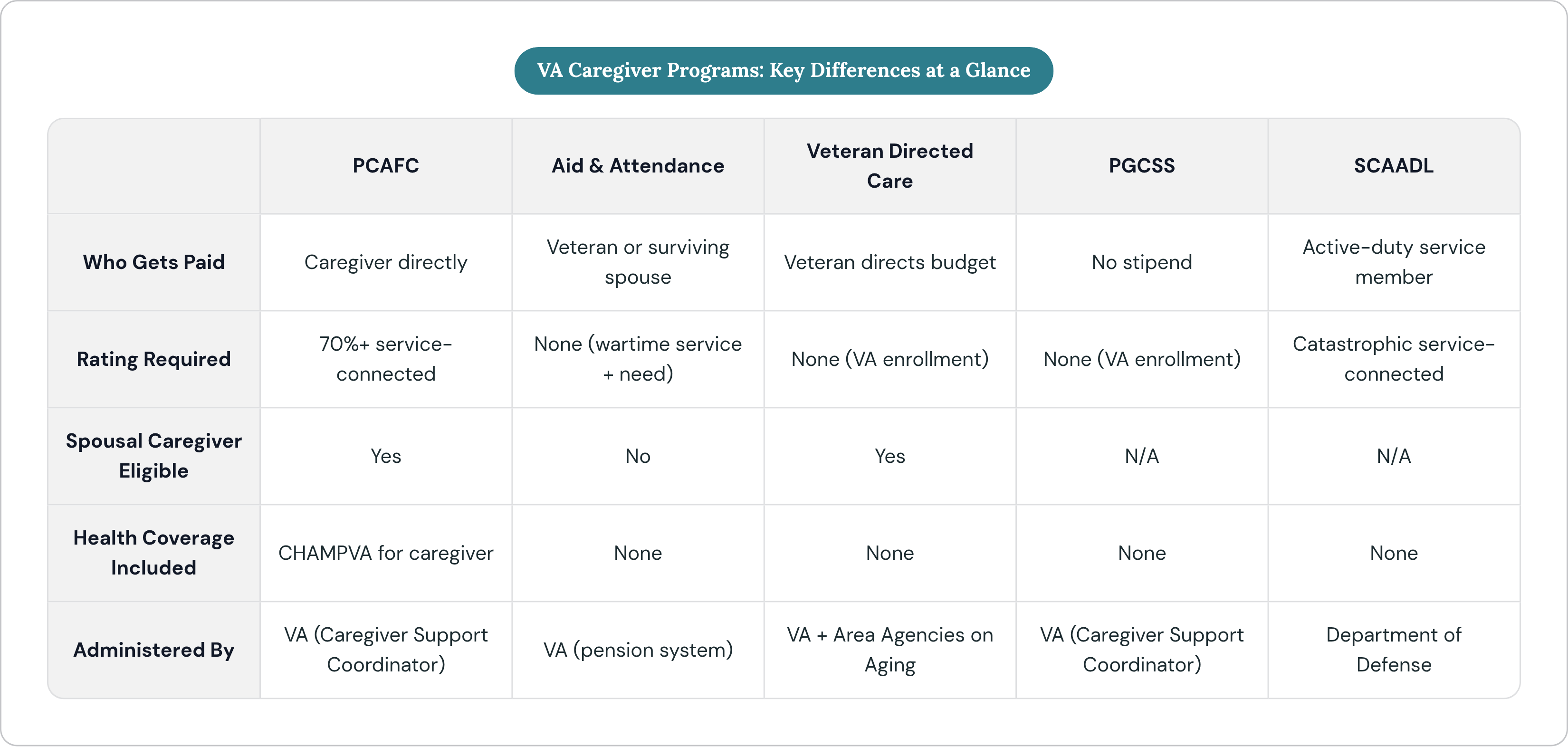
Mapping the programs against the questions caregivers actually ask clarifies the decision space more efficiently than reading each program description in sequence.
Who receives the payment. PCAFC pays the caregiver directly, including spouses. Aid and Attendance pays the veteran, who can then pay non-spouse family members. VDC pays the veteran a budget they can direct to any family member, including a spouse. SCAADL pays the active-duty service member.
Whether a service-connected rating is required. PCAFC requires 70% or higher. Aid and Attendance requires only wartime service and income or asset eligibility. VDC requires VA enrollment and functional need. PGCSS requires only VA enrollment.
Health coverage for the caregiver. Only PCAFC includes CHAMPVA for the caregiver. Given that 44% of caregivers in the 2024 RAND study lacked health insurance, this benefit warrants explicit weight in any comparison. No other program in this set provides it.
Spousal caregivers specifically. PCAFC and VDC both allow spousal caregivers to be compensated. Aid and Attendance does not. For a spousal caregiver, this eliminates one pathway and makes the remaining ones considerably more significant.
Stacking. A veteran could receive Aid and Attendance while a family member is also enrolled in PCAFC, if eligibility criteria for both are satisfied. VDC may be compatible with PCAFC enrollment in some circumstances. The interactions are not always clean; confirming with a VA Caregiver Support Coordinator before assuming compatibility is worth the call, because errors here carry real financial risk.
Families navigating this system tend not to fail because they don't qualify for anything. They fail because they assume one rejection settles the question. The system's complexity functions less as a wall than as a maze with unmarked exits, and the families who map it deliberately are the ones who stop leaving money unclaimed.
Changes in 2024 and 2025 That Affect Current and Prospective Applicants
The regulatory landscape shifted meaningfully in the period leading into 2025, and some of those shifts are consequential enough to change a family's eligibility calculus.
Proposed rules published in December 2024 would expand PCAFC's definition of "serious injury," potentially extending eligibility to veterans and caregivers who currently fall outside that definition. The same proposed rules would reduce reassessment frequency from annual to no more than every two years, a concrete reduction in administrative burden for enrolled families.
The September 2025 final rule extended the PCAFC legacy cohort transition period through September 30, 2028. Legacy participants will not face stipend reductions from reassessments during that window, with certain exceptions.
Enrollment in the general, non-legacy PCAFC component grew 15% in a single year, from roughly 24,800 enrolled caregivers in FY 2024 to approximately 28,500 in FY 2025, per GAO-26-108070. That growth reflects both the expansion to pre-9/11 service eras and rising awareness, but it also signals increasing pressure on processing timelines — applicants should not assume that timelines they read about reflect current conditions.
Proposed telehealth flexibility would allow VA home visits to be conducted remotely during certain emergencies, a change with particular relevance for rural caregivers and those facing transportation barriers.
Aid and Attendance rates increased 2.5% effective December 1, 2024. Caregivers supporting veterans already receiving the benefit should see updated amounts reflected automatically. Those newly evaluating the benefit should use the 2025 rates as their baseline.
How to Find Out Which Programs You Qualify For and Where to Start
Most caregivers should start with one phone call or one in-person visit. The Caregiver Support Coordinator at the nearest VA medical center can assess PCAFC and PGCSS eligibility simultaneously and initiate the 10-10CG application process. For caregivers who cannot visit a facility or want to understand their options before an appointment, the VA Caregiver Support Line is 1-855-260-3274.
Aid and Attendance begins with VA Form 21-2680, initiated by the veteran or surviving spouse. Veterans Service Organizations, particularly DAV, can assist at no cost and often have accredited staff available to prepare the application correctly. This pathway runs separately from the PCAFC process and requires a separate intake.
VDC entry runs through the veteran's VA social worker, who coordinates with local Area Agencies on Aging. This is a different office from the one involved in PCAFC enrollment, a different coordinator, a different process. Conflating the two wastes time caregivers cannot afford.
For SCAADL, active-duty service members should contact their installation's Wounded Warrior program or military branch benefits office. The critical action for any service member approaching separation is to file the 10-10CG for PCAFC before or immediately at separation, not afterward.
This system's complexity reflects a piecemeal legislative history in which each program was built independently, layered onto infrastructure never designed to unify them. Families absorb the cost of that fragmentation every time they assume one closed door means the building is locked.