CDWA Pay Schedule 2026 for Washington Caregivers
The 2026 contract delivers 10% wage gains and a new top step for experienced caregivers.
The contract currently in force is the 2025–2027 Collective Bargaining Agreement between CDWA and SEIU 775, effective July 1, 2025, ratified by a caregiver "YES" vote. It was negotiated against a difficult fiscal backdrop: Washington faced a historic $15 billion budget shortfall during the period leading up to bargaining. SEIU 775 had entered negotiations seeking to restore IP wages to 2020 purchasing power. What emerged was a compromise, roughly 50% restoration of that purchasing power loss, which the union characterized as the best achievable outcome given the state's constrained budget envelope.
Whether that framing holds up depends on whose math you trust. Fifty percent restoration sounds like a concession until you consider that the alternative, in a $15 billion shortfall year, may have been zero. Caregivers I have spoken with are divided on this. Some regard it as a genuine win; others view it as a ceiling dressed up as a floor.
Several provisions bear directly on what a 2026 paycheck looks like. The agreement locks in at least 10% in total wage increases across the two-year term, delivered in semi-annual increments on January 1 and July 1 of each year. Caregivers also advance through step increases as their Career Credit Hours accumulation crosses defined thresholds. Those step movements are independent of the calendar-driven raises, meaning a caregiver can receive both in the same year if a threshold crossing happens to coincide with a scheduled rate adjustment. The contract also introduced a new top step for caregivers who have accumulated 40,000 or more CCH, a formal recognition of long-tenured providers that the previous agreement lacked entirely.
Other provisions affect caregivers in less immediately visible ways. Paid holidays are being phased in across the agreement's term. The contract imposes stronger financial penalties on CDWA for late or inaccurate payments, and pay stubs are now required to display PTO balances and overpayment information more transparently than before. These are accountability mechanisms, not decoration. A caregiver who does not read their stub will miss their benefit, but these provisions exist now in a way they did not before.
SEIU 775 represents more than 50,000 long-term care workers across Washington, Montana, and Alaska. The scale of that membership explains why the contract carries legal weight and why its provisions constitute a floor rather than a suggestion. The full CBA is publicly available in English, Spanish, Russian, Simplified Chinese, and Korean at seiu775.org/contracts/.
The 2026 Hourly Wage Scale and How Career Credit Hours Determine Your Step
IP wages are tiered according to Career Credit Hours, and those tiers shift twice per year. The CCH count is cumulative across a caregiver's entire history in the program; it does not reset by year, by client change, or by a gap in employment. A caregiver who worked 3,000 hours a decade ago and returns today carries those hours forward. That continuity matters more than most new enrollees realize.
The January 1, 2026 rate for an entry-level IP, defined as fewer than 2,000 CCH, is $22.63 per hour, per figures reported by LegalClarity.org in April 2026 and consistent with CDWA's Become a Provider page. On July 1, 2026, that entry rate rises to $23.54. At the top of the scale, caregivers with 40,000 or more CCH can earn up to $27.28 per hour by mid-2026. Both anchors sit well above Washington's 2026 state minimum wage of $17.13; the entry rate alone runs roughly $5.50 per hour above that floor.
Two wage mechanisms operate in parallel and independently of each other. Calendar-driven increases happen automatically on January 1 and July 1 for all IPs. Step advancement happens when an IP's CCH crosses a defined threshold. If those two events fall in the same calendar year, the caregiver receives both adjustments. The full step table covering all tiers between the 2,000-CCH and 40,000-CCH anchors is available in the CBA and on CDWA's official provider resources.
Indeed's aggregated data from more than 6,500 Washington job postings estimates an average CDWA caregiver hourly rate of approximately $22.38. That figure is a useful cross-check and aligns with the expectation that most of the workforce sits in the lower steps of the scale. It is not a contract figure and should not be used for planning purposes in place of the CBA.
Differentials That Add to the Base Rate
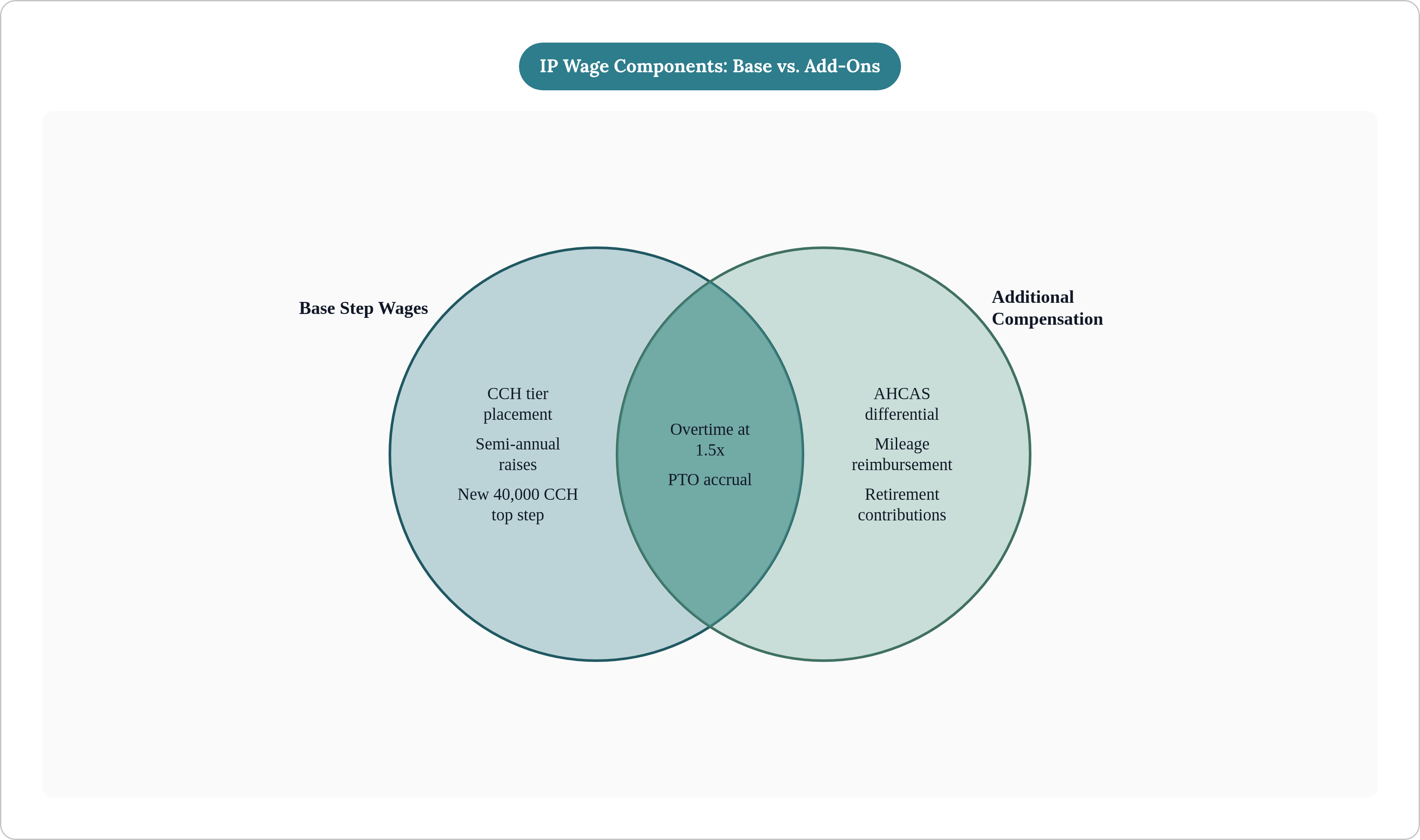
Base step wages are not the ceiling. For caregivers who qualify, differentials can add meaningful amounts to the hourly rate.
The Advanced Home Care Aide Specialist certification carries a differential of $0.75 per hour above the caregiver's regular step rate, and it is additive. It stacks on top of other applicable certification differentials rather than replacing them. Eligibility depends on two factors: the IP's accumulated CCH and the complexity of care the client requires. Not every caregiver will meet both criteria, and some client situations will not trigger the complexity threshold.
Federal overtime law applies to IPs as it does to other employees. Hours worked beyond 40 in a single workweek are compensated at 1.5 times the regular rate. This is most relevant for IPs who support multiple clients or who cover extended shifts; the workweek calculation aggregates all hours regardless of how many clients generate them.
The CBA also includes a mileage reimbursement provision, with the reimbursable mileage cap increasing to 130 miles in July 2026. The per-mile rate is set in the contract itself. Caregivers should reference the CBA document at seiu775.org/contracts/ for the precise negotiated rate, which is calculated on different criteria than the IRS standard mileage figure and may differ from it.
How the 2026 Payroll Calendar Actually Works
The IP payroll cycle runs on two-week pay periods throughout the year. Missing a submission deadline by a single day delays payment by a full pay cycle. At current wage rates, that gap is not abstract.
Hours must be submitted to CDWA by 5:00 PM Pacific Time on the Monday following the close of the pay period. The pay date falls two Fridays after the pay period ends, not the immediate Friday. The gap between the last shift of a period and the resulting paycheck is approximately 12 days for most periods.
A concrete example from CDWA's published 2026 payroll calendar: the first pay period of 2026 covers December 14 through December 29, 2025, for live-in and EVV providers. The correction deadline for that period was December 28, 2025. The corresponding pay date was January 9, 2026. That sequence, end of period, correction window, pay date, repeats across every pay period on the calendar.
The full 2026 calendar, listing every pay period boundary, correction deadline, and pay date, is published by CDWA at consumerdirectwa.com/resource/payroll-calendar/ as a downloadable PDF.
Live-in providers and hourly or EVV providers may have slightly different submission workflows. The 2025–2027 CBA also introduces stronger penalties for CDWA in cases of late or inaccurate payment, and caregivers who identify a discrepancy have a defined grievance mechanism through SEIU 775. Knowing that mechanism exists before a problem arises is considerably more useful than discovering it after.
The Tools Caregivers Use to Submit Time and Track Pay
Two platforms handle the operational layer of time submission and tracking, and they serve distinct purposes.
DirectMyCare is CDWA's secure web portal, the primary interface for viewing hours, checking authorizations, submitting time, and managing account notifications. CareAttend is CDWA's Electronic Visit Verification app, used by non-live-in IPs to clock in and out of individual shifts. The app captures GPS coordinates at the start and end of each shift to satisfy federal EVV requirements, which mandate electronic verification of Medicaid home care visits.
Live-in IPs do not use CareAttend for EVV in the same way that hourly providers do; their time submission follows a different workflow.
The Monday 5:00 PM deadline applies regardless of technical difficulty or scheduling pressure. Time entered after the cutoff rolls into the following pay period. There is no provision for retroactive inclusion in the period just closed, and a single missed submission can shift two weeks of pay forward by another two weeks. Caregivers who routinely work close to the deadline should build in a buffer, because the system will not accommodate the exception.
The 2025–2027 CBA's requirement for more transparent pay stubs, including visible PTO balances and overpayment details, gives caregivers more data to audit their own records. That transparency is only useful if caregivers read their stubs and flag discrepancies promptly.
Paid Holidays, PTO Accrual, and Retirement Contributions in 2026
The 2025–2027 CBA phases in paid holidays across the contract term. Labor Day was added effective July 1, 2025, so it is already in effect for all of 2026. On July 1, 2026, three additional holidays come into force: Martin Luther King Jr. Day, Memorial Day, and Thanksgiving. By the end of the contract period, the full list will include New Year's Day, MLK Jr. Day, Memorial Day, Independence Day, Labor Day, and Thanksgiving, six paid holidays total.
PTO accrues at one hour earned for every 23 hours worked, and training time is compensable. On 80 hours worked in a pay period, that yields approximately 3.5 hours of PTO, which accumulates meaningfully across a full year.
Retirement contributions warrant particular attention because of a mid-year change. Employer contributions to the SEIU 775 Secure Retirement Plan increase from $1.20 per hour to $1.65 per hour on July 1, 2026, a $0.45 per hour increase. That enhanced rate applies only to caregivers who have reached 8,000 or more CCH. The plan itself is documented as the first retirement plan of its kind nationally for home care workers, an unusual distinction in a sector that has historically offered little in the way of long-term savings infrastructure. Enrollment is automatic following a six-month participation requirement.
Healthcare coverage includes medical, dental, and vision for $25 per month. The 2025–2027 contract did not increase that premium cost share. Benefits are administered through SEIU 775 Benefits Group; eligibility and enrollment are managed at myseiubenefits.org/cdwa/.
Who Can Be a Paid Caregiver in Washington and Where Spousal Rules Changed in 2026
Washington's default rule for Medicaid programs including Community First Choice, COPES, and MPC is that a spouse cannot serve as a paid Individual Provider. This reflects longstanding Medicaid policy that draws a boundary between informal family support and formal paid caregiving, and it catches people off guard more often than it should.
Two exceptions exist. The first involves Veteran-Directed Care, available when the care recipient is a veteran enrolled in that specific program. The second is the WA Cares Fund. Beginning July 2026, a spouse can be paid as a caregiver if the care recipient has earned WA Cares Fund benefits and needs assistance with at least three activities of daily living. That provision did not exist before July 2026 and represents a material expansion of the paid pathway for spousal caregivers, one worth understanding carefully before assuming it applies to a given situation.
Adult children, siblings, and other non-spouse family members can generally enroll as IPs under standard Medicaid programs, subject to the same CDWA enrollment process that applies to any other provider. Families navigating this often underestimate how much the specific program designation matters. Which Medicaid program the care recipient is enrolled in determines which spousal exception, if any, is available, and the distinction is consequential enough to clarify through DSHS benefit discovery resources before initiating CDWA enrollment.
Estimating What a 2026 Paycheck Looks Like in Practice
Working through the arithmetic on a representative example anchors the rate discussion to a tangible number.
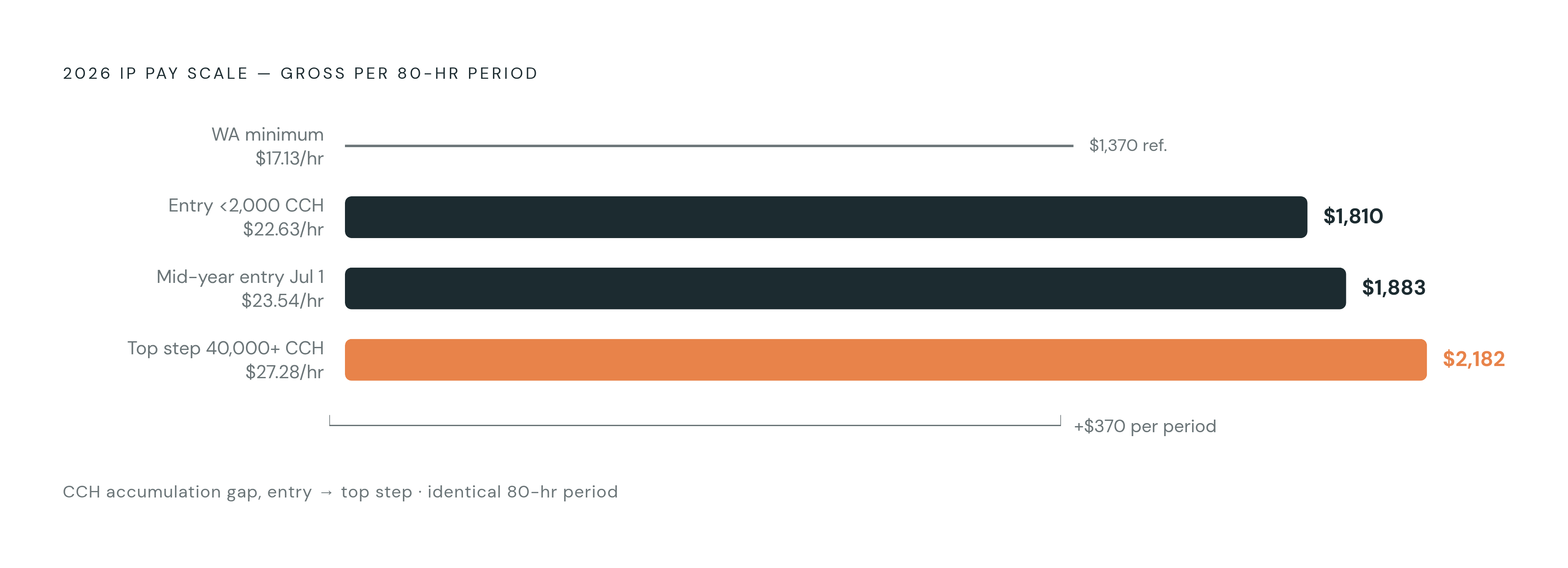
Consider a new IP with fewer than 2,000 CCH, no AHCAS differential, and 80 hours worked in a standard two-week pay period. At the January 2026 rate of $22.63 per hour, gross pay for that period is approximately $1,810. After the July 1, 2026 rate increase to $23.54, the same 80-hour period produces approximately $1,883 gross. At the 40,000-plus CCH top step, $27.28 multiplied by 80 hours yields approximately $2,182 gross. The spread between entry and top steps, roughly $370 per pay period on identical hours, illustrates why CCH accumulation carries concrete financial consequences over a career.
Deductions move gross pay toward take-home. Federal and state income tax withholding varies by filing status and declared exemptions. Social Security is withheld at 6.2% and Medicare at 1.45%, rates set by federal law. Caregivers enrolled in health coverage contribute $25 per month in premiums. Net pay is individual; the gross figures above are the defensible starting point for any estimate, and caregivers should run their specific situation through a withholding calculator using their actual filing status.
PTO accrual on 80 hours is approximately 3.5 hours earned for that pay period. It does not appear as a cash item on the stub, but it represents paid leave accumulating toward future use.
The paycheck for a given period arrives roughly 12 days after the period closes. A late time submission stretches that gap by two full weeks. For a caregiver who is the primary earner in a household, that delay lands differently than it does on a spreadsheet.