VA Caregiver Stipend Pay Chart 2025
How the VA calculates caregiver stipends based on location and care tier.

The foundation is the Office of Personnel Management's General Schedule, specifically the annual rate for GS-4, Step 1 in the veteran's locality pay area. Divide that annual rate by 12. Apply a tier multiplier. That is the caregiver's monthly stipend.
Two caregivers providing functionally identical care can receive meaningfully different payments because their veterans live in different parts of the country. The formula keys to the veteran's VA-registered home address, not the caregiver's. If they share a household, which is typically the case, this distinction is moot in practice; structurally, though, the geographic variable follows the veteran.
OPM updates GS pay tables annually, and stipend amounts adjust automatically when it does. For 2025, OPM implemented a 4.7% General Schedule increase effective January, and that increase flows directly into the stipend formula without any separate VA action. The VA's own illustrative materials have referenced historical examples, including a 2022 Dallas calculation showing a Level 1 stipend of approximately $1,818.54 per month, but those figures are superseded. The 2025 rates derived below reflect current OPM tables.
The Two Care Tiers and What Each Multiplier Means in Practice
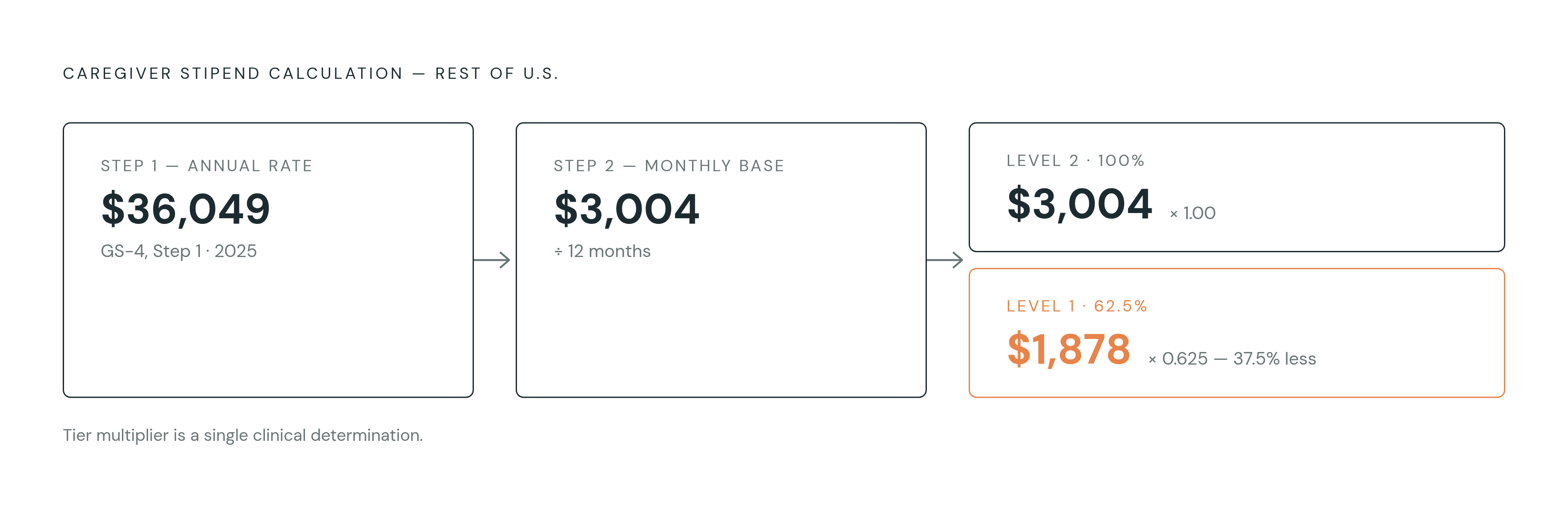
The tier multiplier is where clinical assessment translates into dollars. But what if the gap between tiers is larger than most families expect? It is worth pausing on that, because the difference is not marginal, and most families coming into this process underestimate how much turns on that single determination.
Level 1 applies a multiplier of 0.625: the caregiver receives 62.5% of the base monthly rate. This tier reflects veterans who can still self-sustain in the community with support, whether that means assistance with activities of daily living or supervision due to cognitive or safety concerns, but who do not require constant oversight.
Level 2 applies a multiplier of 1.00, the full base monthly rate, when the VA determines the veteran is unable to self-sustain in the community and requires intensive personal care, constant supervision, or 24-hour support to remain safely at home.
At every locality, Level 2 pays 60% more per month than Level 1. On the Rest of U.S. baseline, that gap runs approximately $1,127 per month in 2025 figures; in a high-cost metro, the gap widens further in absolute dollars. The tier is not self-selected. The VA determines it through an in-person evaluation of the veteran's personal care needs. Caregivers cannot appeal the formula itself, but they can request reassessment if the veteran's condition changes. That raises an important question: what happens when a veteran's health deteriorates after an initial Level 1 determination and the family has been quietly absorbing a heavier care burden than the original assessment captured? This is precisely when a reassessment request becomes critical.
2025 Stipend Amounts by Locality: The Actual Pay Chart
The figures below are derived from OPM's 2025 General Schedule salary tables, effective January 2025. Each locality's GS-4, Step 1 annual rate is divided by 12 and multiplied by the applicable tier factor. Figures are approximate due to rounding.
| Locality Area | GS-4, Step 1 (Annual) | Level 1 (~62.5%) | Level 2 (100%) | |---|---|---|---| | Rest of U.S. (baseline) | $36,049 | ~$1,877/mo | ~$3,004/mo | | Washington–Baltimore–Arlington, DC-MD-VA-WV-PA | $41,247 | ~$2,148/mo | ~$3,437/mo | | Boston–Worcester–Providence, MA-RI-NH-CT-ME-VT | $40,828 | ~$2,127/mo | ~$3,402/mo | | Albany–Schenectady, NY-MA | $37,191 | ~$1,937/mo | ~$3,099/mo | | Albuquerque–Santa Fe–Las Vegas, NM | $36,440 | ~$1,898/mo | ~$3,037/mo | | San Antonio–New Braunfels–Pearsall, TX | $36,578 | ~$1,905/mo | ~$3,048/mo |
High-cost localities, including San Francisco and New York City, operate under separate OPM tables and produce Level 2 amounts substantially above $3,400 per month. Readers in those areas should retrieve the exact GS-4, Step 1 figure directly from OPM's 2025 salary tables and apply the formula themselves. The Rest of U.S. rate functions as a floor; no caregiver in the program receives less than the baseline locality calculation. Counties not assigned to a named locality area default to it, which means a significant portion of rural America sits at that floor regardless of local cost-of-living variation.
How to Find Your Specific Locality and Calculate Your Own Rate
To understand why this works, we must first look at the veteran's official VA-registered address. That address determines the locality, which determines the applicable GS table. From there, look up the veteran's county or metro area in OPM's locality pay area definitions, retrieve the GS-4, Step 1 annual rate from OPM's 2025 General Schedule salary tables at opm.gov/policy-data-oversight/pay-leave/salaries-wages/2025/general-schedule, divide by 12, then multiply by 0.625 for Level 1 or 1.00 for Level 2.
Relocation complicates this in ways families rarely think through in advance. If the veteran moves, the stipend recalculates based on the new address locality. Moving from a rural Rest of U.S. county to the Washington-Baltimore-Arlington area shifts the Level 2 monthly stipend from approximately $3,004 to approximately $3,437, a difference of roughly $433 per month, or more than $5,000 annually. That figure belongs in any serious household relocation analysis, and it rarely is.
What the Stipend Counts As, and Doesn't Count As, for Taxes and Income
The PCAFC monthly stipend is tax-free. It is not classified as wages and does not need to be reported as income on a federal tax return. For caregivers who also hold outside employment, the stipend supplements earned income without increasing taxable income or compressing marginal rates.
One persistent source of confusion: some caregivers have received IRS Form 1099-NEC from the VA. Both the IRS and the VA classify the PCAFC stipend as non-taxable despite the issuance of that form. But how does that affect caregivers who receive the form and assume it signals taxable income? The 1099 does not change the tax treatment; it creates an administrative headache. Bringing a tax professional into the picture early (someone who can document the exempt status correctly) is the practical fix before the return inadvertently attracts scrutiny.
The stipend is paid once monthly. When the scheduled payment date falls on a weekend or federal holiday, payment typically arrives on the closest prior business day.
Benefits Beyond the Monthly Payment That Increase the Program's Total Value
Evaluating PCAFC by the stipend alone is like pricing a house by the cost of the front door. The monthly payment is visible; the supporting benefits are where the actual economic calculation gets interesting.
Primary Family Caregivers receive CHAMPVA health insurance if they do not already qualify under another plan. In real-dollar terms, CHAMPVA coverage can represent $10,000 to $20,000 or more per year in premiums and out-of-pocket costs avoided, depending on health utilization. For a younger caregiver without employer-sponsored insurance who would otherwise be purchasing individual coverage on the marketplace, this benefit alone can rival the stipend in annual economic value.
Beyond insurance, caregivers receive up to 30 days of respite care per year, temporary relief arrangements that allow the primary caregiver to step back without disrupting the veteran's care. Access to the VA's Virtual Psychotherapy Program for Caregivers provides telehealth therapy specifically designed for this population. Caregiving is a role where the costs accumulate quietly, and the burnout rarely announces itself until the situation is already well past manageable. Legal and financial planning assistance related to the veteran's needs is also available, as is access to military commissaries, exchanges, and recreation retail facilities.
Secondary caregivers, who receive no stipend, remain eligible for some of these support services, including respite care and mental health resources.
Legacy Cohort Caregivers: The Three-Tier Formula and the 2028 Extension
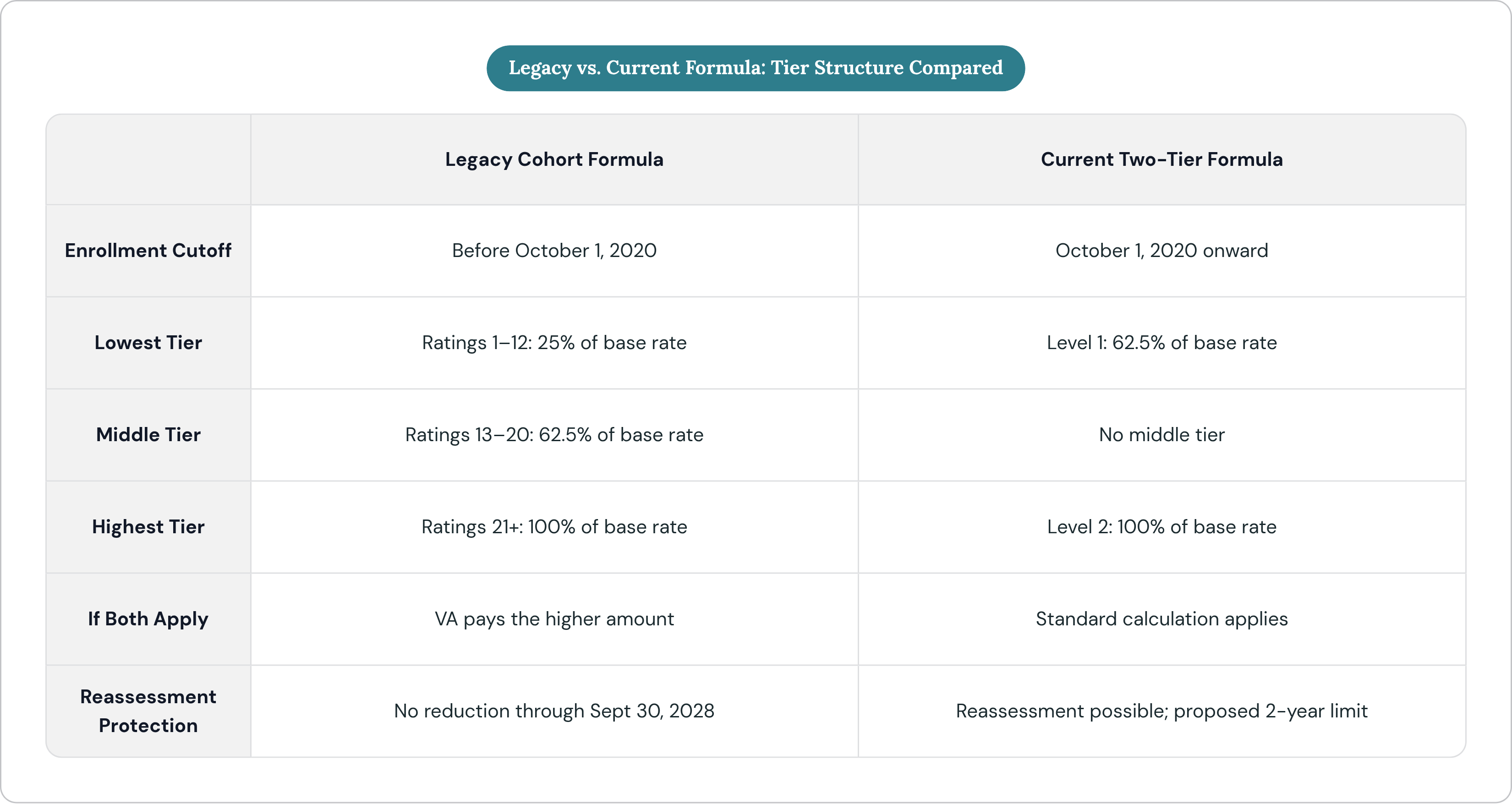
Caregivers who enrolled in PCAFC before October 1, 2020 may be calculated under a transitional legacy formula that differs structurally from the two-tier system described above. Instead of Level 1 and Level 2, the legacy formula uses three clinical rating bands applied to the same GS-4, Step 1 base monthly rate: clinical ratings 1 through 12 yield 25% of the base monthly rate; ratings 13 through 20 yield 62.5%; ratings 21 and above yield 100%. If a legacy caregiver also qualifies under the current Level 1 and Level 2 system, the VA pays whichever amount is higher.
The regulatory history here is tangled, and the public-facing program summaries have not reflected it consistently. A March 2022 decision by the U.S. Court of Appeals for the Federal Circuit set aside certain eligibility criteria the VA had implemented in October 2020, requiring the agency to repeat certain reassessments for legacy participants. That outcome left a population of caregivers in real uncertainty. This was not administrative ambiguity but concrete financial exposure.
The VA responded with a final rule published September 29, 2025, extending the legacy cohort transition period through September 30, 2028. During this period, legacy participants and legacy applicants will face no stipend reduction based on reassessment, with limited exceptions. As of December 2024 proposed rulemaking, more than 14,500 legacy applicants and participants had not been determined eligible under the post-October 2020 criteria, or had been determined eligible at a lower stipend amount. If you are currently receiving a stipend under the older formula, you are protected from a downward reassessment until at least September 30, 2028.
Proposed Rule Changes from December 2024 That Could Affect Future Stipend Amounts
In December 2024, the VA published proposed revisions to PCAFC regulations. As of mid-2026, none of these proposals have been finalized; they are directional signals, not settled policy, and the distance between a proposed rule and a final one is not trivial.
The proposals include limiting reassessments to no more than once every two years, introducing more predictability for caregivers who currently face the possibility of more frequent evaluation cycles. A proposed expansion of the "serious injury" definition to include individual unemployability could meaningfully widen the pool of eligible veterans, potentially admitting families previously excluded on eligibility grounds. Additional proposals address telehealth home visits during declared emergencies, revised definitions for key eligibility criteria, and changes to revocation and discharge processes.
The program's fiscal year 2025 budget is approximately $2.6 billion, and that funding appears protected in current budget discussions. Broader VA workforce reductions (with approximately 40,000 employees affected in fiscal 2025 predominantly from the Veterans Health Administration) have not directly targeted the caregiver program. It is also worth considering that this scale of institutional disruption carries downstream consequences for processing times and support availability — consequences that do not show up in budget lines but accumulate in the lived experience of families waiting on determinations. For those currently on the margin of eligibility, the proposed expansion of the serious injury definition carries real financial weight, because who qualifies and at what tier is an abstraction with concrete dollar consequences.
How to Apply and What to Expect During the VA's Evaluation
The application begins with VA Form 10-10CG, the Application for Caregiver Benefits. Both the veteran and the caregiver must complete sections of the form, which can be submitted online through va.gov, by mail, or in person at a VA medical center's caregiver support coordinator office. Finding that coordinator early matters; they serve as the primary point of contact throughout the review process and can identify documentation gaps before they become delays.
After submission, the VA schedules a home visit. A VA clinician conducts an in-person assessment of the veteran's care needs, and this visit is the primary mechanism by which the tier determination is made. Treat it as a functional assessment, not a formality. The clinician is evaluating the veteran's actual daily care requirements. The caregiver's self-report is one input, not the whole record, and generalities about care burden do not serve the family as well as specifics do.
The evaluation period can extend across several weeks. During this window, caregivers should document their current care activities in precise terms: frequency, duration, and nature of personal care tasks. If the initial assessment yields a Level 1 designation that does not reflect the veteran's actual care burden, the appropriate response is a reassessment request when the veteran's documented needs support a different conclusion.
Upon approval, the VA provides written notification of the stipend amount and tier. Retain that documentation. If circumstances change, including the veteran's health, residence, or care needs, reporting those changes promptly ensures the formula recalculates accurately, rather than continuing to reflect a snapshot taken months or years prior.