National Family Caregiver Support Program Explained
A trillion-dollar unpaid workforce mostly unaware the program supporting them even exists.
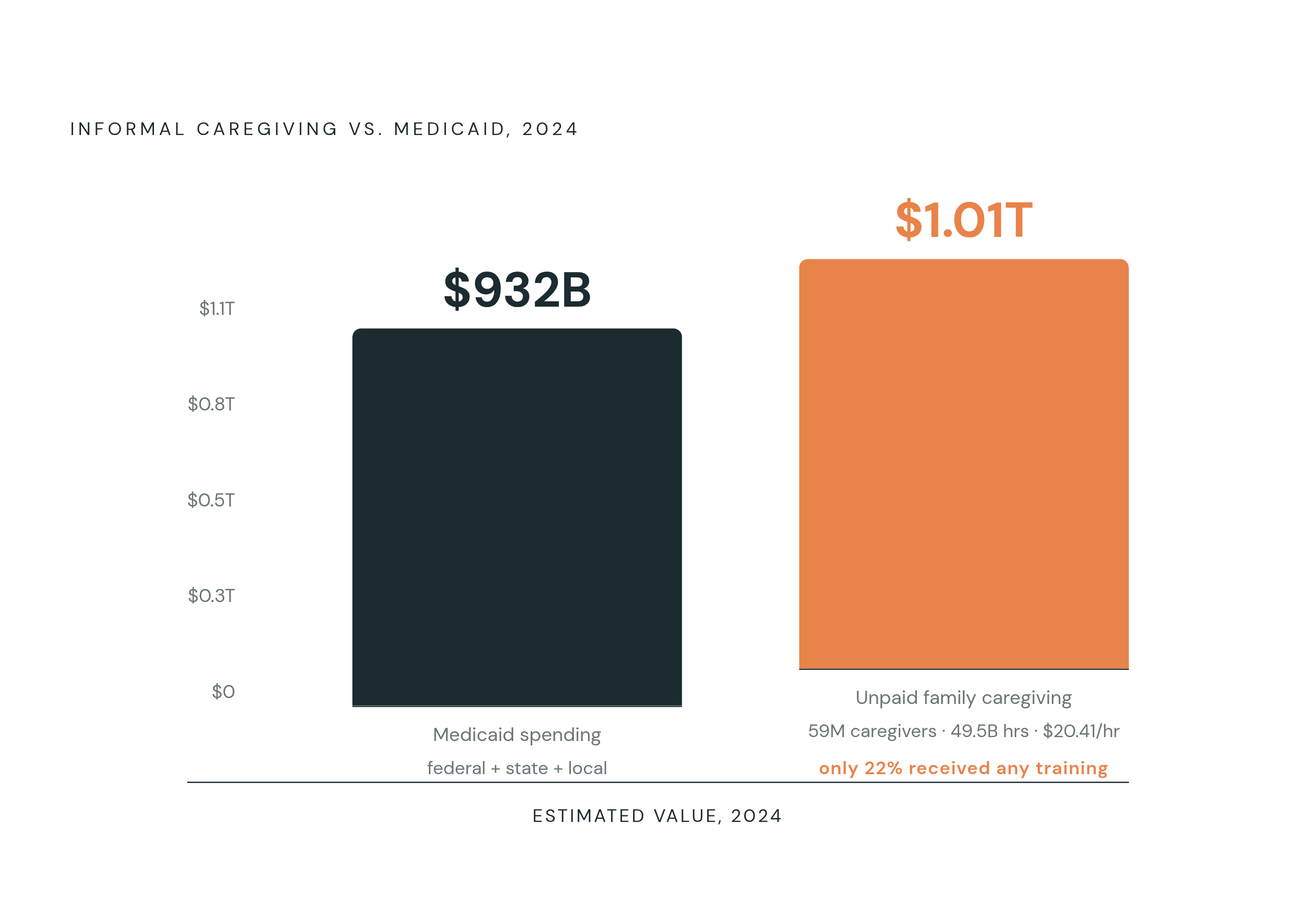
Some numbers are large enough that comprehension fails before alarm sets in. According to the AARP and National Alliance for Caregiving's Caregiving in the U.S. 2025 report, 63 million American adults provided ongoing care to adults or children with a medical condition or disability in 2025, representing nearly one in four adults and a 45 percent increase since 2015. The AARP Valuing the Invaluable 2026 report, released in March 2026, estimated that 59 million adult caregivers provided 49.5 billion hours of care in 2024, valued at $20.41 per hour: $1.01 trillion in unpaid labor.
That figure exceeded total federal, state, and local Medicaid spending in 2024, which was $932 billion. The informal caregiving economy is larger than Medicaid, the single largest public payer of long-term care in the United States, staffed entirely by people who receive no compensation and, in the majority of cases, no training.
Only 22 percent of caregivers report having received any training at all. That statistic, sitting alongside the trillion-dollar labor figure, tells you something about the nature of the gap NFCSP was built to address. But what if the absence of training is not just an oversight — what if it reflects something deeper about how society values caregiving labor itself? Caregivers who lack guidance on health management, financial planning, and care coordination don't simply perform the job less efficiently; they absorb the cost of that deficiency in their own physical and mental health. The research on caregiver burnout, depression, and chronic illness is well established, and the downstream effects on public health systems are both substantial and documentable.
The National Family Caregiver Support Program, authorized under Title III-E, Section 371 of the Older Americans Act and established in 2000, was the first federally funded program designed explicitly to support the caregiver rather than solely the person receiving care. For decades, public policy treated caregiving as a delivery problem: how do we get services to the elderly or the disabled? NFCSP reframed it. If the caregiver collapses, the care collapses. After twenty-five years of operation, most caregivers have still never heard of it. That raises an important question: whether this reflects a policy failure, an awareness failure, or something more structural about how we regard caregiving labor is largely unresolved, and the distinction matters for anyone thinking about what the program should become.
The five services NFCSP funds — and what each one actually provides
NFCSP authorizes five categories of services. States retain considerable flexibility in how they allocate funding across those categories, which means what any given caregiver actually encounters depends heavily on geography. The federal structure sets the menu; state and local agencies determine the portions.
Information about available services is the most basic offering: connecting caregivers to what exists in their area. A well-run information service doesn't hand someone a brochure and call it done; it provides real orientation to a landscape most caregivers have never had reason to map before the situation forced them to.
Assistance in accessing services goes a step further. This is active navigation support, not a referral list. Staff help caregivers work through eligibility processes and secure what they need. The practical difference between being told something exists and being helped to obtain it is considerable, particularly for caregivers managing full-time employment alongside caregiving responsibilities.
Individual counseling, support groups, and caregiver training address both the practical and psychological dimensions of the role. Training covers health management, nutrition, financial literacy, and problem-solving specific to caregiving contexts. Support groups offer peer connection. Counseling addresses the emotional weight that most caregivers are wholly unprepared for when they step into the role. ACL data indicates that well over 100,000 caregivers have received counseling, peer support, and training through NFCSP; precise annual figures are available through ACL's Aging Integrated Database.
Respite care is, in many states, the functional core of the program. It provides temporary relief by arranging for a trained substitute caregiver to attend to the care recipient, whether at home, at an adult day care center, or at an overnight residential facility. Most commonly, states deliver respite through vouchers redeemable from pre-approved providers. ACL data reflects that more than 604,000 caregivers received respite care through nearly six million hours of relief, figures that communicate both the scale of demand and the program's actual reach.
Supplemental services are provided on a limited basis to complement, not replace, what the family member provides. Home modifications and assistive devices are common examples. These are not comprehensive renovation grants; they are targeted additions that extend a caregiver's ability to manage safely at home.
The allocation question carries real consequences. South Carolina, to take one documented example, directs roughly 80 percent of its NFCSP funds to respite services. A caregiver there seeking training or counseling through NFCSP will find a substantially different program than a caregiver in a state that distributes funding more evenly. It is also worth considering what that geographic variation means in practice: inferring what's available from the federal menu, rather than confirming it locally, tends to lead people astray.
Who qualifies — the four caregiver populations NFCSP covers
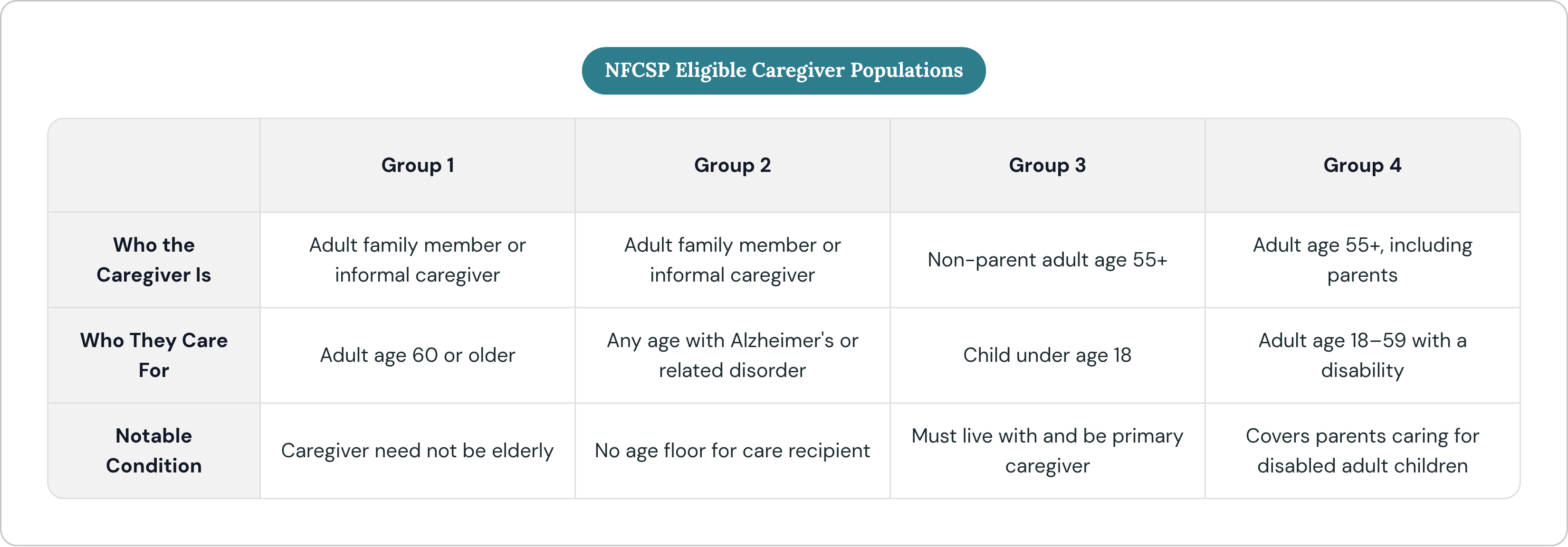
NFCSP's eligibility structure has been refined through successive reauthorizations. The current framework, updated by the 2020 Supporting Older Americans Act, covers four distinct populations.
The first and largest group is adult family members or other informal caregivers providing care to someone age 60 or older. The caregiver does not need to be elderly; the care recipient does.
The second group is adult family members or informal caregivers providing care to an individual of any age with Alzheimer's disease or a related disorder. The absence of an age floor for the person with dementia reflects a policy amendment made in 2006. A caregiver supporting a 45-year-old with early-onset Alzheimer's qualifies under this provision. Many people in exactly that situation don't know it.
The third and fourth groups address grandparents and older relatives. Adults age 55 or older who are not the parents of the children they care for and who provide care to children under 18 constitute the third eligible population. The fourth group covers adults age 55 or older, including parents, who care for adults between 18 and 59 with disabilities. These categories acknowledge that caregiving is not a single demographic phenomenon, and that intergenerational caregiving by older adults carries its own distinct burdens.
For grandparent and relative caregivers, additional parameters apply: the caregiver must be 55 or older, live with the child, serve as the primary caregiver, and have either a legal or informal caregiving relationship. The 2024 OAA final rule extended discretion to local entities to define "adult caregiver" in ways that can, under certain circumstances, include individuals under 18, a meaningful expansion for the often-invisible population of young caregivers.
For respite care and supplemental services specifically, eligibility also turns on the functional status of the care recipient. The person receiving care must be unable to perform at least two activities of daily living without substantial assistance, or must require significant supervision due to cognitive or mental impairment that poses a health or safety risk. That functional threshold does not apply to informational services or assistance accessing services.
Each state sets its own eligibility guidelines within these federal parameters. Confirming eligibility with the local Area Agency on Aging, rather than inferring it from the statute, is the approach least likely to result in a wasted trip.
How funding flows from Congress to your local Area Agency on Aging
The funding architecture of NFCSP is formula-based, not competitive. Congress appropriates money, the Administration for Community Living within the U.S. Department of Health and Human Services administers the program federally, and grants flow to states and territories based on their proportional share of the population age 70 and over. There is no grant writing, no competitive scoring. Larger elderly populations draw larger allocations.
States are required to provide a 25 percent match for NFCSP dollars. In practice, OAA programs draw roughly three dollars of non-federal money for every federal dollar, well above the statutory minimum. States frequently blend NFCSP funds with other state and local funding streams to extend coverage and fill gaps the federal allocation alone would leave open.
The delivery infrastructure is substantial: 56 state and territorial agencies on aging administer NFCSP at the state level; below them, 618 area agencies on aging translate state priorities into local services; nearly 20,000 service providers, along with 281 Tribal organizations and one Native Hawaiian organization representing 400 Tribes, constitute the local delivery network.
The practical consequence of this architecture is straightforward. A caregiver in a state with robust supplemental appropriations will encounter a meaningfully different program than one in a state funding only at the federal floor. Knowing the federal structure tells you what's possible; knowing your state tells you what's actually available.
How to actually find and apply for NFCSP services in your area
The fastest entry point is the Eldercare Locator, a public service of the U.S. Administration on Aging available by phone and online. One call or one search connects a caregiver to their local Area Agency on Aging, regardless of state. That AAA is the primary intake point for NFCSP.
Local AAA staff conduct individual conversations with each caregiver, assess their situation and needs, identify what NFCSP supports are available in that area, and connect them to services. The general sequence: contact the AAA, request information on NFCSP availability, submit an application, and allow the agency to review eligibility before services are arranged.
For respite or supplemental services, expect questions about the care recipient's functional status, specifically ADL limitations or cognitive impairment meeting the threshold described in the eligibility criteria. For informational services, the bar is lower.
AAAs also connect caregivers to state and community programs beyond NFCSP. The conversation is worth having even when NFCSP eligibility is uncertain, because local agencies carry visibility into resources that resist independent discovery.
What the program's own outcome data shows about its impact
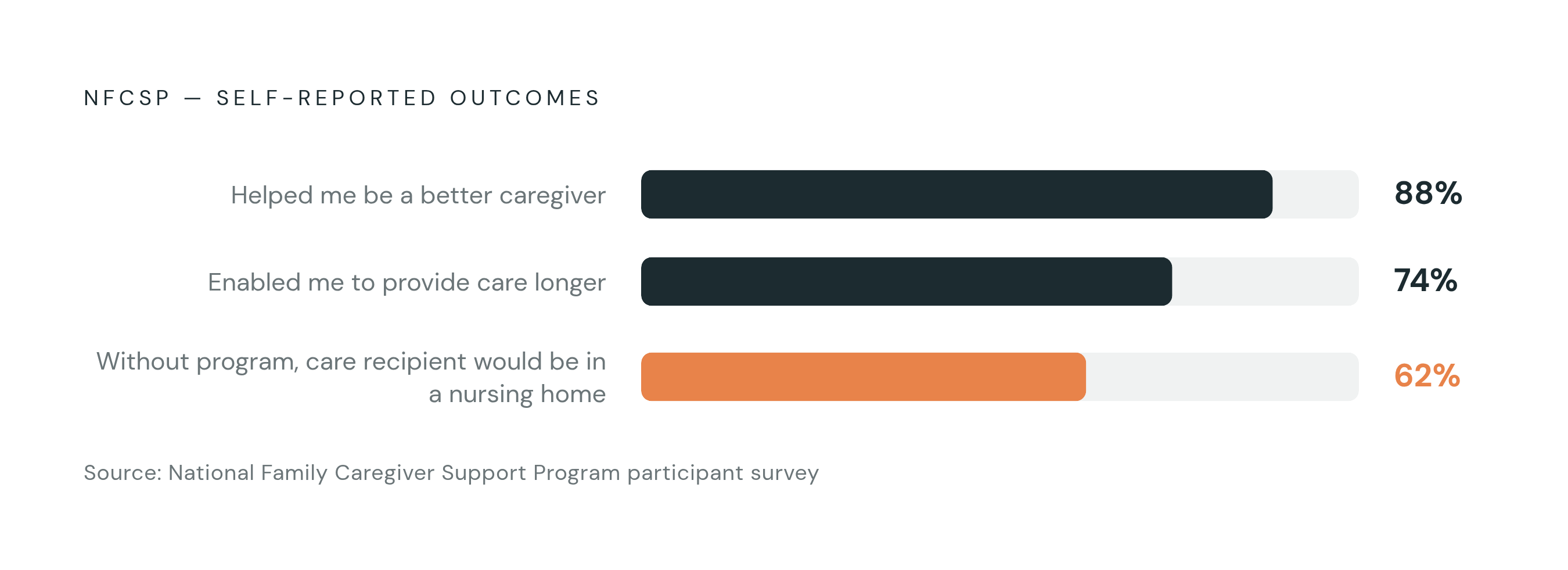
The outcome data ACL has collected from program participants speaks to what NFCSP is preventing, not just what it is providing.
Nearly 62 percent of caregivers served by NFCSP indicated that without the program's services, the person they care for would be living in a nursing home. One might argue that self-reported survey data has its limits here: people who have just received a service are not disinterested evaluators of that service's necessity. But the consistent direction of the finding, across multiple outcome questions and multiple program years, is hard to dismiss wholesale. Eighty-eight percent of caregivers reported that services helped them be a better caregiver. Seventy-four percent reported that services enabled them to provide care longer than would otherwise have been possible.
Taken together, these figures suggest that NFCSP functions less as a support program in the conventional therapeutic sense and more as an institutional-placement-prevention mechanism operating at meaningful scale. The literature on NFCSP-type interventions does establish a link between caregiver support services and reductions in caregiver depression, anxiety, and stress, outcomes with their own downstream cost implications for healthcare systems.
One data point that gets insufficient attention in policy conversations: nearly 42 percent of caregivers report providing care for two to five years, and approximately 27 percent for five to ten years. Caregiving is a sustained life role for the majority of people who take it on. Why exactly does this matter? A program that provides episodic relief without building durable support structures is mismatched to that reality. This is precisely why the structure of NFCSP, with its emphasis on training and access navigation alongside respite, matters as much as the respite hours themselves.
Recent changes to the program and what may shift next
The 2020 Supporting Older Americans Act reauthorized NFCSP through fiscal year 2024 and updated the eligible caregiver populations in the ways described above. The 2024 OAA final rule extended local discretion on the definition of "adult caregiver," with implications for young caregivers. The program's current reauthorization status should be confirmed with ACL or through congressional records.
In September 2023 and February 2024, ACL announced $20 million in funding to establish a National Caregiver Support Collaborative, a structural investment in coordinating the caregiving support infrastructure at the national level rather than leaving that coordination to state and local improvisation.
Beginning January 2024, Medicare began covering practitioner time spent training caregivers to support people with certain illnesses in carrying out a treatment plan. This is a related but distinct development from NFCSP, worth noting so caregivers are aware of it as a complementary resource.
Senate bill S.4776, pending as of this writing, proposes to extend NFCSP eligibility to grandparents and older relative caregivers supporting youth ages 18 to 22 who are enrolled in school, amend caregiver assessments to account for barriers in accessing information and supports, and reauthorize the RAISE Family Caregivers Act through fiscal year 2029. Its current status should be confirmed before relying on its provisions.
A 2024 ADvancing States survey of 42 states found that 72 percent reported using the National Strategy to Support Family Caregivers to inform their state-level policy work. Federal direction is actively shaping state decisions, which suggests the infrastructure delivering NFCSP is not static.
The caregiving population the program serves is growing, for demographic reasons that are not going to reverse. Sixty-three million caregivers providing a trillion dollars in unpaid labor cannot be adequately served by a program most of them have never encountered. Whether that gap closes depends less on federal appropriations than on whether the people who need this program ever learn it exists.