Caregiver Burnout Signs and Risk Factors
Recognizing burnout before it erodes the caregiver's physical and mental health.
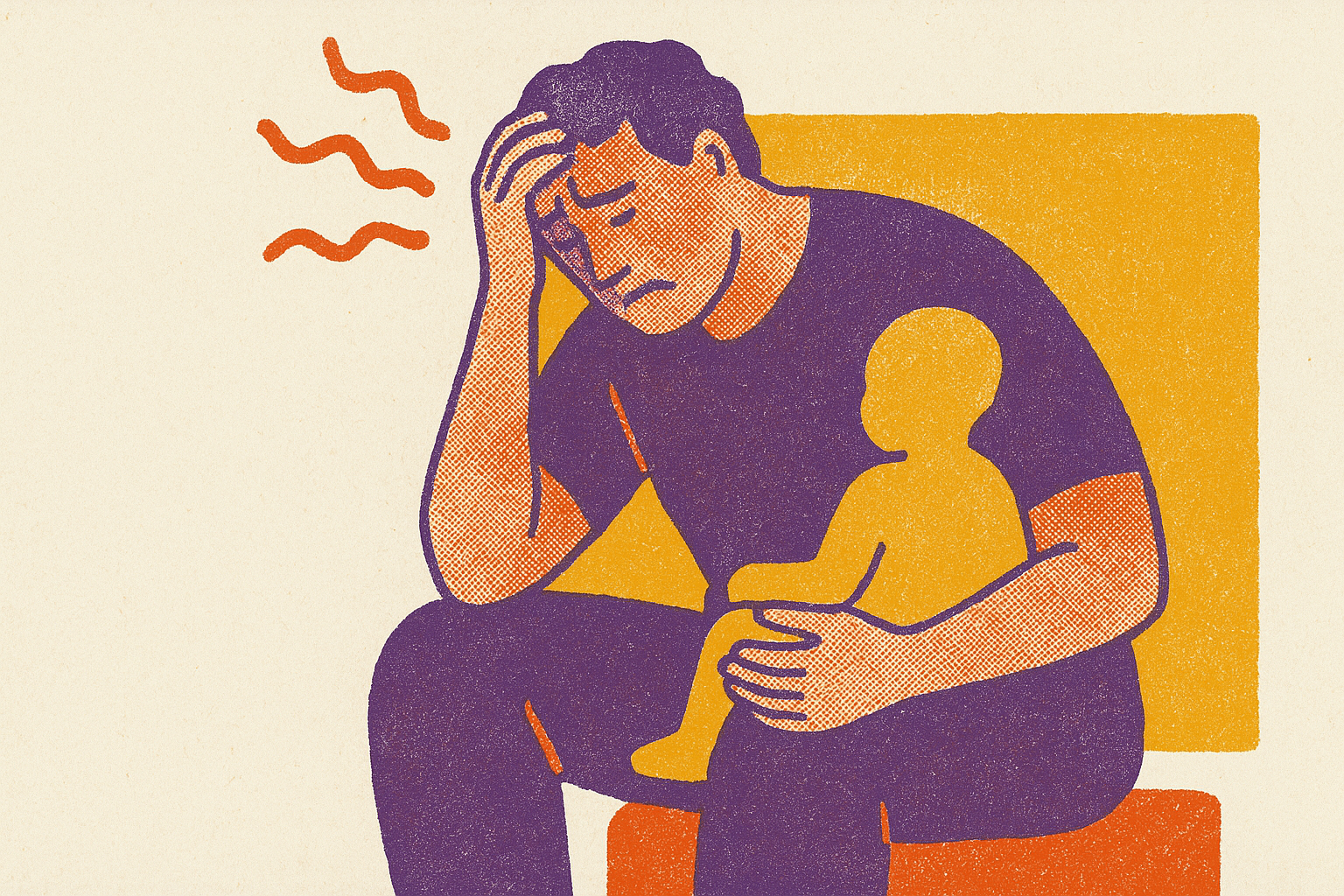
The numbers resist easy dismissal. According to A Place for Mom's 2025 caregiver survey, 78% of caregivers report experiencing burnout, many describing it as a weekly or daily occurrence. That same survey found 87% report stress and anxiety at some point, with more than half experiencing it at least weekly. CDC MMWR 2024 data places lifetime depression prevalence among caregivers at 25.6%, against 18.6% in non-caregivers.
What these figures suggest differs from what the public conversation usually makes of them. If burnout were primarily a failure of individual resilience, you would expect it to cluster around specific personality types, income levels, particular care situations. It doesn't. The distribution is remarkably flat across demographics, which points somewhere other than individual inadequacy. It points toward the structure of the role itself.
The conventional story, that a caregiver burns out because they need better self-care, mostly misses what's happening. The more interesting question isn't whether people burn out. It's what the experience looks like from the inside, before it has a name, before anyone has thought to call it anything at all.
The Emotional Signs That Show Up First
The emotional signals tend to arrive before the caregiver has language for what's happening, and they rarely arrive dramatically. Persistent low-grade sadness, irritability without a clear object, a kind of ambient hopelessness that feels less like grief and more like weather. These get attributed to exhaustion, to a hard week, to something other than what they are.
Anxiety and guilt are particularly deceptive because they can sustain themselves by posing as conscientiousness. The caregiver asking daily whether they're doing enough, spiraling in self-criticism over every perceived shortcoming, often reads their own distress as proof of how much they care. There is a point, though, where that internal questioning stops being meaningful reflection and becomes a loop — at which point it is more accurately read as overload than devotion. The mind under sustained pressure frequently finds hypervigilance more tolerable than helplessness.
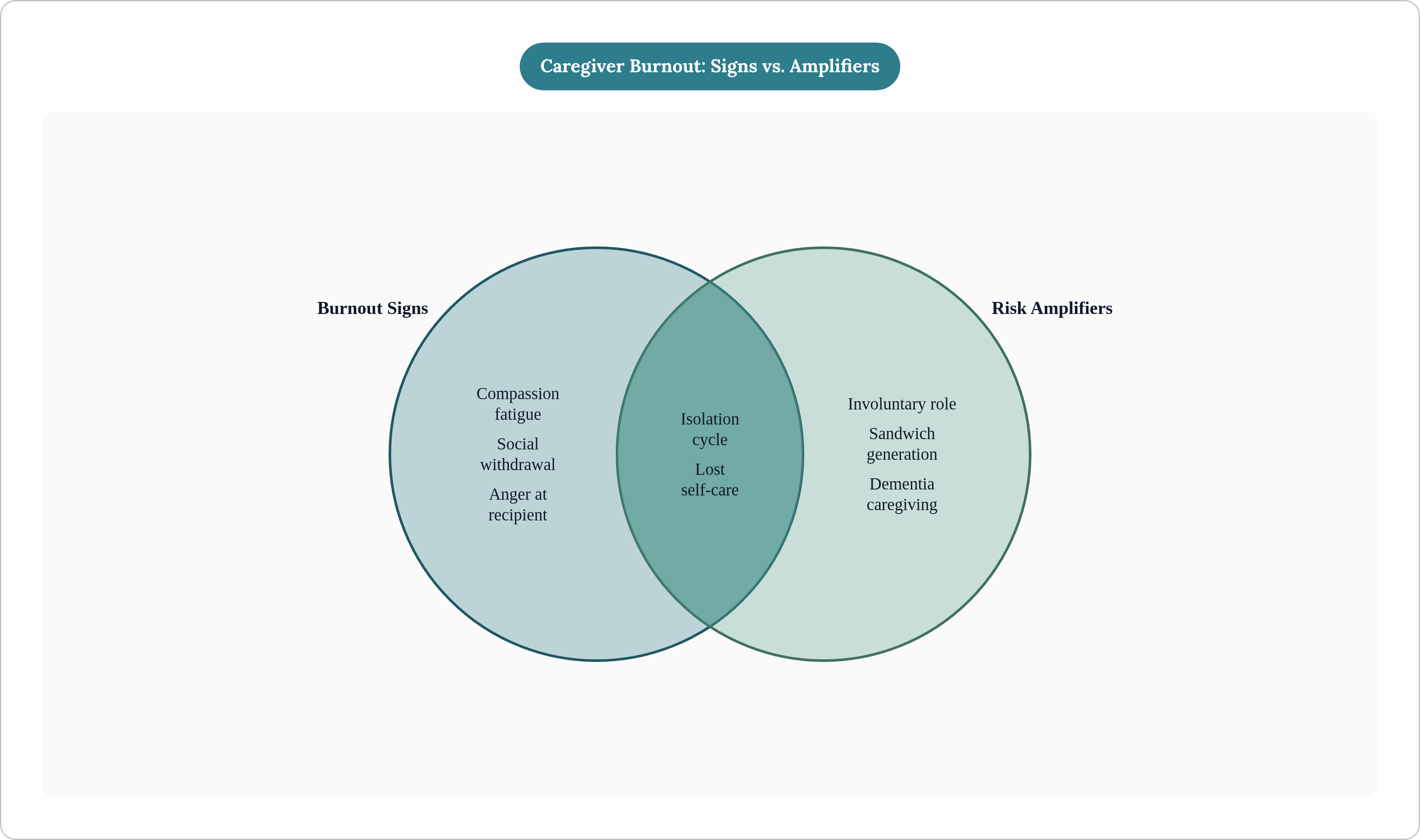
Anger directed at the care recipient is among the most commonly reported and least frequently acknowledged early signs. It surfaces when care is refused, when efforts go unrecognized, when behavioral changes make ordinary interactions combative. The caregiver who can name that anger as a burnout indicator, rather than a character flaw, is in a markedly different position than the one who can only feel ashamed.
Compassion fatigue deserves its own category here, distinct from ordinary tiredness. It is the erosion of the emotional warmth that originally motivated the care. A caregiver who began out of love, or obligation, or both, and now feels numb, detached, going through the motions, is not morally compromised. They are depleted. The word caregivers tend to reach for is "dark," and that word is doing more diagnostic work than it might appear to be. The shift from caring to numb is specific in a way that general stress is not, and it tends to be the signal most often minimized by the people experiencing it.
Cultural pressure to be uncomplaining in a caregiving role is real and persistent. It delays recognition at precisely the moment when recognition would be most useful.
Physical Symptoms and What the Evidence Actually Shows
The physical presentation of caregiver burnout is familiar from lived accounts: chronic fatigue that sleep doesn't resolve, frequent illness, headaches, muscle tension, blood pressure that climbs gradually until it demands attention. Twenty-three percent of caregivers, per AARP 2025 data, report that caregiving has negatively affected their physical health. What begins as a collection of minor complaints tends, if unaddressed, to become more systemic.
But the underlying mechanism is more complicated than the conventional narrative suggests, and getting this wrong has real consequences for how caregivers seek help. A 2019 analysis published in The Gerontologist, examining approximately 30 studies on immune and inflammatory biomarkers in caregivers, found that caregiver stress explained less than 1% of variability in those markers. More recent population-based studies have found minimal physical health decreases in caregivers relative to matched non-caregiver samples; in some analyses, caregivers showed reduced mortality. The claim that caregiving measurably suppresses immune function at the biological level is, on current evidence, substantially overstated.
This does not render physical symptoms fabricated or trivial. The symptoms are real; the mechanism appears to be more psychological than inflammatory. A caregiver noticing that minor ailments aren't resolving, that sleep consistently fails to feel restorative, should take those patterns seriously as signals worth acting on. The appropriate response is probably mental health intervention and stress reduction, not alarm about a trajectory toward systemic physical deterioration. The conventional narrative catastrophizes; the evidence points toward a different and more actionable conclusion.
Behavioral Changes That Mark a Shift into Chronic Burnout
Social withdrawal tends to appear early and tends to be the most visible to others. The caregiver who begins declining invitations, pulling back from friendships, abandoning activities that previously offered relief is not simply busy. They are often entering a self-reinforcing cycle: isolation compounds stress rather than relieving it, and the further they retreat from support, the harder it becomes to seek any.
Apathy toward self-care follows: skipped meals, deferred medical appointments, abandoned exercise routines. This isn't merely neglect. It's closer to a dissociation from the self as a person with needs, and it is among the more reliable markers that the role has subsumed the individual.
When the tension generated by caregiving starts damaging friendships, marriages, and professional relationships, the burnout has breached its original container. The stress is no longer confined to the caregiving context; it has become the context. In more serious cases, behavioral consequences include increased substance use and declining quality of care for the care recipient. That downstream consequence rarely gets factored into discussions of caregiver well-being, which is a peculiar omission given that it touches the person everyone claims to be most concerned about.
The National Alliance for Caregiving has found that caregivers facing high emotional stress lose roughly a full week per month to poor mental health days. Family members and colleagues often notice behavioral changes before the caregiver acknowledges them, and that observational gap is itself a reason the people around a caregiver matter in early recognition. The caregiver is frequently the last person to see it clearly.
How Hours Spent and Duration of Care Accelerate the Path to Burnout
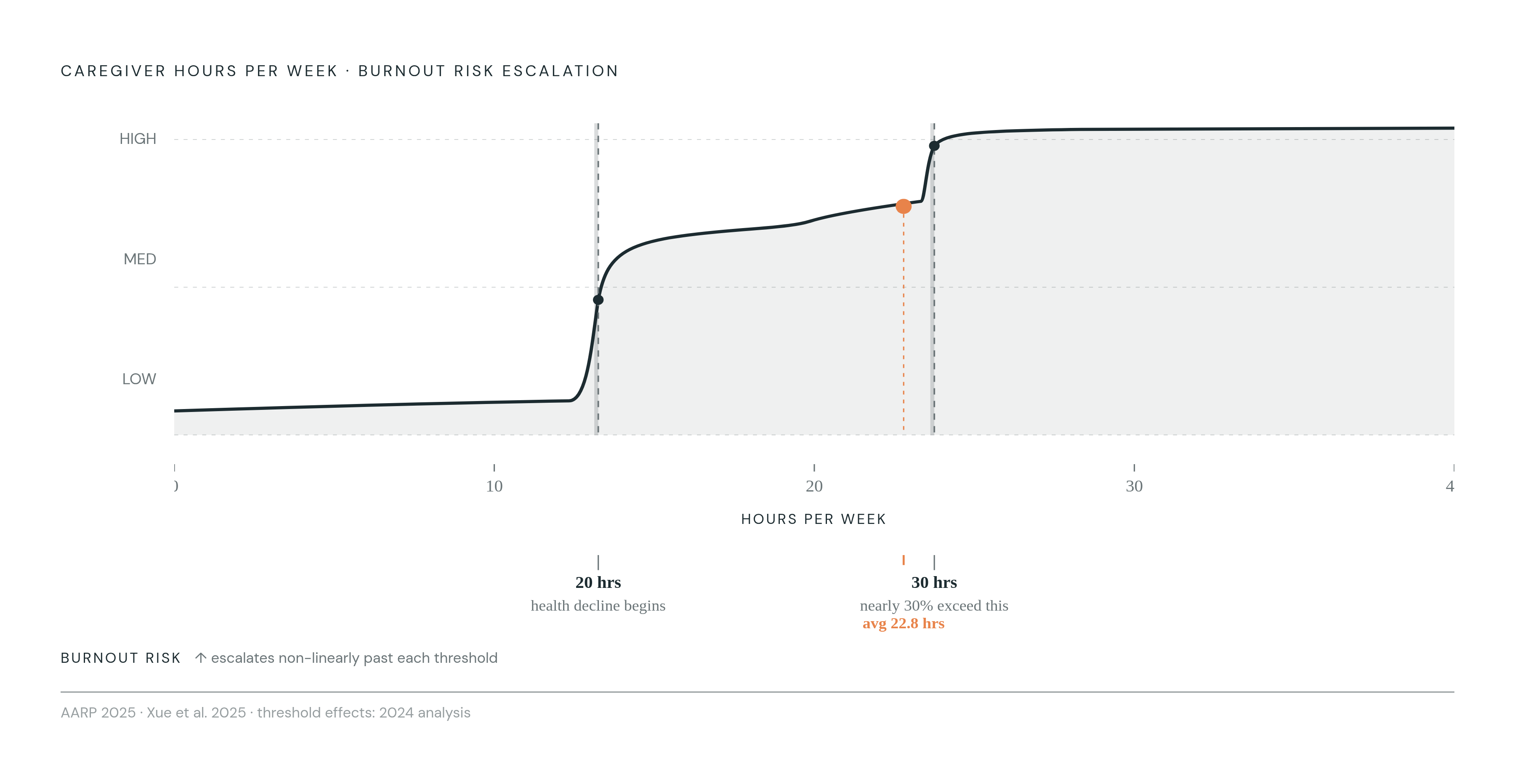
Time is the resource caregivers report losing first, and the arithmetic is unsparing. AARP's 2025 data finds caregivers providing an average of 22.8 hours of care per week, with nearly 30% exceeding 30 hours weekly. Twenty-five percent have been doing this for more than five years; 75% have been at it for at least a year. These are not numbers describing occasional help. They describe a second job, sustained across years, without the boundary of clocking out.
A 2024 analysis identified threshold effects in caregiver psychological well-being as hours increase: the deterioration is not gradual and linear. It accelerates at identifiable intensity levels. Research by Xue and colleagues in 2025 found that exceeding 20 hours of caregiving per week is specifically associated with mental and physical health decline, particularly for sandwich generation caregivers. At certain thresholds, the load changes character, not just weight.
What compounds this is the logic of recovery. Time is also what caregivers need for restoration. When caregiving hours consume the margin that would otherwise allow recovery, each subsequent week begins from a lower baseline than the one before. Sustained across months and years, that baseline drift is what actually builds burnout: not a single overwhelming moment, but a slow accumulation of depleted starting points, each less visible than the last.
Why Sandwich Generation Caregivers Face a Steeper Burnout Risk
Approximately 2.5 million Americans are simultaneously caring for aging parents and dependent children. The structural problem is that both sets of obligations occupy the same finite hours, and neither pauses to accommodate the other.
A 2026 study published in Aging & Mental Health found burnout significantly higher in sandwich generation caregivers than in those caring only for children. The predictors were specific: for parent-only caregivers, insomnia, distress tolerance, and neuroticism emerged as distinct drivers; for sandwich caregivers, the quality of relationships within the caregiving dynamic was itself a significant burnout predictor. The hours matter, but so does the relational texture of the situation.
What makes this population difficult to reach is that neither caregiving obligation looks, from the outside, like too much on its own. Cleo's 2026 Family Health Index, drawn from over 19,200 assessments, found 64% of working women in the sandwich generation at a breaking point. Each obligation appears manageable in isolation. The combination produces overwhelm, and because support systems are not designed to account for it, sandwich generation caregivers frequently lack both the language and the resources to address what they're experiencing. They fall through the gap between two sets of infrastructure that were never built to talk to each other.
The Gender Gap in Who Carries Caregiving's Heaviest Burden
The distribution of caregiving labor is not symmetrical. Sixty percent of sandwich generation caregivers are women, and on average they spend 45 minutes more per day on caregiving tasks than men, per Pew Research data. Cleo's 2026 Family Health Index found that women ages 40 to 54 face the highest burnout risk across all age groups, marked not only by exhaustion but by measurable warning signs of health deterioration. Research by Albertini and colleagues in 2024 found that women transitioning into sandwich caregiving experience increased depressive symptoms and decreased well-being; this effect was less consistent for men.
The workforce consequences are concrete. Nearly half a million women exited the U.S. workplace in 2025 as caregiving pressures mounted, per a Catalyst study. Careers interrupted, financial security diminished, professional trajectories altered in ways that accumulate and compound across decades.
The gender gap in caregiver burnout is real, but it is more accurately attributed to structural role allocation than to any differential in biological vulnerability. Women are more likely to take on caregiving roles, to log more hours within those roles, and to absorb a disproportionate share of the psychological cost. Whether that allocation is natural or inevitable is the more consequential question — and the research supports neither claim. The data on workforce exits suggests that treating it as inevitable is itself generating measurable harm.
Caring for Someone with Dementia as a High-Intensity Risk Situation
About 48% of caregivers assisting older adults are helping someone with Alzheimer's or another form of dementia. Nearly 70% of dementia caregivers report high stress levels, placing them at elevated burnout risk, per Alzheimer's Association data. The intensity here exceeds most other care situations by several dimensions at once.
Dementia caregivers typically assist with more activities of daily living, log more daily hours, and are responsible for managing behavioral and psychological symptoms that fluctuate without warning. The cognitive and emotional changes in the care recipient are not static; they progress, and the caregiver must adapt continuously to a moving target while simultaneously processing anticipatory grief for a person who is still present but gradually less recognizable. That combination of logistical intensity and ongoing loss is unusual in caregiving contexts and is not captured by hours-per-week metrics alone.
The downstream consequences extend beyond the caregiver. Burnout in dementia caregivers is associated with earlier and repeated hospitalization of the care recipient, meaning the harm propagates directly into the continuity and quality of care delivered.
There is something about the dementia caregiving context that I have found consistently hard to explain to people outside of it: stepping back tends to feel morally impermissible to the caregiver, more so than in almost any other care situation, and not because of any failure of perspective. The disease itself creates conditions in which acknowledging limits feels like abandonment. So the behavioral signs of burnout go unacknowledged in this group, not because these caregivers lack self-awareness, but because the role forecloses the psychological permission to acknowledge limits at all. Naming that foreclosure explicitly matters: it is part of why this population is both the highest risk and the hardest to reach.
How Isolation and Lack of Support Turn Manageable Stress Into Burnout
More than half of caregivers, per National Alliance for Caregiving data, did not enter this role voluntarily. Involuntary caregiving is associated with higher rates of isolation, and isolation is one of the most consistent amplifiers of burnout risk across the research literature.
Solo caregivers, those without siblings or other informal support sharing the load, report greater financial difficulty and less social support than caregivers with distributed responsibility, per research by Skoblow and Gilligan published in 2025. The cycle compounds: isolation reduces available support, which increases solo hours, which elevates burnout risk, which reduces the caregiver's capacity to seek help, which deepens isolation. Left alone, it rarely self-corrects.
Sixty-four percent of caregivers also hold full- or part-time employment, per AARP 2025 data. Employed caregivers miss an average of 1.2 days of work per month. The chronic low-grade conflict between professional and caregiving obligations is its own distinct stressor, and it operates largely invisibly to employers. Seventy-three percent of caregivers report that caregiving has affected or will affect their financial stability, per LogicMark and Talker Research data from 2026. Lower-income caregivers face compounding disadvantage across every financial dimension. Many qualify for compensation programs, respite support, and financial assistance that could meaningfully reduce hours or strain; a significant portion never access what is available, largely because navigating an opaque system requires exactly the resources they do not have.
The protective factors are well-established: high perceived self-efficacy, satisfaction with social support, and problem-focused coping all buffer against burnout. Avoidance-focused and maladaptive coping are risk factors. Knowing that is useful. Having access to those conditions is a different question, and it is where most caregivers actually live.
What Catching These Patterns Early Actually Makes Possible
Earlier recognition expands available options. A caregiver who identifies emotional exhaustion and social withdrawal before full burnout sets in can seek respite support, adjust care arrangements, address financial strain, or simply name what's happening to someone positioned to help. A caregiver who reaches the wall in silence has, by that point, fewer of those choices remaining.
The care recipient has a direct stake in this. Burnout in the caregiver is associated with declining quality of care and earlier hospitalization. Sustaining the caregiver is a precondition of sustained care, not an afterthought, and treating it as anything less generates measurable consequences for the person at the center of the arrangement.
Burnout across emotional, physical, and behavioral domains follows recognizable patterns, and recognizable patterns can be caught before they become crises. But only if caregivers have the vocabulary and, more importantly, the permission to look. The caregiver who catches these patterns early is not retreating from responsibility — they are protecting their capacity to continue, which is the only thing that makes continued care possible.