Coordinating Care Across Multiple Providers
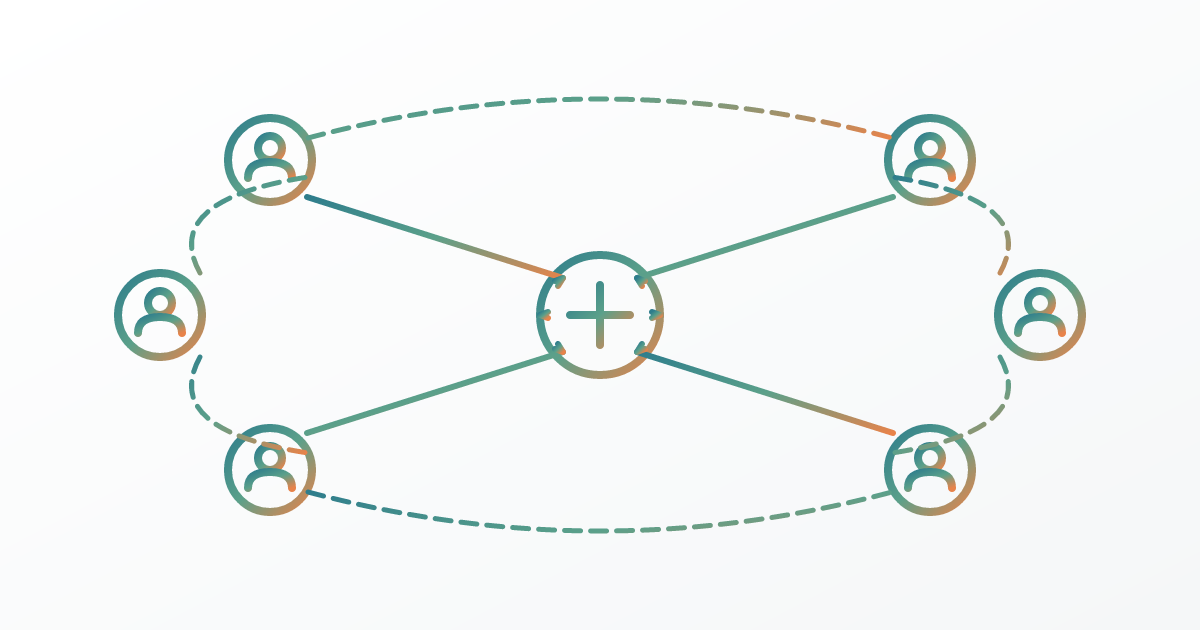
Roughly 25% of Medicare beneficiaries aged 65 and older see 11 or more different ambulatory providers in a given year. That is approximately 9 million people navigating a care environment where no single clinician holds a complete picture of the patient. The cost premium is quantifiable: high-fragmentation patients incur an estimated $4,542 more annually than lower-fragmentation counterparts. Numbers at that scale have a way of turning something intensely personal into something that feels structural and remote, which is precisely the problem.
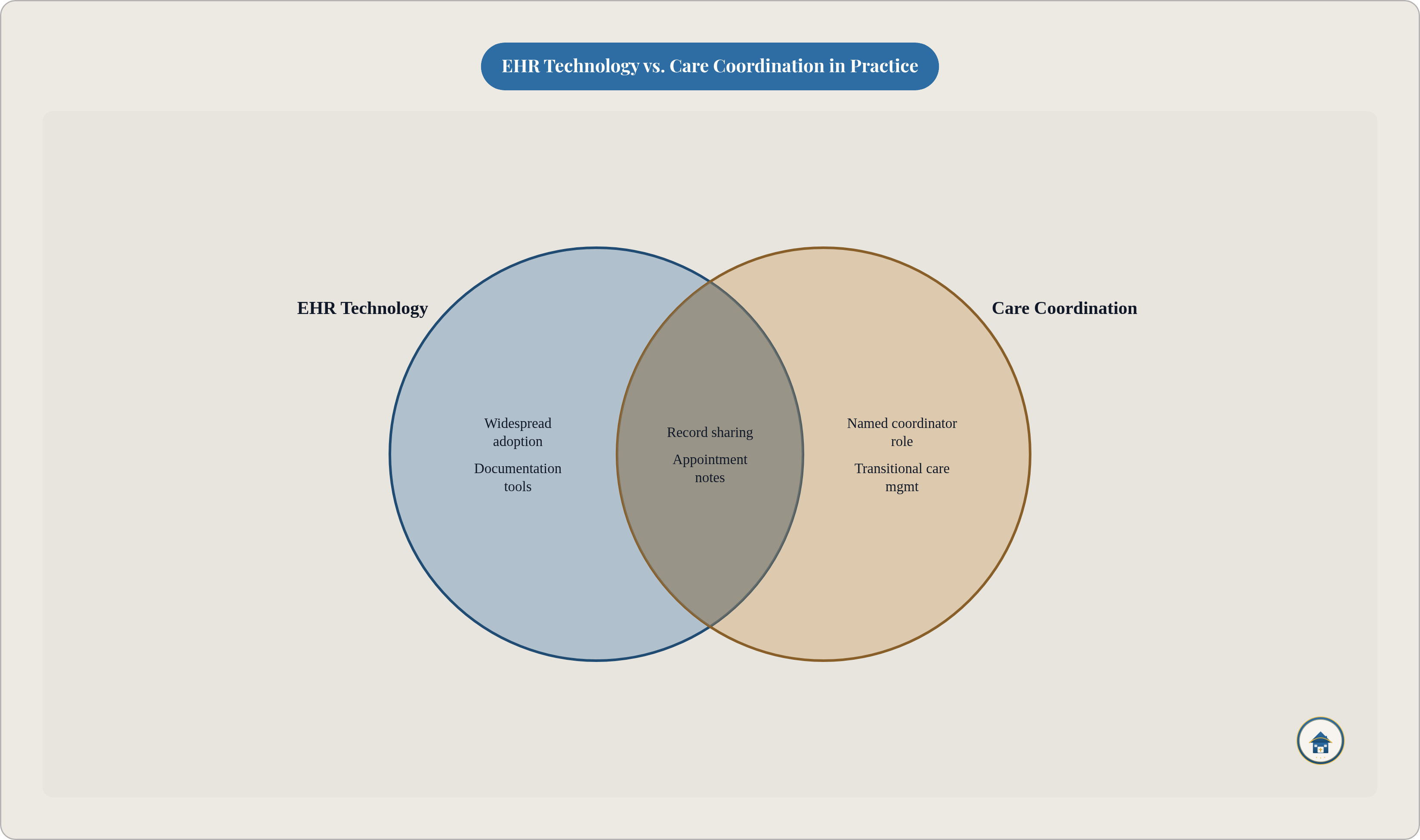
Electronic health records were supposed to close this gap. They haven't. Research from Mathematica has found that technology alone has not resolved the coordination deficit, and anyone who has worked inside a health system can tell you why without consulting a study. EHR adoption is widespread; interoperability is not. Physicians at different institutions, and sometimes within the same institution, operate in systems that don't reliably exchange information. The technology exists as a solution on paper while failing as an implementation in practice.
There is also a reflex worth examining: the instinct to treat fragmentation itself as the pathology. Some specialist use is clinically appropriate, even necessary. An older adult managing heart failure, diabetes, and a recent orthopedic injury should probably see more than one provider. The problem isn't the number of providers; it's the absence of communication between them. Caregivers who conflate the two tend to absorb a kind of ambient guilt that serves no one. This is a structural condition, not a personal failure, and that distinction changes how you respond to it.
Why Medication Management Is Where Fragmentation Does Its Most Visible Harm
More than 40% of adults 65 and older now take five or more medications, up from 24% in 2000, per a 2024 study in JAMA Internal Medicine. Roughly 65% of adults over 65 experience polypharmacy, and no single provider typically reviews the complete medication list across specialists. Each prescriber sees their piece. Nobody owns the whole.
The consequences are specific and documented: drug interactions, prescribing cascades, therapeutic duplication, and nonadherence driven by a complexity no patient can reasonably be expected to manage alone. A prescribing cascade, to name the mechanism precisely, is a drug prescribed to treat the side effect of another drug, which then generates its own side effects, and so on. The prescription list grows; the origin of each new problem becomes harder to trace. I have reviewed medication lists for older adults where it took a pharmacist an hour to reconstruct the causal chain between entry and current crisis.
The caregiver's position in this dynamic is peculiar, and often underestimated by the caregivers themselves. They frequently know more about the full medication picture than any individual physician does, having been present across more appointments, watching the list accumulate over months or years. That knowledge is clinically significant. Sharing it explicitly at each appointment is not an imposition; it is often the information the provider actually needs to make a safe decision.
A single up-to-date medication list — every drug, dose, prescriber, and over-the-counter supplement, including vitamins and herbal products — is one of the highest-impact documents a caregiver can maintain. Bring it to every appointment. Update it every time anything changes. When there's reason to question whether a medication is appropriate for an older adult specifically, the Beers Criteria, available through the American Geriatrics Society, is a named clinical reference a pharmacist or primary care physician can walk through. Asking about it signals that the caregiver is paying close attention; providers tend to respond differently to that signal than to silence.
The Records Problem: Why Providers Often Don't Have Each Other's Information
EHR interoperability is not primarily a technology problem at this point. It is a combination of technical architecture, business incentives, and organizational inertia — a resistance that proves harder to dislodge than any single engineering fix. Systems from different health networks frequently cannot exchange records automatically, and even within the same network the exchange is inconsistent. Behavioral health records are especially siloed: a cardiologist may have no access to a patient's psychiatric history even when that history directly affects treatment decisions, because mental health records carry additional legal protections that complicate integration.
Prior authorization compounds the problem. Physicians spend an average of 13 hours per week on prior authorization requests, processing roughly 39 per week, according to the AMA's 2024 Prior Authorization Physician Survey. That is time not going toward reviewing incoming records, coordinating with colleagues, or thinking through care transitions. A caregiver who interprets a provider's lack of coordination as indifference may be misreading the situation entirely; they are often dealing with a clinician under significant and sustained administrative pressure.
Regulatory momentum is building. The Office of the National Coordinator for Health Information Technology's information-blocking enforcement rules and CMS's prior authorization rule taking effect in 2026 are both designed to push toward better data exchange. Those changes operate in the future. The gap exists now.
Do not assume records have transferred. Request them, carry them, share them directly. When a new specialist enters the picture, ask at the start of the appointment: did you receive records from the primary care physician? Do you have the current medication list? If the answer is no, that conversation needs to happen before clinical decisions are made.
The Questions Caregivers Should Bring to Every Provider Interaction
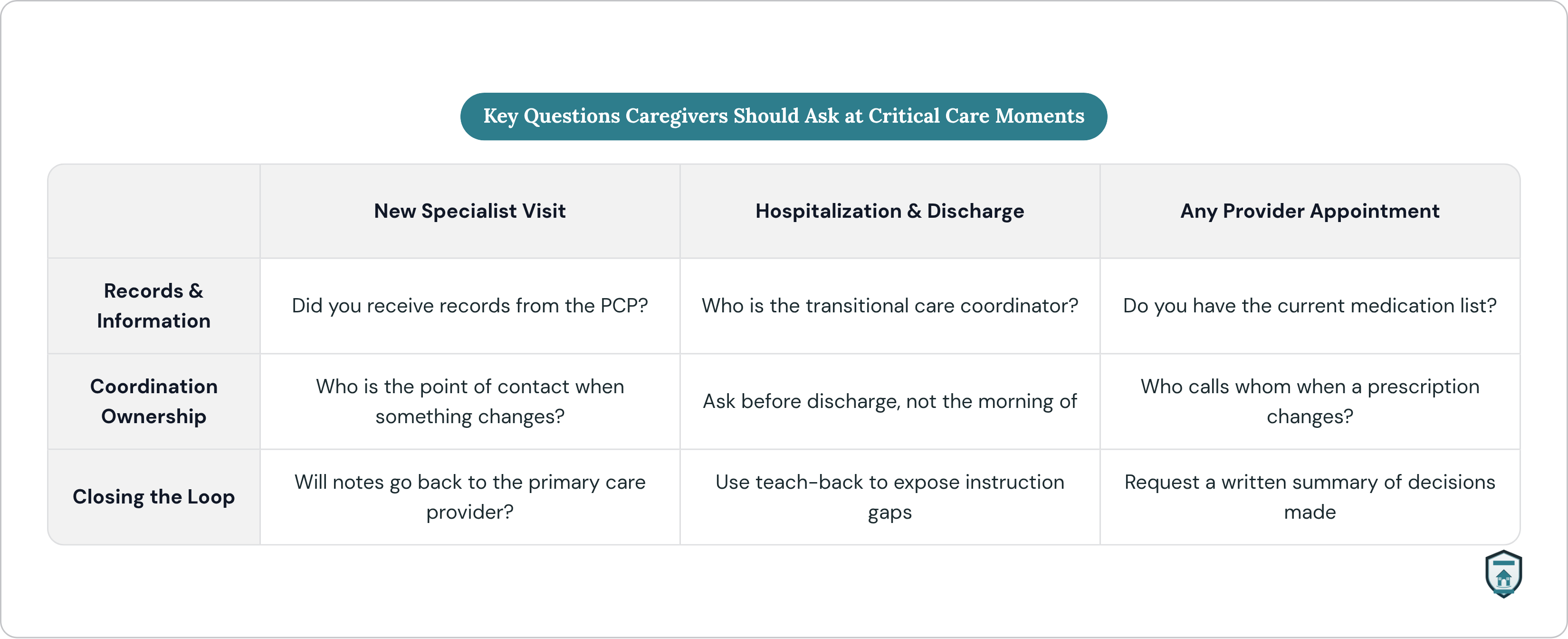
The most disorienting feature of fragmented care is the absence of a named coordinator. Someone needs to own that role explicitly. In most cases the primary care physician is the logical candidate, but "logical candidate" is not the same as a clear, spoken agreement. At the start of any new care relationship, or when a new specialist joins, the question should be direct: who is the point of contact when something changes? Who calls whom when a prescription is added or a treatment plan is revised?
When a specialist enters the picture, three questions should become routine. Have you received records from the primary care physician? Do you have the complete medication list? Will you send notes from this visit back to the primary care provider? These are not aggressive questions; they make the provider's job easier, and most will respond constructively. The hesitation to ask them costs more than the discomfort of asking.
Hospitalizations deserve particular attention. The 30 days following a discharge are among the highest-risk periods in the trajectory of older adult care. Transitional care management programs that prioritize this window, including prompt follow-up visits, prescription confirmation, and clear post-discharge instructions, have been shown to reduce readmission rates substantially, per research published in the American Journal of Medical Quality. Before discharge happens, ask who the transitional care coordinator is and how to reach them.
The teach-back technique is underused and straightforward: at the end of an appointment or discharge conversation, ask the provider to explain the instructions as they would to someone who wasn't in the room. This exposes gaps and catches assumptions. Bring a written list of concerns. Take notes. Ask for a written summary of what was decided and what follow-up is expected. Being in the room as a participant rather than an observer is a posture, not merely a presence.
Practical Tools for Keeping All Providers on the Same Page
A care summary document is the most durable coordination tool available to a caregiver, and its power comes entirely from actually using it. One living record, updated after every significant appointment, that travels to every encounter. It should include all current diagnoses, every provider with contact information, all medications with doses and prescribers, allergies, and recent test results with clinical relevance. Format matters less than discipline: a shared Google Doc, a printed binder, a dedicated app — whatever gets opened and updated consistently is the right format.
An appointment log serves a distinct function alongside the care summary. A running record of who was seen, when, what was decided, and what follow-up was requested protects against a specific and common failure mode: something is ordered, no one follows up, and it falls through the cracks among three providers who each assumed one of the others handled it. I have watched this happen with referrals, imaging orders, and prescription changes. The log catches it.
Patient portals, available through most major health systems, are underutilized by caregivers. Lab results, visit notes, and records are retrievable without waiting for paper copies or relying on memory. Caregivers should request authorized portal access on behalf of the person they're caring for; this requires a formal process but is straightforward to complete.
HIPAA release of information forms are essential. Without being named on these forms, a caregiver cannot legally request records or speak with providers. This sounds obvious. It is regularly overlooked until a crisis makes it urgent.
Care managers and social workers exist inside many health systems and insurance plans, including through Medicare and Medicaid. Most caregivers are unaware they qualify. Ask the primary care office, the insurer's member services line, or the local Area Agency on Aging. The support may already be available; the barrier is usually awareness, not eligibility.
How Value-Based Care Models Are Changing What Coordination Support Is Available
As of January 2025, 53.4% of traditional Medicare beneficiaries, more than 14.8 million people, are in an accountable care relationship with a provider, per CMS. That is the largest annual increase since tracking began. The practical significance for caregivers is concrete: if the person you're caring for is enrolled in an accountable care organization, their providers share financial incentives to coordinate care effectively. Poor coordination in that model costs the providers money. That changes the dynamic, sometimes meaningfully, though shared financial incentives are not the same as reliable coordination, and conflating the two leads to unpleasant surprises.
The Guided Care model is worth knowing by name. A specially trained registered nurse coordinates care for patients with multiple chronic conditions, working alongside primary care and connecting specialist care. Studies have shown it reduces total healthcare costs measurably. The model exists; whether the care environment your family member is in has adopted something similar is a question worth asking directly.
Transitional care coordinators are a specific, titled role in many hospital systems, assigned to manage the handoff from inpatient to home. Ask for this person before a discharge is finalized, not the morning it happens. The window between "patient is being discharged" and "patient is home" is too compressed to build a useful working relationship from scratch.
CMS has stated a goal of placing every Medicare patient in a value-based care arrangement by 2030. Caregivers whose family members remain in traditional fee-for-service arrangements today may need to build the coordination infrastructure themselves. That gap will close gradually, unevenly, and on a timeline caregivers cannot control.
Where AI Tools Are Beginning to Help, and Where They Fall Short
Most of the AI currently deployed in health systems operates on the provider side: identifying high-risk patients, closing care gaps, streamlining documentation. UnitedHealthcare's AI documentation tool, launched in 2025, had saved more than 4,000 providers 2 million minutes across 360,000 visits — a real administrative reduction. Its benefit reaches caregivers only indirectly, through faster and more complete provider notes, but faster and more complete provider notes are not a small thing when the alternative is documentation that lags by days or gets summarized loosely at discharge.
AI is beginning to have more direct utility for caregivers in benefit discovery: identifying programs a family qualifies for but hasn't found — Medicare Savings Programs, Medicaid waivers, caregiver compensation options, state-funded respite care — and guiding them through enrollment. Benefit eligibility is genuinely complex; a tool that parses it systematically can reduce a research burden that has historically fallen on whoever in the family has the most time and health literacy.
The digital divide is a real constraint, and anyone recommending AI tools for caregivers should be candid about it. Caregivers with limited broadband access, older devices, or limited digital literacy are going to find little benefit in app-based coordination platforms. Phone-based and in-person support are essential complements to digital tools, not legacy infrastructure awaiting a graceful phase-out.
The more fundamental limitation is conceptual. AI augments coordination; it doesn't replace the caregiver's organizing role. The human who holds the relationships, who advocates in the room when a provider is moving too fast, who notices that the patient's silence means something the discharge summary won't capture: that person still matters most. Sitting in a hospital room at the end of a long week, watching a physician review a discharge checklist at speed, you understand quickly that no documentation tool substitutes for someone who knows the patient and refuses to be moved along.
When the Caregiver's Coordination Burden Itself Needs Addressing
The structural absence of a built-in care manager doesn't just create work. It creates a specific kind of invisible, uncompensated, often unacknowledged labor that falls hardest on caregivers with the least health literacy and the fewest resources. That asymmetry is documented; it reflects how the system allocates, and consistently fails to allocate, responsibility for coordination in the first place.
Provider burnout is part of the context caregivers rarely see. Approximately 45% of physicians reported burnout symptoms as of early 2024. A fragmented system under administrative strain, staffed by clinicians who are themselves depleted, is the environment in which caregivers are trying to coordinate care. That context doesn't make the frustration disappear. It clarifies its source.
Caregiver compensation programs exist and are used by a small fraction of those who qualify. Medicaid waiver programs, state-funded programs, and VA benefits can pay family members for the care work they are already performing. Respite care, care manager services, and case management through Medicare or Medicaid are available and underutilized. The local Area Agency on Aging, an insurer's benefits navigator, or a hospital social worker can map what's available in a given geography. Most caregivers who find these programs do so late, after years of uncompensated work.
Approaching care coordination as an organizing project — with tools, documents, named roles, and defined processes — is different from carrying it as an unexamined obligation. The former is distributable across family members or paid support; it can be improved and handed off. The latter tends to concentrate, quietly, in one person until something breaks. That framing distinction matters more than most of the logistical choices that follow it.