Creating a Senior Care Plan After a Hospital Discharge
Demand these four documents before your senior leaves the hospital.

Most families don't know what to ask for at discharge, and hospitals don't consistently volunteer it. Federal regulation under 42 CFR § 482.43 requires hospitals to include patients and caregivers as active partners in discharge planning. The operative word is "partners," not recipients of a final-hour briefing. The hospital must also provide a list of Medicare-participating home health agencies, skilled nursing facilities, inpatient rehabilitation facilities, and long-term care hospitals serving the patient's area.
Before leaving, families should have four specific documents in hand: a written discharge summary covering the working diagnosis, any medications changed during the hospital stay, and follow-up instructions; the facility's Medicare-approved provider list for post-acute care; contact information for the discharge planner or social worker; and explicit confirmation of whether the senior was admitted under inpatient status or placed on observation status.
That last item tends to get lost in the noise of discharge day, but it determines Medicare eligibility for skilled nursing facility coverage entirely. A senior who spent four nights in the hospital but was classified as an observation patient has no qualifying stay for SNF coverage purposes, which means the family may face the full cost out of pocket. Hospitals are under no legal obligation to make this distinction visible. Families must ask directly, because in my experience, they rarely do until the bill arrives.
As of September 2025, CMS updated its discharge planning interpretive guidelines, placing hospitals under renewed scrutiny for the quality of the discharge process, not merely its existence. The regulatory environment is tightening, and yet families who don't know to ask for these materials rarely receive them unprompted. The obligation sits with the institution; the vigilance, practically speaking, falls to the family.
How to Assess What Level of Care the Senior Actually Needs
The choice of post-discharge setting is a clinical determination first, a logistical one second. Preferences matter, but they don't override medical reality. And when the clinical recommendation and the family's own assessment point in different directions, the gap between those two positions is worth working through carefully before a decision gets made, not after.
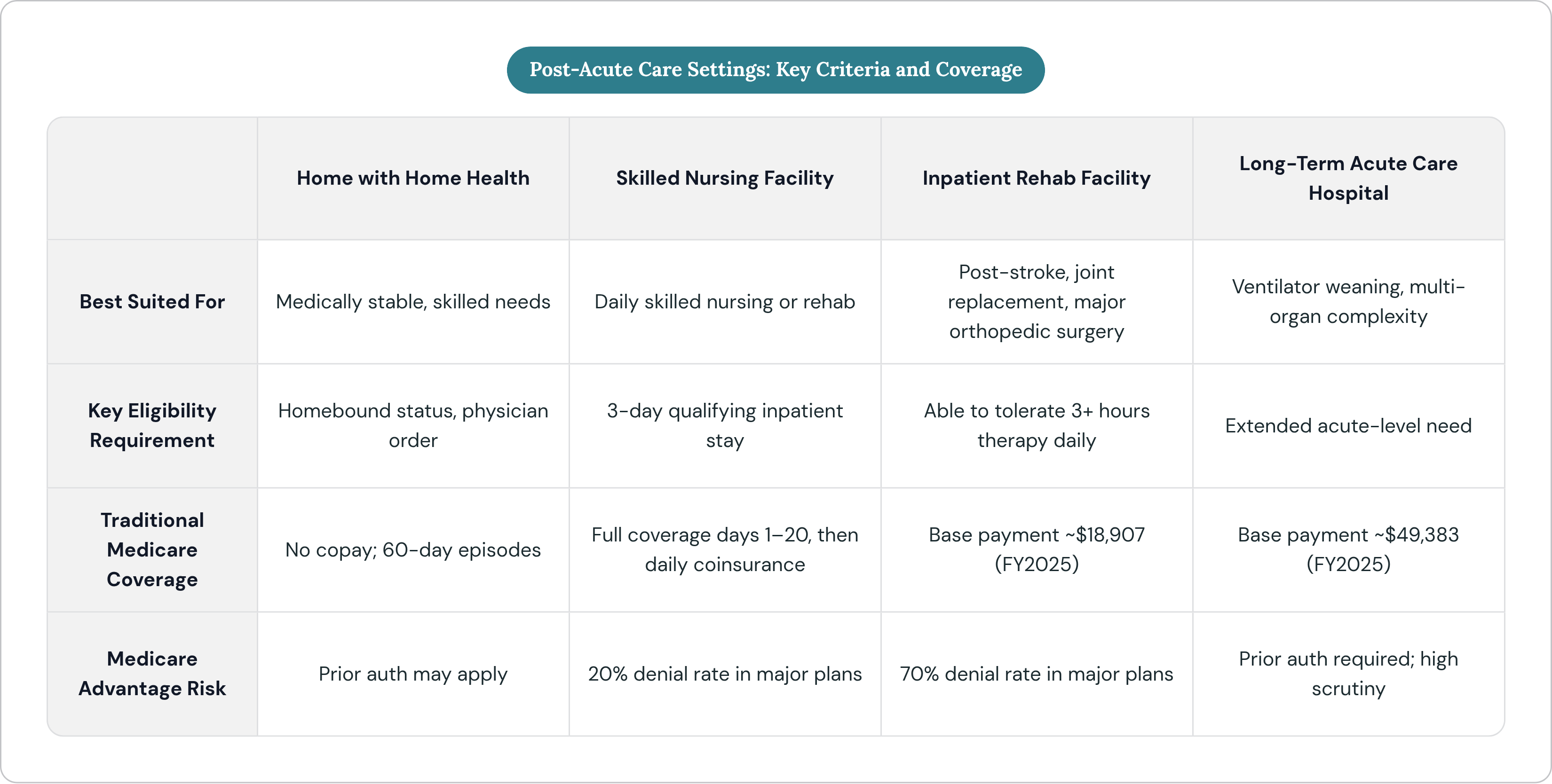
There are four primary post-acute pathways. Home with home health services suits a senior who is medically stable but requires skilled nursing or therapy; Medicare covers this when a physician orders care, the senior is homebound, and skilled care needs are documented. A skilled nursing facility is appropriate when daily skilled nursing or rehabilitation is required, though it carries the three-day qualifying inpatient hospital stay requirement that connects directly to the observation status issue above. An inpatient rehabilitation facility follows stroke, joint replacement, or major orthopedic surgery, and requires the patient to tolerate intensive therapy, typically three or more hours per day. A long-term acute care hospital is reserved for the most medically complex cases: ventilator weaning, complex wound management, multi-organ conditions requiring extended acute-level care.
Roughly 25 to 40% of hospitalized adults discharge to some form of post-acute care, and among seniors specifically, that proportion leans heavily toward facility-based settings. Home is not the right default in every case, however strongly it may be preferred. I've seen families spend enormous energy fighting for a home discharge that then collapsed within two weeks because the underlying complexity hadn't been assessed clearly.
Before settling on a setting, four questions deserve candid answers. Can the senior perform basic activities of daily living, with or without assistance? Are there open wounds, IV medications, or monitoring needs that require clinical skill to manage? Is the home environment physically accessible, accounting for stairs, bathroom safety, and mobility constraints? Is there a capable caregiver available with enough consistent presence to sustain the plan?
The discharge planner's recommendation deserves serious consideration as clinical input. It is not, however, a final determination. Families can and should evaluate options independently, particularly when the recommended setting conflicts with what the assessment above actually suggests.
What Medicare and Medicaid Actually Cover in Each Post-Discharge Setting
Coverage varies sharply by setting, and the distinction between traditional Medicare and Medicare Advantage introduces a second layer of variability that catches families off guard consistently. The rules families assume apply to their plan may not, and that assumption is typically not tested until a claim is denied.
Under traditional Medicare, home health carries no deductible or copayment; the average payment per in-person visit was $237 in 2023, with coverage organized into 60-day episodes beginning within 48 hours of discharge. For skilled nursing facilities, Medicare covers the first 20 days in full, then imposes significant daily coinsurance, with a base daily rate running around $500 in 2025. Inpatient rehabilitation facilities carry a Medicare base payment of approximately $18,907 for fiscal year 2025, subject to documented medical necessity for intensive therapy. Long-term acute care hospitals carry a base payment of $49,383.26 for fiscal year 2025, reflecting their patient acuity.
Medicare Advantage is where things get materially harder. Prior authorization requirements that traditional Medicare does not impose become barriers that can delay or block placement. Among three of the largest MA plans studied in 2022, denial rates for SNF coverage reached 20%; for inpatient rehabilitation facilities, 70%. Those are not marginal numbers. Families enrolled in Medicare Advantage should initiate prior authorization before the placement decision is finalized, not after.
Medicaid's role becomes relevant for lower-income seniors who exhaust Medicare coverage. Extended SNF stays, home and community-based services, and caregiver support programs are potentially within scope, though eligibility rules differ materially by state and the application processes are rarely intuitive.
Private-pay home care sits in a different category. Round-the-clock in-home care can reach an extraordinarily high figure annually, which frequently exceeds the cost of nursing home or assisted living care in comparable markets. This figure tends to surface only after a family has already ruled out institutional care on principle without fully pricing the alternative.
If coverage is denied, the right sequence is to request a written explanation, ask the discharge planner about appeal rights, and act within the appeal window. Delays collapse options, and collapsed options are rarely recoverable.
Medication Management in the First 90 Days After Discharge
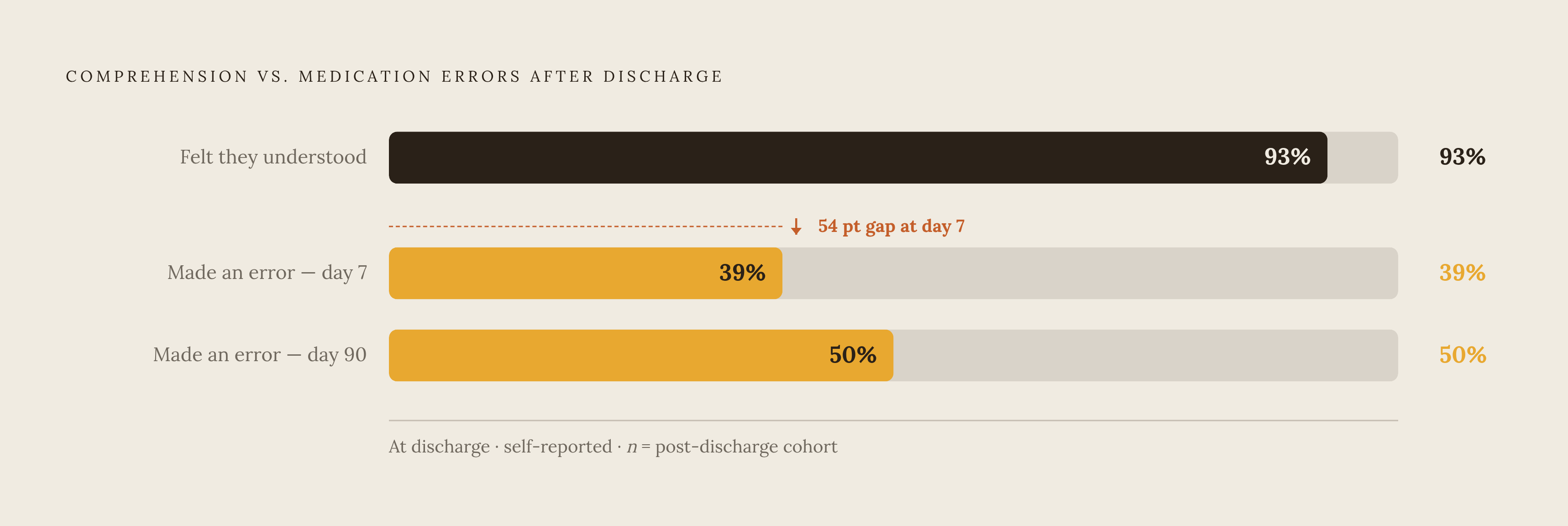
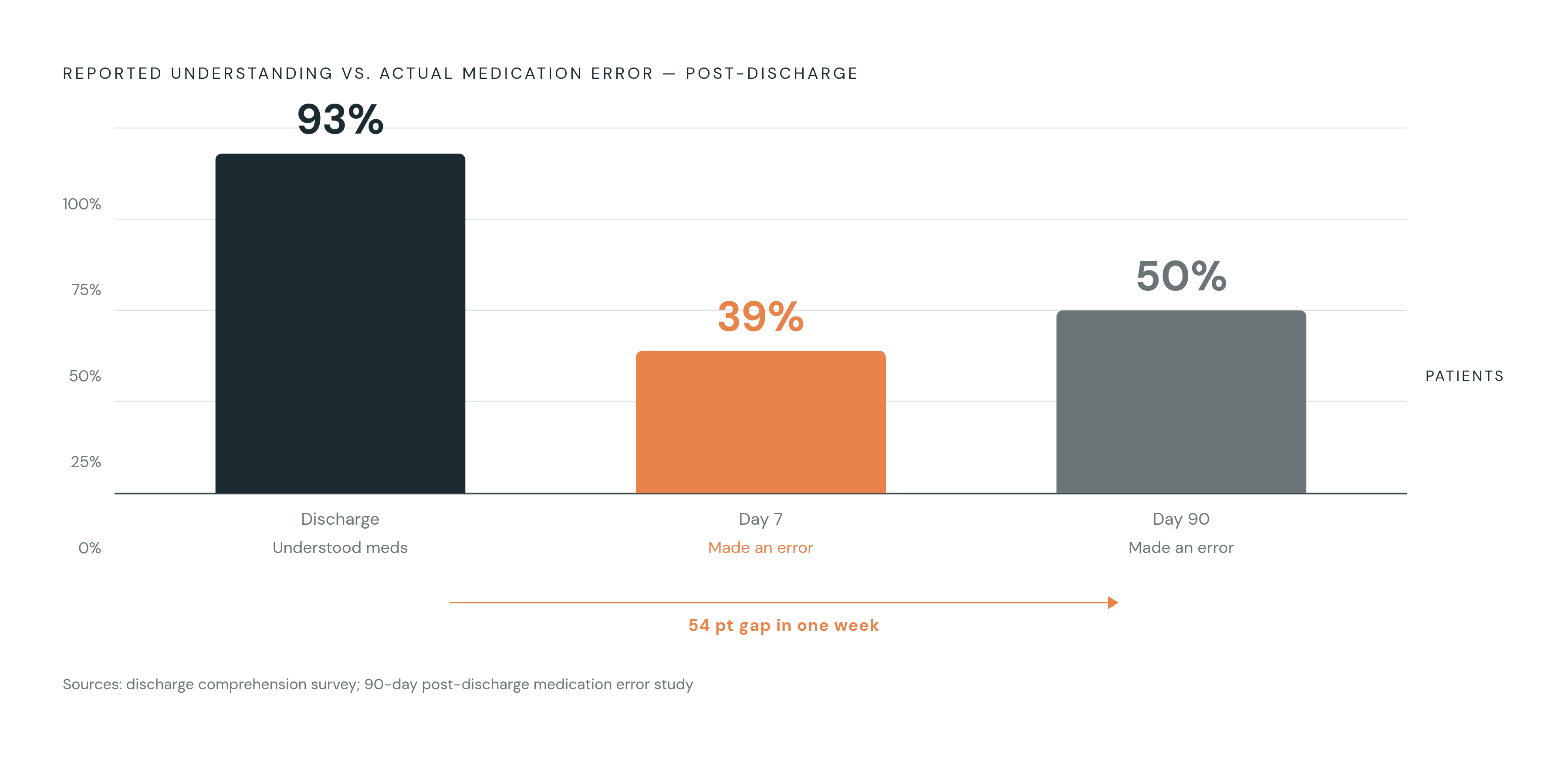
At seven days post-discharge, 39% of older adults had made at least one medication error. By 90 days, that proportion reached 50%. These are not statistics about outliers or patients who were inattentive at discharge.
What makes this particularly difficult to address is the gap between perceived understanding and actual safety. In the same body of evidence, 93% of patients reported understanding the purpose of each medication at discharge; 39% had nonetheless made an error within the first week. That gap bothered me when I first encountered it and still does. Discharge comprehension and safe medication management at home are not the same skill, executed under different conditions with a different cognitive load than the hospital environment produces.
The structural problem underneath this: only 13% of medication changes made during hospitalization received comprehensive discharge planning. Drug classes most frequently implicated in post-discharge adverse events include antibiotics, antidiabetics, analgesics, and cardiovascular medications, precisely the classes most commonly adjusted during a hospital stay. Antihypertensive and glucose-lowering medications carry particular risk when adjusted in the hospital setting and then inadequately monitored once the patient is home.
The practical steps that belong in any care plan follow from this. Reconcile the discharge medication list against what the senior was taking before admission, and treat every discrepancy as requiring physician confirmation rather than assumption. Before leaving the facility, ask the discharging nurse or pharmacist to walk through every medication change explicitly: what was stopped, what was added, what was dose-adjusted, and why. Consolidate all medications to a single pharmacy where possible, which reduces interaction gaps and creates a single record. Set up a pill organizer or medication management system before the senior arrives home, not after. Schedule a pharmacist-led medication review within the first two weeks; it is underused and consistently effective.
Seniors managing five or more cardiometabolic medications face substantially greater risk of errors in both the short and extended term. Medical complexity amplifies everything, and the amplification is rarely linear.
How to Structure the First 30 Days of Care at Home
Ninety percent of readmissions are unplanned. Structuring the first 30 days deliberately is among the most direct available interventions against that outcome, and it is also among the most frequently treated as optional.
Days one through three are the transition period. Confirm that the home health agency has received the physician order and knows the start date; care should begin within 48 hours of discharge when ordered, and this happens automatically only in well-coordinated systems, which means verify it regardless. Prepare the home environment before the senior arrives: remove fall hazards, install grab bars or rails where needed, verify the senior can navigate essential spaces. Fill all prescriptions before discharge. Identify who the primary point of contact is for questions in the first 48 hours, whether the home health nurse, the primary care physician, or the discharge planner.
Week one centers on two priorities with consistent evidentiary support. The follow-up appointment with a primary care physician or specialist, ideally scheduled before leaving the hospital, is the single most consistently supported intervention for reducing readmission risk. The first home health nursing visit will yield its own reassessment; skilled nurses routinely identify gaps the discharge plan missed, and medication discrepancies surface often at this visit. In my experience, that first nursing visit is where the plan meets reality for the first time.
Weeks two through four require sustained, sometimes uncomfortable attention. Monitor for warning signs specific to the discharge diagnosis, and know in advance which symptoms warrant a call to the physician versus an emergency response. Watch for deconditioning, which accelerates quickly after hospitalization and is easy to underestimate in someone who appears to be recovering. Reassess caregiver capacity candidly; one person managing this alone for 30 days will show strain, and the window where burnout begins to emerge corresponds almost exactly with the period of highest clinical risk. For seniors in a SNF or IRF, regular visits and active communication with therapy staff about progress and discharge timing matter concretely.
Effective discharge planning, when implemented well, is associated with 26% fewer readmissions and roughly 2.47 fewer days of hospital stay when readmission does occur. That is not a procedural outcome. It is a clinical one.
Coordinating the People Involved in the Senior's Care
Care coordination failure is among the primary drivers of unplanned readmission. What that means in practice is that the care plan can be clinically sound, the medications correct, the setting appropriate, and the whole arrangement can still collapse because the people responsible for executing it are not communicating effectively.
The care team typically spans several roles. The primary care physician or geriatrician holds clinical oversight and medication authority. The home health nurse provides skilled nursing visits and serves as the first line of observation inside the home. Physical, occupational, and speech therapists address functional recovery, fall prevention, and return to independence. The hospital discharge planner bridges the transition but is generally unavailable for ongoing support after the first few days. Family caregivers are, in practice, the connective tissue holding the plan together day to day. Pharmacists, frequently underused, are among the most effective resources for medication safety and interaction monitoring.
Designate one person as the primary care coordinator. This may be a family member, but it must be someone with enough access and authority to actually function in that role. That person holds all documentation, attends key appointments, and serves as the single point of contact across providers. The fragmentation that drives readmissions is managed, when it gets managed at all, through exactly this kind of human bottleneck.
Create a shared record accessible to the relevant team members: the current medication list, all providers and their contact information, the senior's stated care preferences, and any advance directives. Keep it current. The first version is almost always already outdated by the end of the first week.
Anticipate the gaps. Home health provides skilled visits several times per week, not daily coverage. The family must know what the plan is during the intervals between visits. For seniors who live alone, identify who checks in daily during the first month and what the escalation path is when something seems wrong. That path should be documented before it is needed, not assembled under pressure.
Financial Support Programs Caregivers Often Miss During This Period
The post-discharge period activates eligibility for programs most families never discover, because no single entity is responsible for surfacing them proactively. The uncomfortable reality is that these programs exist, they are funded, and they go underutilized at scale, largely because the people who need them are too overwhelmed to go looking.
Several Medicare-covered benefits warrant immediate confirmation. Home health services, when the senior is homebound and skilled care is ordered, carry no copayment under traditional Medicare. Durable medical equipment, including wheelchairs, walkers, hospital beds, and oxygen, is covered at the majority of the Medicare-approved amount under Part B after the deductible, when ordered by a physician. Outpatient therapy services under Part B become available once home health ends.
For lower-income seniors, Medicaid extends coverage in several directions. Extended SNF stays beyond Medicare's limit, home and community-based services waivers, and the Program of All-inclusive Care for the Elderly (PACE) each offer meaningful support for those who qualify. Eligibility rules differ significantly by state.
Two categories of caregiver support programs are almost universally overlooked. Several states have Medicaid consumer-directed care programs that allow qualifying seniors to designate a family member as their paid caregiver, something most families are unaware of until well after the window has passed. Veterans and their spouses may be eligible for the VA's Aid and Attendance benefit or the Program of Comprehensive Assistance for Family Caregivers, both of which provide financial support for caregiving, yet both are chronically underutilized. State-funded caregiver stipend and respite care programs exist in many jurisdictions and vary widely in structure and availability.
These programs are administered by separate agencies, eligibility criteria diverge across state lines, and families navigating a discharge crisis rarely have the bandwidth to research them independently. Benefit screening tools that aggregate eligibility across Medicare, Medicaid, and state-level programs can reduce that burden meaningfully, and that matters most precisely when caregiver bandwidth is lowest.
Recognizing When the Care Plan Needs to Change
A care plan written at discharge reflects the senior's condition at discharge. Those two things diverge quickly, and the plan that made clinical sense on day one may be inadequate, or simply wrong, by week three. The hard part is that the people closest to the situation are often the last to see it clearly.
The clearest signals are clinical. Any return of the symptoms that prompted the original hospitalization warrants immediate contact with the physician, not watchful waiting. Unexplained changes in cognition, including new confusion or disorientation, deserve the same urgency; in older adults, delirium and infections frequently present through behavioral changes before other symptoms appear. Significant changes in mobility, falls, or withdrawal from eating and drinking are signals the current plan is working poorly, regardless of what the plan anticipated.
Functional trajectory matters as much as acute symptoms. If the senior is not progressing in therapy at the expected pace, that is a data point worth raising with the clinical team rather than interpreting as normal variation. If physical therapy goals are being missed in a skilled nursing facility, the question of whether the current setting remains appropriate should be raised explicitly, not deferred out of discomfort with the conversation.
Caregiver condition is a care plan variable, not a background factor. The family member providing daily care is load-bearing within the system. When a caregiver is visibly depleted, frequently missing scheduled supports, or beginning to make errors in medication administration or symptom tracking, the plan needs revision. Adding respite services, redistributing tasks among family members, or escalating to a higher level of professional support are all adjustments within the scope of a functioning care plan.
The original care plan is a starting point built on incomplete information. What was documented at discharge reflected a clinical snapshot. Revising it, based on what is actually observed rather than what was projected, is the work.