Early Signs a Senior Needs More Support
Neglected personal hygiene and reduced mobility often signal a senior needs support.
Clinicians assess functional independence through activities of daily living, commonly called ADLs: dressing, bathing, grooming, toileting, eating. When these begin to slip, everything else follows.
The signals during a home visit are specific. The same outfit worn across multiple days, visibly unwashed. Hair unbrushed, nails grown past any reasonable length, body odor suggesting bathing has become infrequent. Laundry accumulating in piles. Expired food in the refrigerator. Dishes left unwashed not because of a bad day, but as a pattern.
Resistance to bathing is worth understanding rather than dismissing. In my experience working with families navigating this territory, the resistance is almost never stubbornness in the way families tend to interpret it. It is usually rooted in fear of falling on a slippery tub floor, embarrassment about a changing body, fatigue, or temperature sensitivity. That distinction matters enormously for how a family responds.
These signs are easy to miss for a structural reason: many older adults conceal difficulty out of pride, or out of genuine fear that acknowledging limitations will cost them their independence. A single visit surfaces nothing. Across visits, the pattern becomes harder to rationalize.
The demographic context is relevant here. Among individuals requiring long-term care, women constitute a substantial majority, and women aged 75 and older are significantly more likely than men to need help with ADLs, according to the American Association for Long-Term Care Insurance. Women are also, in many cases, less likely to ask for that help directly. That combination deserves attention from anyone designing support systems, not just from families.
None of these signs necessarily indicate a medical emergency. They indicate that certain daily tasks have become harder than they used to be, and that some form of support, whether a home aide, a revised family schedule, or assistive equipment, would reduce both the burden and the risk.
Falls and Mobility Changes That Precede a Serious Injury
Falls are the leading cause of injury among adults 65 and older. More than 14 million older adults report falling every year, according to CDC data. Fall-related deaths increased 51% over the past decade, reaching 43,020 deaths in 2024, per the National Safety Council. These are not edge cases; they are the most predictable catastrophic risk in this population, which makes early observation genuinely actionable.
What families can observe before any fall occurs is the more useful question. Watch for a senior holding walls or furniture while moving through rooms they've navigated for decades. Watch for reluctance to climb stairs, step over a bathtub threshold, or walk on uneven ground. A shuffling gait, or movement that is noticeably more cautious than even a year ago, is a meaningful change. Unexplained bruises may indicate falls that were never reported.
Reduced activity range is often the most telling sign, and the easiest to overlook. Avoiding the backyard. Skipping errands. Declining outings they used to enjoy. What looks like diminished social interest may actually be fear of falling in unfamiliar terrain. I've watched families spend months trying to address a parent's apparent depression when the root issue was that she was terrified of falling outside her own apartment.
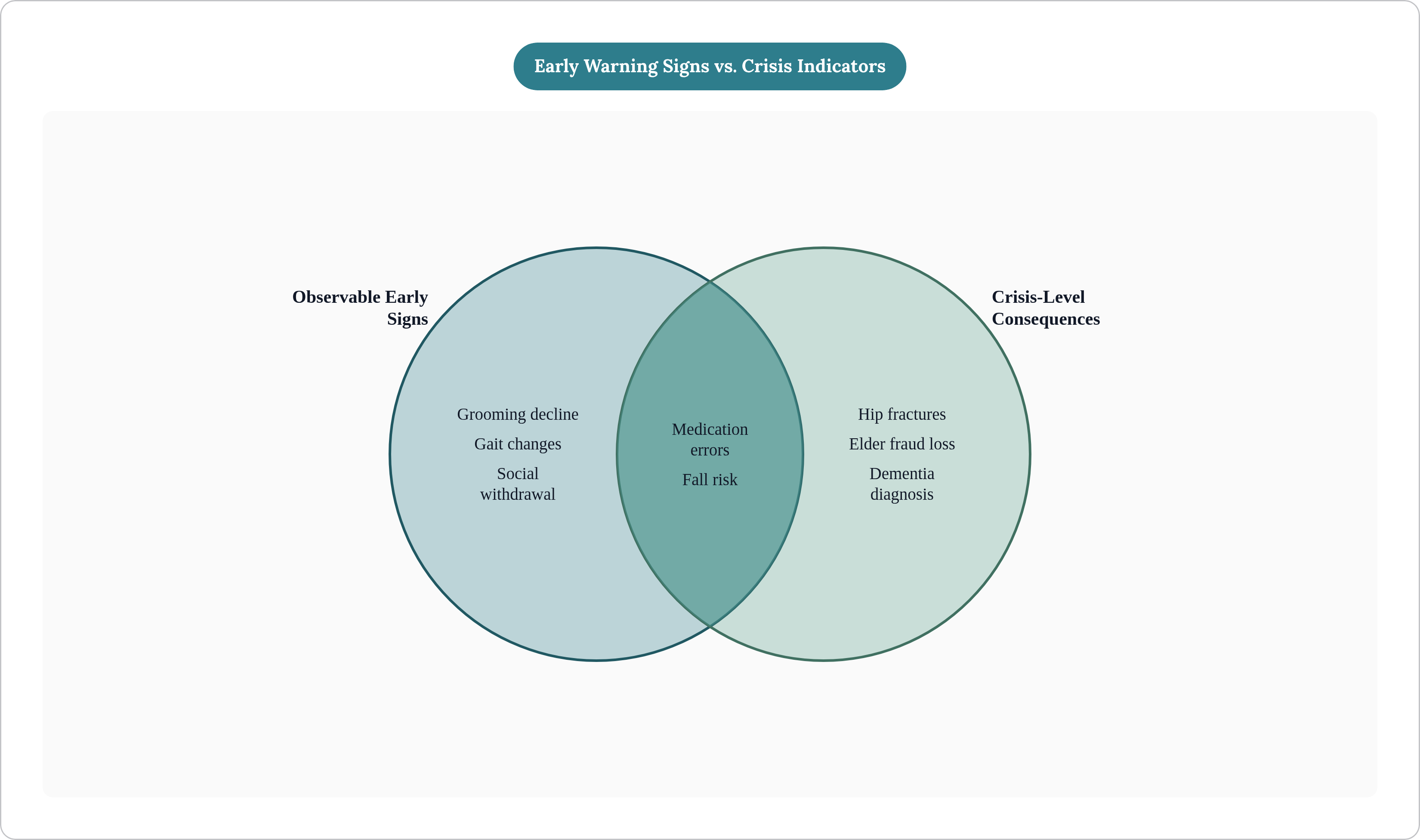
The consequences of a single fall compound quickly. Roughly 20% result in serious injury, including hip fractures or head trauma. Even a fall without injury often triggers fear of falling again, which leads to reduced movement, which accelerates physical deconditioning, which increases future fall risk. The cycle is well-documented and genuinely difficult to interrupt once it's established.
Nearly 27.8% of adults 65 and older reported a fall in 2023, per America's Health Rankings, and that figure is almost certainly low; falls are chronically underreported to both family and physicians.
Environmental flags in the home matter independently of any observed fall. Throw rugs. Poor lighting in hallways and bathrooms. No grab bars near the toilet or tub. Cluttered pathways. These are unaddressed hazards, not aesthetic concerns, and they signal elevated risk whether or not anyone in the home will say so.
Medication Mismanagement as Both a Sign and a Danger in Itself
A large majority of U.S. seniors take at least one prescription medication. A third of adults in their 60s and 70s take five or more regularly. Medication mismanagement among adults 65 and older is seven times more likely to result in hospitalization than in younger populations. Small errors carry disproportionate consequences in this domain, which is part of what makes it so easy to underestimate.
Families can look for specific, observable signs. A pill organizer untouched, or one where pills are clearly out of sequence. Multiple bottles of the same medication, suggesting prescriptions are being refilled without being finished. Confusion about what a given medication is for, or when it should be taken. Missed glucose readings, lapsed blood pressure checks, discontinued CPAP use. These indicate that chronic conditions are not being managed at home the way they appear to be on a physician's chart.
The polypharmacy risk compounds over time. A longitudinal North American study found that each additional medication was associated with an 11% increase in frailty risk over an eight-year period. Individual medications may each be clinically appropriate; the cumulative effect on a system managing multiple conditions simultaneously is a separate, underasked question.
Mismanagement tends to be invisible until it produces a consequence. Seniors may not recognize they've taken a dose twice. Missed doses are unlikely to be volunteered. A hospitalization or a fall may be the first visible sign of what was actually a medication management problem weeks in the making.
A medication reconciliation visit with a physician or clinical pharmacist, pill dispensers with alarms, or in-home support that includes medication reminders can address this directly. None of these require a formal diagnosis to implement.
Cognitive Signs That Show Up Before Memory Loss Becomes Obvious
The Alzheimer's Association's 2025 Facts and Figures report estimates that 7.2 million Americans aged 65 and older currently live with Alzheimer's dementia, a figure that may reach 13.8 million by 2060. A 2025 study published in Nature Medicine estimated a 42% lifetime risk of dementia after age 55, more than double prior estimates. Families have not yet internalized those numbers, in part because early cognitive decline rarely announces itself as dementia.
What it looks like before it looks like a diagnosis: repeating the same question or story within a single conversation. Getting disoriented in a familiar neighborhood. Forgetting to turn off the stove, leaving water running. Struggling to follow a television show or a multi-step conversation. Losing track of dates or seasons not occasionally, but as a consistent pattern. Taking noticeably longer to complete tasks that used to be automatic.
One distinction deserves particular care. Acute confusion developing over hours or days is medically different from the gradual progression of dementia; it may indicate delirium, with numerous potential causes including infection, medication interaction, or metabolic disturbance. Sudden onset warrants immediate medical evaluation.
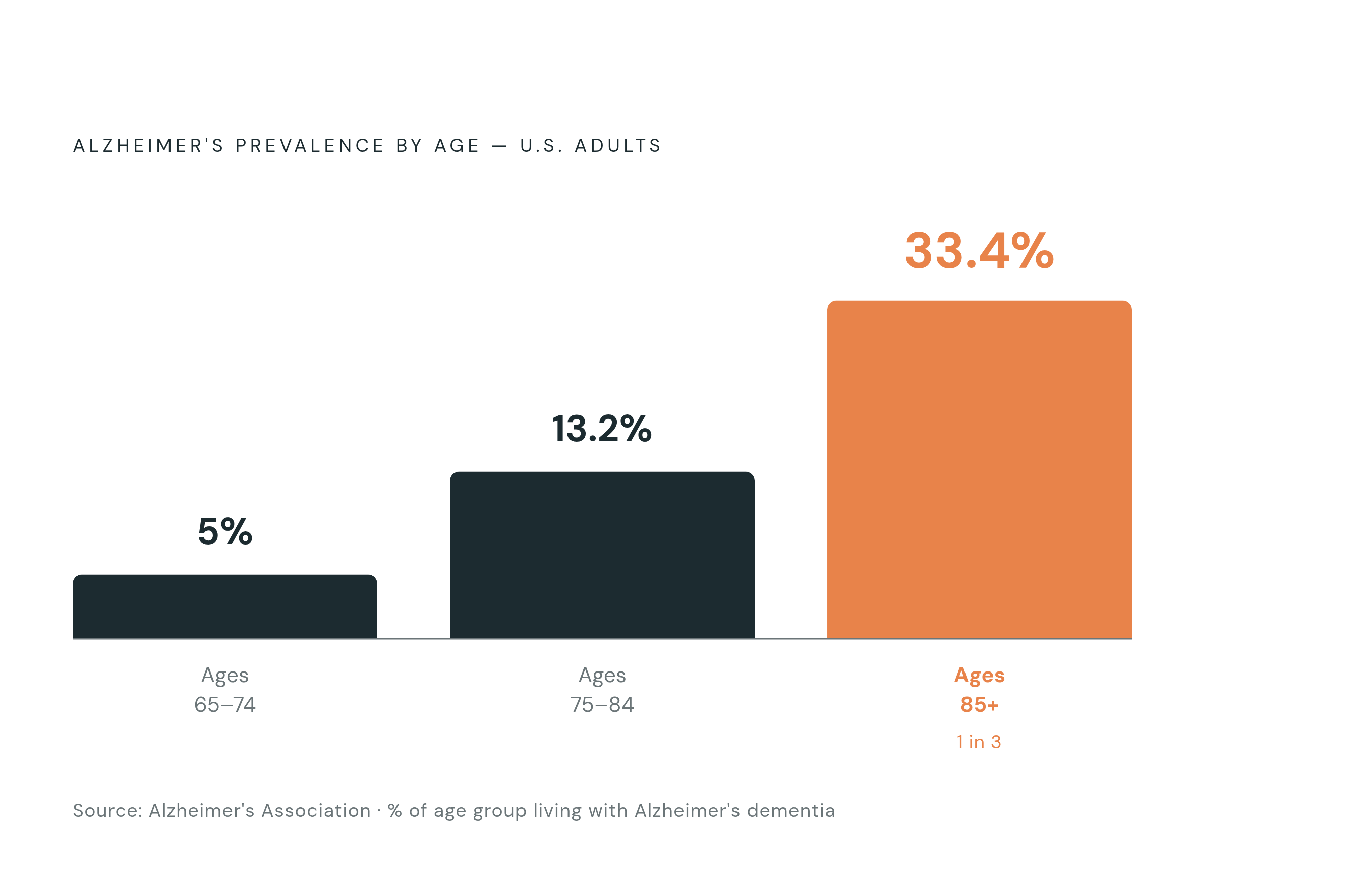
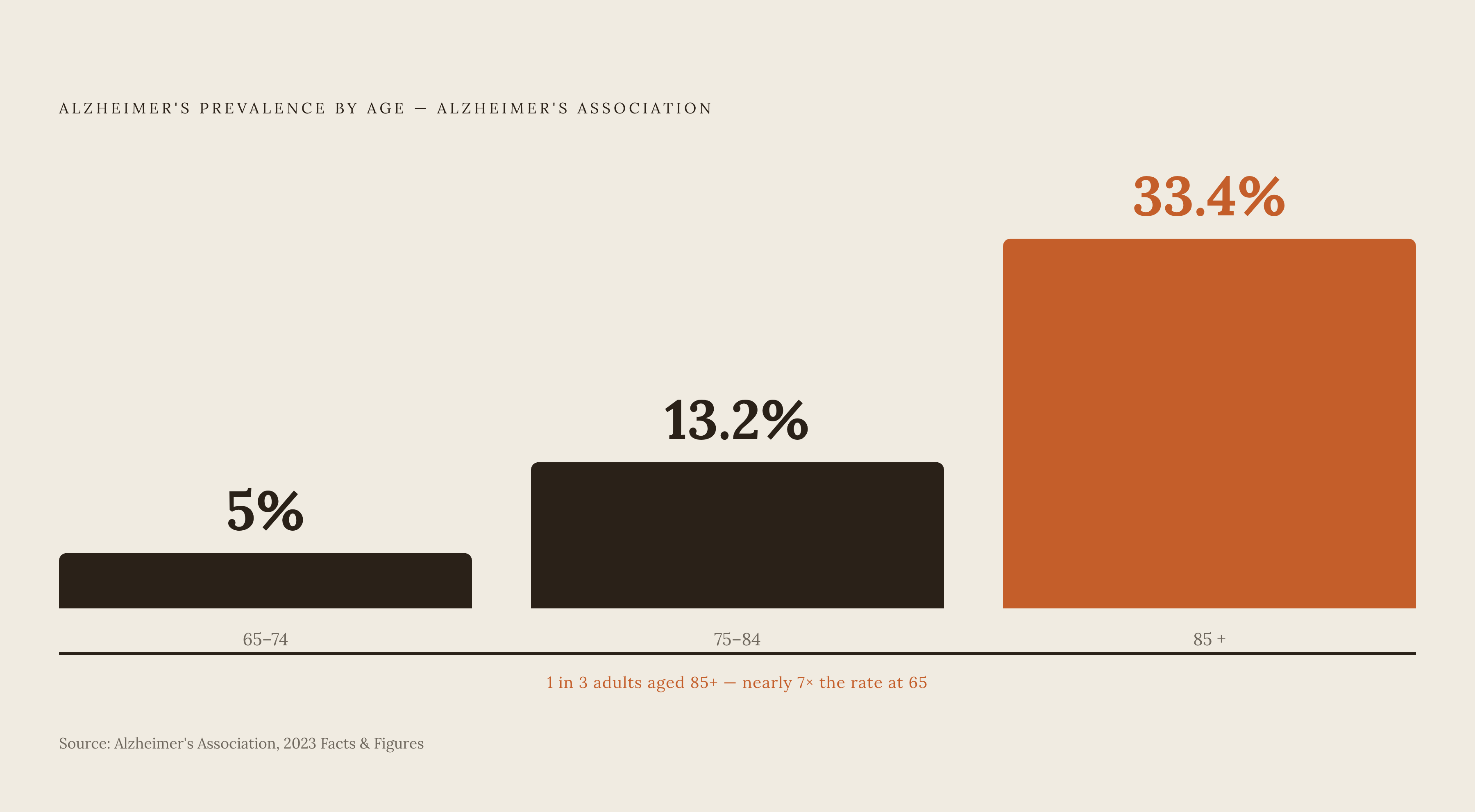
The age gradient for Alzheimer's is steep. Prevalence sits at approximately 5% among those aged 65 to 74, rises to 13.2% among those 75 to 84, and reaches 33.4% among those 85 and older, per the Alzheimer's Association. Age is not a diagnosis, but it is meaningful context for how these signs should be weighted.
Families often wait because early cognitive signs are genuinely ambiguous. They can be attributed to poor sleep, stress, distraction, or the ordinary variability of a tired mind. What I've observed repeatedly is that the signs are often more visible to someone visiting after six months than to someone in daily contact, because daily exposure produces gradual acclimation. Outside observers notice the delta. That asymmetry is worth building into how families structure their attention.
Financial Behavior as an Early Cognitive Flag
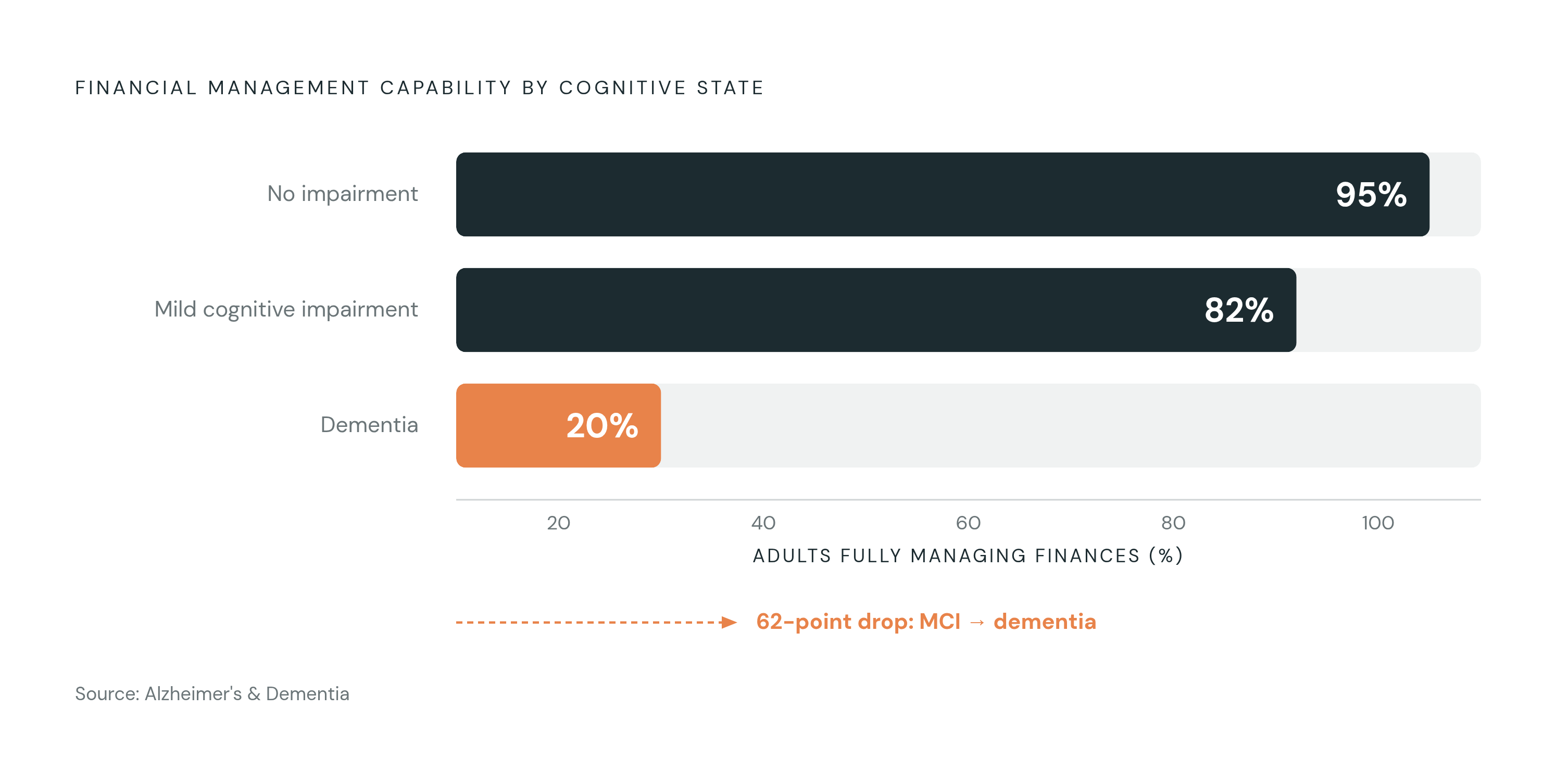
Financial management is cognitively demanding. It requires sequential reasoning, working memory, attention to detail, and the ability to detect irregularities. It is also, according to the Administration for Community Living and the Consumer Financial Protection Bureau, among the earliest detectable indicators of cognitive decline.
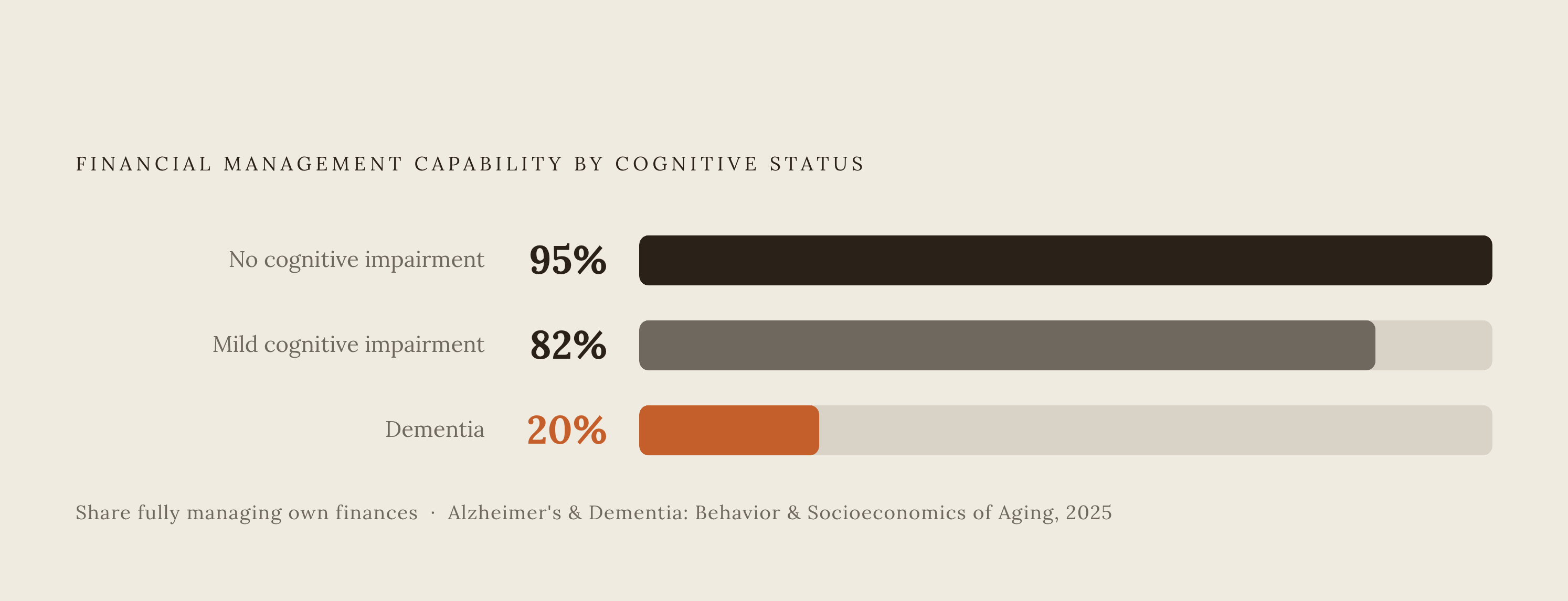
The capability gap is sharp. Research published in Alzheimer's & Dementia: Behavior & Socioeconomics of Aging in 2025 found that 95% of older adults without cognitive impairment can fully manage their finances. That figure drops to 82% among those with mild cognitive impairment, and only 20% of those with dementia are considered fully capable.
Observable signs include unpaid bills stacking up despite adequate income, duplicate purchases or confusion about recent transactions, difficulty reading a bank statement, and susceptibility to unfamiliar charges appearing on accounts. A broader pattern of disorganization around financial documents, particularly in someone who was formerly methodical, is worth taking seriously.
The stakes are concrete. A 2023 study found that households lose roughly half their wealth in the eight years preceding a dementia diagnosis; median household wealth fell from $217,000 to $104,000 over that period. The financial erosion often precedes the formal diagnosis by years.
Elder fraud compounds the risk. In 2024, elder fraud cost more than 147,000 victims an average of $83,000 each, totaling $4.8 billion in losses, a 43% increase from 2023, according to FBI data cited by Morgan Stanley. A USC Dornsife study published in Cerebral Cortex in November 2024 found that self-reported vulnerability to financial scams correlates with reduced cortical thickness in a brain region affected early in Alzheimer's disease. Scam susceptibility may be a neurological signal rather than a character failing. That reframe changes how families should respond, and how gently.
Reviewing financial accounts together, framed as helping with organization rather than oversight, is a low-conflict way to surface warning signs before they become irreversible losses.
Nutrition and Weight Changes That Are Easy to Overlook on a Short Visit
There is no single dramatic figure that anchors this section, and that absence is precisely the problem. Nutritional decline tends not to produce a defining event. It compounds quietly, accelerating physical weakness, increasing fall risk, impairing immune response, degrading cognitive function. It is often the background condition that makes everything else worse.
Among seniors living alone, several intersecting forces drive poor nutrition: loss of energy or motivation to shop and cook; forgetting to eat, which can itself be a symptom of depression or early cognitive change; physical barriers including arthritis making food preparation painful; and a diminished sense of taste and smell that makes eating less rewarding than it once was.
During a home visit, the observable signs are accessible if you look. Expired or spoiled food in the refrigerator. A near-empty pantry with no evidence of recent shopping. Unintentional weight loss visible in how clothing fits. Fatigue or weakness not present the last time you visited. These require no clinical training to notice; they require willingness to actually look.
Nearly 40% of older adults live alone. Meal preparation is a social activity as much as a nutritional one, and eating alone reduces both appetite and motivation to cook. A shared meal is not a sentimentality; it functions as an intervention.
Practical entry points for families include meal delivery services, grocery delivery, or scheduling regular shared meals. The logistical benefit and the relational one arrive together.
Social Withdrawal and Isolation as Health Warning Signs, Not Personality Traits
A January 2025 JAMA study from the University of Michigan National Poll on Healthy Aging found that 33.9% of adults aged 50 to 80 reported feeling a lack of companionship some or all of the time, a figure that rose to 41.4% during the peak of the COVID pandemic. Loneliness at this scale is not a private emotional state. It is a public health condition with clinical consequences that most families are not treating as such.
What withdrawal looks like in practice: a senior who stops attending church, card games, or walking groups they previously looked forward to. Declining invitations with increasing frequency. Phone calls that become shorter and harder to initiate. Giving up driving, which removes the logistical infrastructure of social participation and is a more significant inflection point than families often recognize.
The clinical consequences are not soft. A study of thousands of older adults in Norway, published in Frontiers in Public Health in 2024, found that social isolation meaningfully increased 20-year mortality risk for both women and men. Isolation is also associated with increased risk of cognitive decline, hypertension, and cardiovascular disease, making it simultaneously a warning sign and an accelerant of other deterioration.
The misread is common. Families interpret withdrawal as introversion, as grief, as a preference for quiet in old age. Sometimes it is. The distinction requires knowing what the person's baseline engagement used to look like, and asking honestly whether what you're observing is a continuity of who they've always been or a retreat from it. That question is more diagnostic than it might appear.
How to Look Across All These Signs at Once Without Overwhelming a Visit
The social dynamics of a holiday or weekend visit work against honest assessment. The senior performs well because company is present. The family doesn't raise difficult observations because they don't want to create tension. What was noticed goes unspoken, and the visit ends without a clearer picture than before. I've seen this happen in families who were genuinely attentive and genuinely worried, and still managed to leave without saying the thing they came to say.
A loose observational framework can counter this without requiring clinical expertise. On arrival, register the home environment: the smell, the state of the kitchen, the contents of the refrigerator, the mail pile, the bathroom. Physical presentation: gait on the way to the door, grooming, clothing, visible weight change, energy level. Conversation: repeated questions, confusion about recent events, difficulty following a topic, unusual anxiety or flatness. Paperwork: is the medication organizer in use? are bills visible and organized? is there a calendar, and does it suggest the person is tracking their schedule?
Multiple family members observing independently is often more valuable than any single detailed assessment. A sibling who visits less frequently may notice changes that a daily caregiver has gradually acclimated to. Different observers catch different things, and comparison is often where the pattern becomes undeniable.
Document what you observe, briefly, after the visit. A few notes create a comparison baseline. Changes over time are frequently more telling than any single observation, and having a record makes conversations with physicians more concrete.
When a conversation about these observations becomes necessary, framing matters considerably. "How have you been managing the grocery shopping lately?" surfaces more honest information than "I noticed you haven't been eating much." One opens a door; the other closes one. Physicians and care teams can receive observations directly from family members; you do not need to wait for the senior to self-report.
What to Do After Recognizing the Signs, and Why Acting Now Opens More Options
The options available to a family are directly shaped by when they act.
At the earliest stages, when individual signs are present but not yet severe, the response can be targeted and minimally disruptive. A home health aide for a few hours per week. Grab bars and better lighting. A medication management system. Grocery or meal delivery. These are additive supports, not wholesale changes to how the person lives, and they are far easier to introduce before a crisis has stripped everyone of patience and time.
As needs increase, a coordinated care approach becomes more valuable. Some families work with geriatric care managers, professionals who assess functional status, coordinate services, and help navigate the complexity of overlapping medical, social, and logistical needs. Senior care advisory services, including Assisted Living Locators, can help families understand the full continuum of options, from in-home support through assisted living and memory care, matching what's available to what the individual actually needs. This kind of structured guidance is particularly useful when families are geographically dispersed or when needs span multiple domains simultaneously.
Waiting for a crisis forecloses options in concrete ways. A hospitalization often triggers discharge planning under time pressure, with limited ability to evaluate facilities carefully or negotiate arrangements thoughtfully. Assisted living communities with memory care units frequently maintain waitlists. The financial and legal instruments that protect a senior's assets and autonomy, durable power of attorney, healthcare proxy, advance directives, are significantly harder to execute once cognitive capacity is meaningfully impaired.
Early recognition tends to feel premature. The senior may resist the conversation. The family may feel like they're overreacting. The signs, examined individually, may not seem serious enough to warrant action. But a senior who has stopped grooming, is moving more cautiously, has a disorganized pill organizer, and has declined three consecutive family invitations is not presenting four minor concerns. They are presenting a pattern, and patterns in this context have a direction.
Acting on that pattern before it produces a crisis is not overreach. It is the difference between choosing and being chosen for.