Comparing Senior Living Options and Costs
Planning senior living before crisis hits saves families tens of thousands.

Most families don't plan their way into a senior living decision. They fall into one. A parent fractures a hip, a dementia diagnosis arrives sooner than anticipated, a hospitalization makes returning home untenable. A choice that deserves weeks of deliberate research gets compressed into days, made under duress, with incomplete information.
That urgency is expensive. Senior living costs have been rising roughly 5% per year in assisted living, meaning every year of deferred planning is a year of lost leverage. The landscape spans at least six distinct option types, each representing a different care level and a different price point, and the variation between them is wide enough to reshape a family's financial picture entirely.
Senior living is not a category. It is a continuum, running from housing-only arrangements at one end to round-the-clock skilled medical care at the other. Care level drives cost more than any other variable, and the tier a senior needs today is often not the tier they'll occupy in two years. Treating these options as roughly equivalent, distinguished mainly by amenities or zip code, is the first and most costly mistake families make.
Seniors-only apartments sit at the low-care end: standard rental units restricted by age, typically requiring at least one resident to be 55 or older. No personal care services are included. The value proposition is community and predictable housing cost, not clinical support.
55+ active adult communities offer more in lifestyle amenity but not in care. A resident who needs help with bathing, dressing, or medication management must arrange that independently, which is a distinction families often discover later than they should.
Independent living bundles meals, housekeeping, activities, and utilities into a monthly fee. It is designed for adults who can fully care for themselves but prefer not to maintain a home. The distinction from assisted living is the absence of hands-on personal care, a line that matters enormously once care needs arrive.
Assisted living is where the care spectrum shifts materially. Residents receive daily help with activities of daily living, including bathing, dressing, toileting, and medication management, alongside meals and housekeeping. The level of assistance is tiered within most facilities, meaning residents pay more as their needs intensify. Nearly 49.9% of assisted living residents are over 85, and 42% carry a dementia diagnosis. Those numbers suggest that most families are planning for a higher care level than they initially anticipate, whether they know it or not.
Memory care is a specialized form of assisted living designed for residents with Alzheimer's disease or other forms of dementia. More than 7.2 million Americans aged 65 and older are living with Alzheimer's in 2025, according to the Alzheimer's Association. Memory care units are secured, purpose-built environments with staff trained specifically for cognitive decline. The programming, the physical infrastructure, and the staff-to-resident ratios are all structured differently than standard assisted living, and that difference carries a price.
Skilled nursing facilities, commonly called nursing homes, provide 24-hour medical care and represent the highest level of support available outside a hospital setting. Residents typically require clinical intervention: wound care, IV therapy, physical or occupational rehabilitation, or management of complex chronic conditions.
Continuing Care Retirement Communities (CCRCs), also called Life Plan Communities, occupy a category of their own. Rather than representing a single care level, a CCRC is a single campus encompassing all of the above, from independent living through skilled nursing, often with contractual guarantees about future care access. The financial structure involves substantial entry fees alongside monthly costs, which makes it fundamentally different from stand-alone facilities and requires an entirely different analytical lens.
The most consequential point from this taxonomy is one that gets glossed over in most senior living conversations: planning around current needs alone is a common and costly error. A senior's care needs will almost certainly evolve. But what if the family has not built a plan that accounts for that? The result is typically a plan that gets rebuilt under pressure, on someone else's timeline.
What Each Option Actually Costs Per Month in 2025
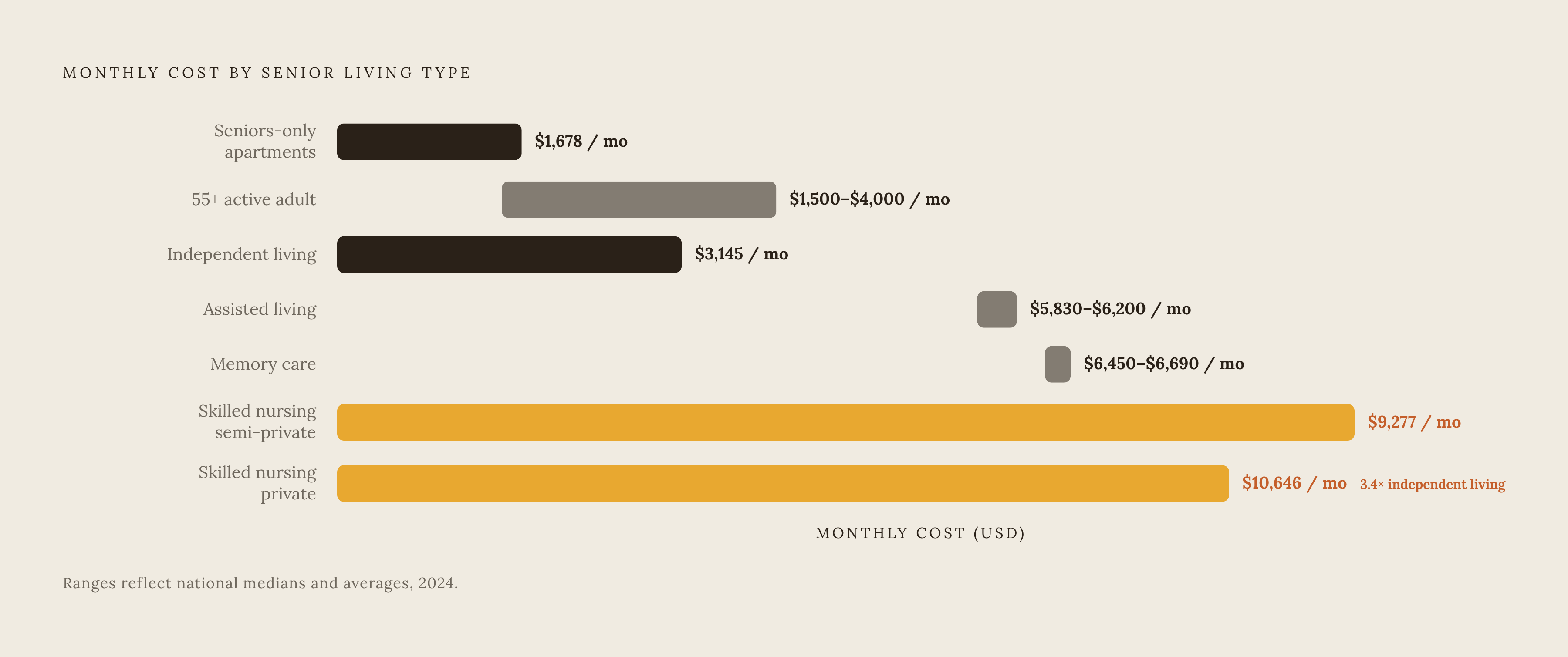
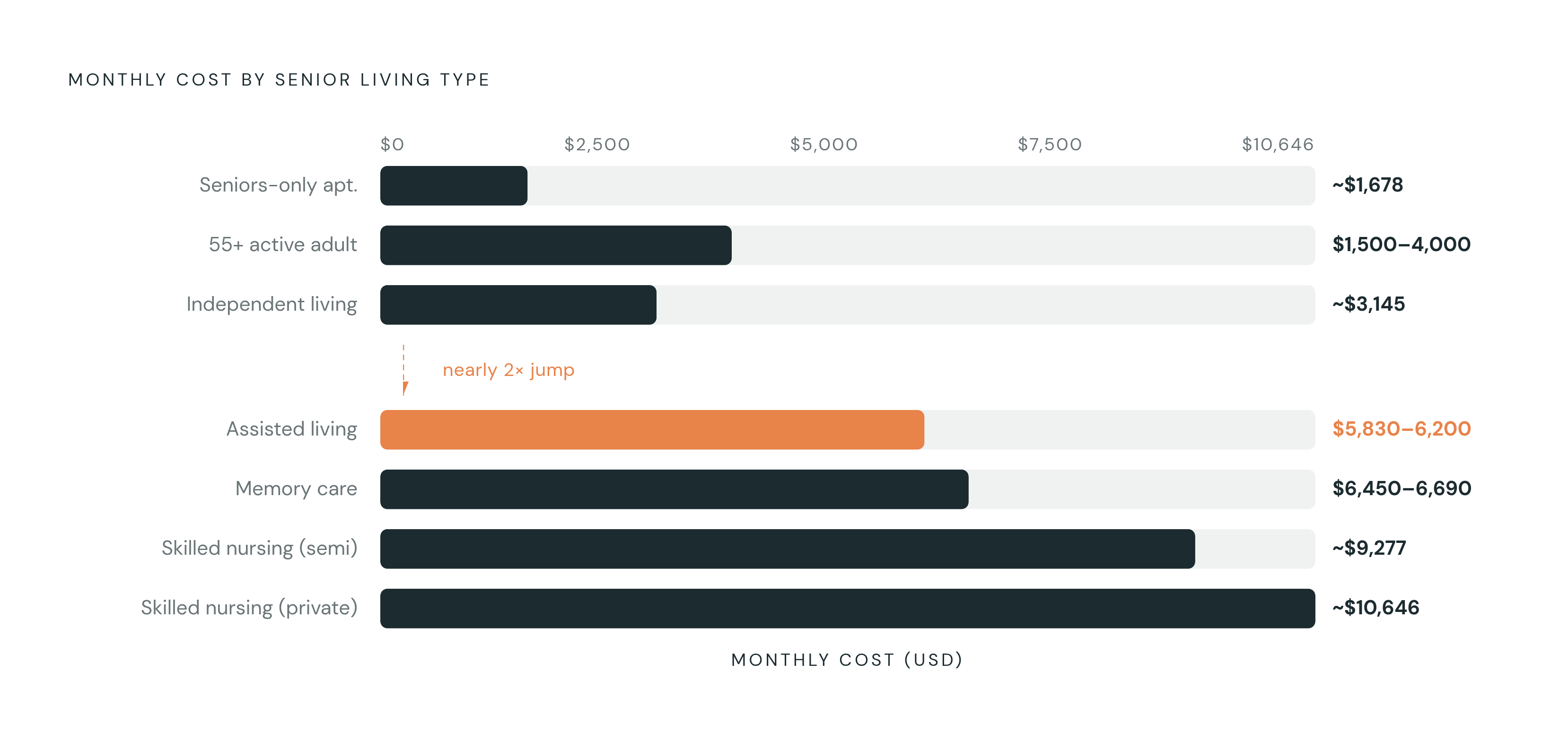
Cost comparisons in senior living resist easy generalization. The variables are numerous: state, unit size, care tier within a facility, what's bundled versus billed separately. The figures below use the most current available data and should be treated as reference points rather than guarantees.
| Care Type | National Median (Monthly) | Annual Equivalent | |---|---|---| | Seniors-only apartments | ~$1,678 | ~$20,136 | | 55+ active adult communities | $1,500–$4,000 | $18,000–$48,000 | | Independent living | ~$3,145 | ~$37,740 | | Assisted living | $5,830–$6,200 | $69,960–$74,400 | | Memory care | $6,450–$6,690 | $77,400–$80,280 | | Skilled nursing (semi-private) | ~$9,277 | ~$111,324 | | Skilled nursing (private) | ~$10,646 | ~$127,752 |
Sources: A Place for Mom 2026 data; CareScout Cost of Care Survey, July–November 2025; AssistedLiving.org, December 2025; Stellar Living.
The state-level spread in assisted living is dramatic. Missouri's median sits around $5,464 per month; Massachusetts approaches $9,610. That gap represents nearly $50,000 per year for nominally equivalent care. South Dakota is among the most affordable states, with a median around $4,350 per month. For families with geographic flexibility, this variance is a meaningful planning variable, not background noise.
Independent living ranges from roughly $2,319 per month in Wisconsin to $4,795 in Hawaii. The base price typically bundles meals, activities, housekeeping, and utilities, which makes the sticker price more inclusive than it appears relative to maintaining a private home.
CCRCs require a separate lens entirely. Monthly fees run roughly $3,873 to $4,246, according to A Place for Mom, but entry fees range from $100,000 to well over $1,000,000 depending on contract type. The monthly figure alone significantly understates the actual financial commitment.
Costs rose from 2024 to 2025, extending a sustained upward trend. A family that builds a budget today based on current figures and then waits two years to act will find the numbers have moved.
Why Memory Care Costs 15–25% More Than Standard Assisted Living
The memory care premium is not arbitrary. It is not primarily a function of nicer finishes or more attentive marketing. It reflects structural cost drivers that are non-negotiable, and understanding what those drivers are matters because families who don't understand them tend to treat the premium as negotiable, or avoidable, when it is neither. Why exactly does this happen? The answer lies in three specific cost drivers.
Staffing ratios and training requirements come first. Memory care requires more staff per resident than standard assisted living, and those staff members must carry specialized training in dementia care, de-escalation, and behavioral intervention. These are regulatory requirements in most states and clinical necessities in all of them.
Physical security infrastructure comes second. Memory care units are locked and designed to prevent wandering, one of the most dangerous behaviors associated with moderate-to-advanced dementia, through secured entry points, enclosed outdoor spaces, and environmental design that reduces disorientation. Installing, maintaining, and operating that infrastructure represents a real cost that standard assisted living facilities simply do not incur.
Specialized programming comes third. Effective memory care is not custodial. It involves therapeutic activities, sensory programming, and structured daily routines designed for residents with cognitive impairment, all of which require trained personnel and dedicated resources that don't appear in a standard assisted living staffing model.
The broader staffing environment compounds all three. According to industry data, 63% of assisted living facilities report staff shortages, and 87% report difficulty hiring. In memory care, where skill requirements are more specific and the qualified candidate pool is smaller, that pressure is most acute.
The memory care premium is worth understanding not just as a line item, but as a window into a broader dynamic: the more clinical the care need, the more structural cost pressure a facility faces, and that pressure flows directly to families. The time to model it is before a placement.
The Real Cost of Aging in Place Once Care Needs Grow
A large majority of Americans aged 50 to 80 prefer to remain at home as they age, according to a national poll cited by SeniorSite.org. The preference is understandable. Home carries meaning that a facility cannot replicate, and there are real cases where aging in place is the right call. The trouble is that the financial picture most families construct around it tends to be incomplete in specific, predictable ways.
Maintaining a median-priced home, accounting for taxes, utilities, and maintenance, costs several thousand dollars per month before any care services, per an ASHA report. That number is often invisible in family planning because it's distributed across multiple budget lines rather than arriving as a single monthly invoice. People see the mortgage or the rent; they don't see the total.
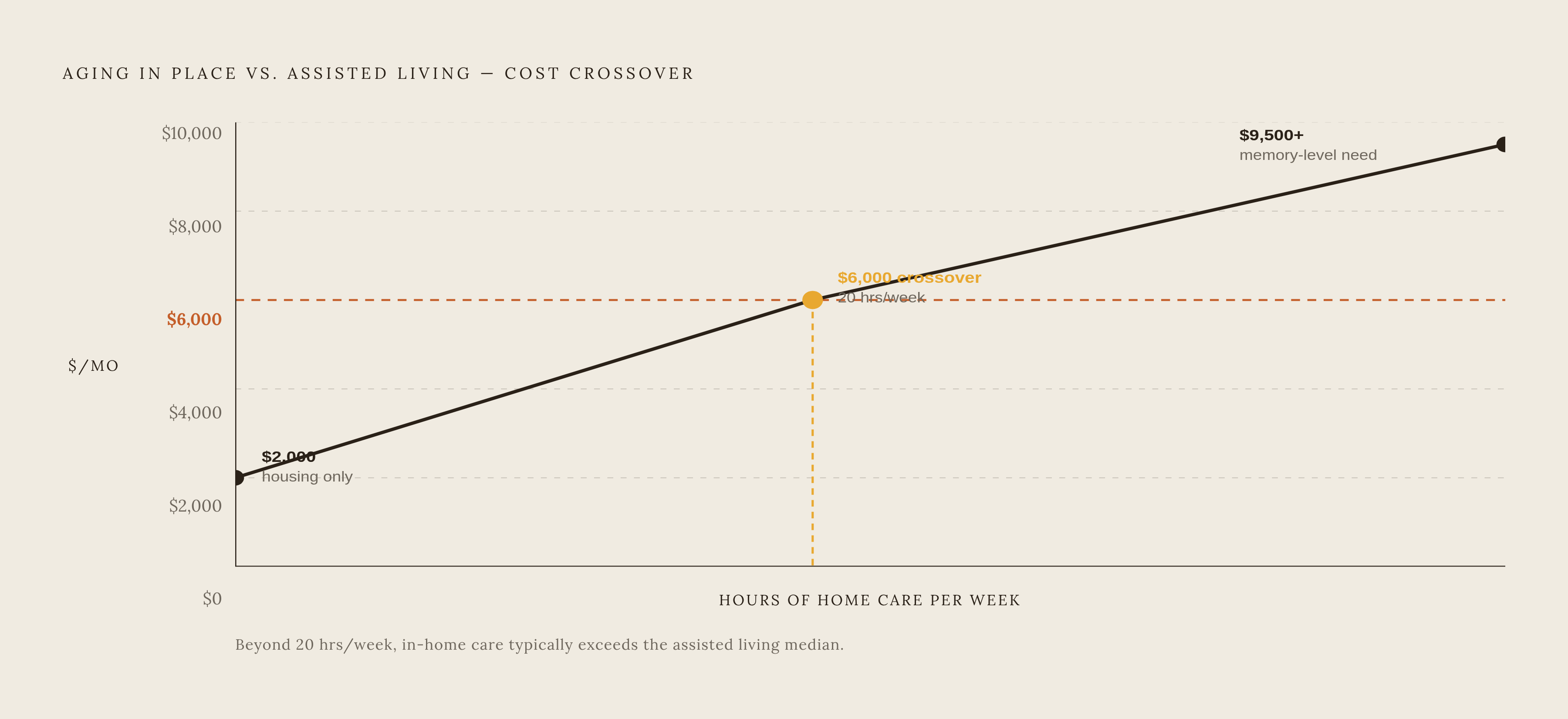
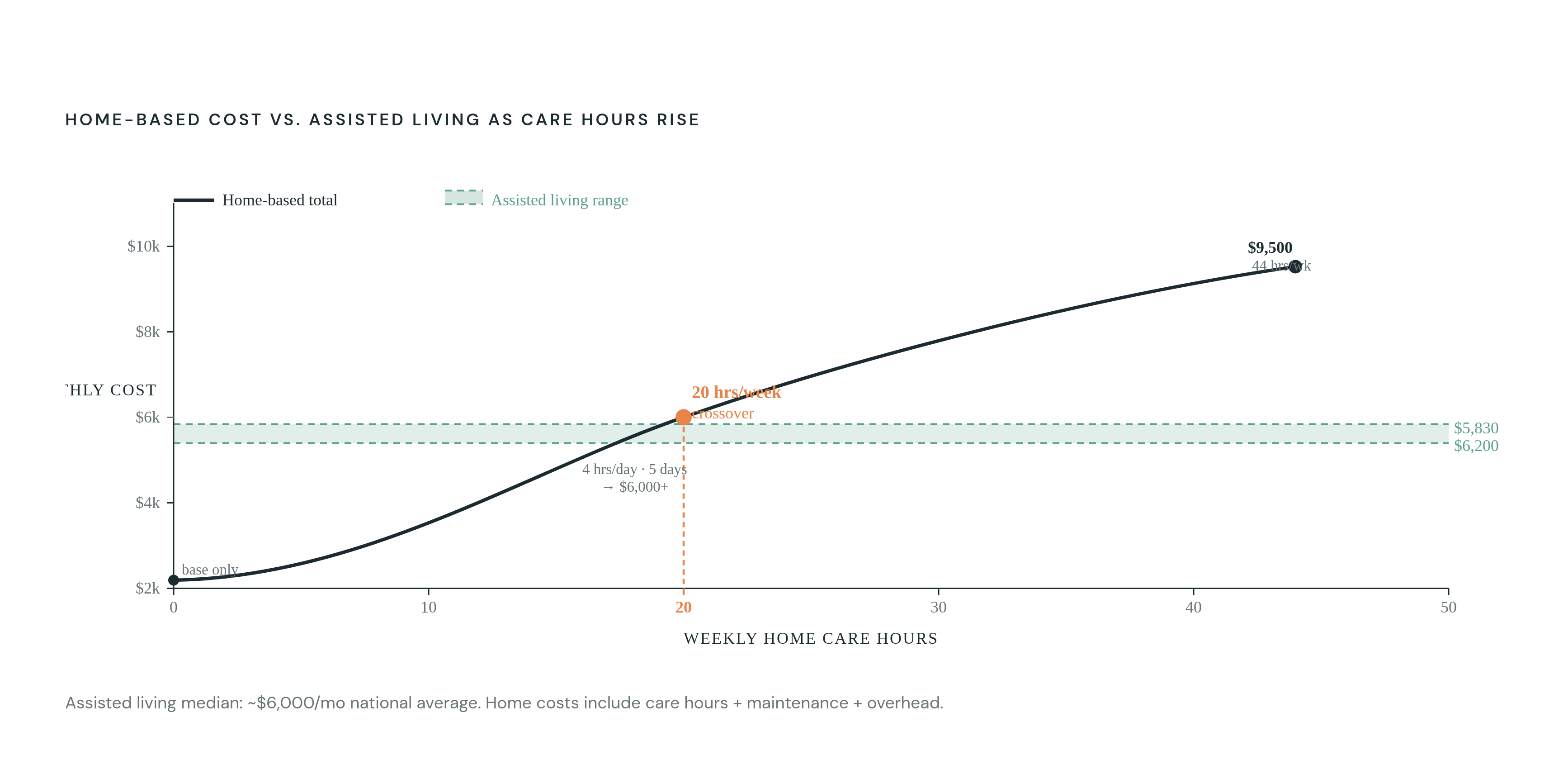
Add modest home health care, four hours daily, five days a week, and the combined total reaches well over $6,000 per month, which exceeds many assisted living options. For a senior with memory-level care needs requiring roughly 44 hours of weekly home care, combined monthly costs can exceed $9,500, higher than most assisted living facilities and competitive with lower-end memory care.
The crossover point is approximately 20 hours of weekly home care. Beyond that threshold, the economics of aging in place frequently invert. Geographic exceptions exist: Hawaii and Delaware are among the few states where aging in place tends to remain less expensive than assisted living, largely because local facility costs are disproportionately high.
There is also a cost that almost never appears in the family spreadsheet. A 2025 Guardian Life trend report found that caregivers spend a substantial share of their income on caregiving-related expenses. AARP data shows a significant share of caregivers carry debt attributable to those same responsibilities. These are real financial costs being absorbed by adult children and spouses, and they are systematically excluded from most aging-in-place cost estimates. That raises an important question: if informal caregiving carries a measurable income loss and debt burden, is the family solving for the right number at all? Families who don't account for these hidden costs are often solving the wrong equation without knowing it.
What Medicare and Medicaid Actually Cover, and the Gaps Families Don't Expect
The most consequential financial planning misconception in elder care is widespread and persistent: most families believe Medicare covers senior living. It largely does not.
Medicare is designed for acute medical episodes, not ongoing personal care. Its skilled nursing benefit covers up to 100 days following a qualifying three-night inpatient hospital stay. Days 21 through 100 require a substantial daily coinsurance in 2025. Beyond 100 days, coverage ends entirely. For the vast majority of assisted living stays, memory care placements, and long-term nursing home residencies, Medicare pays nothing. The confusion is partly a product of Medicare's visibility in acute care; families see it work in a hospital context and reasonably, but incorrectly, assume it extends further.
Medicaid functions differently. It is the primary payer for skilled nursing care for residents who have spent down assets to eligibility thresholds. Coverage rules, income limits, and qualifying criteria vary significantly by state, which means a family's options depend heavily on geography. Medicaid is a genuine safety net for long-term nursing home care, but accessing it requires navigating a complex, state-specific eligibility process, often at the worst possible moment.
CCRCs introduce another layer of financial complexity. Type A, or Life Care, contracts lock in future care costs at a predictable rate in exchange for a higher entry fee. Type B and Type C contracts expose residents to market-rate charges as care needs escalate. For a family signing a CCRC agreement, the contract type is not a fine-print detail; it is the central financial planning variable, and it deserves as much scrutiny as the entry fee itself.
Most families begin senior living by paying out of pocket. Long-term care insurance, veterans benefits, and certain Medicaid waiver programs can offset these costs substantially, but navigating eligibility for any of them is difficult without guidance. This is partly why so few families pursue them proactively, and why so many arrive at a placement decision without knowing what they actually qualify for.
Benefits and Programs That Can Offset Senior Living Costs That Families Routinely Miss
The problem is not a shortage of programs. It is that families focus on the cost comparison and skip the prior step of determining whether they qualify for assistance that would change the math entirely.
Medicaid Home and Community Based Services (HCBS) waivers can fund in-home care or assisted living for eligible individuals, reducing or eliminating out-of-pocket costs. Waiver availability and eligibility criteria differ by state, and waitlists exist in many markets, but for families who qualify, the financial impact is substantial enough to reshape the options available to them.
The VA Aid and Attendance benefit is a pension supplement available to eligible veterans and surviving spouses that can be applied toward senior living costs. It is among the most underutilized benefits in elder care, partly because the application process requires documentation that takes time to assemble and partly because the benefit itself is poorly publicized. Families with veterans in the household should treat this as a first inquiry, not an afterthought.
Supplemental Security Income (SSI) add-ons in certain states can be applied to residential care settings, creating additional monthly income that offsets facility costs.
State-specific caregiver compensation programs allow, in some states, family members to be paid for providing care to a Medicaid-eligible relative. These programs vary widely in structure and eligibility but represent real income that can reduce the total cost burden on a household.
Medicare Advantage supplemental benefits represent another commonly overlooked category. Some plans include limited home modification, transportation, or in-home support benefits that go unused simply because enrollees aren't aware of them.
The barrier across all of these programs is the same: opacity. Eligibility rules differ by state, care setting, and household structure in ways that make self-navigation genuinely difficult. Families who identify and enroll in available benefits before selecting a senior living option are working from a more accurate budget, which gives them a clearer view of what's actually within reach on the care spectrum.
How to Match a Senior Living Option to a Specific Situation Rather Than Just a Price Point
Price is not the primary variable. Care need is. The cost comparison only becomes meaningful once a family has a clear-eyed read on where the senior actually falls on the care spectrum, and where they are likely to be in two or three years.
Start with the activities of daily living. Which can the person manage independently today, and what does the trajectory look like over the next two to five years? A senior who needs minimal assistance now but carries a progressive diagnosis will almost certainly require a higher level of care within the average assisted living stay of roughly 22 months. Planning for today's needs without accounting for tomorrow's is a setup for a disruptive and expensive transition, often one that happens on someone else's timeline.
The second consideration is cognitive diagnosis, or meaningful early signs of one. The presence of dementia, or a high-probability trajectory toward it, changes the calculus significantly. A memory care environment offers not just security infrastructure but a therapeutic model that standard assisted living cannot replicate. Moving a resident out of a familiar environment mid-decline is itself a clinical risk, and it is one that rarely appears in cost projections.
The third is informal care. If a family member is currently providing care, what is that actually costing them? When the 26% income share and the debt accumulation figures from caregiver research are applied to a real household budget, the economics of informal caregiving often look different than the family assumed going in.
For families trying to avoid moving a parent multiple times as needs escalate, the CCRC model is worth modeling even when the entry fee looks prohibitive. It is also worth considering whether a Type A contract that guarantees care access at a predictable rate could prove less expensive in total than a series of private-pay transitions across multiple facilities. The math only works if you do it in advance.
Fee structures in any facility deserve scrutiny before signing. Base rates in assisted living can appear reasonable until the care add-ons are itemized: additional charges for higher ADL assistance, medication management, or incontinence care can add hundreds to thousands of dollars monthly. The comparison that matters is fully loaded cost, not the number on the brochure.
State-level cost variation is too large to treat as an afterthought. A family with geographic flexibility that ignores the tens-of-thousands-of-dollars annual spread between Missouri and Massachusetts assisted living rates is leaving a significant variable off the table.
Every week of planning before a crisis is a week of preserved leverage. The families who navigate this well tend not to be the wealthiest or the best connected. They are the ones who started the conversation before they had to.