Does Medicare Pay for Nursing Home Care
Medicare covers only skilled nursing care, not the daily assistance most residents actually need.

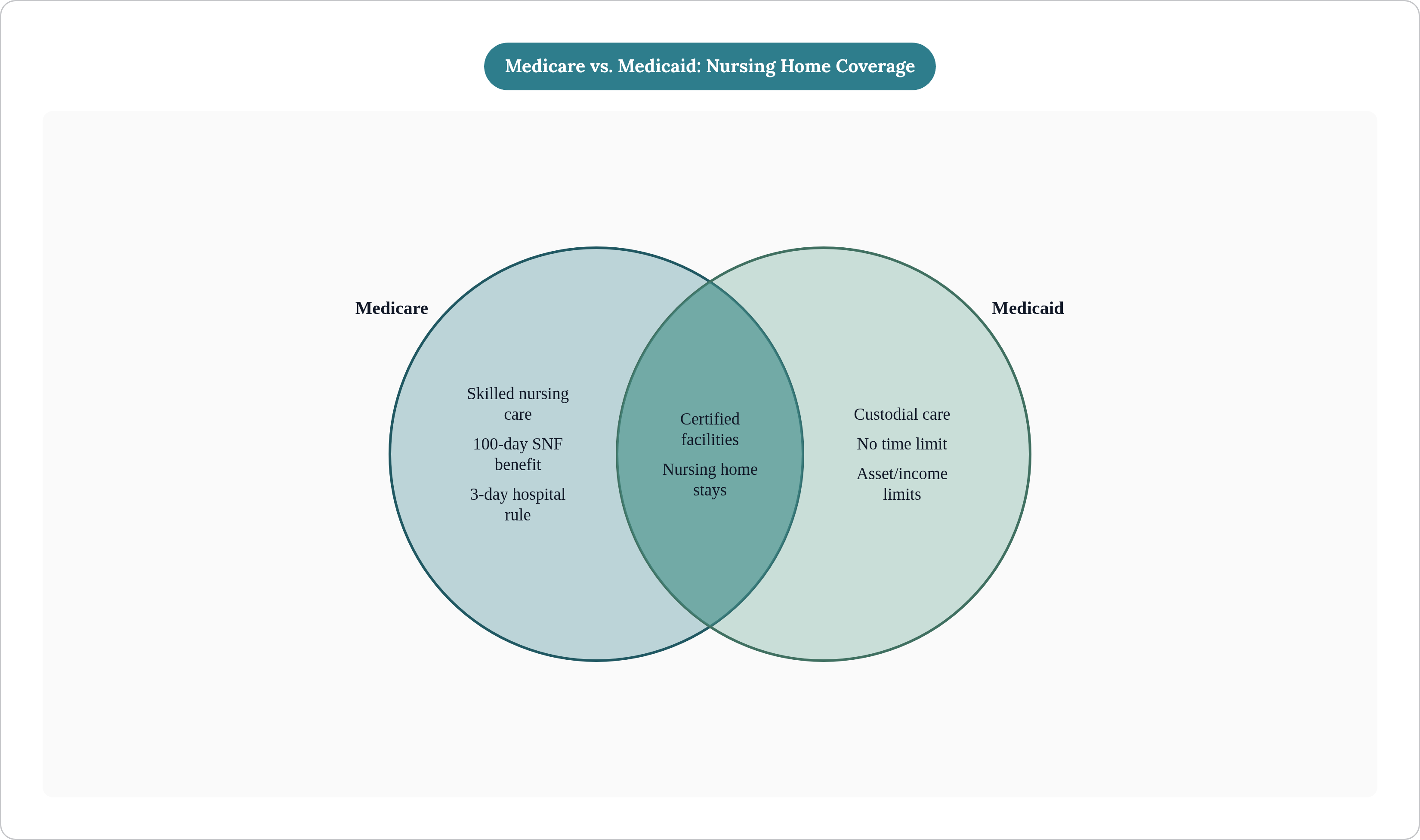
Medicare covers skilled nursing care and does not cover custodial care. That distinction determines whether Medicare enters the picture at all, and everything else in nursing home financing flows from it.
Skilled nursing care, as Medicare defines it, requires licensed medical professionals, must be ordered by a physician, and must be medically necessary for treatment of a specific condition. Wound care for a surgical site, intravenous antibiotics, post-stroke rehabilitation, complex medication management following a cardiac event. Services that require clinical training to deliver safely.
Custodial care is something different. It encompasses assistance with what the industry calls activities of daily living: bathing, dressing, eating, transferring from bed to chair, toileting. These are the services that define most nursing home residents' days. They require attentiveness and care, but not a nursing license. Medicare, by design and by statute, pays for none of it.
Here is where assumption and reality tend to diverge most sharply. A patient can enter a nursing facility on Medicare-covered skilled care and lose that coverage the moment their clinical condition stabilizes to the point where skilled services are no longer the primary need. The stay continues; the coverage does not. What remains is custodial need, and Medicare was not built for that.
Medicare was designed as an acute care program, intended to cover short-term medical events and recovery. Long-term residential care, a social and functional need as much as a medical one, was deliberately left to other programs and other payers. That design intent is what makes the rest of this discussion legible.
The Four Conditions That Must Be Met Before Medicare Part A Covers a Single Day
Assuming a patient does need skilled care, Medicare Part A's nursing home benefit becomes available, but only after four distinct conditions are satisfied. Missing any one of them eliminates coverage entirely.
The 3-Day Inpatient Hospital Stay
Medicare requires a qualifying inpatient hospital admission of at least three consecutive days before a skilled nursing facility stay will be covered. The discharge day does not count. Three midnights as a formally admitted inpatient: that is the threshold.
The Observation Status Problem
This is where families most frequently get blindsided. A patient can spend several nights in a hospital, never leave the building, and still fail to satisfy the 3-day rule. The reason is observation status, a billing classification under which a patient is treated as an outpatient receiving observation services rather than an inpatient receiving hospital care. Nights spent under observation do not count toward the three-day inpatient requirement, regardless of where in the hospital the patient slept or how serious their condition was.
Congress addressed the transparency problem, if not the underlying structural one, through the NOTICE Act, which requires hospitals to provide written notification within 24 hours when a patient is receiving observation care. That notification must include an explicit statement about what the status means for SNF eligibility. The burden still falls on the family to ask directly, on the day of admission: is this classified as inpatient or observation? Waiting until discharge to raise it is often too late.
The 30-Day Transfer Window
Once discharged from the qualifying hospital stay, the patient must be admitted to a Medicare-certified skilled nursing facility within approximately 30 days. Delays beyond that window, whether from family indecision, facility availability, or administrative lag, can forfeit Medicare eligibility for that benefit period entirely.
Daily Skilled Care Required
A physician must certify that the patient requires daily skilled nursing or rehabilitation therapy services. Medicare expects skilled services seven days a week, or at minimum five days a week for therapy, depending on the service type. The moment that clinical need can no longer be certified, coverage becomes vulnerable.
Beneath all four of these conditions sits one more: the facility itself must be Medicare-certified. Not all nursing homes hold that certification. Families who assume a local facility accepts Medicare without verifying that fact can find themselves without coverage even when every clinical condition is met.
One exception is meaningful enough to name. Physicians affiliated with Accountable Care Organizations, and many Medicare Advantage plans, have authority to waive the 3-day inpatient requirement in certain circumstances. This is not universal, but it is worth investigating before a hospital stay becomes a crisis.
What Medicare Actually Pays Across the 100-Day Coverage Window, and What It Doesn't
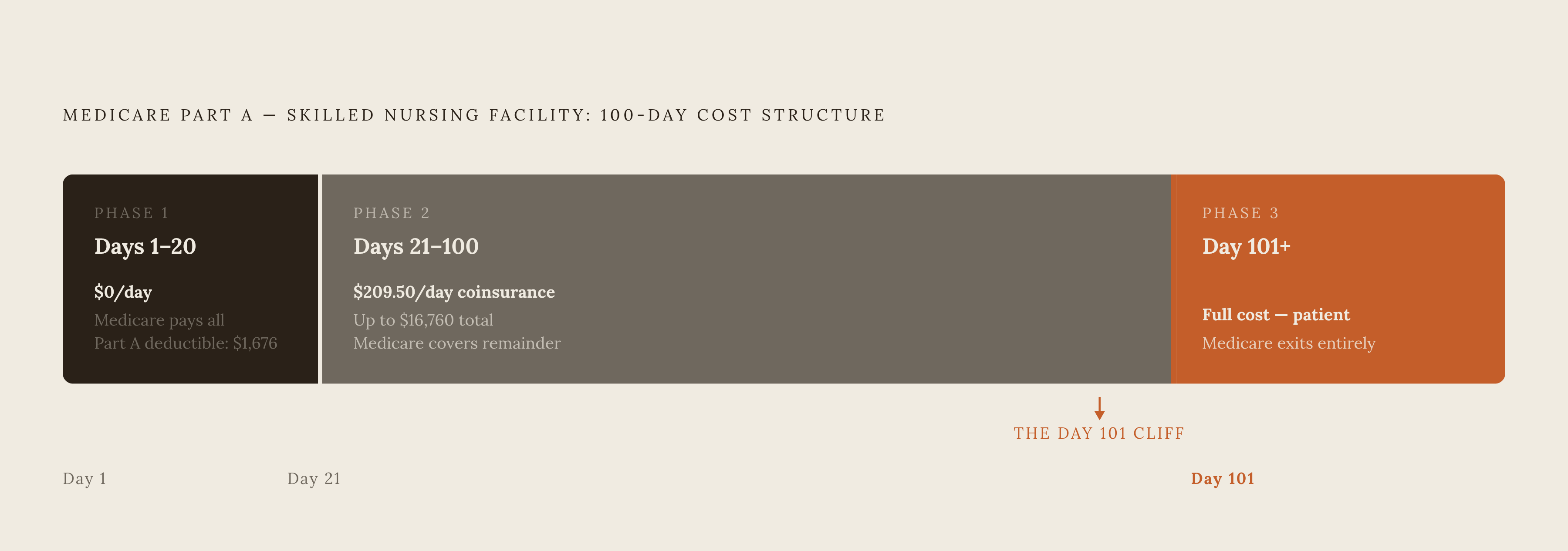
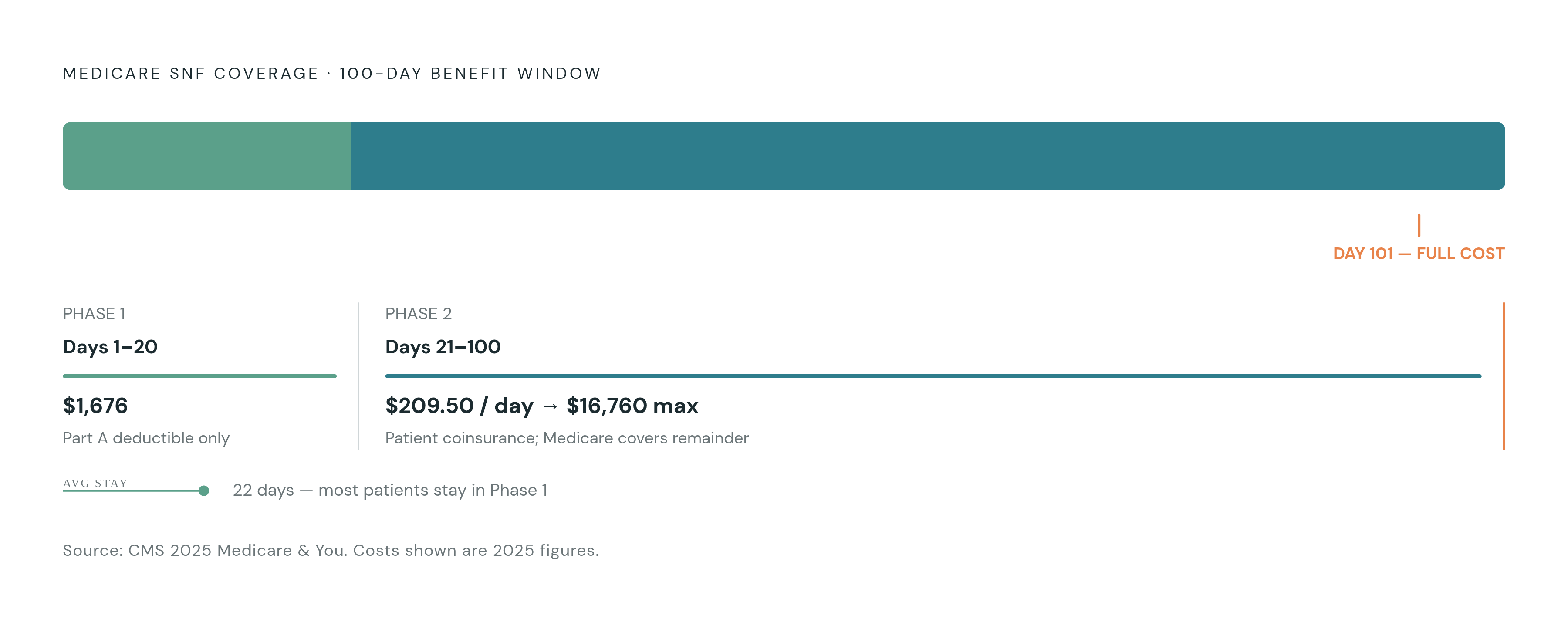
Medicare's SNF benefit runs up to 100 days per benefit period. A benefit period begins when a patient is admitted to a hospital or SNF and ends after 60 consecutive days with no inpatient hospital or SNF care. Theoretically, a patient could exhaust one benefit period and begin another, but that requires a 60-day gap in care, which is rarely clinically realistic for patients who need ongoing skilled services.
Within those 100 days, the cost structure is tiered.
Days 1 through 20 are the most favorable. Medicare pays all covered costs after the Part A deductible, which stands at $1,676 in 2025 and rises to $1,736 in 2026. For those first 20 days, the patient's only out-of-pocket obligation is that deductible.
Days 21 through 100 introduce a daily coinsurance: $209.50 per day in 2025, rising to $217 per day in 2026. If a patient uses the full coinsurance window, those charges accumulate to more than $16,000. Medicare pays the remainder of covered costs during this period, but the daily share compounds quickly for families not expecting it.
Day 101 is Medicare's exit. From that point, the patient bears the full cost.
During a qualifying stay, Medicare's covered services include semi-private room accommodations, meals, skilled nursing care, physical and occupational therapy, speech-language pathology, medications, medical supplies, and dietary counseling. Private room upgrades, telephone and television service, and personal amenities are excluded even within a qualifying stay.
One figure puts much of this in context. The average Medicare SNF stay runs approximately 22 days. Most patients never reach the coinsurance phase. For many families, the Part A deductible is the primary out-of-pocket cost during a covered stay, which makes it the number worth planning around, not the 100-day ceiling.
How Coverage Can End Before Day 100, and One Protection Most Families Don't Know Exists
The 100-day ceiling is a hard outer limit, but Medicare coverage frequently ends well before it is reached.
When a skilled nursing facility determines that a patient is no longer making measurable clinical progress, it can issue a Notice of Medicare Non-Coverage, terminating Medicare's payment for the stay. This happens with regularity in rehabilitation settings where therapy progress plateaus. From the facility's administrative perspective, a patient who has stabilized no longer meets the criteria for skilled care, and the paperwork follows accordingly.
For years, the "improvement standard" operated as the de facto rule: no progress, no coverage. A federal settlement in 2013 changed that. Jimmo v. Sebelius, settled in the U.S. District Court for the District of Vermont, established that Medicare must cover skilled care required to maintain a patient's condition or slow deterioration, even in the absence of clinical improvement. The standard is medical necessity, not measurable progress.
Jimmo protections are invoked far less often than they apply. Facilities do not volunteer this framework, and families rarely know to ask for it. Coverage terminations based solely on a "no improvement" rationale can and should be challenged when the patient still requires skilled services; knowing this changes the conversation at the nursing station considerably.
The vehicle for that challenge is a formal appeal. When a Notice of Medicare Non-Coverage is issued, the patient has the right to request an immediate independent review by a Beneficiary and Family Centered Care Quality Improvement Organization. This is a statutory right. Requesting that review requires no lawyer, and it can extend coverage while the review is pending.
How Medicare Advantage and Medigap Change the Coverage Picture
Everything described above applies to Original Medicare, Parts A and B. For the significant and growing share of beneficiaries enrolled in Medicare Advantage or holding a Medigap supplement policy, the calculus shifts, sometimes favorably, sometimes not.
Medicare Advantage
Medicare Advantage plans, offered by private insurers under contract with CMS, must cover at least everything Original Medicare covers for SNF care. The plan-specific rules layered on top of that floor vary considerably, and the differences matter in ways families often discover too late to act on them.
Some Advantage plans impose a copayment for the first 20 days of SNF care, a period when Original Medicare charges nothing beyond the Part A deductible. Others waive the 3-day inpatient rule, which can be valuable for beneficiaries who end up under observation status or who need SNF placement without a preceding hospital stay. Network restrictions add another layer: Advantage plans typically require the nursing facility to hold a contract with the plan, and placement at a non-contracted facility can mean substantially reduced coverage or none at all.
Reading the Evidence of Coverage document and calling the plan to confirm SNF network status at any facility under consideration are concrete steps that can prevent a costly surprise. Plan-specific verification should happen before a hospital admission is already underway.
Medigap
Medigap, or Medicare Supplement insurance, is designed to cover cost-sharing gaps in Original Medicare, including the daily coinsurance for SNF days 21 through 100. A beneficiary with a comprehensive Medigap plan can substantially reduce or eliminate out-of-pocket exposure during that coinsurance window.
One constraint is firm: Medigap is available only to Original Medicare enrollees. A beneficiary enrolled in Medicare Advantage cannot purchase a Medigap policy. For families deliberating between plan types, this is a structural consideration worth factoring in before enrollment decisions are locked.
What Pays After Medicare Stops: The Four Payers Families Actually Rely On
When Medicare exits, whether at day 101 or earlier, families generally face one of four payers. Understanding each one clearly is the precondition for coherent planning.
Medicaid
Medicaid is the dominant payer for nursing home care in the United States, covering approximately 63% of all nursing home care nationally. Unlike Medicare, Medicaid covers long-term custodial care with no fixed time limit, at Medicaid-certified facilities, for beneficiaries who qualify.
Eligibility thresholds are strict. In 2026, income eligibility generally requires monthly income below $2,982, and countable assets must typically not exceed $2,000 for an individual. States have some flexibility in how they apply these thresholds, but the general architecture is consistent.
Spousal protections exist and are meaningful. A community spouse resource allowance permits a healthy spouse living at home to retain a portion of the couple's joint assets, generally between $30,828 and $154,140 in 2025, depending on state rules. Medicaid recipients who qualify for nursing home coverage contribute nearly all of their monthly income toward the cost of care, retaining only a small Personal Needs Allowance set by each state.
Two features of Medicaid that families consistently underestimate deserve direct attention. The first is the 5-year look-back period. Medicaid examines asset transfers made in the five years preceding an application. Transfers that appear designed to reduce countable assets can trigger a penalty period during which Medicaid will not pay for nursing home care. The timing of any asset movement matters enormously, and decisions made years before a need arises carry consequences when the application is finally filed.
The second is estate recovery. Medicaid is not a grant. States are required to seek reimbursement from a beneficiary's estate after death for nursing home costs paid during their lifetime. Families who treat Medicaid as free care are operating with an incomplete picture of what the program actually requires in return.
Long-Term Care Insurance
Private long-term care insurance covers both skilled and custodial care and, unlike Medicare, requires no qualifying hospital stay. For those who hold a policy and make a claim, coverage can substantially delay or reduce Medicaid spend-down and provides access to care settings and quality tiers that Medicaid reimbursement rates often will not support.
The supply problem is real. As of 2023, roughly 7 million Americans held a long-term care insurance policy, a small fraction of those who will ultimately need long-term care. The market has contracted significantly as insurers repriced the risk of longer-than-expected claims. For those who purchased coverage years ago, the benefit may be substantial; for those approaching retirement without it, options are narrower.
Veterans' Benefits
Veterans' benefits are among the most consistently overlooked payers in long-term care planning. The Department of Veterans Affairs operates nursing home care programs for eligible veterans, with scope of coverage depending on service-connected disability status, level of need, and available resources. Some benefits extend to surviving spouses.
Families often are unaware a veteran qualifies, or simply do not think to inquire, particularly when the veteran's service-connected disabilities seem unrelated to the current nursing care need. Any family with a veteran member facing long-term care costs should speak with a VA benefits counselor or an accredited VA claims agent before assuming no benefit applies.
Private Pay
When none of the above payers applies, or applies fully, families pay out of pocket. The national median cost for a semi-private nursing home room in 2025 is approximately $9,555 per month; a private room runs approximately $10,646. At those rates, substantial savings deplete quickly.
The transition from self-pay to Medicaid eligibility, often called spend-down, is not inherently a failure of planning. For a significant share of Americans, it is the predictable endpoint of a long-term care stay financed through personal assets. Treating it as a catastrophe rather than a likely scenario tends to make planning worse, not better.
The Real Financial Exposure Families Face When Planning for a Nursing Home Stay
The national median nursing home cost in 2025 was approximately $122,275 per year. That median obscures geographic variance that shapes individual exposure considerably. Alaska's annual median is dramatically higher; Texas is considerably lower. Where someone ages, and where their family can realistically place them, is not incidental to the financial calculus.
The trajectory matters as much as the current figure. If costs continue rising at approximately the rate reflected in recent federal long-term care cost surveys, today's annual figures would approach $186,000 within two decades. Families planning for a parent's potential need ten or fifteen years from now are not planning for today's costs. They are planning for a moving target.
The Milliman LTC Index estimates that a 65-year-old would need to set aside a substantial six-figure sum today to cover expected lifetime long-term care costs at market rates, without Medicaid as a backstop. That is a median estimate across a population; individual exposure varies enormously. A meaningful share of adults 65 and older will need long-term care for longer than five years. For that group, private pay exhaustion leading to Medicaid eligibility is not a catastrophic outcome; it is the expected path, and planning should treat it as such rather than as a worst case.
Medicare's SNF benefit functions as a short-term bridge following an acute medical event, not a foundation for long-term residential financing. Medicaid's income and asset eligibility thresholds create a planning window that closes as assets are spent. Together, these two programs define a gap that families must consciously plan around, and the later that planning begins, the fewer tools remain available.
Where to Start If You're Trying to Figure Out What Your Family Actually Qualifies For
The benefits system described above was not designed for self-navigation. Medicaid eligibility rules differ by state. Medicaid waiver programs, which can fund home- and community-based care as an alternative to nursing home placement, vary enormously in scope, waitlist length, and qualifying criteria. Veterans' benefits involve separate eligibility determinations, documentation requirements, and appeals processes. The programs exist; finding and claiming them requires knowing where to look and how to sequence the inquiry.
Several benefits are commonly missed by families who would qualify. Medicaid home- and community-based waiver programs can fund care in a home or assisted living setting, potentially delaying or avoiding nursing home placement altogether. Certain Medicaid-funded programs compensate family members who serve as paid caregivers, a benefit available in most states that remains widely underutilized. Veterans' benefits sometimes extend to spouses and caregivers in ways families do not anticipate.
A few concrete actions should precede any crisis, regardless of how far off it seems.
Confirm hospital admission status, inpatient versus observation, before assuming Medicare SNF coverage will apply. Ask on the day of admission, not the day of discharge.
Verify that any nursing facility under consideration holds both Medicare and Medicaid certification. These are separate designations. A facility that accepts Medicare may not accept Medicaid, which matters considerably if a long stay becomes likely.
Understand the 5-year look-back window before any asset transfers occur. A gift made in good faith to an adult child five years before a Medicaid application can delay eligibility precisely when it is most needed.
Review Medicare Advantage plan-specific SNF rules before a hospital stay becomes urgent. The differences between plans are material and frequently not communicated clearly at enrollment.
Tools designed to help families navigate this complexity are beginning to emerge. Some platforms are built to help families identify which Medicare, Medicaid, caregiver compensation, and related benefit programs they qualify for, then guide them through enrollment. The obstacle is finding and claiming benefits before a family is already in crisis.
The system rewards those who arrive early and penalizes those who wait. That asymmetry, more than any single program rule, is what most families discover too late.