Respite Care Funding Sources for Family Caregivers
No income test required; the most accessible federal respite program remains largely unknown.

Established in 2000 under Title IIIE of the Older Americans Act and administered through every state's Area Agencies on Aging, the National Family Caregiver Support Program is, in practical terms, the most permissive federal respite program available. Its distinguishing feature is one most caregivers rarely encounter: there is no income test. That single fact separates it from nearly every other program covered here, and yet it remains routinely unknown, even to the caseworkers supposed to be surfacing it. That raises an important question: if the program is this accessible, why does it go unannounced in so many care settings?
The 2020 reauthorization of the Older Americans Act clarified and expanded eligibility considerably. The program now covers adult family members or informal caregivers of someone 60 or older; caregivers of individuals of any age with Alzheimer's disease or a related disorder; older relatives age 55 or older, not parents, caring for children under 18; and older relatives, including parents, age 55 or older caring for adults ages 18 to 59 with disabilities. That last category stops people cold when they read it carefully. The breadth is unusual for a federal program, and the fact that it goes unannounced in so many care settings reflects something more than administrative oversight.
Benefits are delivered locally. The Area Agency on Aging typically issues a voucher for a set number of hours or a dollar amount; the caregiver selects from a pre-approved provider list. ACL reports the program has provided respite services to more than 604,000 caregivers through nearly 6 million hours of temporary relief. ACL's 2018 Outcome Evaluation found that 74 percent of caregivers said the services allowed them to continue providing care longer than would otherwise have been possible, and caregivers receiving four or more hours of respite per week showed decreased self-reported burden over time while comparison caregivers experienced an increase.
Funding is finite, and waitlists move slowly. The Eldercare Locator at eldercare.acl.gov connects caregivers to the appropriate local office. This program belongs at the beginning of the search, not after other doors have already closed.
The Lifespan Respite Care Program: State-Level Grants That Fill the Gaps for Caregivers Who Don't Fit Other Programs
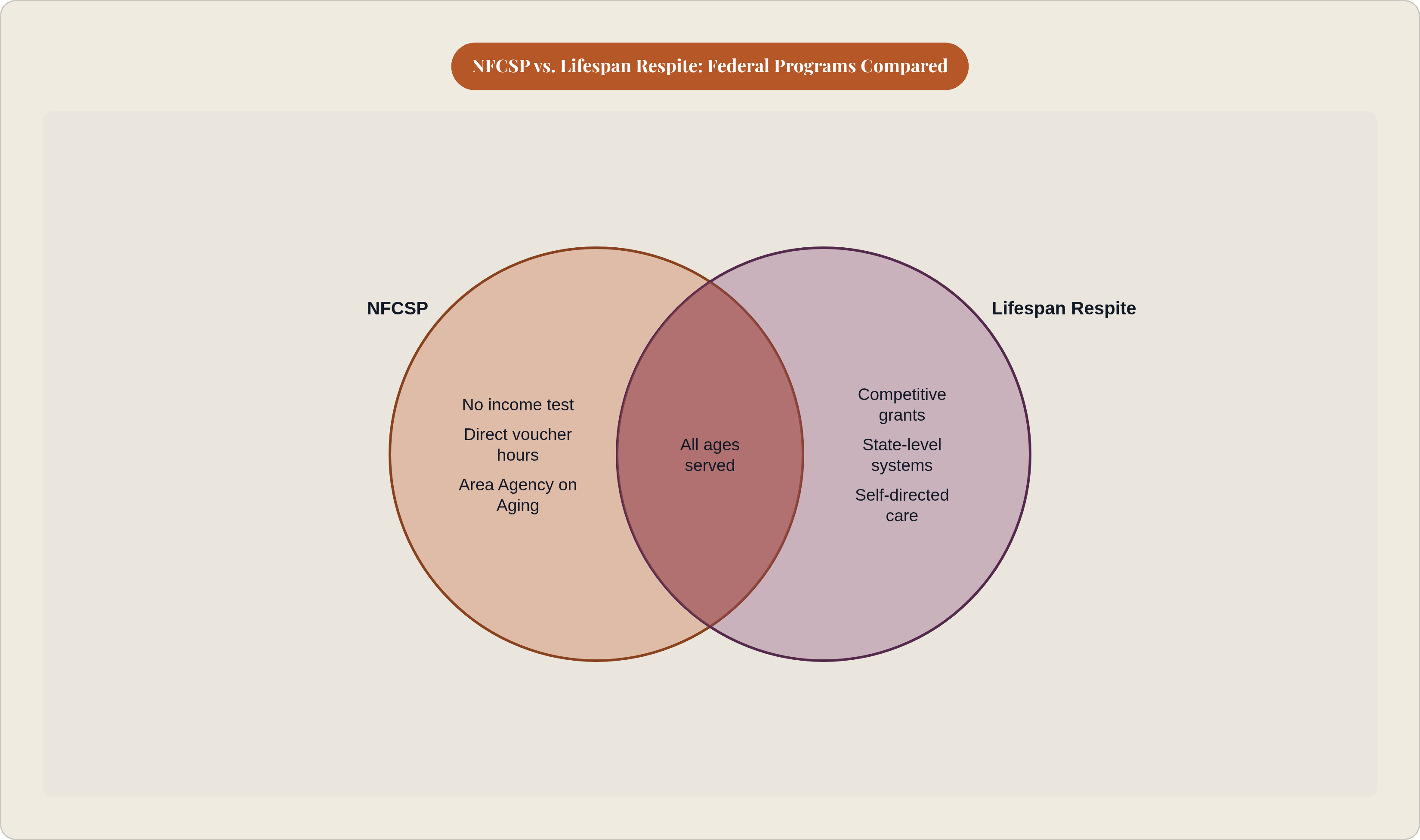
The Lifespan Respite Care Program functions differently from NFCSP in a way that matters practically. Rather than delivering services directly to caregivers, it is a federal competitive grant program that funds coordinated, community-based respite systems at the state level, serving caregivers across all ages, disabilities, and diagnoses. Since 2009, ACL has awarded grants to eligible agencies in 39 states and the District of Columbia. Some states have nothing at all, which is its own kind of answer about federal commitment to this population.
Congressional appropriation reached $10 million in FY 2025, a $2 million increase above the FY 2022 level, and a new funding opportunity posted in June 2026 (Notice HHS-2026-ACL-AOA-LRLI-0053) signals continued federal investment. What state programs actually deliver varies considerably: respite vouchers, caregiver stipends or direct grants, self-directed arrangements where the caregiver selects and sometimes directly hires their provider, volunteer respite worker programs, and improved referral infrastructure are all common features, though no two states look exactly alike.
The population Lifespan is designed for earns too much to qualify for Medicaid home and community-based services waivers but whose care recipients fall short of Medicare's hospice threshold. It is worth sitting with how large that middle group actually is. NFCSP and Lifespan, taken together, constitute the primary federal response to their situation. Given the scale of the problem, that is a fairly modest response.
ARCH National Respite Network maintains a state-by-state locator at archrespite.org; ACL's website lists current grantees. If a caregiver's state has a program, that inquiry belongs at the beginning of the search.
How Medicaid Funds Respite: Why the Eligibility Rules and Waitlists Require a Strategy of Their Own
Medicaid is the primary public payer for long-term respite care, and the architecture surrounding that fact is where caregivers lose the most time. The principal vehicle is the 1915(c) Home and Community-Based Services waiver. KFF's 2025 survey found states operated more than 300 different Medicaid home care programs in 2024, with 258 operating through 1915(c) waivers and 14 through 1115 waivers. More programs does not translate to more access. It means more eligibility architecture to navigate, and the navigation itself can take months.
For 2026, the standard HCBS waiver respite benchmarks require a single applicant to have income at or under $2,982 per month, assets under $2,000, and a care need that meets nursing facility level of care. Meeting all three simultaneously screens out a substantial share of people in precarious situations. But what if a caregiver meets two of the three criteria? They are not necessarily without options; they are often looking at different pathways rather than a closed door, and conflating the two conclusions costs real time.
The waitlist problem is the one that breaks people. More than 700,000 individuals were on HCBS waiver waitlists nationally in 2024, per KFF. Texas alone had over 143,000 waiting. Median wait times exceed one year in many states; some waivers run five years or longer. The only workable response is to apply immediately, before crisis forces the issue, and pursue NFCSP and Lifespan respite concurrently while the application moves through the queue. Waiting until urgency is undeniable is the most common and most costly mistake in this space.
Two additional Medicaid pathways complicate the picture usefully. The Section 1915(i) State Plan Option is currently offered in 23 states, including California, Illinois, Texas, and Washington, and can be accessible without navigating a waiver waitlist. Self-direction, also called cash-and-counseling, is available in 49 states as of 2025 and allows Medicaid enrollees to direct their own home care, including, in some states, paying a family member and purchasing respite from a provider of their choosing.
There is an equity dimension worth naming plainly. Strict income eligibility leaves many near-poor caregivers, disproportionately from racial and ethnic minority groups, without access even when need is greatest, a pattern documented in research published in Innovation in Aging in 2025. The programs exist. The eligibility architecture fails some of the people most vulnerable to caregiver burnout, and that failure is structural.
The state Medicaid office or a SHIP counselor is the right starting point for waiver applications.
What Medicare Actually Covers for Respite: And the Newer Pathways That Go Further Than Most Caregivers Know
Traditional Medicare's respite coverage is narrow and conditional. Under the Part A hospice benefit, Medicare covers up to five consecutive days of inpatient respite care when the care recipient is enrolled in hospice, meaning a physician has certified a terminal illness with a life expectancy of six months or less. Medicare covers 95 percent of the cost; the caregiver is responsible for 5 percent, capped at $1,676 in 2025. Hospice teams don't surface this benefit without prompting as often as they should, and caregivers in that context should ask for it by name.
The GUIDE Model is a more consequential development for most caregivers. Launched in July 2024, Guiding an Improved Dementia Experience is a voluntary, nationwide initiative operating through traditional Medicare that reimburses up to $2,500 annually per eligible patient for respite services, including in-home care, adult day centers, and facility-based respite. Approximately 350 GUIDE programs are currently operating nationally. Nearly 13 million Americans provide unpaid dementia care; GUIDE is the first Medicare pathway that reaches that population directly with a respite benefit. Access begins with the care recipient's physician or neurologist, and ARCH National Respite Network lists participating programs.
Medicare Advantage adds another layer, though a highly variable one. Some plans include in-home respite care, adult day services, meal delivery, and non-emergency transportation as supplemental benefits, but coverage varies sharply by plan and county with no uniform standard. Reading the plan's Summary of Benefits or calling the plan directly is the only reliable method.
One 2025 addition merits separate mention: original Medicare began covering caregiver training as a new benefit category. It is also worth considering how this interacts with existing respite coverage — it is adjacent to respite rather than equivalent to it, but caregivers should confirm that their provider codes the service correctly to capture the coverage.
VA Respite Programs for Veteran Caregivers: Two Distinct Programs With Meaningfully Different Eligibility Requirements
The VA operates two programs with respite components. They are not interchangeable, and conflating them wastes time caregivers generally don't have.
The Program of Comprehensive Assistance for Family Caregivers, PCAFC, is the higher-benefit, more restrictive option. It requires a VA disability rating of 70 percent or higher and is the right starting point for caregivers of seriously injured veterans. Benefits include a monthly stipend, CHAMPVA health coverage for the caregiver, and at least 30 days of respite care per year, deliverable in the home, at a VA Community Living Center, or at a VA-contracted facility.
The Program of General Caregiver Support Services, PGCSS, is open to caregivers of veterans enrolled in VA health care regardless of disability rating or service era. Benefit levels are lower, but the program includes caregiver coaching, peer support, and skills training alongside its respite component. Caregivers who fail to meet PCAFC's threshold often dismiss PGCSS without a serious look. That is a mistake. The programs serve different situations, and PGCSS support is often more immediately accessible than caregivers assume.
Application for either program runs through the VA Caregiver Support Program. The VA Caregiver Support Line at 1-855-260-3274 connects caregivers to a local Caregiver Support Coordinator who guides the process. Many veteran caregivers qualify for programs in both VA and federal or state channels simultaneously; the search should not stop at one source.
Nonprofit Grants and Disease-Specific Organizations That Fund Respite Directly
Government programs have eligibility floors, waitlists, and geographic gaps. Nonprofit grants can move faster and reach caregivers who earn too much for Medicaid but too little to sustain private-pay respite. For a specific segment of caregivers, this layer is not supplementary; it is the primary source of support.
The Alzheimer's Association funds direct respite grants for dementia caregivers through its chapter network. Eligibility and grant amounts vary by chapter; the 2024 program expansion was announced specifically to extend reach. The entry point is the local chapter or the national helpline at 800-272-3900.
Other disease-specific organizations with direct respite funding include the National MS Society, the ALS Association, and Easter Seals, which operates programs for caregivers of children and adults with disabilities. Many condition-specific advocacy organizations fund caregiver support in some form without advertising it prominently. A direct inquiry to a relevant chapter is often the only way to learn what is currently available in a given location.
At the community level, local faith organizations, United Way chapters, and area community foundations fund small respite grants or volunteer programs that rarely appear in national databases. The funding exists; the barrier is most often awareness.
ARCH National Respite Network's respite locator and NCOA's BenefitsCheckUp both surface nonprofit and state grant options alongside federal programs, and Brevy, a free government benefits enrollment service, can help caregivers check Medicaid and caregiver pay eligibility in the same search. Using more than one search tool increases the likelihood of finding what is actually available at the county or zip-code level.
Employer Benefits, FSAs, and Long-Term Care Insurance as Respite Funding Sources
Employer-sponsored benefits are an underused respite funding source, partly because caregivers don't think to look for them in their benefits portals, and partly because HR departments tend to avoid surfacing them proactively. A growing share of large employers offer Employee Assistance Programs that include caregiver resource and referral services; some include a set number of funded respite hours. Backup care benefits, offered by some employers through platforms like Bright Horizons, provide subsidized in-home or center-based care when a primary caregiver has a work conflict. The question is worth asking directly rather than assuming the answer is no.
Dependent care Flexible Spending Accounts can pay for adult day care services for a qualifying dependent, up to the annual IRS contribution limit. HSA funds can pay for certain medically related respite expenses, though which specific services qualify requires confirmation with the plan administrator. Both mechanisms allow caregivers to use pre-tax dollars, effectively discounting costs they would already be incurring.
Long-term care insurance policies vary significantly in their respite provisions. Policies issued in earlier decades often carry different benefit structures than more recent ones; some cover in-home respite and adult day programs explicitly, while others apply only to facility-based care or impose an elimination period before benefits begin. The policy document and a conversation with the insurer or a licensed insurance counselor are the only reliable sources. Caregivers paying LTCI premiums for a care recipient should review those provisions before assuming the benefit doesn't apply. One might argue that reviewing an LTCI policy feels low on the priority list when care demands are immediate — but the benefit window can close if claims aren't filed in time, making early review one of the higher-leverage steps available.
These funding streams do not form a coherent system. Taken together, they constitute a layered, imperfect, administratively demanding collection of resources, one that rewards those who apply early, pursue multiple sources simultaneously, and treat the search as ongoing. The landscape is navigable. But it asks a great deal from people who are already running on very little.