platforms that help family caregivers get paid through Medicaid
Medicaid pays family caregivers in every state, but most who qualify never find out how to enroll.
Medicaid pays family caregivers in every state. Almost nobody knows that, and it's not some throwaway footnote either: Medicaid is the dominant funding source for home care in America, and most families who'd qualify never find the door in. This piece walks through the three ways Medicaid actually moves money to caregivers, what that money looks like once it lands in someone's account, and the platforms that have grown up to close the gap between "you're eligible" and "you're actually enrolled."
Start with who's doing this work for free right now, because the scale of it is staggering once you sit with the number. Around 63 million Americans serve as family caregivers, putting in an average of four hours a day for an older loved one. A large share of adults getting long-term care at home rely entirely on relatives and friends, no paid help involved at all. Medicare, the program most people assume covers this, generally doesn't pay for home and community-based services; Medicaid does. In 2021 alone, Medicaid long-term services and supports payments hit $207 billion, 44.3% of all long-term care spending in the country. So the money exists. Whether the person doing the caregiving has any idea how to reach it is a different question entirely.
How Medicaid actually pays family caregivers — the three program pathways
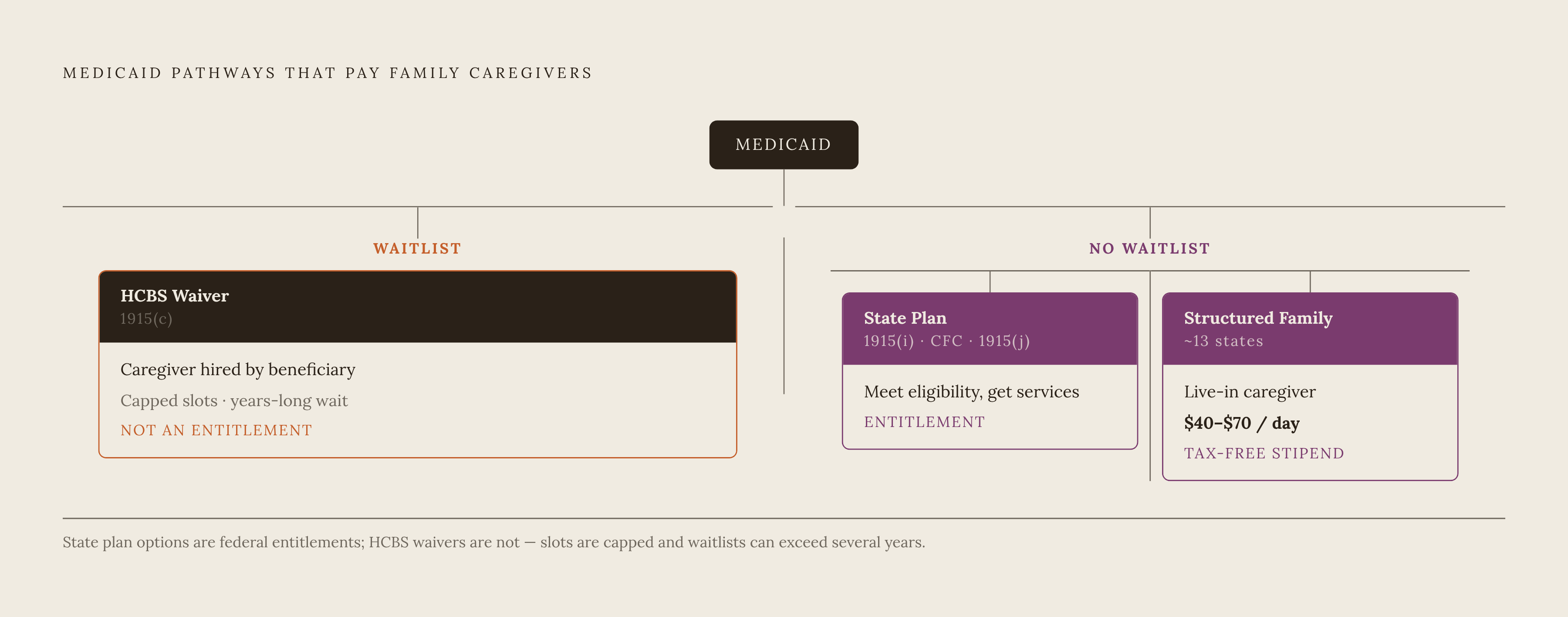
Every state runs some version of a Medicaid-funded consumer-directed personal care program, and every reporting state except Alaska lets the beneficiary self-direct their own care, meaning they can pick a family member and hire them. But "some version" is doing a lot of quiet work in that sentence. Underneath it sit three distinct pathways, and they don't behave the same way at all.
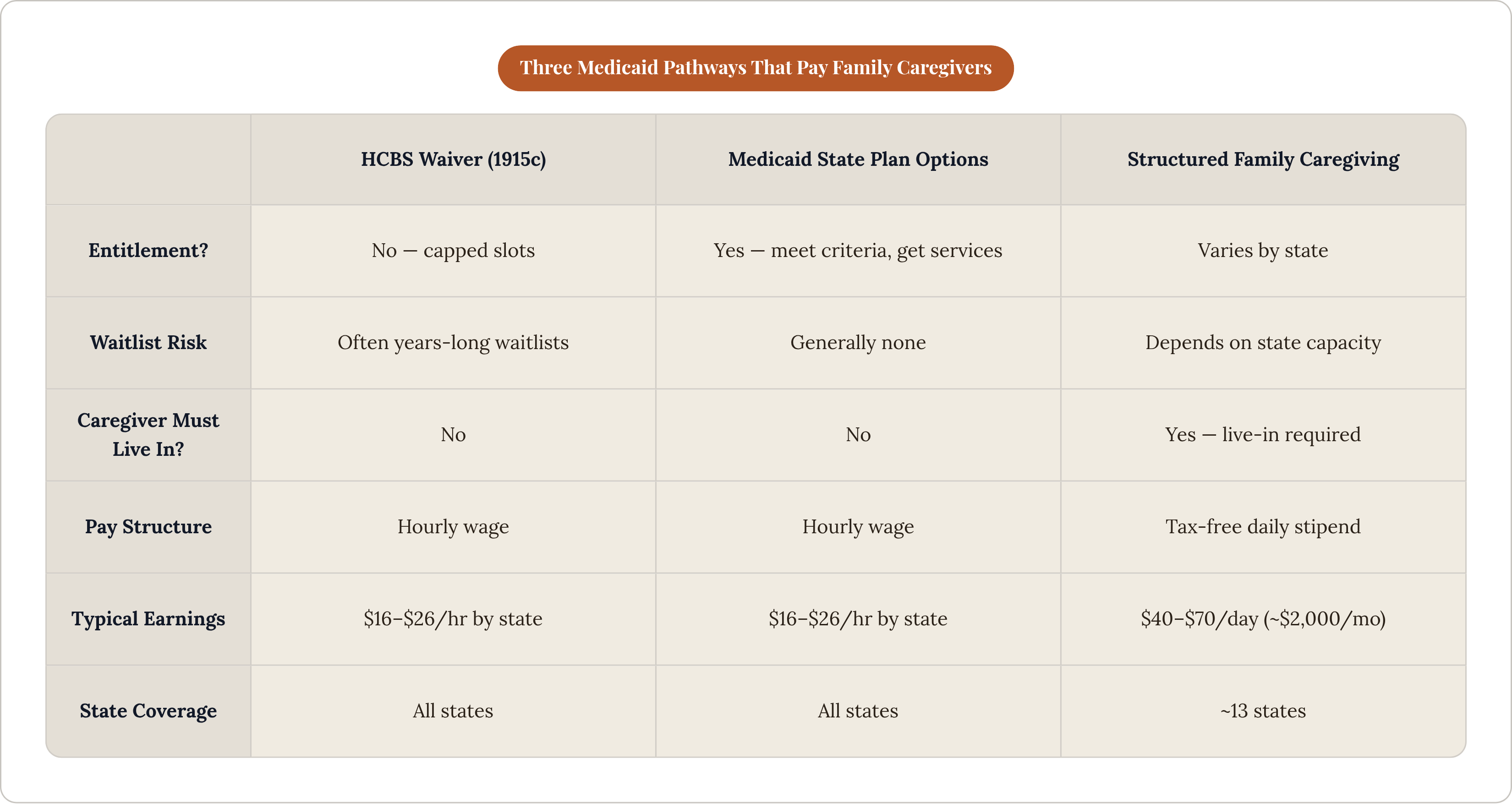
The HCBS Waiver, formally 1915(c), lets a Medicaid beneficiary hire whoever they want for personal care and homemaking tasks. Waivers are common. They are also not entitlements, and that gap matters more than it sounds like it should: states cap the number of waiver slots they fund, so plenty carry waiting lists, some of them years long.
Then there's the Medicaid State Plan option, covering 1915(i), Community First Choice, and 1915(j) self-directed personal assistance services. These are entitlements. Meet the eligibility criteria and you get services, no waitlist, full stop. Waiver versus state plan is probably the single most useful distinction a family can walk in already knowing, and it's the one almost nobody hears about before they actually need it.
Structured Family Caregiving, SFC, is the third pathway, and it's the live-in model. The caregiver shares a home with the person they're caring for and draws a tax-free daily stipend, usually somewhere between $40 and $70. It runs in roughly 13 states, Georgia, Indiana, and Connecticut among them.
Here's where it turns into a genuine mess, though. Consumer-directed programs sometimes get called "cash and counseling" in Medicaid literature, a phrase that shifts by state and means nothing to a person googling for help at midnight. SFC is worse. The exact same program structure runs under wildly different names depending on where you live: Adult Foster Care in Massachusetts, Adult Family Living in Connecticut, RIte @ Home Shared Living in Rhode Island, Monitored In-Home Caregiving in Louisiana, CarePlus in Pennsylvania. Someone who read about Structured Family Caregiving in a Georgia news story has no reason on earth to know Connecticut's "Adult Family Living" is the same program wearing a different name tag. States built out federal Medicaid authority independently of each other, and this is what fell out of that.
So which pathway fits a given family? It depends on the state, the beneficiary's diagnosis and functional needs, and whether the caregiver actually lives in the house. There's no single national rulebook waiting to be consulted here, which is sort of the whole problem in miniature.
What family caregivers actually earn through these programs
This is real money, not a token gesture, though where you live changes the math considerably. A recent KFF report puts the national average for Medicaid-funded personal care services around $18 an hour. Some states climb to $26. Others sit closer to $16.
California's IHSS program, one of the largest in the country at roughly 600,000 participants, pays about $18.50 an hour on average, though the exact figure shifts by county. New York's CDPAP pays $16 to $23 an hour depending on region, and starting in 2026, the rate in New York City, Long Island, and Westchester climbs to $23.81. Missouri and Texas run lower, generally $12 to $18. For comparison, the Bureau of Labor Statistics put the median wage for home health and personal care aides at just under $17 an hour in 2024. Medicaid's caregiver rates in a lot of states aren't just keeping pace with the broader home care labor market, then. In several cases they're beating it outright.
Structured Family Caregiving works differently, since it pays a daily stipend rather than an hourly wage, but it can add up to $2,000 a month for a qualifying live-in caregiver. Starting in July 2026, states have to publish their hourly Medicaid payment rates publicly, which should make comparing programs across state lines considerably less painful than it currently is.
None of that matters, of course, if the caregiver never gets enrolled in the first place. The dollar figures are the payoff. Getting there is the actual problem, and that's what the next section is about.
Why the system is hard to navigate without help
There's no single national program to learn here. Each state runs its own version, under its own name, with its own eligibility rules, its own application, its own rate schedule. A caregiver who moves from Ohio to Pennsylvania to help a parent isn't transferring a benefit. They're starting from zero, in a system they've never laid eyes on before.
Waiver programs often carry waiting lists, as covered above; state plan options generally don't. Most families have no idea this distinction even exists. So they assume they're stuck on a waitlist when a state plan option would have covered them the same week, or they apply for a waiver when a faster route was sitting right next to it the whole time. And getting approved isn't the finish line either: now there's payroll, tax withholding, employer-of-record paperwork on top of the caregiving itself, and most people aren't equipped to handle that alone while also, say, holding down a job.
The naming problem makes everything worse. Because the same program structure carries a dozen different labels state to state, word-of-mouth and basic search engines fail constantly. Someone who heard about Structured Family Caregiving from a friend in Georgia types that exact phrase into a search bar in Connecticut and gets nothing, because Connecticut calls it Adult Family Living. Try explaining that to someone at 11pm who just found out their mother needs round-the-clock care.
The scale of the gap is worth sitting with. KFF data shows millions of people use Medicaid-funded home care. But many family caregivers are already enrolled in Medicaid as their own health insurance, meaning they are already inside the Medicaid system in some capacity without necessarily drawing the caregiver pay they might qualify for. That space, between being enrolled in Medicaid and being paid by Medicaid for caregiving, is exactly what fiscal intermediaries and enrollment platforms exist to fill.
What fiscal intermediaries do and why they're the operational backbone of caregiver pay
Fiscal intermediaries, FIs for short, don't invent new Medicaid money. They connect families to programs that already exist and run the employer-of-record functions that come with hiring a caregiver: enrolling the beneficiary, credentialing the caregiver, running payroll, withholding taxes, staying inside whatever rules the state Medicaid agency has laid down.
Could a family handle all of this alone? In a handful of states, technically, yes. In practice, for most people already juggling caregiving on top of a job and a household, it isn't realistic. FIs get authorized and contracted directly by states, and the competitive landscape swings wildly depending on where you land: some states approve hundreds of FIs that compete for participants, others consolidate down to a single statewide intermediary. New York's move to one FI, which comes up again later, shows exactly what that structural choice can cost when it goes sideways.
The choice of FI, or the absence of choice when a state consolidates, has real consequences for how fast a caregiver actually sees a paycheck and how smoothly the arrangement runs month over month. It deserves the same scrutiny as the initial eligibility question. A good program run by an unreliable FI can still leave someone staring at a check that hasn't shown up two weeks after it was due.
FreedomCare: fast enrollment and same-day pay in consumer-directed programs
FreedomCare operates as an approved fiscal intermediary across more than a dozen states, New York, Pennsylvania, Georgia, Illinois, Michigan, and Ohio among them. The model follows the standard consumer-directed setup: the Medicaid beneficiary picks their own caregiver, and FreedomCare handles enrollment, acts as employer of record, and runs payroll and compliance in the background.
Speed of pay is the clearest thing that sets it apart. Through its InstaPay4Care app, caregivers get paid right after a shift ends instead of waiting on a standard weekly or biweekly cycle. For a household running close to the edge, that's not a nice-to-have feature buried in a settings menu. A two-week gap between finishing a shift and seeing money land is genuinely destabilizing when rent's due Friday.
FreedomCare works across both consumer-directed programs, CDPAP in New York (roughly $18 to $22 an hour) among them, and Structured Family Caregiving programs like Georgia's, which runs around $60 a day. Worth flagging here: FreedomCare sued New York State over the 2025 CDPAP consolidation to Public Partnerships LLC, arguing the transition hurt the caregivers and consumers it had been serving. That case is still open, and on its own, it tells you something about how high the stakes get when a state decides to restructure the pipes that move millions of dollars in caregiver pay.
Careforth: clinical support alongside the stipend in the Structured Family Caregiving model
Careforth built its business around Structured Family Caregiving specifically, instead of trying to cover every pathway at once. It's now in 11 states with more than 800 employees, and beyond the tax-free daily stipend for live-in caregivers, it layers in clinical coaching, social workers, and nurses around that caregiver. That's a different pitch entirely from a pure payroll-and-compliance FI. Careforth wants to be clinically involved, not just administratively present, and the distinction shows up in how the company talks about itself.
The company holds NCQA accreditation for its SFC program, a credentialing detail that matters less to the individual caregiver and more to the health plans Careforth is trying to partner with. Growth has moved fast: Ohio alone has an estimated 1.5 million family caregivers, and Careforth had already signed up 400 families in the state by late 2025.
The outcomes data is the more interesting claim, honestly. Published outcomes data shows Careforth's SFC participants had a 45% lower probability of falls and a 21% lower probability of emergency department visits, measured against a comparable group of dual-eligible beneficiaries. That's the quiet argument the whole industry is building toward: paying family caregivers isn't only fair, it's cheaper downstream, because a supported caregiver notices the thing a burned-out or absent one misses. A new partnership with SCAN Health Plan points at something else worth tracking, too. Medicare Advantage plans are starting to contract directly with SFC platforms, which could open a second door into these programs outside the usual state Medicaid application route.
Public Partnerships LLC: the scale player and what the New York CDPAP consolidation reveals
Public Partnerships LLC, PPL, is the biggest operator in this space by a wide margin: 20 states, 50 programs, more than 500,000 participant and caregiver relationships under management. Scale like that comes with real advantages and real exposure, and New York's recent experience shows both sides at once.
New York consolidated its CDPAP program, a $10 billion program serving a huge population, from more than 600 fiscal intermediaries down to PPL as the sole statewide FI. The stated goal was consistency and cost control. The result, so far, has been messy: the Department of Justice filed suit alleging impropriety in the bidding process behind the consolidation, and advocates report roughly 150,000 workers and 90,000 patients have left the program, citing missing paychecks during the transition.
PPL, for its part, reports a 4.31 out of 5 satisfaction rating among participants and projects $1 billion in taxpayer savings from the move. Both figures could well be true at once, which is exactly what makes this instructive rather than a simple morality tale. A single statewide FI can mean less confusion and lower administrative overhead across the whole system, or it can mean a rocky transition that leaves tens of thousands of people without a paycheck they were counting on for rent that month. Consolidation isn't inherently good or bad; it's a bet on execution, and the caregiver is the one who eats the cost when execution slips. Which is really the argument for why the identity and stability of the fiscal intermediary deserves as much scrutiny from a family as the underlying Medicaid program itself.
Consumer Direct Care Network: state-specific and health-plan-facing models
Consumer Direct Care Network, CDCN, has operated as a Fiscal/Employer Agent in Virginia since 2018. The model keeps selection and supervision with the family: they pick, train, and directly supervise their caregiver, while CDCN handles the employment and payroll mechanics underneath. Managed care organizations Molina and Sentara both use CDCN as their designated F/EA for Virginia Medicaid managed care members, and that points at a pattern worth understanding on its own terms. Increasingly, it's the health plan contracting with the fiscal intermediary, not the family dealing with a state Medicaid office directly.
That health-plan route is becoming a bigger slice of the landscape overall. As Medicare Advantage plans expand supplemental benefits and dual-eligible programs grow, fiscal intermediaries built to operate inside plan contracts, rather than only inside state Medicaid bureaucracies, have a widening market in front of them. It's a variation on the FI model worth watching closely, because it changes who the family's first phone call actually goes to.
What to look for when choosing a platform — and where Brevy fits in the process
The first question isn't which fiscal intermediary to sign up with. It's which Medicaid program the beneficiary actually qualifies for, because that answer shapes everything downstream from it: which FIs are even authorized to operate in that program, what the pay structure looks like, whether a waitlist enters the picture at all.
A few things worth nailing down before choosing anything at all. Which state the beneficiary lives in, and what programs that state actually runs; whether they'd land on a waiver, which may carry a wait, or a state plan option, which generally doesn't; whether the caregiver lives with the beneficiary, since that's what determines SFC eligibility specifically; which FIs are authorized for that state and that program. Once those questions have answers, the differences between FIs become the real decision points: how fast they pay, how usable the app is day to day, whether they layer clinical support on top of payroll, how well they handle non-English speakers, how they respond when something breaks. The PPL situation in New York is a useful reminder this isn't a decision made once at sign-up and forgotten about. Platform reliability keeps mattering for as long as the caregiver stays enrolled.
Eligibility discovery and enrollment guidance, figuring out which programs a specific family actually qualifies for given their state, diagnosis, and living situation, what documentation the application needs, and how to move through enrollment without getting lost in a maze of state-specific names for the same underlying program, is a step that has to happen before any FI comparison becomes relevant. For a family that doesn't yet know whether they're looking at a waiver, a state plan option, or Structured Family Caregiving under some name they've never encountered before, that clarity is what makes every choice after it possible. Without it, a caregiver ends up picking between fiscal intermediaries for a program they haven't even confirmed they qualify for. That's choosing blind, and nobody should have to do it in a system this consequential.