services that help family members get paid to care for a loved one at home
Medicaid programs pay family caregivers, but rules vary wildly by state and program.
No single federal program pays family caregivers. Compensation flows through a patchwork instead: state Medicaid programs, VA benefits, private contracts between relatives, a scattering of employer or state leave policies. Each has its own eligibility rules, its own paperwork, its own vocabulary. The same program can go by three different names in three different states, which sounds like a minor annoyance until you're the one trying to figure out which name applies to you.
Waiting lists. Income and asset thresholds. Rules about which relatives even qualify, and which don't. Stack these together and you get a system that's technically generous but practically hard to walk into, one where caregivers who'd qualify for real money often never apply, simply because finding the path costs more time and legal literacy than a working caregiver has left over at the end of a shift. That gap between what's available and what's found is the entire reason benefit-navigation tools and enrollment-support services have turned into a real industry rather than a niche.
Each section below takes one pathway on its own terms: what it is, who qualifies, what it pays, where the catch usually hides.
Medicaid self-directed care programs (the most widely available route for most families)
Medicaid is the largest single payer of home and community-based long-term care in the country, covering the large majority of home care spending nationwide. Every state and the District of Columbia runs at least one Medicaid program that can pay a family caregiver, and nearly all of them let the person receiving care choose who provides it. The logic, once you see it, is almost obvious: if someone already qualifies for Medicaid-funded home care, the state can redirect that funding to a family member the person already trusts, rather than sending over a stranger from an agency.
States call this different things: consumer-directed, participant-directed, cash-and-counseling. Underneath the branding, three federal mechanisms do the actual work.
The HCBS State Plan Option, authorized under section 1915(i), builds an individualized care plan with a self-direction budget, and family members are generally eligible to be hired within it. Community First Choice, under 1915(k), targets people who need an institutional level of care and allows self-direction specifically for personal tasks like bathing, dressing, mobility. HCBS Waivers, under 1915(c), cover the broadest range of services but come loaded with real constraints: geography, income caps, specific disability categories, and often a waiting list running months or, in some states, years.
Pay rates differ in ways that actually matter to a household budget, with some programs landing close to minimum wage while others pay closer to what a professional home health aide earns on the open market. Eligibility for the person receiving care varies by mechanism too, with waivers generally imposing stricter income and asset limits than the state plan options do.
Who can be hired is its own separate question. Most states allow adult children and other relatives to be paid caregivers, and a growing number now allow spouses, a real expansion from where these programs started. Spouses still face extra scrutiny in some states, since Medicaid treats "legally responsible relatives" differently, and that trips up plenty of married couples who assume the rules work the same for everyone.
Structured Family Caregiving (a Medicaid variant that operates differently from standard self-direction)
Structured Family Caregiving, sometimes called adult family living, monitored in-home caregiving, or coordinated caregiving depending on the state, works more like a foster-care model than a wage job. The caregiver gets a daily stipend rather than clocking hours at an hourly rate, and that stipend is typically tax-free rather than taxable income. That single distinction changes how a family plans its finances and files its taxes, so it pays to understand it before assuming this program behaves like a normal paycheck.
It's currently live in a limited set of states: Connecticut, Georgia, Indiana, Louisiana, Massachusetts, Missouri, Nevada, North Carolina, Ohio, Rhode Island, South Dakota. The model assumes something specific about the living arrangement: the caregiver lives with, or is deeply embedded in, the recipient's household on a continuous basis. Someone dropping in a few times a week doesn't fit this structure, and no amount of paperwork will make it fit.
Even in states where standard consumer-directed Medicaid also exists, it's worth checking whether Structured Family Caregiving fits the household better. The stipend, the tax treatment, the daily-rate design: these suit some family situations in ways an hourly wage program simply doesn't.
How New York, California, and a few other states show what consumer-directed Medicaid looks like in practice
The federal Medicaid framework only becomes real once a state builds a program around it, and that's where things start looking genuinely different depending on your zip code.
New York runs CDPAP, the Consumer Directed Personal Assistance Program, one of the most widely used paid family caregiver programs anywhere in the country. It lets the Medicaid beneficiary choose their own caregiver, adult children and friends included, and puts the recipient in charge of directing that care day to day.
California's IHSS, In-Home Supportive Services, takes a broad approach to who can be hired, allowing a range of family members and friends to serve as paid caregivers. It's one of the more inclusive programs in the country on the question of family relationships, even with that carve-out.
Texas runs the STAR+PLUS Waiver. Pennsylvania runs Community HealthChoices. Same federal authority underneath, different names, different administrators, different pay rates, different lists of who counts as an eligible caregiver. The lesson that falls out of comparing these programs is simple, if a little unsatisfying: don't assume your state mirrors what you read about someone else's. Search your own state's Medicaid agency directly, or use a program locator built for this, rather than working off a neighbor's experience or a national article that only covers the two or three biggest examples.
The Caretaker Child Exception (when "payment" takes the form of a home rather than a paycheck)
This one is a Medicaid asset-transfer exemption, not a payment program in any conventional sense, and it's worth sitting with that distinction before you get your hopes up about a paycheck, because there isn't one here.
Here's how it works: a parent can transfer their home to an adult child who has been serving as caregiver, without triggering the penalty period Medicaid normally imposes on asset transfers. The home becomes the compensation, essentially, handed over instead of paid out in installments over time.
The requirements are specific and, frankly, unforgiving. The adult child has to have lived in the parent's home for at least two years immediately before the parent's admission to a nursing facility, and has to have provided a level of care that can be shown to have delayed that admission. Skip this exception and transfer the home within Medicaid's five-year look-back window instead, and you trigger a penalty period that pushes back the parent's Medicaid eligibility, sometimes by years.
This pathway rewards caregivers who were already doing the work, but only if the documentation and the timing line up exactly. Getting an elder-law attorney involved isn't optional caution here; it's close to a requirement, since a documentation gap or a timing miscalculation can cost the family the house and delay Medicaid eligibility in the same stroke.
VA programs for veterans' families (a separate system with meaningful compensation and a high rejection rate)
Families caring for veterans at home have access to an entirely separate system, one that runs parallel to Medicaid rather than through it, and in some cases pays considerably more.
The centerpiece is PCAFC, the Program of Comprehensive Assistance for Family Caregivers. It pays a monthly, tax-free stipend to family caregivers, spouses included, who provide daily care to a qualifying veteran. Two tiers exist: a lower stipend for veterans who need less intensive support, a higher one for veterans who can't sustain themselves independently and need extensive daily supervision. The program also throws in health insurance for the caregiver if they'd otherwise be uninsured, mental health counseling, and respite care. Eligibility hinges on the veteran having a service-connected disability rated at a high level of severity. The VA recently extended protections for legacy participants (those who applied before October 2020) through late 2028, shielding them from stipend cuts during reassessment periods.
The catch is steep, since the program denies a large majority of applicants outright. Navigation support from organizations like the Elizabeth Dole Foundation or the American Legion isn't a nice-to-have precisely because of that. For many families it's the difference between getting approved and giving up somewhere in the paperwork.
Aid and Attendance works differently. It's a monthly pension add-on that helps cover care costs, and that can include paying a family caregiver, but spouses cannot be compensated as caregivers under this benefit, and it comes without the health insurance or counseling PCAFC provides. It fits veterans who don't qualify for PCAFC, or whose care needs are lighter to begin with.
Veteran-Directed Care, or VDC, takes the self-direction model and applies it within the VA system. The veteran controls a care budget directly and can hire family members, friends, or a spouse; it's built for veterans who need nursing-home-level care but want to stay in their own home instead.
Personal care agreements (how families can create a private, legally sound pay arrangement without any government program)
A personal care agreement, sometimes called a caregiver contract or family care agreement, is a written contract between the person receiving care and the family member being paid to provide it. No government program touches this one, and the money comes straight from the care recipient's own savings, investments, or other assets.
The agreement spells out which services get provided, how often, where, and at what rate, usually benchmarked against what a professional caregiver would charge in that local market. Three things make it legally defensible: it has to be in writing, it has to cover future services rather than pay retroactively for care already given, and the rate has to reflect a reasonable local market rate rather than exceed what an outside professional would charge for the same work.
Why does any of this matter beyond keeping peace at the dinner table? Medicaid's five-year look-back period, that's why. When someone applies for long-term care benefits, Medicaid reviews five years of financial history, and payments to a family member without a formal agreement in place often get read as gifts, which triggers a penalty period. A properly drafted agreement recognizes those same payments as legitimate compensation, and that protects the family's future eligibility.
There's a tax wrinkle too, one families miss constantly: the caregiver is generally treated as a household employee, which means the care recipient is on the hook for payroll taxes and a W-2. Skipping that step doesn't void the arrangement, but it builds up exposure nobody wants to untangle later.
An elder-law attorney earns their fee here: setting the pay rate against defensible local benchmarks, structuring the paperwork to satisfy Medicaid's rules, fitting the whole agreement into the family's broader estate and benefits plan.
Paid family leave (what it covers, where it exists, and why it's only a partial answer)
Paid family leave is the odd one out on this list, running through employment rather than through the care recipient's benefits or assets.
Federal law, under the FMLA, guarantees unpaid leave for family caregiving, and it stops there; nothing in federal law requires that leave to be paid. Whether it is depends entirely on where you live and who signs your paycheck. A growing number of states have passed their own paid family leave laws providing partial wage replacement during a caregiving leave, and that list has expanded noticeably in recent years.
What it covers is a defined stretch, weeks rather than months, during which the caregiver draws a portion of normal wages. What it doesn't cover is anything ongoing: once the leave period runs out, no further payment comes through this channel, full stop. Some employers offer paid caregiver leave beyond what state law requires, so a five-minute call to HR is worth making before ruling this out.
This pathway suits a specific situation best: an employed caregiver managing a defined transition, a parent's hospitalization and recovery, say, rather than someone providing daily assistance for years on end. Check your state's labor department and your employer's HR policy at the same time, since state law sets a floor here, not a ceiling.
How the pathways compare (matching the right program to a family's actual situation)
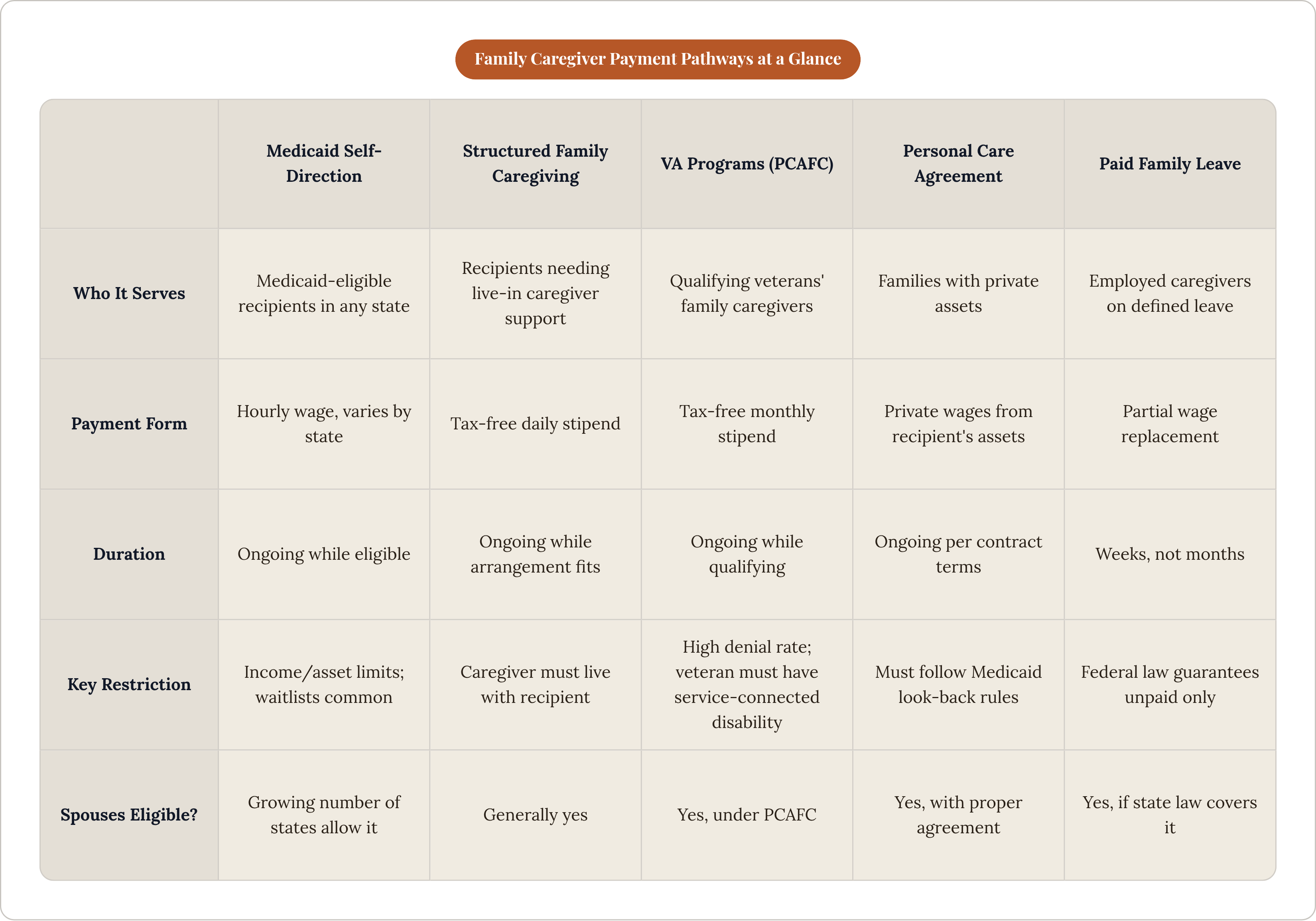
No single program works for every family, and pretending otherwise does caregivers a disservice. The right pathway depends on the care recipient's age, disability type, income, assets, and veteran status; on the state they live in; on the caregiver's own employment situation and relationship to the person they're caring for.
Medicaid self-direction is the broadest option by a wide margin: available in every state, ongoing rather than time-limited, scalable to whatever level of care is needed. Whether it opens up at all, though, depends on the care recipient clearing income and asset thresholds that shift program to program.
VA programs offer some of the most generous compensation on this entire list, but they're closed to anyone outside a veteran's household, and the high denial rate means application support isn't a luxury. Support is often the deciding factor in whether the application survives review at all.
Personal care agreements serve families with private resources who don't qualify for public benefits, and they protect those resources, and future Medicaid eligibility, only if the agreement gets structured correctly from day one. Get the paperwork wrong, and a family trying to do this the right way ends up facing the exact penalty period they were trying to dodge.
Taken together, these six pathways describe a system that's real but scattered across a dozen agencies and a hundred different application forms. The compensation exists, and the eligibility rules are exact, if not always intuitive. Finding the right door usually takes more digging than it should, and that's the quiet tragedy sitting underneath all of this: the money is there, and somebody in the family still has to be the one who goes and finds it.