Caregiver Contracts and Personal Care Agreements
How a written agreement protects caregivers and Medicaid eligibility.
There are roughly 59 million Americans providing unpaid care to an aging or disabled family member, logging an estimated 49.5 billion hours annually. AARP's "Valuing the Invaluable 2026" report puts a dollar figure on that contribution: $1.01 trillion. The typical caregiver is a 49-year-old woman holding down a full-time job while providing an average of 24 hours of care per week on top of it. According to the National Health and Aging Trends Study, care hours provided by family members grew 50% between 2011 and 2022. That trajectory is accelerating, not plateauing.
The financial consequences are not abstract. Nearly 80% of family caregivers absorb out-of-pocket costs averaging $7,200 per year. Those who leave the workforce entirely to provide care risk losing roughly $300,000 in lifetime wages and benefits. The gap between what caregivers give and what they receive isn't an oversight; it reflects a system with no default mechanism for compensating family members. A personal care agreement is designed to address exactly that gap, but only if it is constructed correctly. I've watched well-intentioned families execute these agreements in ways that rendered them legally meaningless or Medicaid-disqualifying. What follows is an attempt to map the terrain carefully, including the places where it gets complicated.
What a Personal Care Agreement Actually Is
A personal care agreement, variously called a caregiver contract, elder care contract, or personal services contract, is a written agreement between a care recipient and a caregiver formalizing what services are provided, at what frequency, in what location, and at what rate of compensation. The parties don't have to be related, though most are: typically an elderly parent and an adult child.
In plain terms, it converts an informal, invisible caregiving relationship into a documented, compensated one with legal standing. That conversion matters more than it initially appears. But what if the money changes hands without any agreement in place? An undocumented transfer of money from parent to child, even one that fairly reflects compensation for genuine care, looks identical to a gift from the outside. The agreement creates the evidentiary distinction.
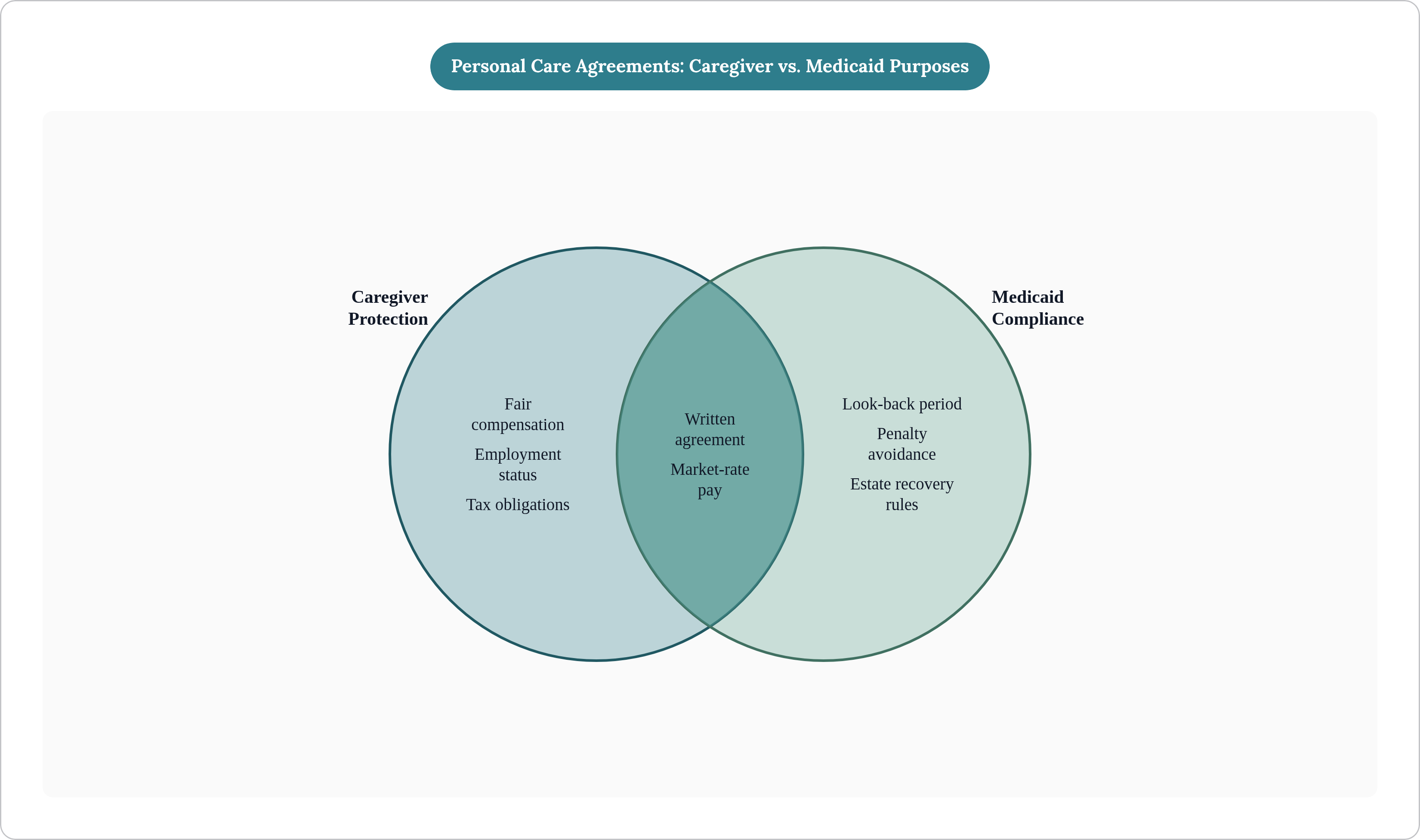
What a personal care agreement is not: it is not a power of attorney, a care plan, or a Medicaid application. It intersects with all three, but it is a private contract, and conflating it with those instruments is one of the more persistent sources of confusion I see among families navigating this for the first time. Its two purposes are separable in theory but inseparable in practice: it compensates the caregiver fairly, and it documents the financial transaction in a way Medicaid will recognize. Satisfying one purpose while neglecting the other is, practically speaking, a failure.
What a Valid Personal Care Agreement Must Contain
Eight core elements belong in every personal care agreement: a description of services, the frequency of those services, the location where care is provided, the pay rate, the payment schedule, start and end dates, a modification clause, a termination clause, and the signatures of both parties. This is the structural minimum.
The agreement must be written and dated before services begin. The prohibition on retroactive compensation is among the hardest rules in Medicaid compliance, and it is uniformly enforced. Families that begin informal care and later formalize it with a contract frequently discover — often at the worst possible moment — that payments made before the contract was executed are treated as gifts regardless of what the document says.
The pay rate requires independent verification. The national median for in-home care in 2026 is $34 per hour, which provides a reasonable reference point, but local market rates govern. An above-market rate invites scrutiny; below-market may undercompensate the caregiver in ways that create downstream tax and employment issues. The American Bar Association recommends reviewing and updating the contract at least annually and following any significant medical event, because care relationships rarely stay static.
Notarization requirements vary by state with no universal standard, which means state-specific research is necessary before the agreement is signed. Beyond notarization, caregivers should maintain a contemporaneous daily log of services rendered, hours worked, and payments received. The contract establishes the framework; the log is what Medicaid actually audits. Practical drafting provisions worth including are a termination clause allowing either party to exit with written notice and a backup-care provision addressing illness, vacation, or emergency.
How the Medicaid Look-Back Period Makes a Written Agreement Essential
When someone applies for long-term care Medicaid, the state examines every financial transaction from the preceding 60 months. This is the five-year look-back rule, and it exists specifically to prevent asset transfers designed to meet Medicaid's eligibility threshold, which in most states caps individual assets at $2,000.
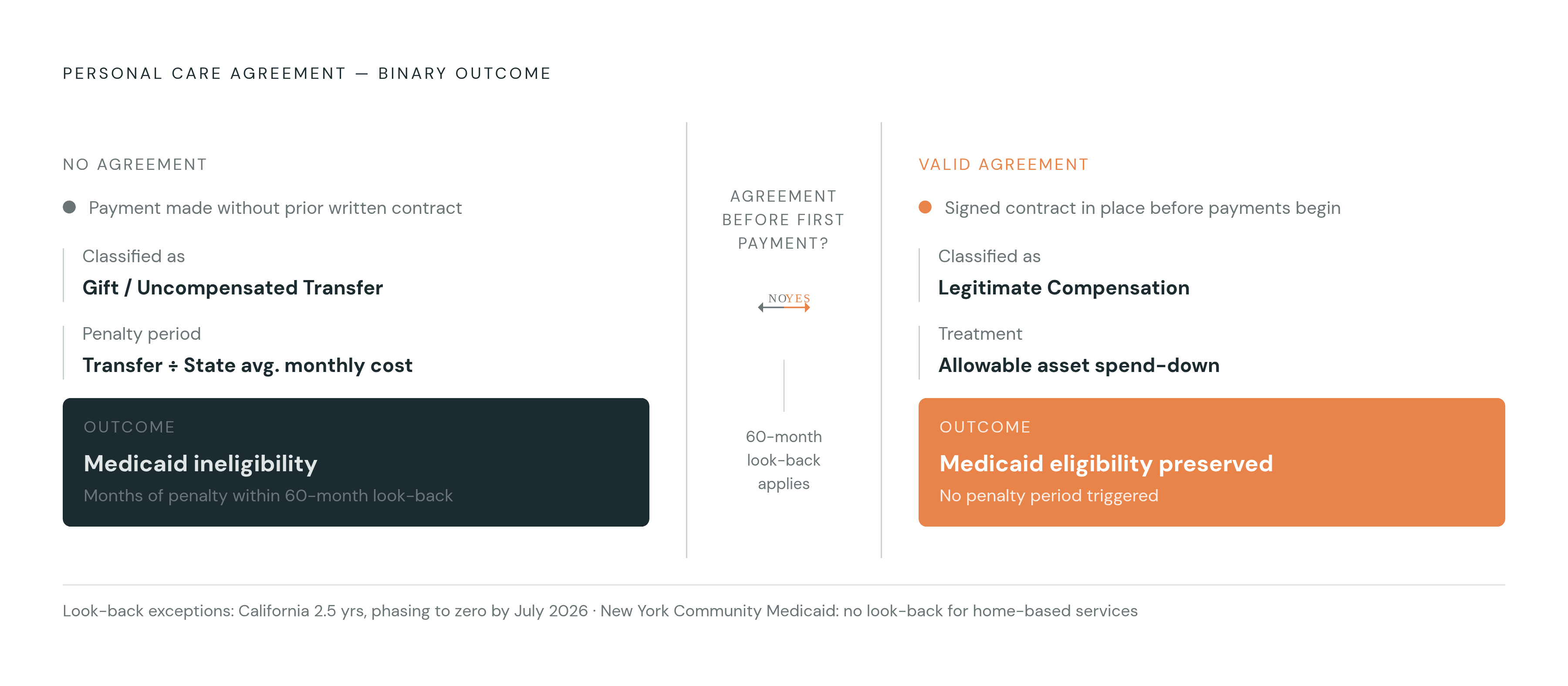
Without a personal care agreement, payments to a family caregiver are presumptively gifts. Gifts during the look-back period trigger a penalty period during which Medicaid will not cover nursing home or long-term care costs. The penalty is calculated by dividing the value of the improper transfer by the state's penalty divisor — typically the average monthly private-pay nursing home cost — to determine the months of ineligibility. Even a modest volume of undocumented payments can translate to months without coverage, arriving precisely when the family can least afford the gap.
With a valid agreement in place, those same payments are reclassified as legitimate compensation for services received. They become an allowable spend-down of assets rather than a disqualifying transfer. The legal and financial difference between those two classifications is substantial — and it hinges almost entirely on whether the agreement was in place before payments began.
State variation is worth flagging here. Forty-nine states use a five-year look-back for long-term care Medicaid. California's look-back has been phased down to 2.5 years and is being eliminated entirely by July 2026. New York's Community Medicaid currently has no look-back for home-based services, though a 30-month look-back has been pending since 2025. These distinctions are material: a planning strategy that is sound in one state may be unnecessary or differently structured in another.
How Periodic Payments and Lump-Sum Arrangements Work Differently Under Medicaid Rules
Two payment structures are available: periodic payments, typically weekly or monthly wages corresponding to services already rendered, and lump-sum prepayments for future care calculated using an actuarial life table and a market-rate hourly figure.
Periodic payments are easier to document and to audit. Each payment corresponds to a defined period of service, and the caregiver's log connects the payment to specific tasks completed on specific dates. This alignment with Medicaid's evidentiary requirements makes periodic structures more defensible for most families, particularly those without experienced legal counsel.
Lump-sum arrangements are legally permissible in some states, but they carry a specific and underappreciated risk: if the care recipient dies before the projected period of care is complete, the unearned portion reverts to the estate, where Medicaid's Estate Recovery Program can pursue it. That contingency requires careful actuarial and legal structuring that most families aren't positioned to execute without professional help.
It is also worth considering the operative principle underlying both structures: payment can only cover future services. The prohibition on retroactive compensation applies equally to lump-sum and periodic arrangements. This is not a technical nuance; it is the foundational constraint around which both structures must be designed.
Capacity, Signing Authority, and When to Involve an Attorney
The agreement should be created while the care recipient still has full cognitive capacity. A personal care agreement signed after capacity is lost is unlikely to be accepted by Medicaid, and the conditions under which it was executed may invite a challenge to its validity entirely.
If a durable power of attorney was established while the senior was mentally competent, the POA holder can sign the agreement on the senior's behalf. This is a workable arrangement, but it contains a conflict of interest that demands scrutiny: when the adult child is both providing care and signing as the parent's legal representative, attorney involvement is not optional. That conflict creates real legal exposure that good faith cannot eliminate. A guardian or conservator can also execute the agreement on behalf of a person who lacks capacity, though subject to court oversight requirements that vary considerably by state.
Elder law attorney involvement is broadly advisable across all of these scenarios, not just the complicated ones. State-specific Medicaid rules, notarization requirements, capacity questions, and the agreement's intersection with existing estate documents all make the cost of DIY errors disproportionate to the cost of professional guidance.
Tax Obligations That Come with Compensating a Family Caregiver
The IRS generally classifies paid in-home caregivers as household employees, not independent contractors. That classification makes the care recipient, or their estate, the employer. For 2025, once a caregiver earns $2,800 or more during the year, the employer must withhold and remit Medicare and Social Security taxes, which total 15.3% of wages; that threshold increases to $3,000 for tax year 2026.
Family exemptions exist but are narrow. Wages paid to a spouse, a parent providing care for a child under 18, or a child under 21 working for a parent are generally exempt from FICA. Misclassification, whether by treating a family member employee as an independent contractor or by incorrectly applying an exemption, creates tax liability that surfaces after the fact, often without notice until it compounds.
The tax structure decision is not separable from the contract design. Hourly rate, payment frequency, and worker classification should be determined together. Arriving at those decisions sequentially, with a tax professional after the contract is already drafted, routinely produces documents that require revision. Involving both an elder law attorney and a tax professional at the drafting stage is the more efficient path, even when it feels like a significant upfront investment.
Common Mistakes That Make Caregiver Contracts Unenforceable or Medicaid-Noncompliant
The most common error is paying before the contract is signed. Medicaid treats those payments as gifts without exception, regardless of the family's intent or the subsequent execution of a written agreement. I've seen this mistake made not out of negligence but out of urgency: the care need arises suddenly, compensation begins informally, and the contract is treated as something to formalize later. Later is too late.
Setting a pay rate without referencing local market comparables is the second most consequential error. The 2026 national median of $34 per hour provides a reference point, but Medicaid reviewers are attentive to rates that deviate significantly from what a professional agency would charge for comparable services in the same area. Overcompensation draws scrutiny; the agreement needs to be defensible on its face.
Skipping notarization in states that require it renders the contract potentially void regardless of its other contents. Failing to update the agreement as care needs evolve creates a different problem: an agreement written for light household assistance that still governs full personal care is likely inaccurate at the moment of a Medicaid application and may be challenged on those grounds. Maintaining no service log leaves the contract without corroboration; without contemporaneous records, Medicaid has no reliable way to verify that the exchange was real and ongoing.
Treating lump-sum and periodic payment structures as interchangeable is a subtler but serious error. The estate recovery exposure inherent in lump-sum arrangements is categorically different and requires specific legal structuring that periodic arrangements don't demand.
The pattern is consistent: families treat the personal care agreement as a formality executed once and set aside, rather than as a living document that must be accurate and well-documented at the moment a Medicaid application is filed — which may come years later. But how does this affect our original promise — that a properly constructed agreement protects the caregiver and the family? It only holds if the agreement remains accurate and the records behind it remain current. That discipline, sustained over what may be a long caregiving arc, is where most families underinvest, and where most of the preventable losses occur.