IHSS Electronic Timesheet System for Family Caregivers
California's digital system speeds up caregiver payments and ensures federal compliance.
Paper timesheets were a reasonable starting point for a program that predated viable digital infrastructure. Reasonable starting points, though, accumulate costs, and in IHSS those costs compounded quietly for decades.
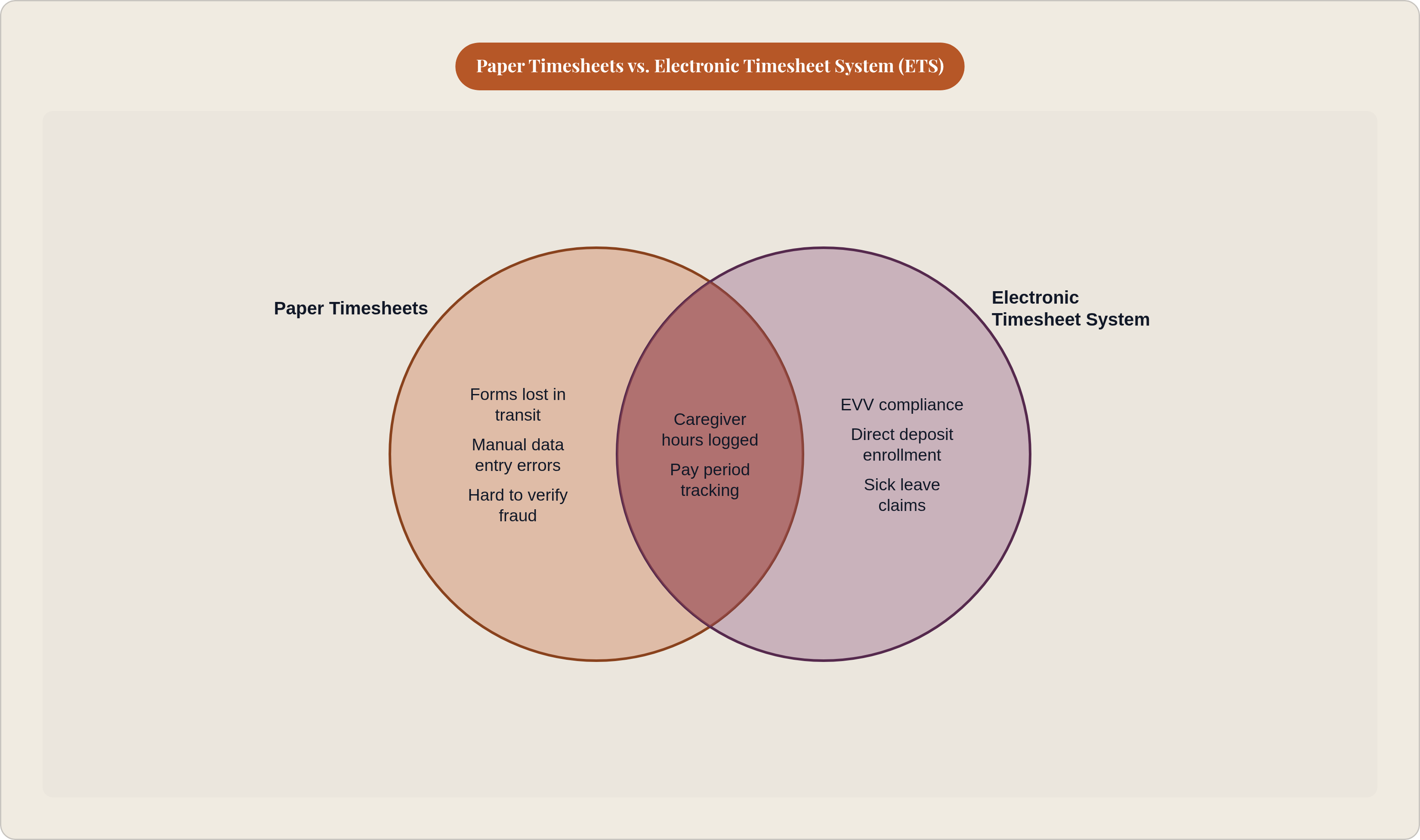
The failure modes were structural, not incidental. Forms vanished in transit. Manual data entry by county staff introduced errors that took weeks to unwind. Fraud verification was nearly impossible; paper offered no reliable method for confirming that hours were worked on the dates indicated. And while caregiver turnover has multiple causes, delayed or incorrect payment appears consistently in accounts from providers and advocates who have spent real time with this population. When a paycheck is someone's entire household income, a two-week correction cycle is not a bureaucratic inconvenience. It is a decision between rent and groceries.
Federal pressure eventually formalized what program administrators already knew. The 21st Century Cures Act of 2016 required all states to implement Electronic Visit Verification for Medicaid-funded personal care services, capturing six defined data elements: service type, recipient identity, date, location, provider identity, and start and end times. California implemented EVV for personal care services on January 1, 2022, extending it to home health care services on January 1, 2023, per the California Department of Health Care Services. The Electronic Timesheet System became one of California's approved mechanisms for meeting that federal mandate, making the shift simultaneously an operational improvement and a legal obligation.
California rolled out ETS gradually, beginning with pilot counties including Riverside, Yolo, and Sacramento before expanding statewide. That sequencing was deliberate: pushing a new system to a program serving hundreds of thousands of recipients simultaneously would have been operationally reckless. Paper timesheets remain technically available, but the practical incentives, speed, accuracy, EVV compliance, reduced administrative friction, pull decisively toward ETS for anyone who has experienced both systems firsthand.
What the Electronic Timesheet System Actually Is and What It Can Do
The Electronic Timesheet System operates through California's IHSS Electronic Services Portal at www.etimesheets.ihss.ca.gov, administered by the California Department of Social Services, and available at no cost to both providers and recipients under IHSS and Waiver Personal Care Services.
The portal runs on any modern browser across computers, tablets, and smartphones, available at all hours. Language access includes English, Spanish, Chinese, and Armenian, reflecting the demographic reality of a program operating across California's linguistically varied counties.
Most caregivers I have seen come into the system treat the portal as a timesheet submission tool and nothing more. That reading costs them. The feature set for providers is substantially broader:
- Enter and submit electronic timesheets
- View timesheet and payment status and history
- Enroll in or update direct deposit
- Opt into paperless paystubs
- Submit sick leave claims
- Update contact information, including address and phone number
Recipients use the same portal to approve or reject submitted timesheets, replacing the paper signature requirement entirely.
For providers without reliable internet access or with visual impairments, California maintains a Telephonic Timesheet System as an alternative. Providers call 1-866-376-7066, option 3, and navigate a phone-based process capturing the same EVV data elements. Enrolling in either ETS or TTS means discontinuing paper timesheets for subsequent pay periods; the two digital systems are not interchangeable on a period-by-period basis, and the system will not accommodate switching mid-cycle.
How to Register for ETS as a Provider or Recipient
The detail that trips up more families than any other: both the provider and the recipient must register separately. A provider who completes enrollment without a recipient on the other end can view payment history, but cannot submit timesheets for approval. A submitted timesheet sitting in a recipient's unmonitored queue sits idle, and the payment clock does not start until approval is complete. That sequencing matters more than it appears at first.
Before starting, both parties should gather the same documents: their Provider or Recipient number from IHSS paperwork, their Social Security number, and a valid email address. For TTS enrollment, a Registration Code mailed separately by the county is also required.
Provider registration through the ESP:
- Navigate to www.etimesheets.ihss.ca.gov
- Click "Register" and select the provider role
- Enter your Provider number, Social Security number, and email address
- Create a username and password
- Verify your email to activate the account
TTS registration by phone:
Call 1-833-342-5388 with your Registration Code, Provider or Recipient number, and Social Security number ready.
Recipients follow the same online process, selecting the recipient role during registration. Active IHSS recipient status, basic device and internet access, and a valid email are the technical prerequisites.
The ETS Help Desk at 1-866-376-7066, option 4, fields questions about registration and account issues from both providers and recipients.
How to Enter, Submit, and Get Approval for a Timesheet Each Pay Period
IHSS operates on semi-monthly pay periods. Providers can submit timesheets as soon as hours are completed; there is no requirement to wait until the period closes. For households budgeting week-to-week, that window matters.
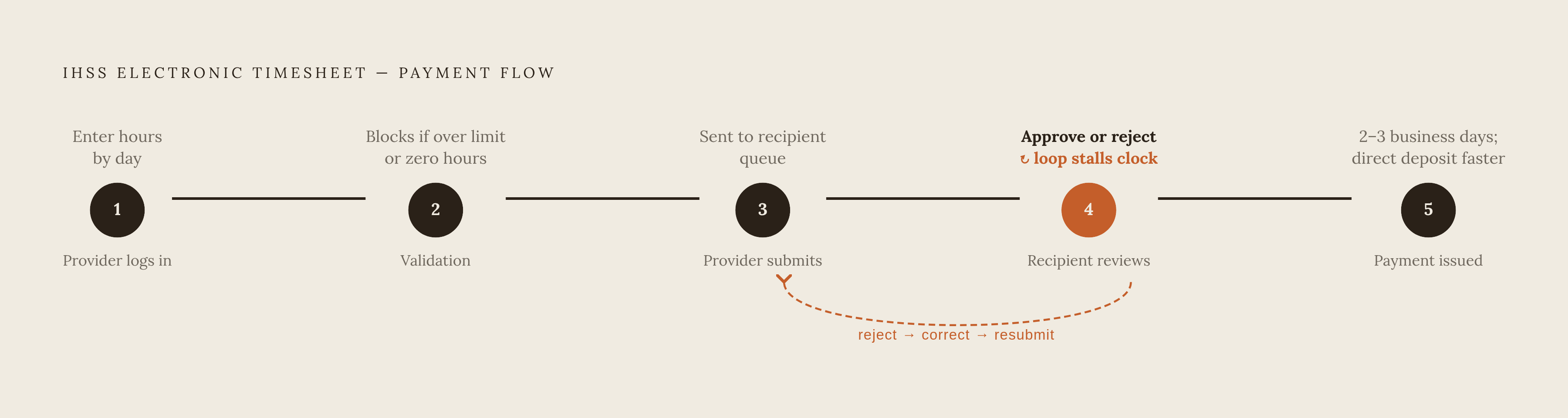
Entering hours: Log into the ESP, select the correct recipient, select the applicable pay period, and enter hours by day. Before submission, the system runs an automated validation check. Timesheets that would exceed the recipient's remaining authorized monthly hours, exceed the provider's assigned hours, exceed the weekly maximum, or reflect zero remaining authorized hours are blocked. These are not errors to work around; they are protections against overpayment clawbacks that would land on the provider later.
Submitting to the recipient: Once the timesheet clears automated validation, the provider submits it and it moves to the recipient's queue.
Recipient approval: The recipient logs in, reviews the hours, and approves or rejects. A rejection requires the provider to correct and resubmit; recipients are expected to provide a reason, which gives the provider something concrete to address rather than guessing.
Once approved, payment is typically issued within two to three business days, according to IHSS county guidance, a genuine improvement over paper processing timelines. Providers enrolled in direct deposit receive funds without waiting on postal delivery. Both parties can monitor status through the ESP dashboard at any point.
Common Mistakes and Error Messages That Delay Payment, and How to Fix Them
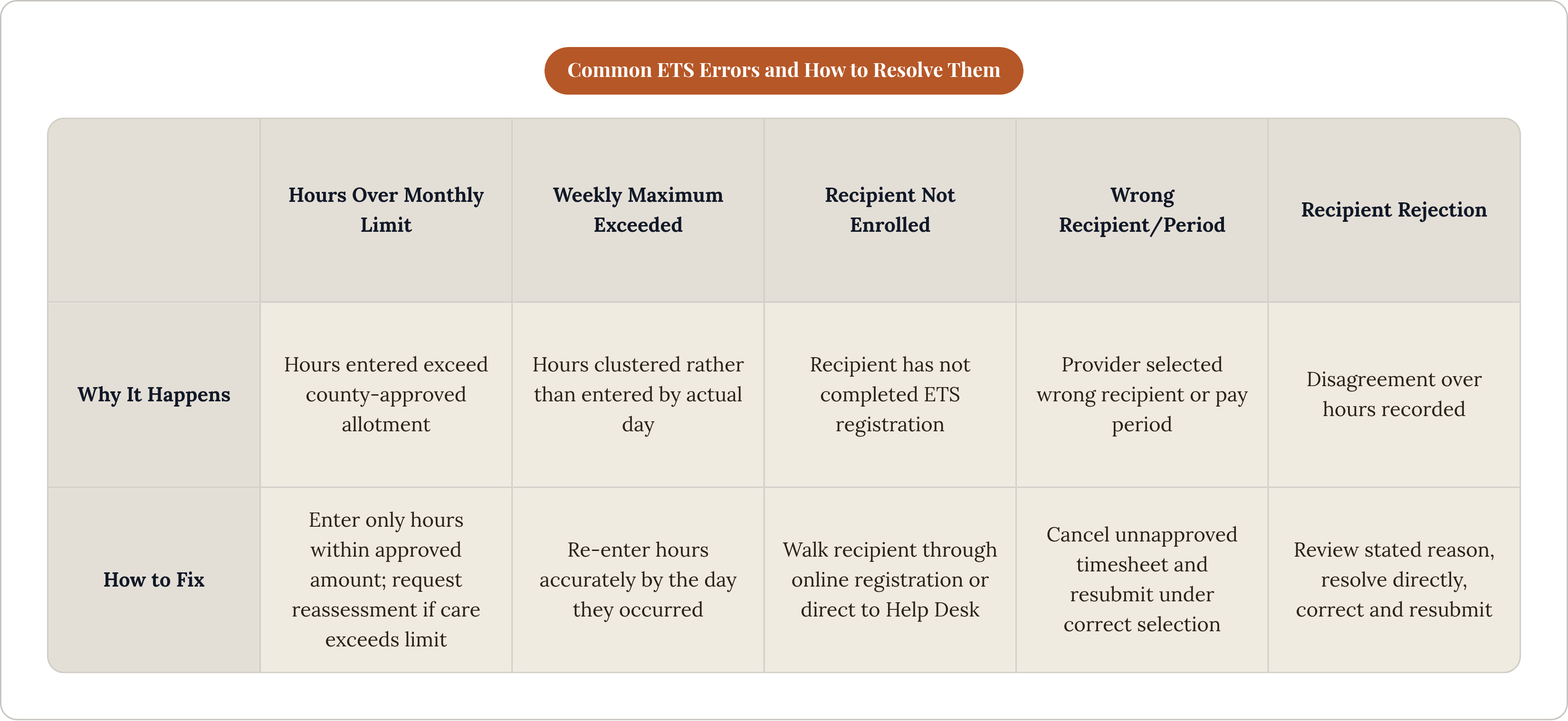
An unresolved error does not slow a timesheet. It stops it entirely. The payment clock does not start until both submission and approval are complete, and knowing why errors occur is faster than calling the county and waiting on hold.
Hours over the authorized monthly limit. Each recipient has a county-approved monthly allotment. Entering hours beyond that amount blocks submission. Review the authorized hours notice and enter only what falls within the approved amount for that period. If care genuinely exceeds the authorized limit on a sustained basis, the correct path is a formal reassessment request to the county.
Weekly maximum exceeded. IHSS caps weekly hours independently of the monthly balance. Clustering hours into fewer days than actually worked triggers this error. Enter hours accurately by the day they occurred.
Recipient has not enrolled in ETS. The most common structural barrier for new provider-recipient pairs. The provider account functions, but timesheet submission requires a registered recipient. Walking the recipient through online registration, or directing them to the Help Desk, is the only resolution.
Wrong recipient or pay period selected. Providers managing care for more than one recipient must confirm the selection before entering hours. If a timesheet has been submitted to the wrong recipient or period and has not yet been approved, cancel and resubmit correctly.
Recipient rejection. Start with the stated reason. Communicate directly to resolve any disagreement about hours recorded, then correct and resubmit. Extended back-and-forth delays payment for both parties.
Login and system issues. Forgotten credentials are handled through the portal's account recovery tools. Persistent technical errors should be escalated to the ETS Help Desk at 1-866-376-7066, option 4.
Two to three business days is the standard processing window after correct submission and approval, not a guarantee. Bank processing timelines, public holidays, and intermittent system issues can extend it. Checking payment status through the ESP dashboard before calling the county saves time on both ends.
How ETS Connects to Direct Deposit, Sick Leave, and Other Payroll Features Family Caregivers Overlook
Caregivers who use the ESP only for timesheet submission leave real money and real protections unclaimed, often for years, sometimes without ever realizing what they missed.
Direct deposit can be established entirely within the portal, with no separate form or county office visit required. Banking information can be updated at any time through the same interface. Wages arrive faster and do not depend on postal reliability.
Paperless paystubs become available once a provider is enrolled in direct deposit. Opting in creates a digital record that proves useful at tax time and for income verification in housing or credit applications. Caregivers who are unaware of this option often reconstruct income documentation from scratch when they need it, which is an entirely avoidable problem.
Sick leave is a benefit IHSS providers accrue, and claims are filed directly through the ESP. Many family caregivers have never filed one, not because they were ineligible, but because no one mentioned it existed and no one mentioned it lived inside the same portal they use to submit timesheets. The information is there; it does not surface unless you know where to look.
Contact information updates, including address and phone number, can be made through the portal. Payment notices and county correspondence route to whatever information is on file, and outdated records create delays that are entirely avoidable.
Provider hiring for recipients is also initiated through the portal, relevant for families coordinating care across more than one person.
The ESP functions as a single point of access for a family caregiver's entire IHSS financial relationship. Using it as a timesheet-only tool means leaving capacity unused, month after month, with no one flagging what you are not claiming.
What Family Caregivers Miss Beyond IHSS Timesheets, and How to Find Those Benefits
IHSS wages are one income stream, not the complete picture. California's IHSS program totals $28.5 billion in fiscal year 2025-26, according to the California Legislative Analyst's Office, and it reaches most eligible families. But many caregivers in the same household qualify for additional state and federal support they have never applied for, not because they looked and found themselves ineligible, but because no one told them to look.
The commonly missed benefits include caregiver compensation programs at the county and state level outside IHSS proper, Medi-Cal coverage for the caregiver rather than just the recipient, supplemental nutrition and housing assistance tied to caregiver household income, and tax credits available to paid family caregivers. These are not edge-case programs designed for unusual circumstances; they are funded programs with real eligibility populations that go substantially unclaimed.
The benefits landscape across Medicare, Medicaid, and California-specific programs is genuinely fragmented. Eligibility rules differ by county, immigration status, age, and disability category. No single government source maps all available programs to a household's specific situation, which means the burden of discovery falls entirely on caregivers who are already stretched thin.
AB 1287, which took effect July 1, 2024, illustrates how quickly eligibility can shift without the change reaching the people it affects. Parents of severely impaired minor IHSS recipients, previously ineligible to serve as paid providers, became eligible on that date on the same basis as any other provider. Many affected families still do not know.
Getting ETS right ensures the wages a family caregiver earns through IHSS are paid accurately and on time. But ETS addresses one income stream in a benefits landscape that frequently holds more, and the complete picture of what a household is owed often requires looking past the timesheet portal entirely.