In-Home Supportive Services California Application Process
Find out what to expect at each step, from eligibility checks to getting your provider paid.
IHSS pays for the daily care that keeps seniors, disabled adults, and disabled children out of facilities and in their own homes. After walking enough families through the paperwork, I've come to a conclusion that surprises people: the forms themselves rarely trip anyone up. What gets families is not knowing what happens next, or when, and this piece lays out the actual order of operations, from checking eligibility to getting a provider enrolled and paid.
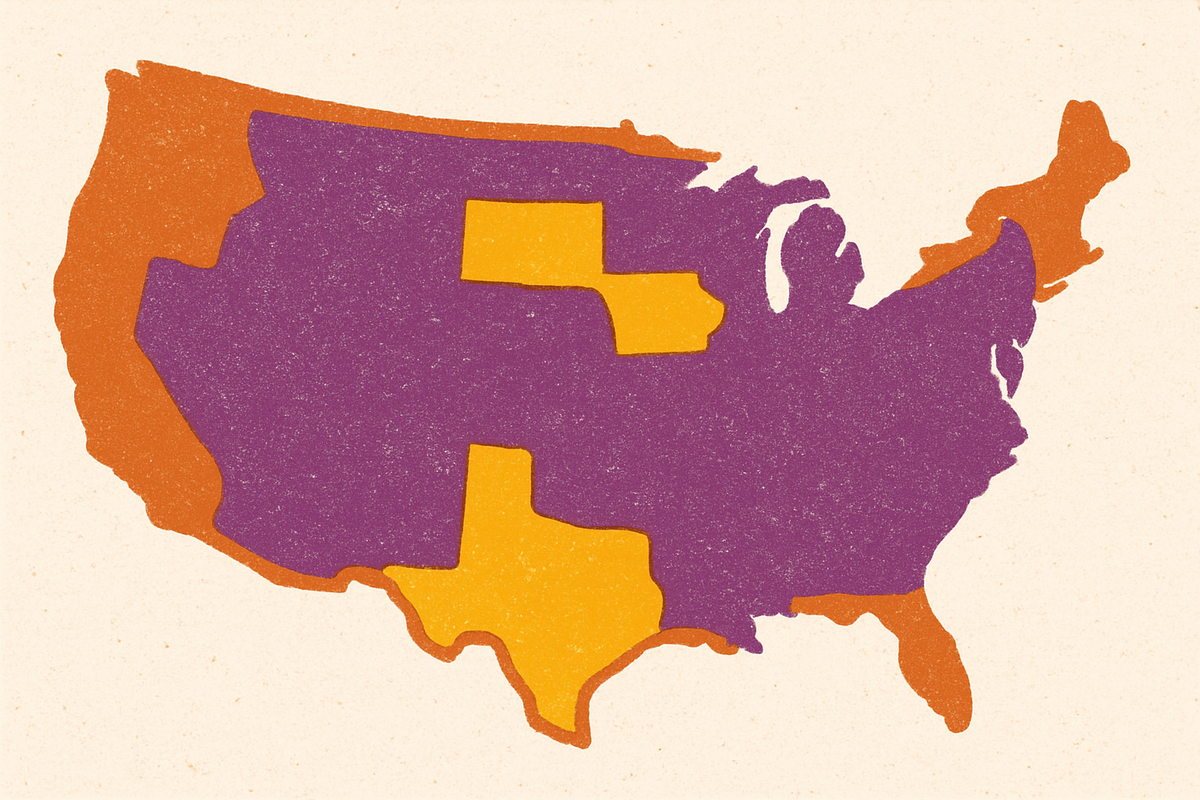
IHSS is funded through a mix of state, federal, and county money, but each county runs its own show, and that detail matters more than it should. Call one county's office on a Tuesday and you might get a different answer than the same call placed one county over on a Wednesday. The program itself covers three kinds of help: personal care (bathing, dressing, toileting, the physical tasks tied to the body), domestic services (meal prep, shopping, laundry, the stuff that keeps a home livable), and protective supervision. That third category is the one people forget exists, built for someone with dementia or a similar cognitive impairment who needs a person present to prevent harm, even when they don't need hands-on help every hour of the day.
The scale is hard to overstate. The California Legislative Analyst's Office projects roughly 771,650 recipients for the 2025-26 cycle, with total funding near $29.9 billion. Between 2015 and 2024, the state's 65-and-over population grew 29 percent while California's overall population grew just over 2 percent, per LAO figures; over that same window, the number of Californians with a disability rose 14 percent. The funding keeps climbing because the need does too.
One more number worth knowing going in: 283 hours a month, the hourly cap IHSS can authorize for a single recipient. That's close to full-time coverage, and it tells you the program was built to genuinely offset the cost of home care, not just take the edge off it.
Who qualifies — the eligibility criteria applicants must meet before applying
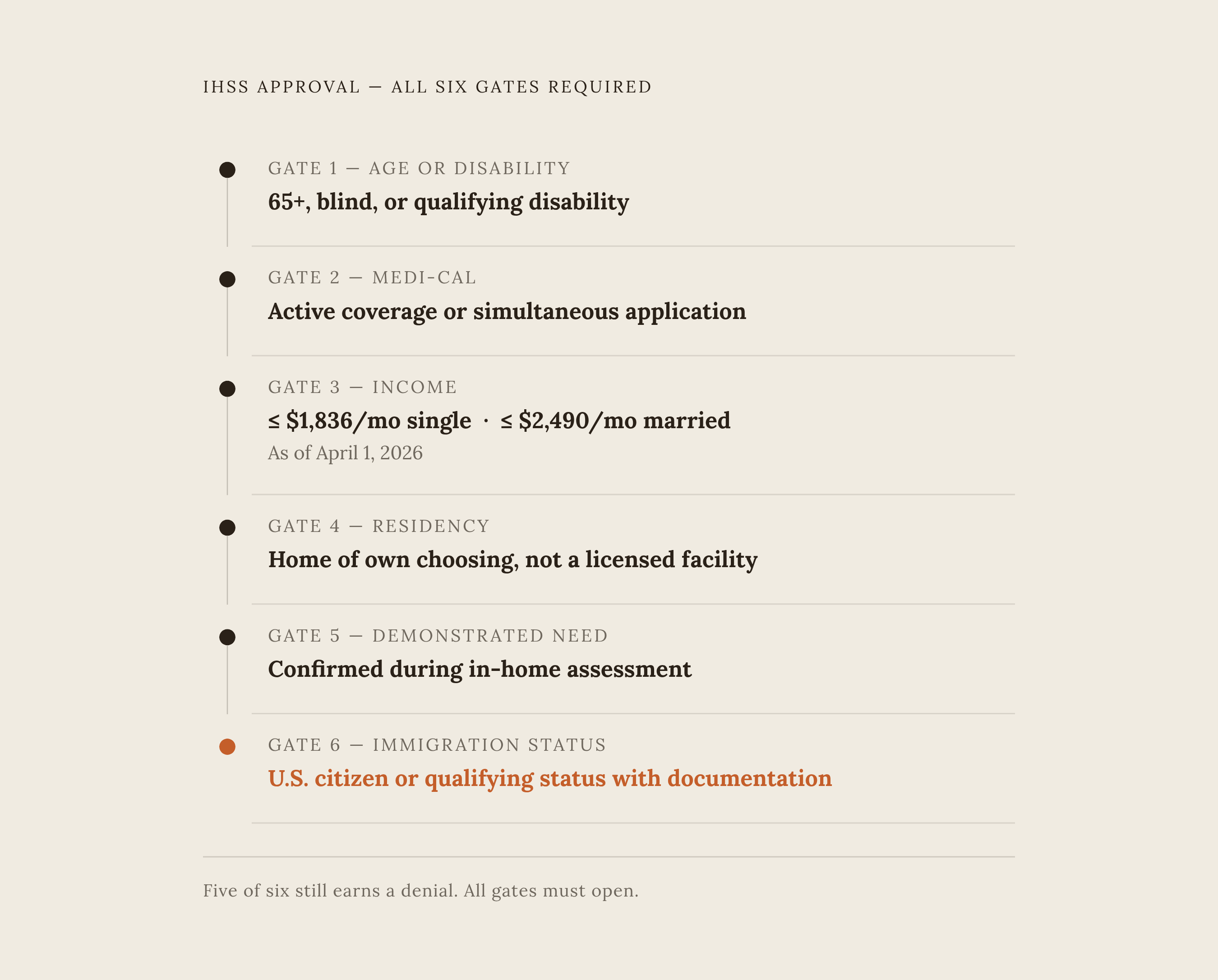
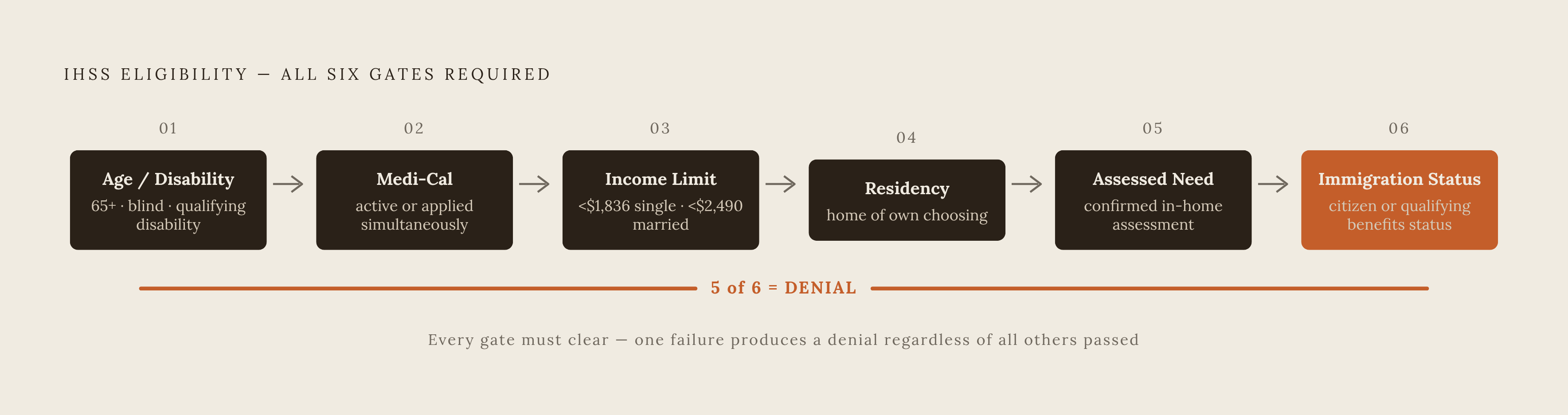
Eligibility isn't one gate, it's six of them stacked in a row, and clearing five out of six still gets you a denial letter.
Age or disability status comes first. An applicant has to be 65 or older, blind, or living with a qualifying disability. Children qualify too, but only when their care needs exceed what's typical for their age; a five-year-old needing help getting dressed is unremarkable, a twelve-year-old needing the same help usually isn't, and that gap is where eligibility actually lives.
Medi-Cal comes next. Applicants need active coverage, or need to be applying for it at the same time as IHSS. Families connected to a Regional Center have a secondary path, an institutional deeming waiver, that sidesteps some of the usual income counting. If Medi-Cal status is murky or still pending, don't sit on the IHSS application because of it; filing both at once is common, and it works fine.
Income is its own hurdle. As of April 1, 2026, a single applicant can earn up to $1,836 a month and still qualify; a married couple's limit sits at $2,490. Both figures land around 138 percent of the Federal Poverty Level, the benchmark California uses here.
Residency matters, though the specifics are narrower than people assume. The applicant has to live in a home of their own choosing: a house, apartment, mobile home, dorm room, or room with board. Living in a hospital or a licensed care facility disqualifies someone, since the entire point of IHSS is supporting independent living, not supplementing institutional care.
Then there's demonstrated need, the one that doesn't get settled on paper. The applicant has to actually require hands-on help with daily living tasks to stay home safely, and that gets confirmed during the in-home assessment, covered in the next section.
Last is immigration status. Applicants need to be U.S. citizens or hold a status that qualifies for public benefits, with documentation to back it up.
None of these six is exotic on its own. Together, though, they explain why an application that looks obviously deserving on the surface still gets denied over a technicality, usually income or paperwork, rather than over the actual care need.
How to submit the initial application — SOC 295
One form starts everything: SOC 295, Application for In-Home Supportive Services. There's no fee and no referral, and no gatekeeper has to sign off first, so anyone who thinks they qualify can just start.
Counties have to accept three submission paths. Mail always works: fill out the paper form, send it to the county IHSS office. Some counties run an online portal, though not all of them do, which loops back to the county-by-county variation mentioned earlier. There's also the phone route, either calling the local office directly or dialing the statewide IHSS line at 1-877-800-4544, which can point an applicant toward the right office when the county number isn't obvious.
Confirm which method a given county actually prefers before submitting; it saves real time. So does having a few things ready before that call or that form: full contact information and date of birth, Social Security number, a Medi-Cal number if one already exists, and contact info for a spouse, guardian, or emergency contact where applicable.
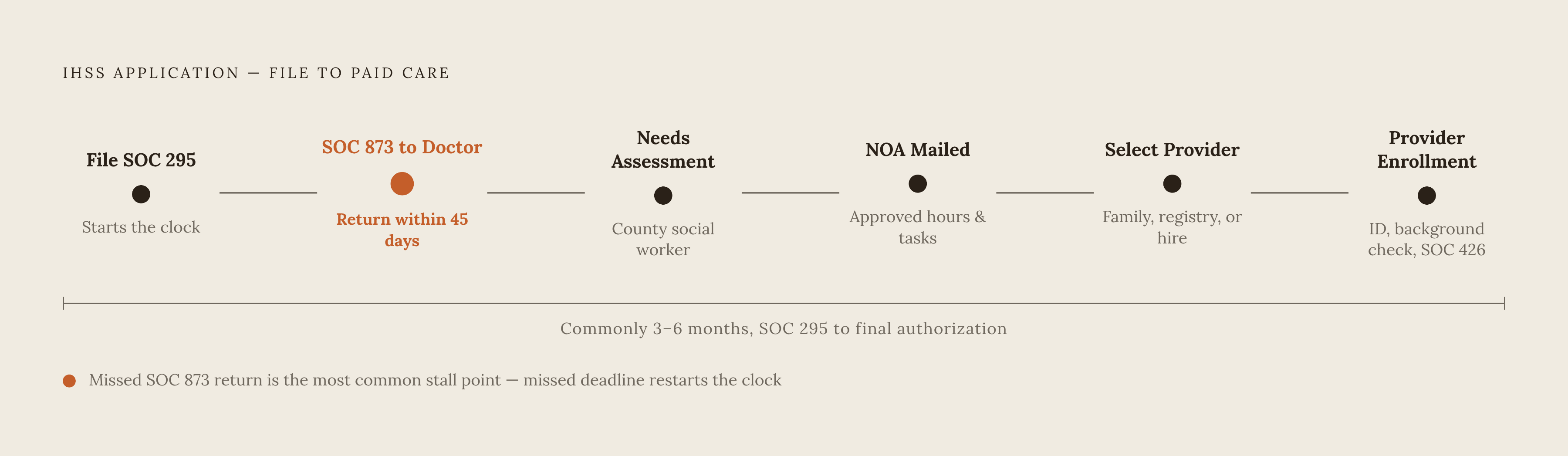
Submitting the SOC 295 starts the clock. The health certification, the in-home assessment, the eventual Notice of Action, all of it follows from this one form. Given how long the full process can run, filing early is about the only variable an applicant fully controls.
The Health Care Certification form — what it is and how to get it completed in time
Once the SOC 295 is in, the county mails a second form: SOC 873, the Health Care Certification. The applicant doesn't fill this one out themselves. It goes to a primary care physician or another licensed health professional, who documents the medical conditions and the specific need for in-home help, and this form becomes the clinical backbone for whatever the social worker later confirms in person.
Here's the number that actually matters: 45 calendar days. That's the window to get the completed SOC 873 back to the county, counted from the date the county mails it out. Missing that window can stall the application or invalidate it outright, meaning a clock that was already running has to start over from scratch.
Doctor's offices are not fast, as a rule, and some need two to three weeks just to process the paperwork request, before scheduling even enters the picture, before a physician who wants to see the patient in person signs off on anything. Call the doctor's office before the form even shows up, tell them it's coming, and ask directly how much lead time they typically need. Keep a copy of the completed form before mailing it back, too: if it gets lost in transit, a phone call and a fax beats restarting the whole certification from zero.
The in-home needs assessment — what the social worker evaluates and how to prepare
Once the application and the health certification are both on file, a county social worker calls to schedule an in-home visit. There's no phone assessment and no video call substitute; someone has to physically see the living situation and watch how the applicant functions in it, in real time.
What is that social worker actually looking for? Mental and physical ability first, and specifically where the limits sit: which tasks the applicant handles alone, which ones need help, how much help, in what form. The living arrangement gets evaluated too, along with whatever support already exists, a family member covering weekends, another service already in place.
All of it gets organized around Activities of Daily Living, ADLs, the standard framework for measuring functional independence. The social worker isn't only asking questions here; they're watching, and documenting what they see against that ADL framework. The authorized monthly hours that come out the other end trace directly back to what gets written down in this one visit, which is what makes preparation matter in a very literal, hours-and-dollars way.
So what does preparation actually look like? Document a typical day: which tasks need assistance, roughly how long each one takes, what happens on the days help isn't there. Honesty about the bad days matters more than people expect going in, since there's a real pull to describe the good day, the one where everything went fine, but assessors need to see the hardest days, because that's where the actual risk lives. Bring medical records, doctor's notes, a prescription list; it fills in details that otherwise get glossed over in conversation. Having a family member or advocate in the room isn't a bad call either, since applicants tend to minimize their own limitations, sometimes out of pride, sometimes just habit, and a second person catches what goes unsaid.
One case worth flagging: if the applicant currently lives in a care facility, IHSS can run a preliminary assessment there, with a follow-up once the person actually moves home. And the timeline deserves a dose of realism up front: approvals commonly take three to six months from the initial SOC 295 filing to final authorization. The in-home visit is one stage inside that longer stretch, not a moment where a decision gets made on the spot.
Reading and responding to the Notice of Action
After the assessment, the county mails a Notice of Action, the NOA, and whether it's approved or denied, this is the official word, in writing.
If approved, it lists the total authorized monthly hours and exactly which tasks those hours cover. If denied, it states why. Either way, this is a document to read closely, not skim once and file away in a drawer.
Approved hours aren't set in stone. They get reassessed over time and can move up or down as a recipient's condition changes. A denial, or an approval with fewer hours than expected, isn't the end of the road: the NOA includes a deadline and instructions for filing an appeal, and recipients have the right to a state fair hearing. Legal aid groups and disability rights advocates handle these appeals constantly, often free of charge, which matters, because managing an appeal on top of an already exhausting application is asking a lot of anyone.
One thing worth knowing: back in 2021, California's State Auditor recommended that counties be monitored to ensure applications get processed within 30 days, with a 45-day extension allowed for the medical certification piece. The California Department of Social Services declined to implement it. In practice, that means no enforceable timeline governs how fast a county has to act, and applicants who follow up on their own, rather than waiting on the mail, tend to fare better, mostly because nobody else is chasing that timeline on their behalf.
Choosing and hiring an IHSS provider
Approval opens the next stage: finding someone to actually do the work. IHSS doesn't assign a provider; the recipient chooses, and there are three real paths to that choice.
A family member or friend is the most common arrangement by a wide margin; the LAO notes that recipients are most often cared for by a relative rather than an outside hire. A recipient can also hire from the county's Public Authority Registry, a list of providers already vetted and available for placement. Or a recipient can find and hire someone entirely on their own, outside both channels.
Worth flagging directly: under AB 1287, effective July 1, 2024, a parent can now be a paid IHSS provider for their own minor child, as long as the child has a qualifying disability. A surprising number of families still don't know this exists, and it matters a great deal for parents who've provided unpaid care for years without ever realizing compensation was on the table.
Whoever gets chosen, the recipient is the employer of record. That means the recipient, or a representative, handles hiring, training, and dismissal if it comes to that. Timesheets get reviewed and approved twice a month, an administrative task that doesn't disappear once the provider is in place. Choosing someone already familiar with the recipient's routines, a family member or longtime friend, tends to smooth this considerably. But familiarity doesn't skip steps: every provider, related or not, still completes formal enrollment before a single hour gets paid.
What providers must do to enroll and get paid
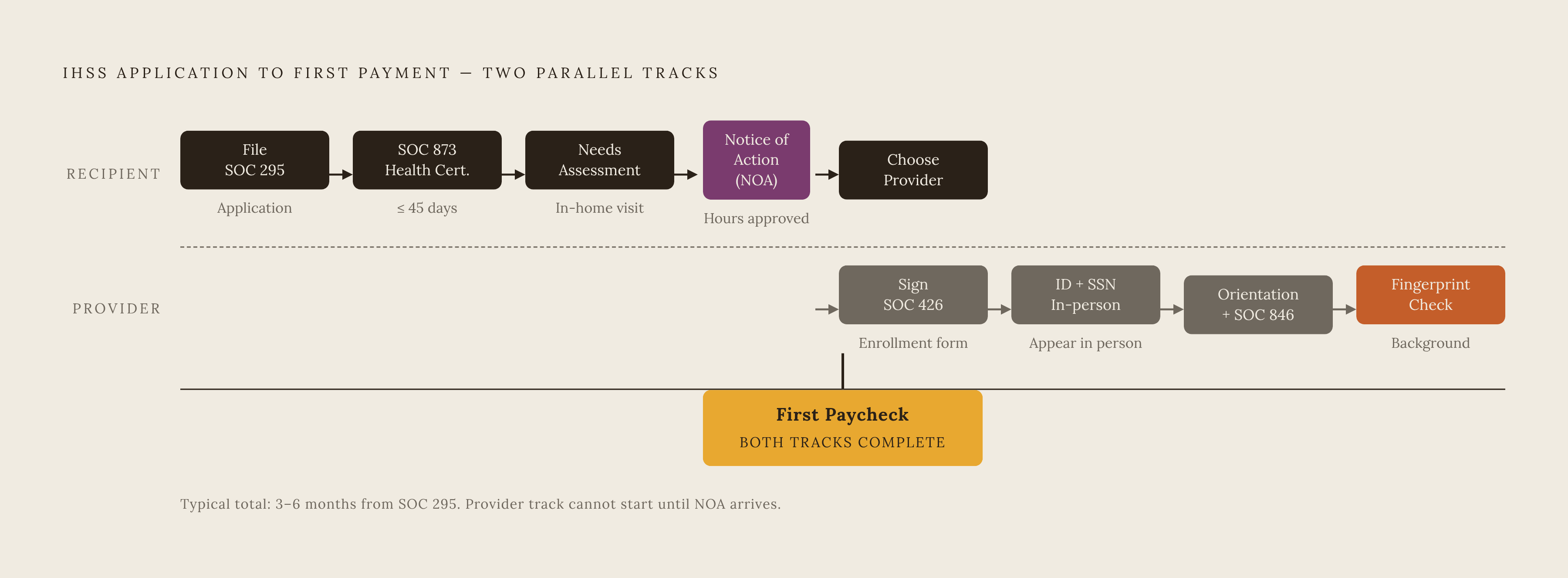
Provider enrollment runs on its own separate track from the recipient's application, and it has to finish before any payment starts. This is where families often lose time they didn't see coming.
The order is fixed. First, the provider fills out and signs the IHSS Provider Enrollment Form, SOC 426. Next, an in-person appearance at the county IHSS office or the Public Authority, original government-issued photo ID and Social Security card in hand, plus photocopies of both. Then the provider works through state-mandated orientation materials and signs a Provider Enrollment Agreement, SOC 846, confirming they understand the program's rules. Last, fingerprints go in for a criminal background check.
That background check carries real weight. Certain criminal convictions can disqualify someone from enrolling, full stop, family relationship or not. Being a parent, a sibling, an adult child doesn't waive the fingerprinting, the ID check, or the signed agreement, and everyone goes through the same steps; no exceptions get carved out for blood relatives.
Since the in-person steps alone can take real time to schedule, especially in busier counties, start provider enrollment the moment the NOA shows up, not once care becomes urgent. That's the difference between a smooth first paycheck and a delay nobody needed.
Where to get help if the process stalls or feels unmanageable
None of this is simple. Income limits, a 45-day medical certification deadline, county-by-county variation in how things run, an assessment that rewards preparation, a separate 90-day provider enrollment track: it all stacks up, and each layer is a place where an eligible family can lose time, lose hours, or lose the application altogether.
So why do so many eligible families end up with fewer hours than they should get, or miss out on IHSS entirely? A few reasons keep surfacing: not knowing the program exists in the first place, underreporting functional limitations during the in-home visit because a good day happened to land on assessment day, missing the SOC 873 deadline while waiting on a slow doctor's office, or never realizing an appeal was even possible after a low-hours decision arrived in the mail.
Call these information failures, because that's what most of them are, and information failures have fixes. County IHSS offices are the first call for any procedural question, and the Public Authority in each county supports both recipients and providers through their respective enrollment steps. The statewide IHSS line, 1-877-800-4544, exists specifically for people unsure where to even start. Legal aid organizations and disability rights advocates handle appeals regularly, often at no cost. There are now tools built to screen families for Medi-Cal, IHSS, and other caregiver compensation programs at once, narrowing the gap between "I might qualify" and an actual completed application before anyone picks up the phone.
The sequence itself is fixed and knowable, once you've seen it laid out. Every stage has a form, a deadline, a visit, an enrollment step, nothing hidden behind the curtain. What trips families up is usually the order of operations, not the underlying eligibility, and getting the order right tends to make the rest follow.