Protecting a Spouse's Assets Under Medicaid
Medicaid has rules protecting the healthy spouse's assets when one spouse needs long-term care.

A single Medicaid applicant has one set of assets to count and one spend-down target to hit. A married applicant has a spouse still living at home, still paying the mortgage, still buying groceries, and Medicaid's rules do not treat that spouse's savings as separate from the applicant's. When one spouse applies for long-term care coverage, Medicaid treats all assets belonging to either spouse as jointly owned, and it doesn't matter whose name is on the account. If the at-home spouse opened a certificate of deposit decades before the marriage, it still counts. A brokerage account funded entirely by the at-home spouse's own salary still counts. Without a separate legal mechanism to interrupt this counting rule, a married couple would have to burn through nearly all of their combined savings before the institutionalized spouse qualifies for coverage, and the spouse remaining at home would be left with next to nothing to live on. This isn't a quirk limited to nursing home care either: the same joint-counting rule applies when the institutionalized spouse receives care through a home- and community-based services waiver rather than a nursing facility. Congress recognized the cruelty of this outcome in 1988, passing the Medicare Catastrophic Coverage Act and codifying a fix at 42 U.S.C. § 1396r-5, the spousal impoverishment statute that the rest of this piece is built around.
What the CSRA and MMMNA cover
Two distinct federal protections do the work of preventing that outcome, and they operate independently of each other. Before going further, the vocabulary needs to be fixed: the spouse who enters a nursing facility or qualifies for an HCBS waiver is the institutionalized spouse, and the spouse who remains at home is the community spouse. Every section that follows uses those two terms exactly this way.
The Community Spouse Resource Allowance, or CSRA, is the asset-side protection. It sets the dollar figure the community spouse can legally keep from the couple's combined countable assets, apart from what the institutionalized spouse has to spend down to qualify. The Minimum Monthly Maintenance Needs Allowance, or MMMNA, is the income-side protection, and it works on a different axis. Rather than fixing an asset total, it guarantees the community spouse a minimum amount of monthly income to live on. If that spouse's own income falls short of the floor, the MMMNA allows income to be diverted from the institutionalized spouse's income to make up the difference.
Before the institutionalized spouse can become eligible, neither protection makes the community spouse spend down personal resources or income first. The community spouse also keeps all of their own income first, in full, before any calculation about diverting the institutionalized spouse's income even begins. The MMMNA only enters the picture when the community spouse's own income comes in below the federal floor. For 2026, that floor is $2,705.00 per month, with a ceiling that rises above the floor to a higher capped amount, figures a federal health agency set out in an informational bulletin. Alaska and Hawaii carry slightly higher minimums than the rest of the country, reflecting the higher cost of living in those two states. CMS updates the MMMNA figures every July, and it updates the CSRA figures separately every January, so neither number stays static year over year.
How the CSRA is calculated
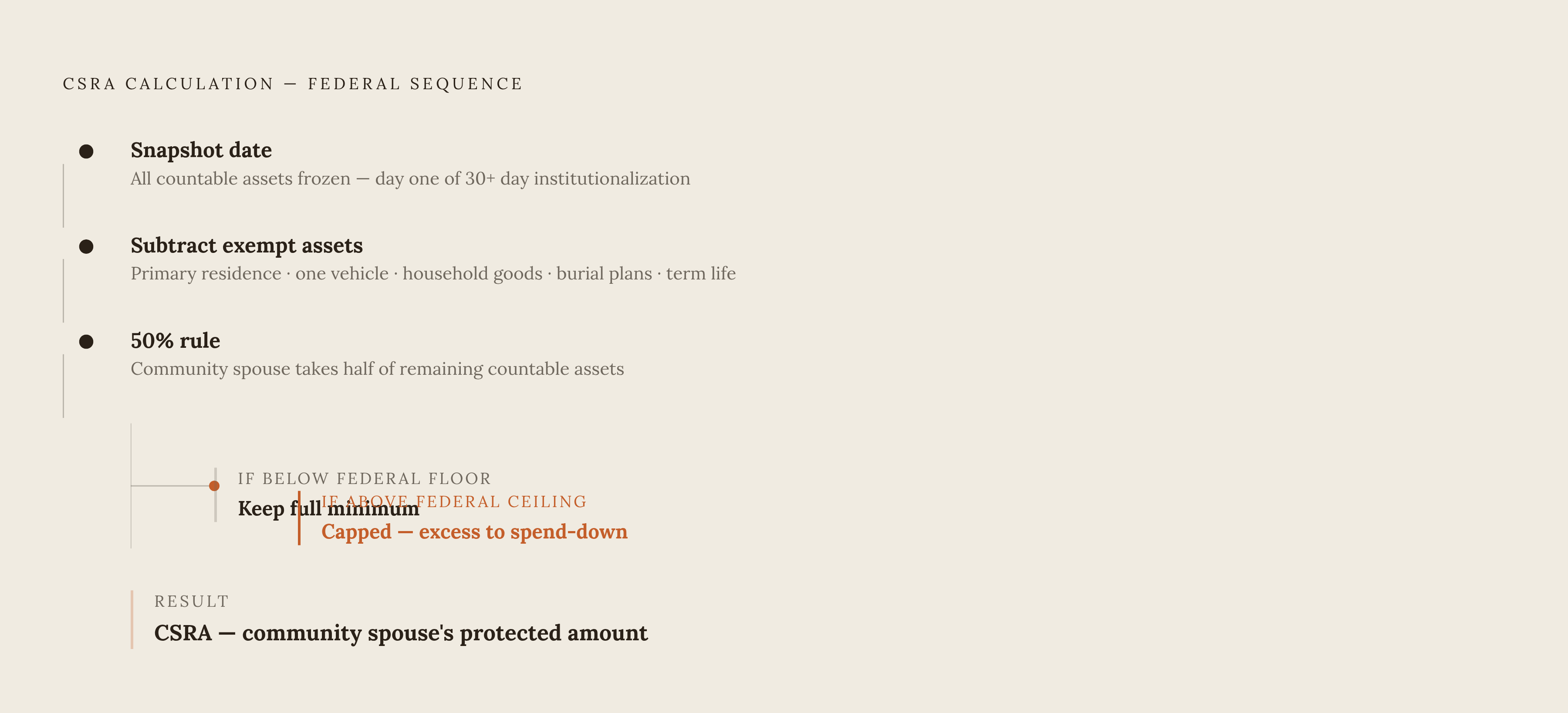
The CSRA is not an arbitrary number a caseworker assigns. It follows a fixed federal sequence, and understanding that sequence matters because the resulting figure is the legal ceiling on what the community spouse can shield from the spend-down requirement.
The sequence starts with a snapshot date. The first day of a continuous period of institutionalization, typically the date the institutionalized spouse enters a nursing facility or hospital for 30 or more consecutive days, freezes the couple's total countable asset picture at that moment. Everything that follows in the calculation uses that frozen figure as its starting point, regardless of what happens to the couple's assets afterward.
From that frozen total, exempt assets get subtracted. The primary residence, as long as the community spouse continues to live there, is excluded entirely from the countable total, regardless of how much equity is in the home. Federal law does cap home equity in some circumstances, but that cap only applies when neither spouse lives in the home, so a community spouse residing there is not subject to it. Beyond the home, one vehicle, household goods and personal property, irrevocable prepaid burial plans, and term life insurance without cash value are also excluded from the countable total.
What remains after those exclusions is the couple's total countable assets, and this is where the 50-percent rule applies. The community spouse keeps half of that countable total. If half of the countable assets comes in below the federal floor, the community spouse doesn't keep a diminished figure. The full federal minimum applies instead, lifting the community spouse up to that floor regardless of how low the couple's actual assets were. If half of the countable assets exceeds the federal maximum, the opposite adjustment applies: the community spouse keeps only up to that ceiling, and anything above it must go toward the institutionalized spouse's spend-down. The institutionalized spouse's own personal asset allowance after spend-down varies by state. Indiana sets that threshold lower, but Maryland sets it somewhat higher under its medically needy standard, effective February 1, 2026.
Two hypothetical illustrations show how this plays out in practice, and neither should be read as a prediction of what any particular reader's household will actually receive. Picture a couple in Maryland with a substantial pool of countable assets, enough that half of the total is between the federal floor and ceiling. The community spouse keeps that half outright, and the institutionalized spouse spends down the remainder to Maryland's asset limit before Medicaid coverage activates. Now picture a couple in Indiana with a far more modest pool of countable assets, small enough that half of the total falls below the federal floor. In that case, the community spouse doesn't keep half. The community spouse keeps the full federal minimum instead, which in this scenario works out to more than literal half of the couple's assets would have provided.
How states set their own CSRA within the federal range
The federal floor and ceiling set the outer boundaries, but states have latitude in how they apply the formula within those boundaries, and that latitude produces real differences in what a community spouse actually keeps. Broadly, states fall into two camps. Some apply the sliding half-of-assets formula described above, adjusted by the floor and ceiling as needed. Others elect a single fixed figure instead, either the federal maximum or a state-set amount, and apply that figure as a flat allowance regardless of how much or how little the couple actually has in countable assets.
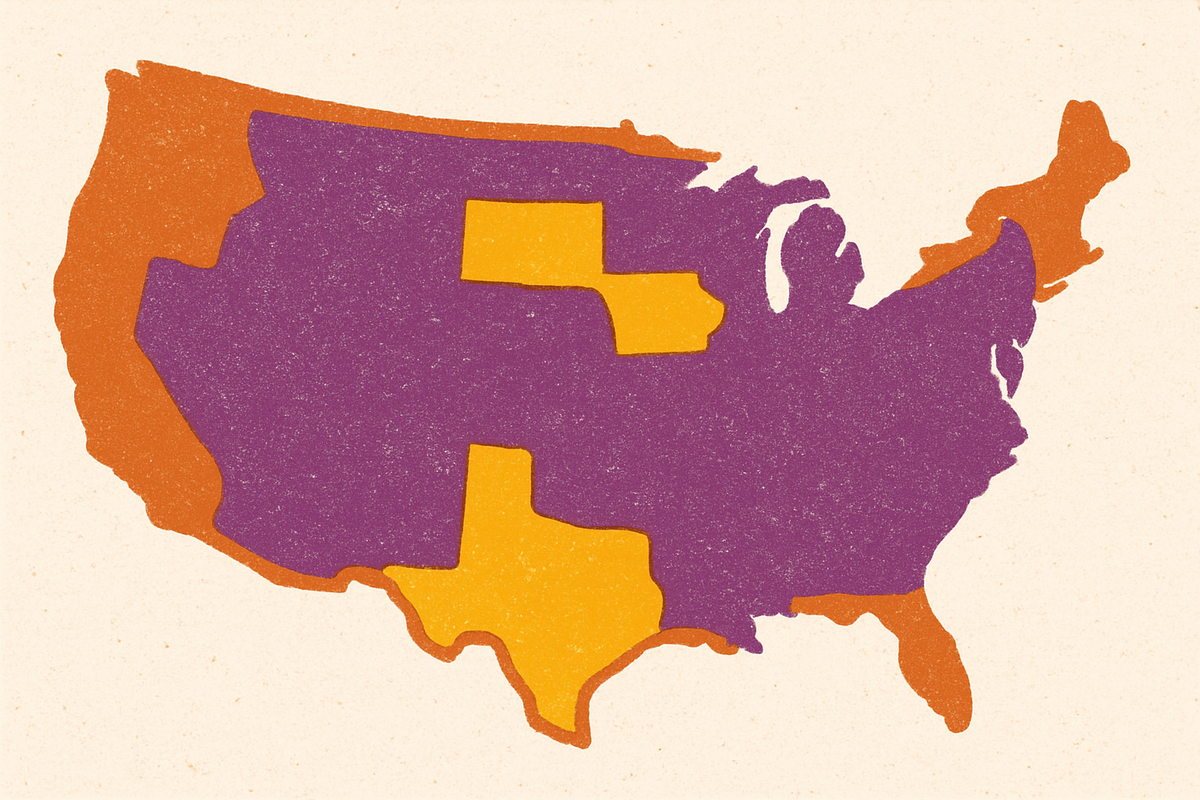
Texas shows why it matters whether a state uses a floor or a flat allowance. Texas does not elect the maximum as a flat CSRA. A community spouse there with modest assets gets brought up only to the federal minimum when half of the countable total falls short of it, not all the way to the ceiling. The maximum functions as a cap on what the formula can produce, and not every community spouse receives it as a guaranteed floor. Maryland takes a different approach: it applies both the federal minimum and maximum as bookends around the half-of-assets calculation, so the community spouse there gets half of countable assets, adjusted at either end.
The practical consequence is that a couple holding an identical total in assets can end up with meaningfully different CSRA figures depending purely on which state administers their Medicaid program, a gap between a flat statewide allowance and a formula that scales with the couple's actual holdings that makes the state of residence one of the first facts a family needs to establish. The same state-level variation occurs on the income side of the ledger. Oklahoma, for instance, does not adopt a minimum MMMNA that applies uniformly across all applicants, so a community spouse there cannot assume the federal floor of $2,705.00 per month applies automatically the way it would in a state that adopts the floor. A reader in that position has reason to ask a direct question before assuming anything: does the state administering this Medicaid case apply the federal minimum automatically, or does it require a separate showing to secure it?
Transferring the CSRA and risks the community spouse still faces
Medicaid approval is not the end of the story for the CSRA. A common and understandable assumption is that once eligibility is granted, the protected asset share simply belongs to the community spouse from that point forward, with no further action required. That assumption is wrong, and it is worth correcting before moving on to planning strategies, because the exposures that follow approval are procedural, not theoretical.
Specific steps are required to ensure the CSRA assets are legally held by and accessible to the community spouse after the eligibility determination is made. Skipping those steps leaves the couple's intentions unenforced, no matter what the caseworker's calculation said on paper.
Two risks in particular deserve attention. The first involves the order in which death arrives. If the community spouse predeceases the institutionalized spouse, the institutionalized spouse loses the benefit of the CSRA immediately. Assets that had been protected throughout the community spouse's lifetime may now count directly against the surviving institutionalized spouse's own eligibility, so the protection the family had relied on reverses. The second risk involves the community spouse's own health. If the community spouse later requires long-term care and applies for Medicaid personally, the couple is measured against a combined asset limit instead of the CSRA. Once both spouses are institutionalized, a combined asset limit far below the CSRA applies to the couple, so the spousal protection built around one spouse remaining at home simply stops once that spouse no longer qualifies as a community spouse under the statute.
States with a Medicaid income cap add a procedural layer on top of these risks. In those states, any of the institutionalized spouse's income above the cap has to be routed through a Miller Trust, sometimes called a qualified income trust, before it can be redirected anywhere else, including the portion the MMMNA allocates to the community spouse. Skipping the trust mechanism doesn't just complicate the paperwork. It can block the income transfer the MMMNA is supposed to guarantee. Waiver programs carry their own wrinkles as well. Indiana's PathWays for Aging HCBS waiver interacts with these spousal impoverishment rules differently than nursing facility care does, so if your institutionalized spouse gets care through the waiver rather than a facility, you have an additional layer of program-specific rules to track alongside the federal framework.
Legal options for protecting more than the standard CSRA and MMMNA
The standard CSRA and MMMNA are federal floors and ceilings, not guarantees that every couple's actual financial circumstances will fit neatly inside them. If a couple's assets or income exceed what those standard allowances protect, several legally recognized strategies can shield additional resources, but each comes with its own conditions and state-specific limits that decide whether it is actually available in a given case.
Instead of just watching countable assets get consumed by facility costs, you can spend down on permissible items. Paying off a mortgage, retiring a car loan, making necessary home improvements, or prepaying funeral arrangements all convert countable assets into exempt ones, or otherwise shrink the countable pool the Medicaid formula measures against. It means using exemptions the rules already recognize, on purpose rather than by accident.
A second option exists if a community spouse's calculated CSRA genuinely isn't enough to live on. Under 42 U.S.C. § 1396r-5(e)(2), the community spouse can request a fair hearing to demonstrate that the standard allowance fails to generate sufficient income for actual needs. Unlike the standard CSRA calculation, the fair hearing and court-order paths carry no dollar cap at all, so a community spouse who successfully makes that showing can retain more than the federal maximum would otherwise allow.
A third option involves converting excess countable assets into an income stream through a Medicaid-compliant annuity. By purchasing an annuity that is irrevocable, non-assignable, and immediate, the community spouse turns a lump sum that would otherwise count against the institutionalized spouse's eligibility into a stream of income that belongs entirely to the community spouse. The annuity has to meet a specific actuarial test: its payment term cannot exceed the life expectancy of the recipient, a requirement that keeps the instrument from functioning as a disguised asset transfer. If executed correctly, this structure lets the community spouse protect considerably more than the standard CSRA would allow, and the institutionalized spouse still moves toward Medicaid qualification on schedule. None of these three paths works identically in every state, which returns the discussion to the same practical question raised earlier: the rules are federal, but the application is local, and a family's actual options depend on exactly which state's Medicaid program is making the determination.
Sources
- Maryland Medicaid Spousal Impoverishment 2026: CSRA & Income
- Texas Medicaid Spousal Impoverishment 2026: CSRA Guide
- Indiana Medicaid Spousal Impoverishment 2026: CSRA & Income
- Community spouse rules for Medicaid (FAQ)
- Using California’s Spousal Impoverishment Rule for Home and Community Based Services - CANHR
- Community Spouse Resource Allowance (CSRA) Explained - UFL
- What happens when one spouse goes to a nursing home