Medicaid Income Disregards and How They Work
Subtracting allowed expenses from gross income often reveals hidden Medicaid eligibility.

Medicaid doesn't add up everything you earn and check it against a limit. It subtracts first, and what's left over, called countable income, is the only figure that ever gets tested against the cutoff. It happens regularly: applicants never learn this and walk away from a benefit they were entitled to, because their gross number looked too high on paper and nobody told them the gross number isn't the one that counts.
Here's the sequence: gross income gets totaled, disregards get subtracted, and the remainder decides eligibility. You'll see that subtracted income called a "disregard" in one manual, an "exclusion" in another, a "deduction" somewhere else. Three names, one idea, and which word you get depends on which document happens to be sitting in front of you.
Before any subtraction happens, Medicaid splits income into two buckets, and getting that split wrong breaks everything downstream. Earned income means wages, net self-employment earnings, sheltered workshop payments, royalties. Unearned income means Social Security, pensions, alimony, net rental income, annuities, interest, state disability, unemployment, cash gifts from family. Different disregards attach to each bucket, applied in a specific order, and the order depends on which bucket the dollar came from in the first place.
So what's actually at stake? Someone whose gross income sits above the stated limit can still qualify once the disregards run their course. But someone who doesn't know disregards exist looks at their own number, assumes the worst, and walks. That second scenario plays out regularly in Medicaid casework, and almost every time, it didn't have to happen.
The MAGI and non-MAGI split — two entirely different frameworks for counting income
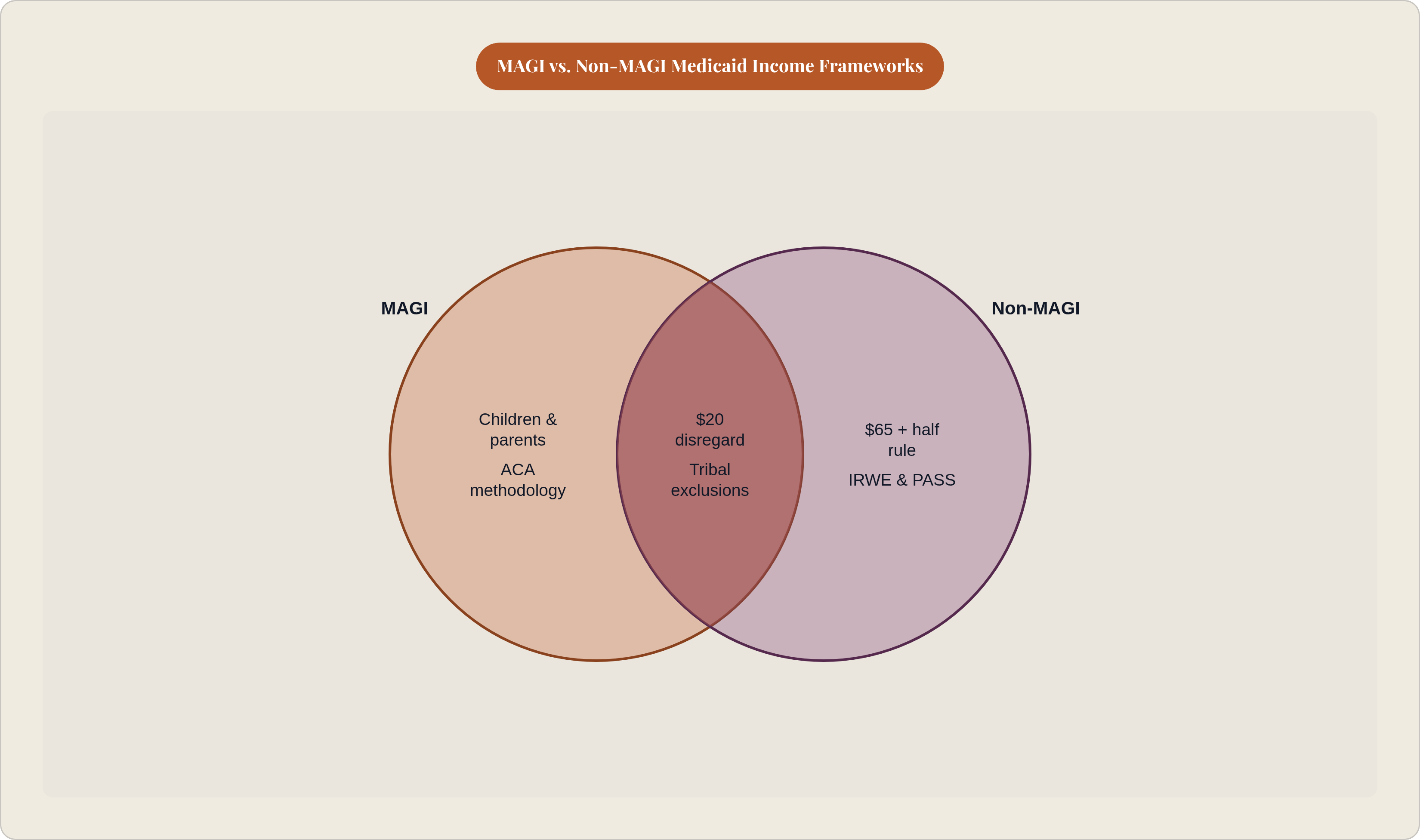
Medicaid runs two separate counting systems, and neither one borrows rules from the other. The Affordable Care Act created MAGI, Modified Adjusted Gross Income methodology, and it replaced state-specific disregards for most non-elderly, non-disabled applicants. That pulled control of the math out of state hands for a huge slice of the Medicaid population, and states haven't gotten it back.
MAGI covers most children, pregnant women, parents, and non-disabled adults, essentially anyone whose eligibility gets measured against a percentage of the Federal Poverty Level. States lost the ability to invent their own disregards for this group, but one disregard survived: a flat 5 percentage points of FPL, which is why a statutory 133% FPL limit functions as 138% FPL in practice. For 2026, that comes out to roughly $66.50 a month for a single adult. Small number on paper. For someone sitting right at the edge, though, it's the difference between a denial and an approval.
MAGI starts from adjusted gross income, so above-the-line deductions, IRA contributions, student loan interest, HSA contributions, have already trimmed the figure before Medicaid ever touches it. Some income types disappear from the count entirely: child support received, veterans' benefits, workers' compensation, gifts, inheritances, TANF, SSI.
Non-MAGI, sometimes called SSI methodology, covers a different group: people whose eligibility depends on age (65+), blindness, or disability. This is where the stacked, layered disregards live, and it's where the rest of this piece spends most of its time. A handful of states run 209(b) rules for their non-MAGI populations, criteria a notch more restrictive than standard SSI allows. So "non-MAGI" isn't one fixed thing everywhere you go, and that trips up experienced caseworkers too, not just first-time applicants.
Nothing that follows means much until you've pinned down which of these two frameworks governs the case in front of you. Get that wrong at the start, and everything downstream is wasted effort.
The $20 general income disregard — where the non-MAGI calculation always begins
Almost every non-MAGI applicant, whether they're going after Aged, Blind, and Disabled Medicaid, nursing home Medicaid, an HCBS waiver, or a Medicare Savings Program, starts the same way: subtract $20.
The order isn't negotiable. The $20 hits unearned income first, and if unearned income comes in under $20, whatever's left carries over and applies against earned income instead. Neither bucket goes below zero; there's no refund, no negative income created anywhere in the math.
$20 is the federal number, though states can move it around. Illinois uses $25 as of 2026. New Hampshire uses $13. Most states just stick with $20, so treat any deviation as something to verify against your specific state rather than something to assume going in.
One wrinkle trips people up constantly: married couples generally get a single $20 disregard against their combined income, not $20 apiece. If both spouses have modest unearned income and somebody assumes each gets their own subtraction, the math in their head is wrong before it even starts, usually in the direction that makes eligibility look worse than it actually is.
Order matters this much because whatever's left of the $20 after it hits unearned income changes how much runs through the earned income steps next. These aren't two independent subtractions happening side by side; they're sequential, and skipping the sequence produces a number that still looks plausible on the page while being completely wrong underneath.
How the earned income disregard works — the $65 deduction and the half-remainder rule
Once the $20 has done its work, earned income gets its own two-step treatment. This is where the math starts actually rewarding people who are still working, rather than just tolerating them.
First, subtract $65 from earned income, then cut what's left in half; only that half counts. Run both steps and roughly three-quarters of earned income vanishes from the countable total. It's a deliberate design choice: the program wants people to keep working without every dollar earned costing a dollar of eligibility.
Married couples again get one earned income disregard applied to combined earnings, not one per working spouse.
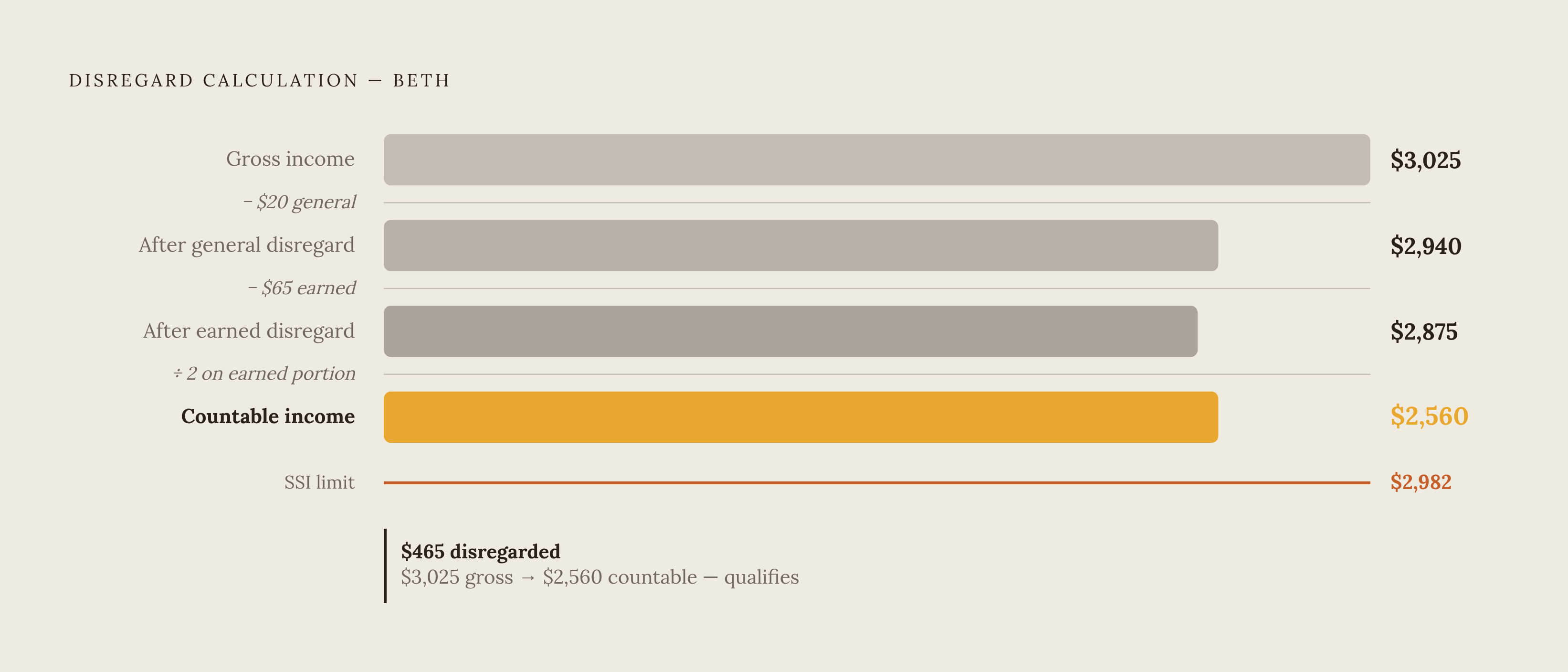
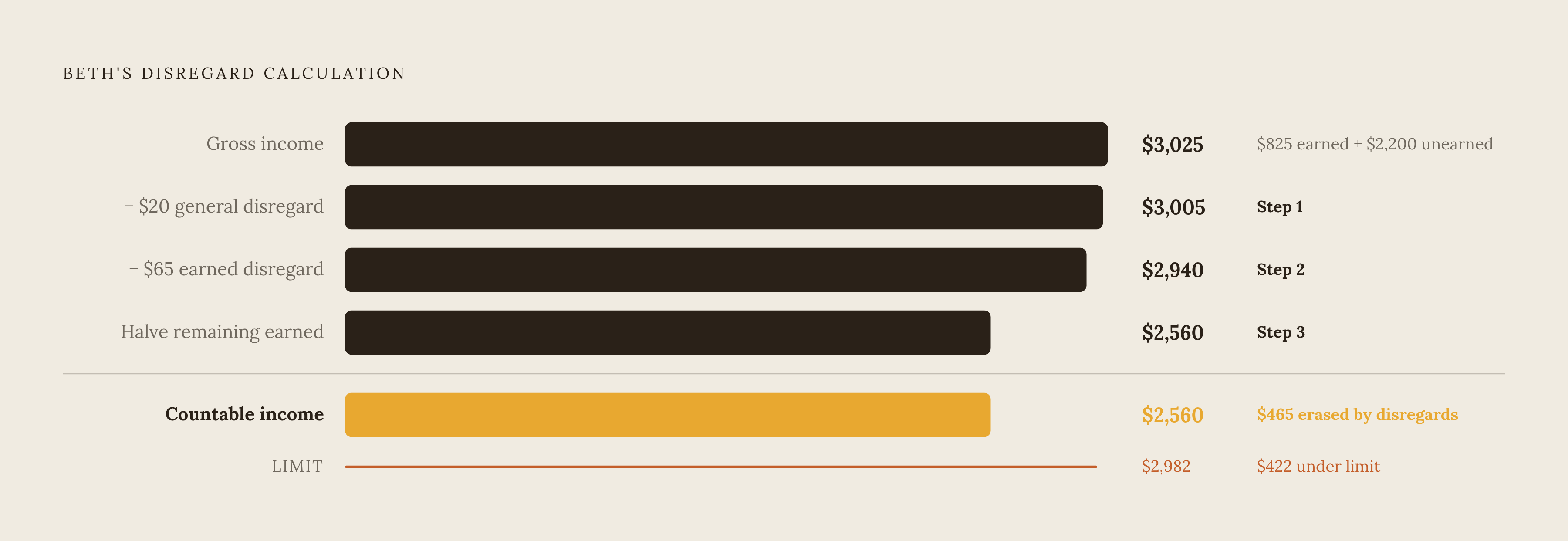
Consider a case MedicaidLongTermCare.org wrote up in July 2026, because it's such a clean demonstration of how much this can move the needle. A woman named Beth brings in $825 a month in earned income and $2,200 in unearned income, for a gross total of $3,025. Her limit is $2,982, so on paper she's over, and if she stopped there, she'd assume she didn't qualify. Run the disregards and the picture flips. Subtract $20 from unearned income: $2,180 left. Subtract $65 from earned income: $760 left. Halve it: $380 in countable earned income. Add that back to the $2,180 and you land at $2,560 a month in total countable income, comfortably under the $2,982 limit. She qualifies. A gross-income comparison would have turned her away for no reason at all.
A second case, from MedicaidEligibilityCalculator.com, runs the same mechanics at a lower income level. John earns $900 a month plus $500 in Social Security, $1,400 total. Subtract $20 from the Social Security: $480. Subtract $65 from his earnings: $835. Halve it: $417.50. Add the two together: $897.50 in countable income, under the $994 SSI Federal Benefit Rate limit for that year. He qualifies too.
Put both examples next to each other and the point is hard to miss: these disregards can close a gap of hundreds of dollars and flip someone from clearly ineligible to clearly eligible. Doing the math out of order, or skipping a step, doesn't produce a slightly-off answer. It produces the wrong answer, full stop.
Other non-MAGI disregards that apply in specific circumstances
Past the $20 and $65 disregards sit a handful of narrower rules, and most of them only apply if the applicant, or whoever's helping them, knows enough to raise a hand.
Impairment-Related Work Expenses, IRWE for short, let a disabled person deduct documented costs tied to working, specialized transportation, adaptive equipment, that sort of thing, from earned income. The logic holds up on its own terms: if a disability adds real cost to holding a job, that cost shouldn't cancel out the benefit of working in the first place.
A Plan for Achieving Self-Support, a PASS, approved by the Social Security Administration, excludes income set aside toward a vocational goal from the countable total entirely. This one is aimed less at this month's eligibility and more at where somebody's headed a year or two down the road.
Blind or disabled students under 22, enrolled regularly in school, college, or vocational training, get their earnings excluded up to $2,410 a month, capped at $9,730 a year, per 2026 figures from bplc.cssny.org.
A few smaller rules round it out. Earned Income Tax Credit payments are excluded the month received and the month after. Income that's irregular or infrequent, no more than once a quarter, under $20 unearned or a small amount earned, gets disregarded outright. Income Native American and Alaska Native individuals receive from tribal sources is excluded under federal law across both MAGI and non-MAGI calculations, which makes it something of an outlier on this list. VA Aid and Attendance payments, specifically the portion paid above the basic VA pension, are excluded in most states. Given how much that population overlaps with long-term care applicants, it comes up more often than you'd guess.
None of this happens on its own. IRWE, PASS, and VA exclusions need documentation or an active claim on file. The state isn't out there hunting for reasons to lower your countable income; that part is on the applicant, or on whoever's filling out the paperwork for them.
How spousal impoverishment rules function as income disregards for married applicants
Nursing home care runs $5,000 to $8,000 a month or more in a lot of markets. Congress looked at what that cost does to a married couple when one spouse needs institutional care and the other doesn't, it can wipe out the at-home spouse's entire financial base, and built spousal impoverishment protections to stop exactly that. The income rule sitting at the center of those protections works like a disregard, even though almost nobody in the field calls it that by name.
In income-cap states, the community spouse's income, meaning the spouse staying at home, gets disregarded entirely when the state figures out the institutionalized spouse's Medicaid eligibility. It simply doesn't enter the equation. That matters more than it sounds like it should: without it, a working or pension-drawing spouse's income could disqualify their partner from care they actually need, which is precisely the outcome Congress was trying to prevent.
There's a floor working the other direction too: the Minimum Monthly Maintenance Needs Allowance, MMMNA. The community spouse keeps a protected level of monthly income, and for 2026 that range runs $2,643.75 to $4,066.50, higher in Alaska and Hawaii, per federal guidelines. If the community spouse's own income falls short of that floor, income gets redirected from the institutionalized spouse to close the gap. Call it a disregard running backward: instead of excluding income from a calculation, it moves income across the household to protect the person left at home.
Assets come into it too, through the Community Spouse Resource Allowance, CSRA. It's framed as an asset rule rather than an income rule, but the two interact constantly, since assets the community spouse keeps generate income, and that income affects whether the MMMNA gap needs filling at all. The 2026 CSRA maximum and minimum figures are set federally and adjusted each year.
States calibrate all of this on their own, and the calibration shifts year to year. California's Medi-Cal program reinstated a $130,000 asset cap for non-MAGI long-term care programs starting January 1, 2026, a good reminder that income and assets both get tuned separately by each state rather than locked to one national number. Spousal impoverishment protections may be some of the most state-variable rules in the entire system. Washington sets the floor and ceiling; each state fills in the rest on its own schedule.
Why the same income can be treated differently depending on state and program
If the same dollar of income qualifies someone in Idaho and disqualifies them in Delaware, what does "the Medicaid income limit" even mean as one portable idea? It's fifty overlapping systems sharing a federal skeleton, a very different picture from what most people assume when they hear "Medicaid limit" tossed around at a kitchen table.
Under federal Medicaid law, states can adopt methodologies less restrictive than SSI for specific Medicaid groups. Plainly: a state can choose to disregard income SSI would otherwise count, which widens eligibility past the federal floor. States can also build disregards tied to specific purposes, income spent on medical expenses or in-home care, say, as a tool to expand eligibility for particular groups without rewriting the whole system from scratch.
The variation doesn't stop at state lines. Within one state, a disregard available under an HCBS waiver might not apply under that same state's nursing home Medicaid program. Same state, same applicant, two different programs, two different outcomes, because each program recognizes its own set of disregards independent of the others.
Income limits swing hard by state too. Idaho's nursing home and HCBS limit sits at $3,002 a month for 2026; Delaware's is $2,485. That's over $500 a month of daylight for nominally the same coverage type, and it stacks right on top of whatever gap the disregard rules already create underneath it.
As of 2026, 47 states run a Medicaid Buy-In program for working adults with disabilities, per KFF, one of the more widely adopted optional expansions in the program's history. But each state's version counts income differently, so being Buy-In eligible in Ohio tells you nothing about being Buy-In eligible in Nevada. KFF's 2026 data also shows every state except Alabama extends Medicaid to low-income older adults and people with disabilities whose income sits above standard SSI limits. That's not a fringe detail. It means the non-MAGI disregard system is foundational to how the program works almost everywhere.
Income that disqualifies someone in one state might clear them in the state next door, and which program they apply to inside their own state can matter just as much as which state they happen to live in.
How to approach the disregard calculation in practice — and where to get help
Count up what's actually stacked here: the MAGI/non-MAGI fork, the $20 disregard, the $65-plus-half rule, IRWE, PASS, student earnings, spousal impoverishment, then state-by-state and program-by-program variation layered on top of all of it. That's a lot of moving parts for a system that ultimately spits out one number, countable income, and checks it against one limit.
Order matters more than most people expect going in. Apply the earned income disregard before the general disregard, or forget to carry an unused piece of the $20 over from unearned to earned income, and the countable figure comes out wrong. It can flip someone from eligible to ineligible, or the reverse, without anyone noticing exactly where the error crept in.
Documentation isn't optional. I've seen good cases stall for weeks over this exact point. IRWE, PASS, and VA exclusions need proof on file; the state isn't going to apply them just because they exist somewhere in federal code waiting to be claimed. And none of it matters until the MAGI-versus-non-MAGI question gets settled first, since the two frameworks share almost nothing between them.
Add state and program variation on top of all that, and a generic, national-average calculation is going to be wrong for plenty of specific applicants, plenty of the time. The disregards stack, $20, then $65, then a halving, and small errors early in that stack compound by the time you reach the end of it. This isn't a system that rewards confident guesswork, and it's not one that punishes people for asking questions either.
If gross income looks over the limit, treat that as a starting point for a conversation, not a stopping point. A caseworker, a benefits counselor, or a Medicaid planner who works this specific state's rules day in and day out can run the numbers in the right order and catch a disregard a first-time applicant would never think to claim. Some tools exist specifically because the math above is easy to get wrong and expensive to get wrong when it goes sideways.
That matters most for family caregivers, plenty of whom are helping a parent or spouse apply for Medicaid while also hoping to get into a caregiver compensation program themselves. HCBS waivers that pay family caregivers require the care recipient to qualify for Medicaid first, so getting the disregard calculation right carries real weight in that situation. It's often the line between a rejection letter and an approval for both people involved.