Extra Help and Medicare Savings Programs
Millions of eligible seniors miss billions in drug and medical cost savings due to unawareness.
The gap between who qualifies and who actually enrolls is not a rounding error. An estimated 6 million people who qualify for Medicare Savings Programs are not enrolled. Up to 3 million individuals who could benefit from Extra Help are currently missing out.
A 2025 study published in JAMA Network Open, using data from 2018 through 2020, found that only 56.7% of MSP-eligible beneficiaries were actually enrolled, across a sample representing over 179 million beneficiary-years. What made the finding particularly instructive was the direction of the selection effect: enrolled individuals tended to have worse health, lower income, and fewer assets. The people being left behind are not the poorest or sickest. They are the ones with somewhat more resources or marginally better health who still qualify but have not applied.
The barrier, more often than not, is awareness and navigation rather than ineligibility. That distinction shapes everything that follows.
The four Medicare Savings Programs and what each one covers
QMB: Qualified Medicare Beneficiary
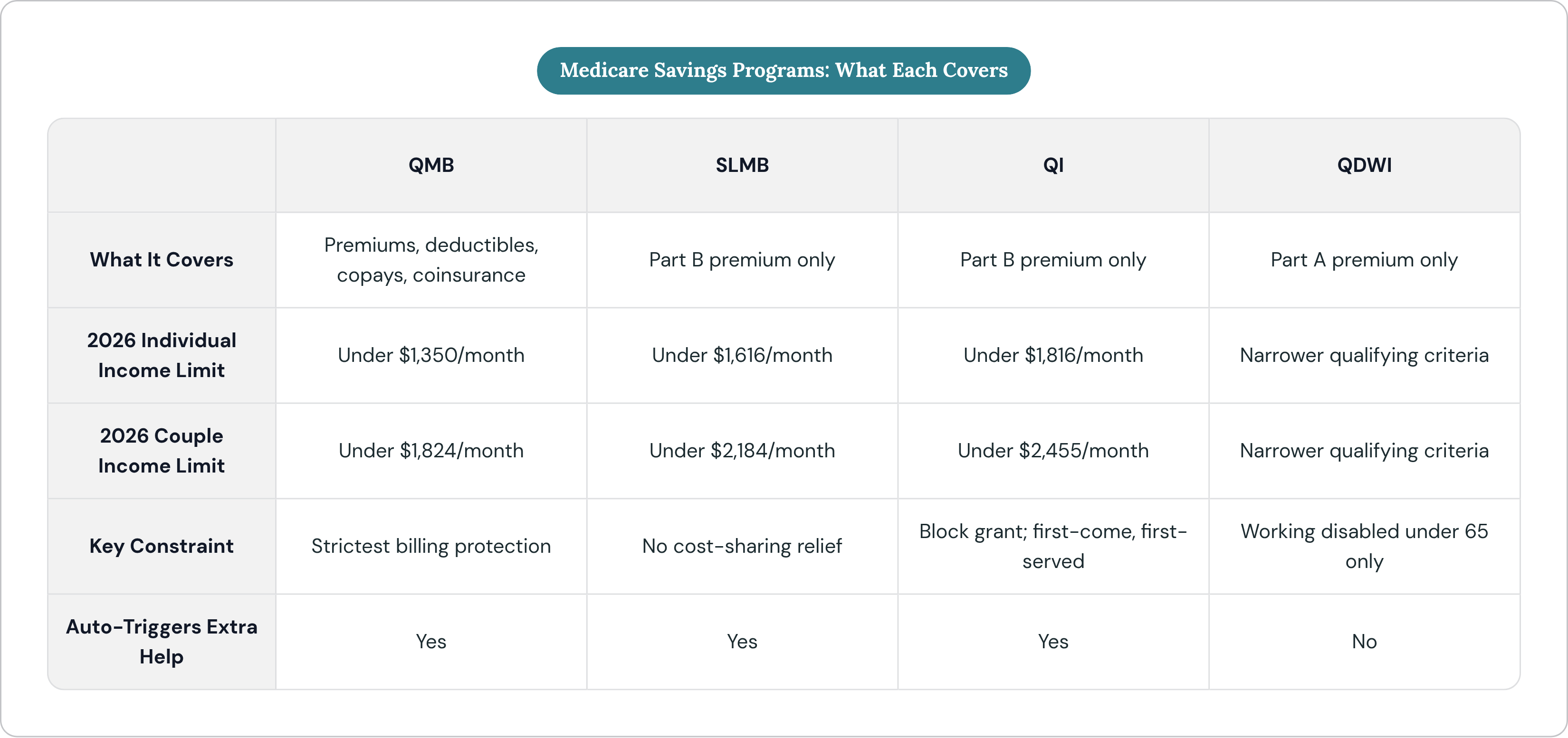
QMB is the most comprehensive of the four programs and, for someone managing a serious or chronic condition, potentially the most valuable benefit in the entire Medicare landscape. It covers Part A premiums where applicable, Part B premiums, and all Part A and Part B deductibles, copays, and coinsurance. The 2026 monthly income limits, after applying a standard $20 general income disregard, are $1,350 for an individual and $1,824 for a couple.
The billing protection embedded in QMB deserves particular emphasis. Federal law prohibits any provider, whether in Original Medicare or Medicare Advantage, from billing a QMB enrollee for Medicare cost-sharing. This is a prohibition, not a reimbursement mechanism. A beneficiary who understands this protection should never pay a Medicare cost-sharing bill at the point of service; a provider who bills one is in violation of federal law. For someone with one hospital stay, two emergency department visits, and a handful of specialist follow-ups in a single year, QMB can eliminate anywhere from $5,000 to $10,000 in cost-sharing, on top of Part B premium savings.
SLMB: Specified Low-Income Medicare Beneficiary
SLMB covers the Part B premium only, which in 2026 is $202.90 per month, translating to roughly $2,434 in annual savings. The 2026 income limits are under $1,616 per month for an individual and $2,184 for a couple. It does not cover deductibles, coinsurance, or the Part A premium. For beneficiaries in reasonable health who face modest cost-sharing exposure, the premium savings alone represent meaningful relief.
QI: Qualifying Individual
QI also covers the Part B premium and serves a slightly higher income tier than SLMB. The 2026 income limits are under $1,816 per month for an individual and $2,455 for a couple. Two features distinguish QI from the others. First, it is funded by a federal block grant, meaning enrollment is first-come, first-served each year; the funding is finite and can be exhausted before year's end. Second, QI enrollees must reapply annually, and prior enrollment confers no guarantee of continued coverage. Beneficiaries who also qualify for full Medicaid are ineligible for QI.
QDWI: Qualified Disabled and Working Individual
QDWI is the narrowest of the four. It serves working disabled individuals under 65 who lost premium-free Part A coverage after returning to work, covering the Part A premium only. In 2026, that premium can exceed $500 per month for those who do not qualify for premium-free coverage, making QDWI consequential for a small but specific population.
Asset limits: the federal floor is not the whole picture
The federal asset baseline for MSPs in 2026 is $9,950 for an individual and $14,910 for a couple. States, however, can set higher limits or eliminate them entirely. Connecticut, Delaware, Louisiana, Maine, and Mississippi have no asset limit for at least some MSP programs. California's limits are $130,000 for an individual and $195,000 for a couple in 2026. The federal figure is a floor, not a ceiling, and checking your state's specific rules is essential before drawing any conclusions about eligibility.
Extra Help eligibility, what it pays, and the IRA change that expanded it
For 2025, Extra Help income thresholds are $23,475 per year for an individual and $31,725 for a married couple living together, approximately 150% of the federal poverty level. Asset limits are $17,600 for an individual and $35,130 for a couple. The primary residence does not count as a resource, regardless of its market value.
The benefit structure in 2025 includes a $0 Part D premium up to the benchmark plan amount, $0 Part D deductibles, and capped copays of no more than $4.90 for generic drugs and $12.15 for brand-name drugs. In 2026, those caps adjust to $5.10 and $12.65, respectively. For a beneficiary managing multiple chronic conditions with a complex drug regimen, the distance between retail drug costs and what Extra Help requires them to pay can be considerable.
Two additional protections matter here. Extra Help enrollees are exempt from the Part D late enrollment penalty, which compounds at 1% of the national base premium per month of delayed enrollment and, once assessed, applies for life. Extra Help status also grants a monthly Special Enrollment Period to enroll in or switch a stand-alone Part D plan, a flexibility unavailable to most beneficiaries outside designated enrollment windows.
Before 2024, Extra Help operated in two tiers: a full subsidy for those with income up to 135% of the federal poverty level, and a partial subsidy for the 135% to 150% range. The Inflation Reduction Act, effective January 1, 2024, eliminated the partial subsidy tier. Anyone who now qualifies for Extra Help receives full benefits. Approximately 300,000 additional individuals gained full coverage as a direct result.
One provision that surfaces less often than it should: if Extra Help eligibility is backdated upon approval, plans are required to refund any overpaid premiums and copays from the eligible period. A delayed application is not necessarily an application without retroactive value.
How MSP enrollment automatically triggers Extra Help
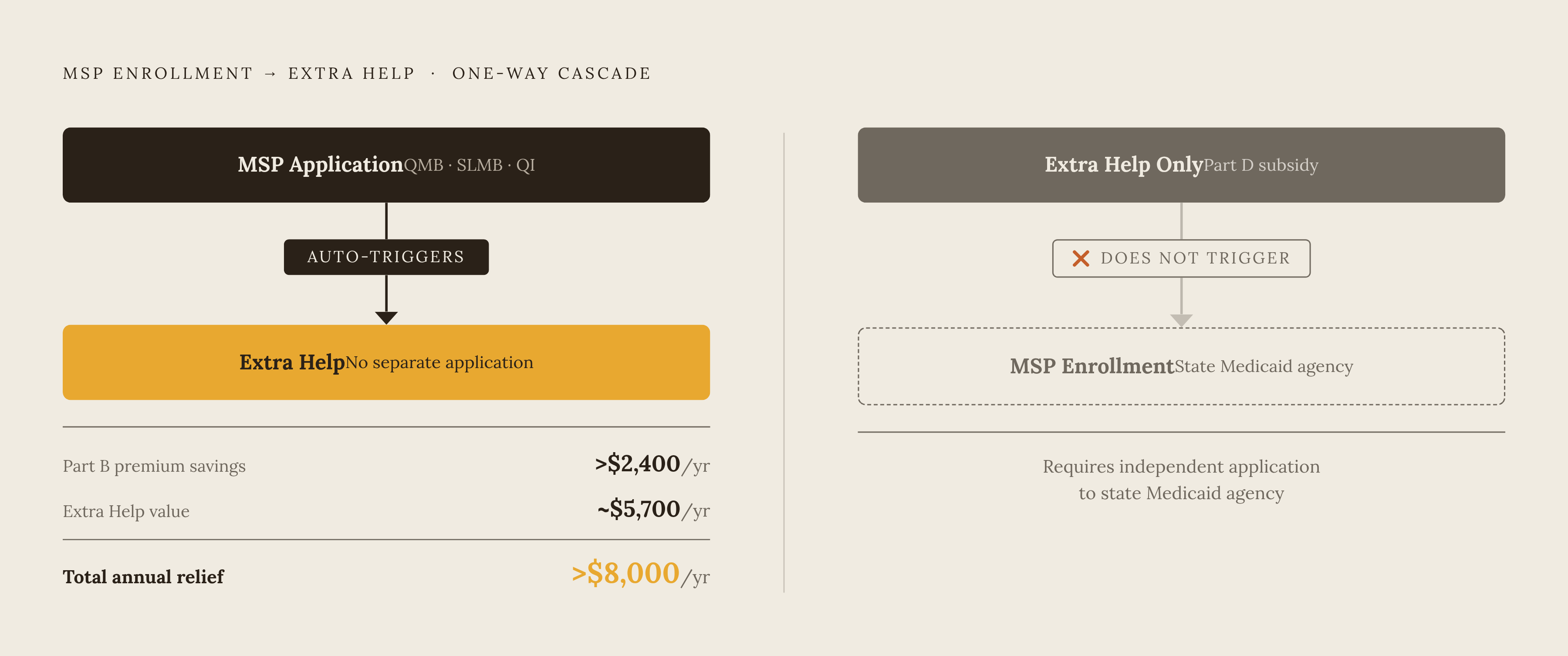
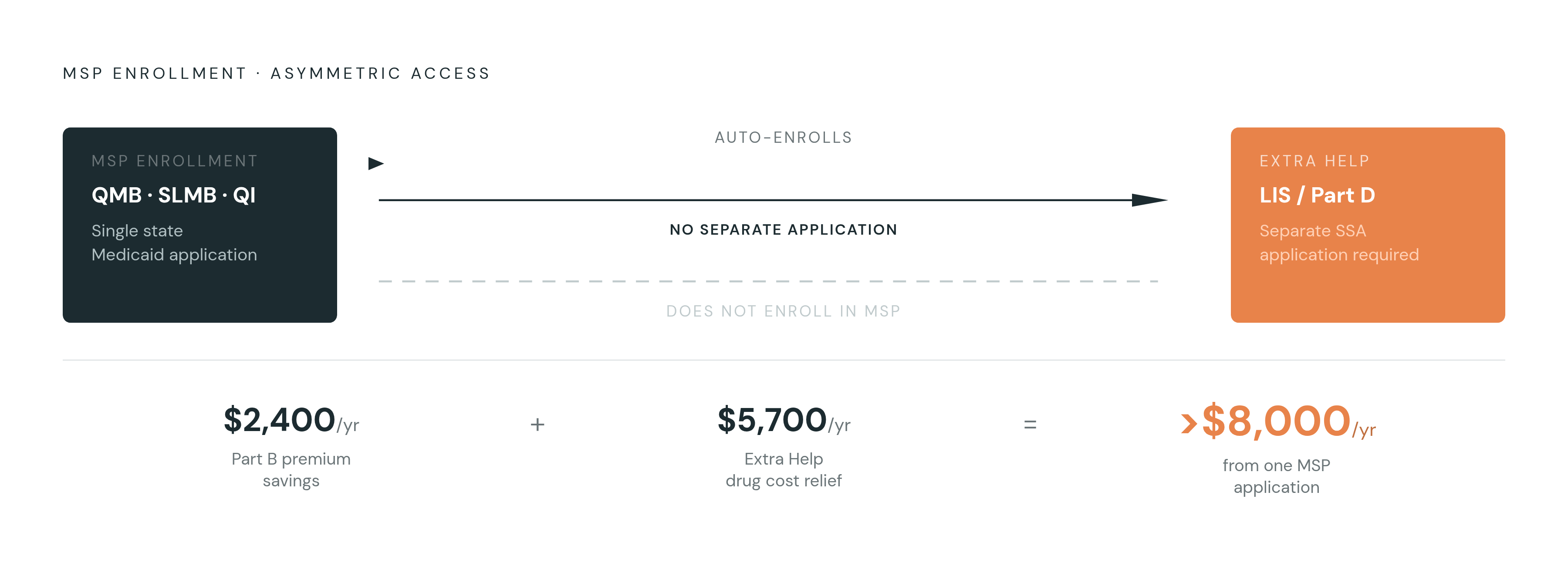
Here is where the two programs, distinct as they are, intersect in a way that changes the practical calculus of enrollment. Enrollment in QMB, SLMB, or QI automatically qualifies a beneficiary for Extra Help, with no separate application required. The same applies to people dually eligible for Medicare and Medicaid, and to SSI recipients, who receive automatic Extra Help enrollment signaled by a purple notice from CMS.
A single successful MSP application can, in other words, unlock benefits on both sides of the Medicare cost equation simultaneously. Part B premium savings from MSP enrollment can exceed $2,400 per year. The Social Security Administration estimates the annual value of Extra Help at approximately $5,700. Together, a QMB enrollment can yield well over $8,000 in annual cost relief from one application.
The reverse is not true. Qualifying for Extra Help does not enroll someone in an MSP; MSP enrollment requires a separate application through the state Medicaid agency. This asymmetry has direct implications for how someone should sequence their efforts. MSP is the door that, once opened, also opens Extra Help automatically. Extra Help is more straightforward to apply for directly, but it does not open the MSP door. For someone who suspects they qualify for both, the MSP application is the more efficient place to begin.
Why income and asset rules are less disqualifying than many people assume
The most persistent misconception I encounter, across years of working through these eligibility questions with real people, is that homeownership disqualifies someone from these programs. It does not. The primary residence is excluded as a countable resource for both Extra Help and MSPs, regardless of the home's market value. I have watched this misunderstanding alone prevent people from applying who would have qualified without question.
Income disregards introduce a second layer of nuance. Certain income types are excluded from the eligibility calculation, which means a person's gross income may appear to exceed the threshold on paper while their countable income falls within limits. The specific disregards vary by program, but the structural principle is consistent: the headline income figure and the figure used in the eligibility determination are not always the same number.
For Extra Help specifically, circumstances that can raise the effective income threshold include living in Alaska or Hawaii, earning income from work, or supporting additional family members within the household. These adjustments apply automatically when relevant, but they require the applicant to actually submit an application for those factors to be considered.
On assets: California's individual limit is $130,000. Several states have eliminated the asset limit entirely. A beneficiary with modest savings who self-disqualifies based on the federal baseline may well be eligible under their own state's rules, and never know it.
QI's funding cap deserves its own distinction. This is a practical constraint rather than a traditional eligibility barrier; the qualification criteria may be fully met, but the funding may be exhausted before an application is processed. That argues for applying early in the calendar year rather than waiting.
The only reliable way to know whether someone qualifies is to apply. Assumptions about homeownership, savings balances, or gross income have turned out to be wrong often enough, in my experience, that I treat self-disqualification as the central problem in this space rather than a reasonable precaution. The application is the assessment.
How enrollment actually works for each program and what to do if circumstances change
Extra Help applications are filed through Social Security, online at SSA.gov, by phone, or in person at a local office. State Medicaid agencies and State Health Insurance Assistance Program (SHIP) counselors can also accept the application. MSP applications go through the state Medicaid agency, not SSA. This is precisely where many people stall: they believe they have applied for everything when they have only applied for one of the two programs.
SHIP counselors are available in every state, free of charge, and operate without any financial stake in the products or plans a beneficiary ultimately chooses. For someone who finds the forms or eligibility rules difficult to navigate, SHIP is the most consistently reliable resource available.
A few operational details worth tracking. If income drops mid-year, an Extra Help application can be filed at any point; benefits, once granted, run through December 31 even if income rises after enrollment. If Extra Help eligibility is backdated, plans must refund overpaid premiums and copays from the eligible period. QI must be renewed each year and carries no guarantee of continued coverage given its block grant structure; failing to reapply, or applying late, risks losing coverage entirely.
Extra Help is not available in Puerto Rico, the U.S. Virgin Islands, Guam, the Northern Mariana Islands, or American Samoa. Beneficiaries in those territories should inquire about locally available assistance programs.
Once enrolled, most of these benefits operate automatically or with minimal ongoing action, QI being the notable exception. What the data on under-enrollment suggests, and what working in this field confirms, is that the people most likely to be left behind are those who never applied because they assumed, incorrectly, that they would not qualify.