What Medicare Part D Covers and Costs in 2026
Deductibles, premiums, and out-of-pocket caps shift dramatically in 2026.
Medicare Part D runs on a genuinely different rulebook in 2026 than it did even two years ago, and the changes aren't cosmetic. Get the deductible, the three coverage phases, and the new out-of-pocket cap wrong, and you're the person opening a February bill wondering why a specialty prescription cost four times what you'd budgeted. Get them right, and this piece is a walk through how to avoid that.
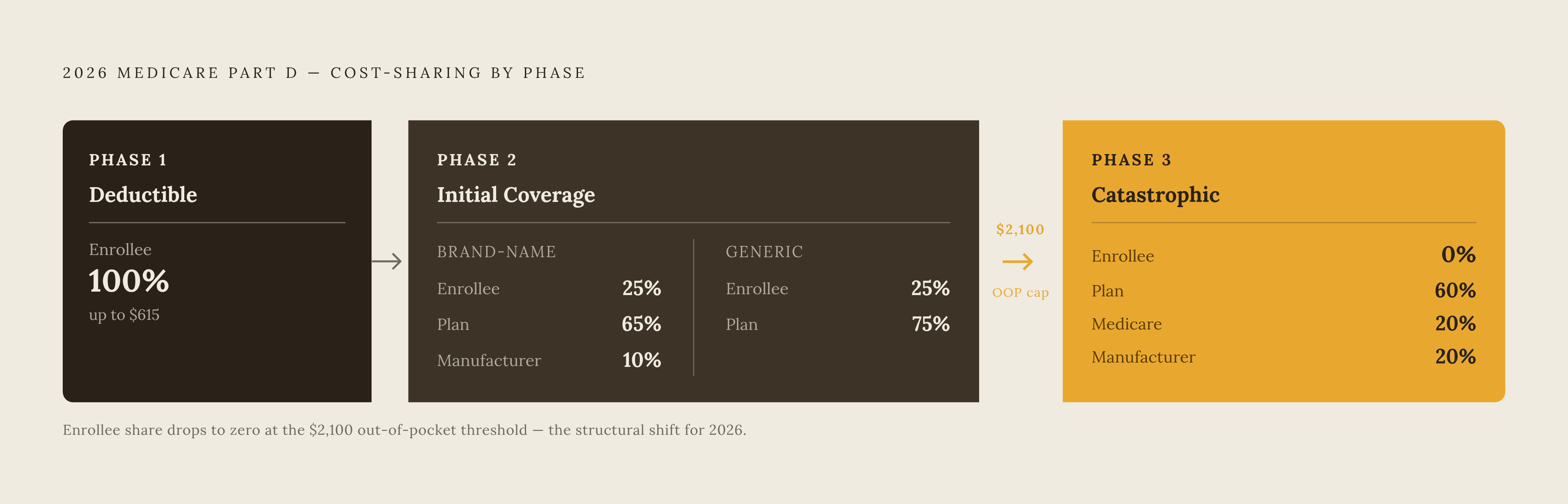
The average stand-alone PDP premium fell from $38.31 in 2025 to $34.50 in 2026, while average MA-PD premiums dropped from $13.32 to $11.50 after rebates, per CMS. The gap between those two figures is structural: MA plan sponsors apply rebate dollars to shrink the Part D premium bundled inside the plan, a pool PDPs have no access to, which is why nearly 8 in 10 MA-PD enrollees who don't receive low-income subsidies pay no monthly Part D premium at all in 2026. On the cost-sharing side, Part D now runs a clean three-phase structure: a deductible period up to $615 where you pay the full drug cost, an Initial Coverage Period where you pay 25% on both brand-name and generic drugs, and catastrophic coverage that kicks in once out-of-pocket spending crosses the $2,100 annual cap, after which you pay nothing on covered drugs for the rest of the year. For someone on a high-cost specialty drug, that cap is the single most consequential number in the calculation: a 25% coinsurance charge in the Initial Coverage Period accelerates the climb toward it, and once crossed, the plan absorbs 60%, Medicare covers 20%, and the manufacturer covers the remaining 20%, with the enrollee paying nothing further.
Part D is sold through private insurers rather than administered by Medicare directly, and you get it one of two ways: a stand-alone prescription drug plan (PDP) bought alongside Original Medicare, or a Medicare Advantage plan with drug coverage baked in (MA-PD), where the drug benefit rides inside a bigger policy that also handles hospital and medical care. Tens of millions of people split across these two structures, and which side you land on shapes almost everything downstream: premiums, formularies, cost-sharing, all of it. A separate program, the Low-Income Subsidy (also called Extra Help), knocks costs down further for enrollees who qualify; that comes back up when we get to the coverage phases below. Checking eligibility for Extra Help is one of the things a free Medicare enrollment service like Brevy can run through before someone commits to a plan. Enrollment is time-bound too, the Annual Enrollment Period runs each fall, and new Medicare enrollees get their own Initial Enrollment Period tied to when they first qualify. Miss the window without other creditable drug coverage lined up, and a late enrollment penalty follows you for as long as you carry Part D.
How do 2026 Part D premiums compare to 2025, and why do MA-PD and PDP enrollees see such different numbers?
Start with CMS's headline number. The average stand-alone PDP premium dropped from $38.31 in 2025 to $34.50 in 2026, down $3.81, while average MA-PD premiums after rebates fell too, from $13.32 to $11.50. KFF tells a slightly different story on the MA-PD side, though the PDP direction matches: their estimate has PDP premiums falling from $39 to $36, but MA-PD premiums ticking up from $7 to $8. Small numbers, sure, but they're moving in opposite directions depending on whose data you trust, and that alone tells you something about how noisy these averages get once rebate accounting enters the picture.
Why does PDP cost so much more than MA-PD to begin with? The gap is structural. MA plan sponsors get rebate dollars for offering Medicare Advantage, and they can pour that money into shrinking the Part D premium bundled inside the plan. Stand-alone PDPs have no such pool to draw from; there's no medical plan attached to subsidize the drug benefit. That's the entire mechanism behind a gap running more than 4x on average, and it's also why, per KFF, nearly 8 in 10 MA-PD enrollees who don't get low-income subsidies pay no monthly Part D premium at all in 2026.
Here's the part that deserves more attention than it usually gets. CMS has been running a Part D premium stabilization demonstration that's held premium growth down artificially, and it expires in 2027. The 2027 base beneficiary premium is already set to rise meaningfully from where things sit now, so if you're enjoying a low premium in 2026, treat it as a temporary window, not a new normal, and budget accordingly.
One more thing worth sitting with: a low premium doesn't mean a low total cost. Plans with $0 premiums often carry higher deductibles or push your drugs onto pricier tiers. The premium is only the first line on the invoice, and it rarely tells the whole story.
The 2026 deductible and which drugs it applies to
The maximum Part D deductible for 2026 is $615, up $25 from $590 in 2025. That's a ceiling CMS sets, not a number every plan actually charges, and the room underneath that cap is where plans start looking genuinely different from one another.
Some plans apply the full deductible only to brand-name drugs and set generics at no cost, so you'd pay nothing out of pocket for a generic from day one. Others waive the deductible entirely and fold that cost into the premium instead. Two things never get touched by the deductible, no matter how a plan is built: insulin covered under a Medicare drug plan skips it completely, and ACIP-recommended vaccines under Part D are exempt too, so a shingles shot shouldn't trigger a deductible charge.
This is one of the more consequential things to check during enrollment, and it gets skipped constantly because everyone's eyes go straight to the premium first. If you're on a brand-name drug with no generic equivalent, the deductible structure can swing your annual cost by hundreds of dollars, regardless of the headline maximum.
How cost-sharing works across the three coverage phases
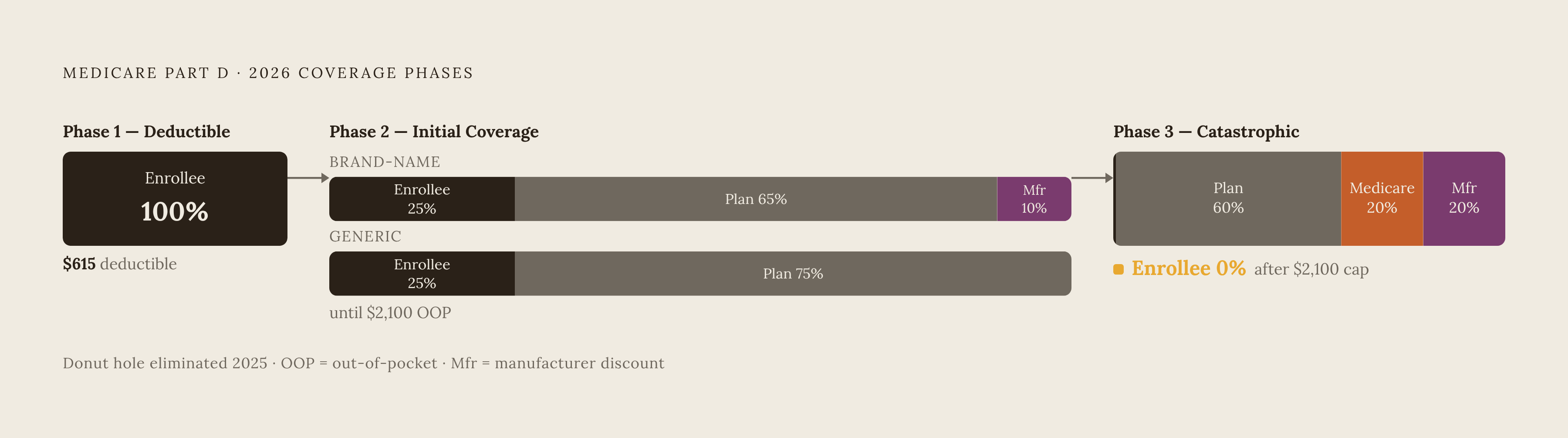
The donut hole is gone. It got phased out starting in 2025, and Part D now runs on a cleaner three-phase structure, according to NCOA. Understanding these phases might be the single most useful thing an enrollee does all year, because cost-sharing behaves completely differently depending on which one you're standing in.
Phase one is the deductible period, where you pay the full cost of your drug costs until you hit the plan's deductible, somewhere up to that $615 ceiling.
Phase two is the Initial Coverage Period, and brand-name and generic drugs split apart here in a way that trips people up. For brand-name drugs, the enrollee pays 25%, the plan pays 65%, and the manufacturer covers the remaining 10%, per NCOA. Generics work differently since there's no manufacturer discount in the mix: the plan pays 75%, the enrollee pays 25%. That 25% might show up as coinsurance (a percentage of the drug's price) or as a flat copay, and the difference matters more than it sounds like it should. On an expensive drug, a percentage balloons fast in a way a flat copay never does.
Phase three is catastrophic coverage, and it's the biggest structural shift Part D has seen in years. Cross the annual out-of-pocket cap, and you pay nothing for covered drugs the rest of the calendar year, while the plan picks up 60%, Medicare covers 20%, and the manufacturer covers the last 20%, per NCOA. For someone on a high-cost specialty drug, hitting catastrophic coverage early in the year is now a real possibility, and it reshapes their entire annual budget around that one fact. Which raises the obvious next question: how big is that cap, and how fast can someone actually get there?
The $2,100 annual out-of-pocket cap and what counts toward it
Before 2025, there was no ceiling at all on what a Part D enrollee could spend in a year. Someone on a specialty cancer drug or a rare autoimmune treatment could rack up tens of thousands of dollars annually with nothing stopping it. That risk has been reshaped by the reforms, not merely reduced; the structure itself changed underneath it.
The Inflation Reduction Act put a $2,000 cap in place starting in 2025, indexed to climb over time. For 2026 it sits at $2,100, per q1medicare.com. What counts toward it: your deductible, plus copayments and coinsurance on covered drugs. Premiums, IRMAA surcharges (more on that below), and anything you pay for a drug that isn't on your plan's formulary don't count. That last one trips people up constantly, since paying cash for a non-formulary drug does nothing to move you closer to the cap, no matter how much you spend.
There's a second piece of the 2025 reforms worth knowing here: the Medicare Prescription Payment Plan, or M3P. It lets you spread out-of-pocket costs into equal monthly installments across the year instead of eating one huge hit in January when an expensive prescription gets filled early. Enrollees already signed up get automatically re-enrolled unless they opt out or switch plans, and it's particularly useful for anyone filling high-cost brand-name or specialty drugs right at the start of the year.
M3P doesn't lower your premium, but it changes the risk calculus completely for anyone juggling multiple prescriptions or a single expensive one: for the first time, there's a known ceiling, and a tool to smooth out the climb toward it.
Income-related surcharges (IRMAA) that add to the monthly cost
Everything above assumes a flat premium for everyone in a given plan, which understates the picture for higher earners. IRMAA, the income-related monthly adjustment amount, tacks a surcharge onto the plan premium for higher earners, and in 2026 it kicks in once modified adjusted gross income clears $109,000 for single filers or $218,000 for joint filers, per Kiplinger.
The surcharge runs from $14.50 to $91.00 a month, stacked on top of whatever the plan already charges, with the exact amount depending on which income bracket applies to you.
Two mechanics make this messier than the table suggests. There's a two-year lookback baked in: your 2026 IRMAA is calculated off your 2024 income, not what you're earning now, so someone who retired in 2025 could still get hit with a surcharge based on their last working year's salary, even though their income has since dropped off a cliff. The brackets themselves also work as a cliff rather than a slope; cross a threshold by one dollar, and you owe the full surcharge for the entire tier, with no gradual phase-in like you'd get with income tax brackets.
Roughly 8% of Part B beneficiaries pay an income-related amount, so this hits a real but minority slice of enrollees. Anyone who had a qualifying life event, retirement, divorce, the death of a spouse, can request an IRMAA recalculation using more current income instead of the two-year-old figure Social Security defaults to, and recently retired readers, or anyone helping a parent through a similar transition, should know that path exists. Worth restating plainly too: IRMAA sits entirely outside the $2,100 cap, as a separate cost on a separate track, and catastrophic coverage protection never touches it, no matter how deep into the year you get.
How formularies determine which specific drugs a plan actually covers
None of the cost math above means anything if your actual medication isn't covered, and this is where comparing plans gets genuinely granular. Every Part D plan runs its own formulary, its own list of what's covered, and coverage isn't standardized across plans the way Original Medicare's hospital benefit is.
Federal rules set a floor, not a ceiling. Plans have to cover at least two drugs in each therapeutic category and class, and they must cover every drug within six protected classes: antidepressants, antipsychotics, anticonvulsants, immunosuppressants, antiretrovirals, and antineoplastics. Beyond that floor, plans build formularies however they want. That's exactly why the same drug costs wildly different amounts from one plan to the next, sometimes for no reason more sophisticated than which tier a given insurer decided to park it on.
Most plans sort drugs into five tiers, and lower tiers mean lower cost-sharing. Lower tiers generally cover generics at the cheapest cost-sharing rates, mid-range tiers cover preferred and non-preferred brand-name drugs, and the highest tier covers specialty drugs at the greatest out-of-pocket expense.
On top of tier placement, plans layer on utilization management tools that affect access even when a drug is technically covered. Prior authorization means the plan has to sign off before the drug gets dispensed. Step therapy means you try, and often fail, a cheaper alternative first before the plan covers what your doctor actually prescribed, while quantity limits cap how much you can fill at once, regardless of what the prescription says.
Formularies reset every January 1, and that's not some minor administrative footnote. A drug sitting comfortably on tier 2 in 2025 can jump to tier 4 in 2026, or vanish from the formulary entirely. Checking the current-year formulary during enrollment can be the difference between a plan that actually works for you and one that quietly stops.
Two exclusions are worth keeping in mind regardless of plan. Over-the-counter products, even when a doctor writes a prescription for them, generally aren't covered unless a prescription-strength version of the drug exists (common antihistamines, laxatives, and pain relievers fall into this gap). Prescription eyeglasses and contact lenses aren't covered either, though medications treating the underlying eye disease are.
The 10 negotiated drugs now priced under the IRA, and what it means at the pharmacy
For the first time in the program's history, the federal government negotiated drug prices directly with manufacturers, and those prices took effect January 1, 2026, under the Inflation Reduction Act's Medicare Drug Price Negotiation Program. Whatever you think of the politics, the mechanism itself is worth understanding on its own terms.
Ten drugs make up this first cohort, and they are among the most commonly prescribed medications in the country rather than obscure specialty drugs on some rare-disease list, which is a big part of why this first round carries so much weight.
Plans are required to cover these 10 and apply the negotiated "maximum fair price," so enrollees paying coinsurance on any of them see lower cost-sharing than before. Trace the mechanism through and it's simple: coinsurance is a percentage of the drug's price, the negotiated price lowers that base number, so the 25% you're paying in the Initial Coverage Period now gets calculated against a smaller figure. Same percentage, smaller number underneath it, lower dollar amount out of pocket.
Who actually notices this at the pharmacy counter? Enrollees on one or more of these drugs who haven't yet hit catastrophic coverage, since that's where the savings show up, and once you're past that point you're already paying nothing regardless of what the negotiated price is.
This is also just the first chapter. The IRA authorizes the negotiation program to expand to more drugs in future years, and the 10 drugs live in 2026 are a starting cohort, not the ceiling. Worth watching when that list grows again, because it will.
How to compare plans during enrollment using what you now know about coverage and costs
Put all of this together and the comparison exercise looks nothing like just glancing at premiums. The real question isn't which plan charges the least per month; it's which plan produces the lowest total cost over the year for the specific drugs you actually take. A $0-premium plan with a high deductible and your medications parked on tier 4 easily costs more over twelve months than a plan charging a modest monthly premium with better tier placement.
Start by checking whether your drugs are on a plan's formulary, and at what tier. Then look at the deductible structure and ask whether it even applies to the tier your drugs sit on, since a brand-name drug on a plan with a full deductible behaves nothing like the same drug on a plan that waives it for that tier. From there, estimate whether you're likely to hit the $2,100 cap this year, and think about whether M3P would help smooth that cost instead of front-loading it into January and February. If you're on any of the 10 IRA-negotiated drugs, confirm the plan is actually applying the maximum fair price, and if your 2024 income puts you near an IRMAA threshold, fold that surcharge into your total cost comparison now, rather than treating it as a surprise you'll deal with later.
Medicare's Plan Finder tool at medicare.gov is still the best resource for running this side by side, mostly because it lets you punch in your actual drug list and see estimated annual costs across plans instead of guessing off premium alone. Part D's structure has shifted more in the past two years than in the prior decade combined, and running the comparison fresh each Annual Enrollment Period, instead of assuming last year's plan still fits, is what keeps a manageable prescription list from turning into a January surprise.