Budgeting for Out-of-Pocket Senior Care Expenses
Most seniors dramatically underestimate the long-term care costs Medicare will not cover.

A 65-year-old retiring in 2026 can expect to spend $185,500 out of pocket on health care over the rest of retirement, up 7.5% from $172,500 just a year earlier, according to OPEN MINDS. That number sounds staggering until you notice what it excludes: long-term care, the single largest expense most seniors will face and the one Medicare barely touches. Roughly 70% of people who reach age 65 will need some form of paid care before they die, according to U.S. News & World Report, and one in five of them will need it for more than five years, according to Urban Institute data. News. Yet only 7% of seniors say they fully understand their insurance coverage for long-term care, and just 11% have bought a long-term care policy. That gap between what people think Medicare will pay for and what it actually pays for is where most retirement budgets quietly fall apart, and it's the problem this piece is trying to close.
None of this is meant to scare anyone into paralysis. The goal is the opposite: knowing the real numbers, early, turns a future crisis into a plan.
What Medicare covers in 2026 and what it does not
Start with the baseline costs, because they went up again. Part B premiums crossed $200 a month for the first time in 2026, landing at $202.90, while the Part B deductible rose to $283 and the Part A inpatient deductible climbed to $1,736, per ElderLawAnswers. Part D's maximum deductible rose too, to $615 from $590 in 2025, according to Blue Moon Senior Counseling's Medicare guide. These are baseline costs for people who are otherwise healthy. They are not the number that breaks a retirement plan.
That number comes from a different misunderstanding entirely. Medicare, in its traditional form, does not cover long-term custodial care: help bathing, dressing, eating, or moving through a daily routine. It does not matter whether that help happens at home, in an assisted living apartment, or in a memory care wing. Medicare covers only narrower, more short-term needs than most people assume, not long-term custodial care. What it does cover is narrower and more short-term than most people assume: up to 100 days of skilled nursing facility care after a qualifying hospital stay, with a daily copayment of $217 kicking in after day 20 in 2026, plus limited home health visits and hospice. Dental, vision, and hearing sit outside standard Medicare entirely, so they're either paid out of pocket or picked up through a Medicare Advantage plan.
Speaking of which: traditional Medicare's out-of-pocket exposure can be substantial for anyone facing a complex hospital stay without supplemental coverage, unlike Medicare Advantage plans, which do impose an out-of-pocket cap. That asymmetry alone should reshape how families think about which version of Medicare they're on.
And 2026 brought turbulence on top of the usual cost creep. A significant number of seniors were forced off their Medicare Advantage plans when insurers exited certain markets, disrupting coverage for many who had limited replacement options. Rural seniors and people on small-carrier plans had the fewest replacement options. Stand-alone Part D plans shrank too, leaving fewer choices specifically for drug coverage. Medicare covers acute and short-term skilled care reasonably well. It does not cover the slow, sustained, hands-on care that defines most people's final years.
What each care setting costs in 2026, from home care to nursing homes
The figures below come from the CareScout (Genworth) Cost of Care Survey, collected between July and November 2025 across roughly 16,000 completed responses. It's the industry's longest-running benchmark for these numbers, now in its third decade, so treat it as the anchor and everything else as context.
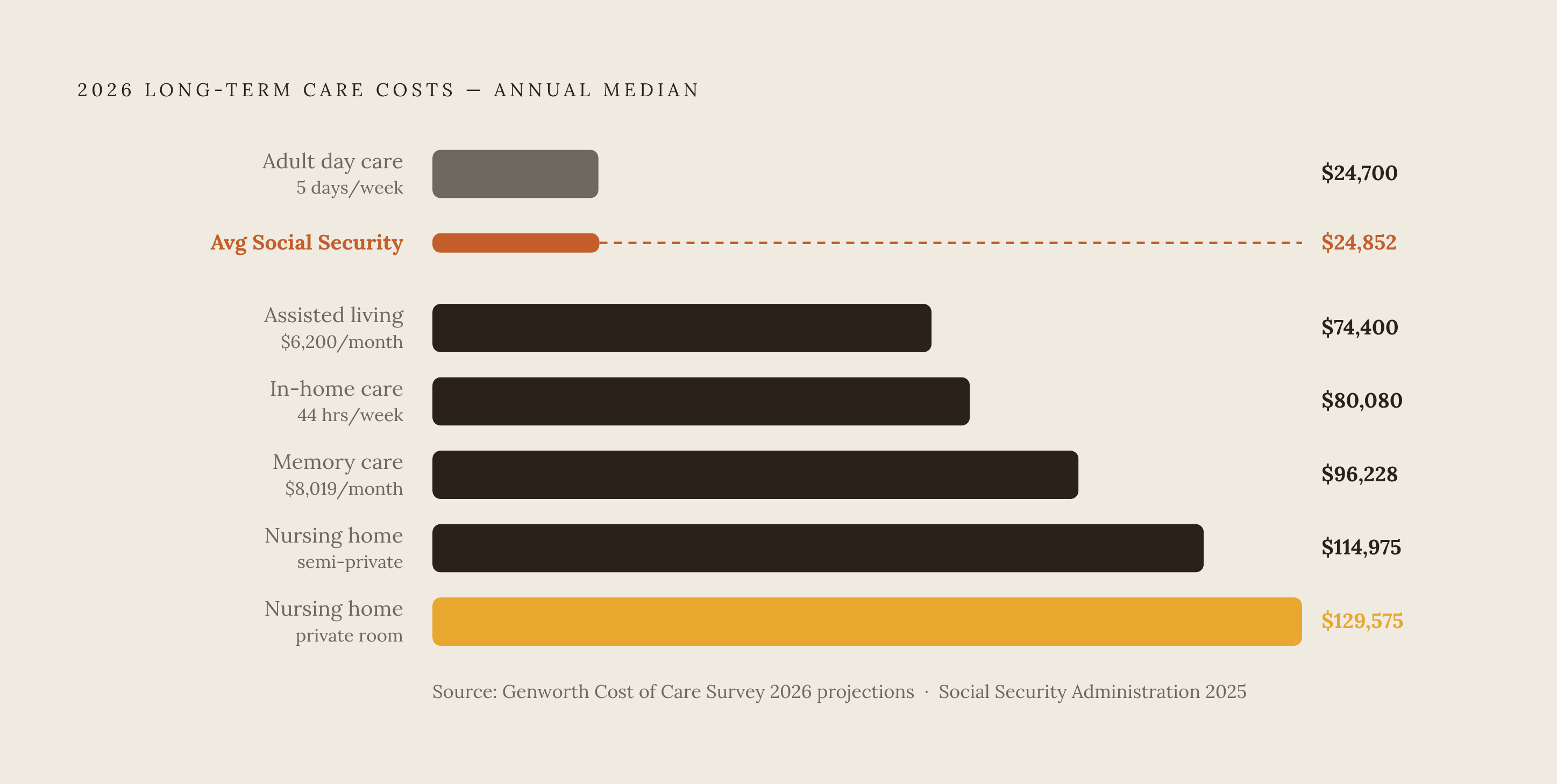
In-home non-medical care runs a national median of $35 an hour, a 3% increase year over year. That sounds manageable until it's stretched across a real week. At 44 hours a week, the kind of coverage a family needs once part-time help isn't enough, annual cost hits $80,080. Part-time help, something like 20 hours a week, remains affordable for families who can share caregiving duties among relatives. Once someone needs supervision around the clock, paid in-home care can cost more than a facility, because home care means paying for one person's undivided time rather than staff shared across many residents.
Adult day care is one of the few bright spots in this whole picture. The national median is near $95 a day, or about $24,700 a year at five days a week, and it's one of the rare settings where cost actually dropped, roughly 5%, from the prior year. For families juggling a working caregiver and a parent who needs daytime supervision but not full residential care, it's a genuinely useful budget lever.
Assisted living tells a different story. CareScout's 2025 survey puts the national median at $6,200 a month, or $74,400 a year, a 5% jump from the year before. SeniorLiving.org's research lands slightly higher, at $6,313 a month ($75,756 annually). Even the least expensive states hover close to $5,000 a month, more than double the average Social Security benefit of $2,071 a month as of January 2026. The spread between states is wide: Mississippi comes in lowest at $4,715 a month, Hawaii highest at $12,000, per SeniorLiving.org data. Watch for the trap that catches families constantly: communities advertise a base rate, then stack "level of care" fees on top as needs increase. Always ask for the all-in monthly number.
Memory care runs higher still, a national median of $8,019 a month per SeniorLiving.org, typically 15% to 25% above standard assisted living. Alzheimer's and related dementias are projected to cost the country $818 billion in 2026, according to the USC Schaeffer Institute, and family members are expected to provide 6.8 billion hours of unpaid care this year, valued at $237 billion. Most of that financial weight lands directly on families, not institutions. If a loved one is already in assisted living racking up heavy level-of-care add-ons, moving into the memory care wing of that same community sometimes costs less overall, because specialized care gets bundled into the rate instead of billed piece by piece.
Nursing homes are at the top of the cost ladder. CareScout's 2025 numbers show a private room at $355 a day ($129,575 a year) and a semi-private room at $315 a day ($114,975 a year). SeniorLiving.org's June 2026 figures run a bit higher: $376 a day for private ($11,294 a month) and $328 for semi-private ($9,842 a month). State variation here is enormous, semi-private room costs vary dramatically by state, a difference of many thousands of dollars a month for the same category of care. If current projections hold, the monthly cost of a semi-private room reaches roughly $11,077 by 2030, a 12.5% increase from today. Costs have broadly kept climbing into 2026, driven in part by labor shortages that pushed wages for qualified in-home caregivers higher in recent years.
Medicaid as the primary long-term care payer
Medicaid is the largest payer of long-term care in the country, covering roughly two-thirds of nursing home residents nationally. But it only reaches people who meet strict state income and asset limits, and those limits are tight by design: applicants generally must spend down countable assets to very low levels, with monthly income subject to strict state-set caps. Medicaid's five-year look-back period adds another layer of friction. Transfer assets too close to the application date, and the penalty period can delay eligibility for months, sometimes longer.
One gap trips up families who assume Medicaid coverage is complete once they qualify: Medicaid coverage in assisted living settings is often limited in scope. Depending on the state, significant costs may still come out of pocket even after Medicaid approval. That distinction alone can add thousands of dollars a month back onto a family's ledger even after Medicaid approval.
A large population is dually eligible for both Medicare and Medicaid, and this group faces particular exposure to policy shifts underway right now. Proposed federal legislation is projected to significantly cut Medicaid spending over the next decade, according to ElderLawAnswers, and new administrative barriers to enrollment and renewal have been introduced. Dual-eligible older adults could feel this first, because Medicaid often fills in exactly what Medicare leaves out, home care, dental, vision, hearing, and those are the categories states tend to trim when budgets tighten.
None of this makes Medicaid a program to write off. It remains the backbone of long-term care financing for millions of families, and for those who qualify, it can cover costs no private budget could absorb alone. But its scope is not fixed, and treating it as a guaranteed safety net, rather than one piece of a plan that still needs personal savings behind it, is its own kind of risk.
What Social Security, VA benefits, and long-term care insurance contribute to the budget
Start with the plain arithmetic. The average Social Security benefit was $2,071 a month as of January 2026, less than half the cost of even the cheapest assisted living communities in the country. It covers groceries, utilities, and basic living costs reasonably well. It was never built to carry the weight of long-term care, and it doesn't.
Veterans and their spouses have another lever available, one that goes underused largely because awareness of it stays low and the application itself is dense. The VA's Aid and Attendance benefit, at 2026 rates effective December 1, 2025 and including a 2.8% cost-of-living adjustment, pays up to $2,874 a month for a married veteran, a lower rate for a single veteran, and a separate rate for a surviving spouse. It's tax-free, and it can meaningfully offset the cost of in-home care or assisted living when stacked against other income sources. Families who qualify and never apply are leaving real money on the table every month.
Long-term care insurance is the piece almost nobody holds. Only 11% of people who face something close to a 70% lifetime chance of needing paid care have actually bought a policy. That's not a small planning gap, it's close to a structural absence of protection across the entire retiree population.
So what actually bridges the distance between fixed income and real care costs? In practice, families stack multiple sources at once: Social Security, retirement savings, pension income, proceeds from selling a home, contributions from adult children, and, for the fortunate few, long-term care insurance payouts. No single source does the job alone, and pretending otherwise is exactly how budgets built around Social Security plus savings collapse the moment nursing home or memory care costs enter the picture.
Building a layered budget across care settings and income sources
Care needs escalate over time, and a budget that only models today's situation is already out of date. In-home care at $35 an hour and a nursing home at $355 to $376 a day are two entirely different financial universes, and most people will move through more than one setting as needs change. Planning has to account for that progression.
Facility care often becomes the cheaper option compared to one-on-one home care once paid in-home help reaches roughly 40-plus hours a week, since facility care relies on a shared staffing model. Somewhere around 40-plus hours a week of paid in-home help, facility care, with its shared staffing model, often becomes the cheaper option compared to one-on-one home care. Knowing that number ahead of time changes the decision from a reactive scramble into a planned transition.
Geography is a lever too, and a surprisingly large one. The gap between Mississippi's $4,715 monthly assisted living median and Hawaii's $12,000 isn't a rounding error, it's tens of thousands of dollars a year, and it means where a parent lives, or is willing to relocate to, functions as a real financial decision rather than a lifestyle preference.
From there, the budget builds in layers. The first is the Medicare baseline: understanding precisely what's covered (short-term skilled care) versus what isn't (long-term custodial care), so expectations match reality from day one. The second layer is benefits programs, actively checked before any private dollar gets spent: VA Aid and Attendance eligibility, Medicaid waiver programs, and state-level caregiver compensation programs that many families qualify for and simply never apply to. The third layer is long-term care insurance, evaluated honestly against age, health, and the likely trajectory of care needs, since it only makes economic sense if purchased early enough to be affordable. The fourth layer is personal assets: retirement savings, home equity, and family contributions, the funds that fill whatever gap remains. The $185,500 lifetime out-of-pocket health care estimate, which explicitly excludes long-term care, functions as a floor here, not a ceiling, for savings targets.
AI-driven benefit screening tools, the kind that can instantly surface which Medicare, Medicaid, and caregiver compensation programs a household actually qualifies for, have become a legitimate first step for families overwhelmed by how fragmented this system is. Benefits programs aren't a fallback to consider after private savings run out, and these tools make benefit discovery fast and free. They're supposed to be checked first, since every dollar of benefit identified early is a dollar of private savings that doesn't need to get spent.
A short list of starting moves makes this concrete. Request itemized, all-in quotes from at least three facilities in the target area, not the marketing rate. Check VA eligibility for any veteran or surviving spouse in the family. Understand Medicaid's look-back window and asset limits before making any transfers. Model the crossover point between in-home and facility care given realistic hours of need. And revisit the whole plan annually, because 2026's Medicare Advantage disruption and the Medicaid cuts moving through federal policy are proof that this landscape shifts faster than most household budgets are built to track.
Sources
- How Much Does Assisted Living Cost in 2026?
- Out-Of-Pocket Health Care Costs For People Retiring In 2026 Estimated At $185,500, Up 7.5% From 2025 - OPEN MINDS
- Nursing Home Costs in 2026 by State and Type of Care
- Blue Moon Insurance: Your 2026 Medicare Guide
- 2026 Health Care Costs in Retirement: Top Expenses & Estimates | U.S. News
- The Cost of Senior Care is on the Rise
- carescout.com
- elderlawanswers.com