Social Security Credits Lost to Caregiving
Unpaid caregiving can cost women over $295,000 in lifetime Social Security benefits.
Social Security's benefit formula runs on a simple mechanical fact: it counts a worker's 35 highest-earning years, and unpaid caregiving contributes exactly none of them. Two failure modes follow, credits that never accrue, and zero-earning years that drag down a lifetime average, and together they quietly cut retirement income for the very people already sacrificing income to care for someone else. This piece traces how that math works, who absorbs it, what's moving in Congress right now, and what a caregiver can actually do with the system as it exists today, not the one that might exist someday.
Start with the mechanics, because they explain everything downstream. Social Security bases retirement benefits on a worker's 35 highest-earning years, and credits accumulate only from earnings that pass through payroll taxes or get reported as self-employment income. Qualifying for any benefit at all takes 40 credits, roughly 10 years of covered work, and in 2026 a full year's four credits requires $7,560 in reported wages. Unpaid caregiving generates none of that. Not partial credit, not a prorated fraction. Zero reported income, zero credits, every single year. As of June 2026, no federal law grants Social Security credit for unpaid family care, so someone who spends a decade managing a parent's medications and doctor visits gets treated by the SSA's formula exactly like someone who never worked at all during that decade. That is an outcome the system was built to produce rather than an edge case it failed to anticipate. It's the design working precisely as built, and the people it shortchanges most are the ones who can least afford it.
Two distinct harms follow, and the second is far less understood than the first. The obvious one: a caregiver might never hit the 40-credit threshold needed to qualify for benefits at all. The quieter one hits people who do qualify anyway, because their zero-earning years still get folded into the 35-year average, dragging the benefit down permanently. Picture someone who worked 20 years, then spent 10 years caregiving with no income. The SSA still needs 35 years of earnings history to run its calculation, so those 10 caregiving years enter as zeros, and the remaining five years get filled by whatever early, low-earning years exist in the record, often the least representative years of that person's career. A third effect compounds it further: workforce gaps depress wages when caregivers eventually return to paid work, so even the years after caregiving ends come in lower than they would have without the gap, according to Capita's August 2025 analysis. This is a recurring deduction rather than a one-time one. It's structural, and it follows the caregiver for the rest of their working life.
Who is actually doing this work, and how much of it
In 2025, 63 million American adults provided ongoing care to an adult or child with a medical condition or disability, according to a national caregiving survey, a substantial share of American adults, and a 45% increase since the same survey series ran in 2015. The growth rate matters more than the raw count here. This is a substantial population absorbing a real, non-trivial cost. It's an expanding one, moving toward the center of the labor force rather than sitting at the edges of it.
The scale of labor involved deserves sitting with rather than skimming past. The 59 million caregivers tending to adults provided 49.5 billion hours of care in 2024, valued at an average of $20.41 per hour, for a total economic contribution of $1.01 trillion, according to AARP's Valuing the Invaluable 2026 report. In workforce terms, that's roughly 24 million full-time workers, about 17% of the entire national workforce, per an AARP press release from March 2026. That $1.01 trillion figure exceeded total federal, state, and local Medicaid spending in 2024, which came in at $932 billion. Caregivers, in aggregate, contribute more economic value than the country's largest safety-net health program spends to provide care.
Timing is where the damage compounds. The median caregiver age is 50.1 years, squarely inside the peak earning window, the years when retirement savings and Social Security credits should be compounding fastest rather than stalling out. Average time commitment runs 23.7 hours per week, and 24% of caregivers put in 40 or more hours weekly, functionally a full-time job displacing paid work. Nearly 29% have been at it for five years or more, with the average caregiving episode lasting 4.5 years, and separate reporting (via Fortune, cited by the Epoch Times) puts average total workforce exit at around six years. These aren't people on the margins of the labor market. They're mid-career workers pulled out at the exact moment their earnings, and their Social Security credits, should be peaking.
What those zero-earning years actually cost over a lifetime
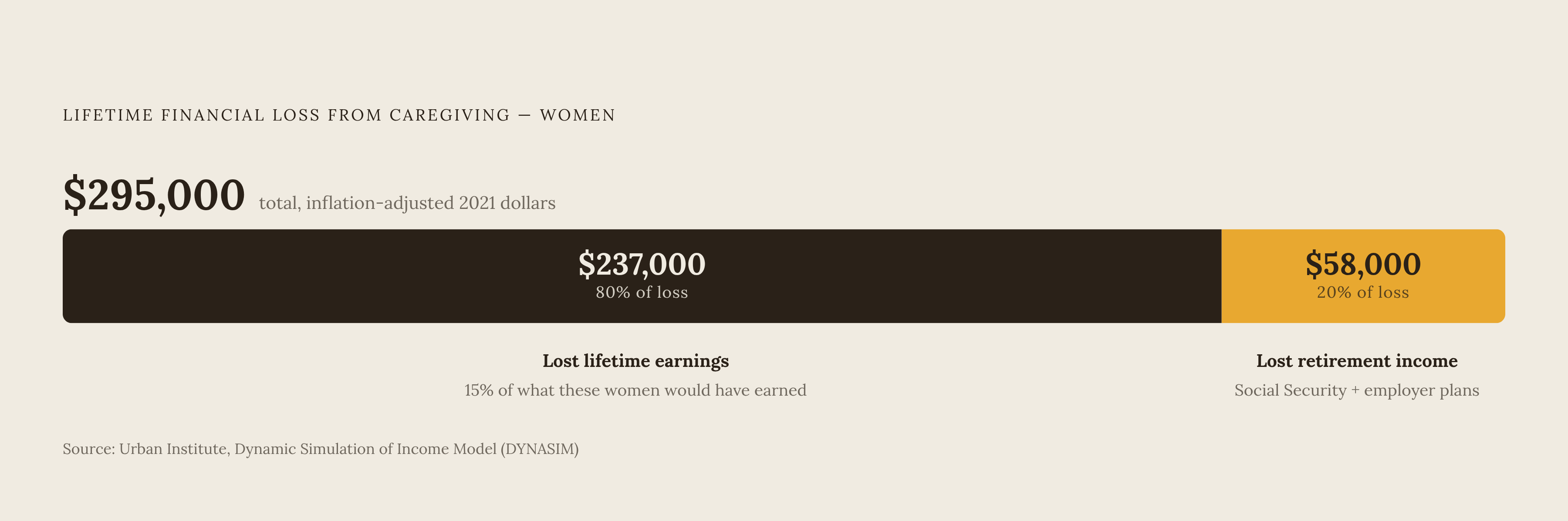
The Urban Institute's Dynamic Simulation of Income Model put a number on what caregiving costs women over a lifetime: an average of $295,000 in forgone lifetime income, in inflation-adjusted 2021 dollars. The composition of that figure matters as much as the total. About 80% of it, roughly $237,000, comes directly from lost lifetime earnings, representing 15% of what those women would have earned without caregiving. The remaining 20%, about $58,000, comes from lost retirement income, Social Security and employer-based retirement plans combined. The earnings hit is the larger piece, sure, but the retirement hit is a substantial cost in its own right. It's tens of thousands of dollars that would otherwise have compounded for decades.
The MetLife Study of Caregiving Costs arrives at a similar order of magnitude from a different angle, putting average lifetime loss for caregivers 50 and older at $303,880. Split by gender, women average $324,044 in lifetime loss, men $283,716. Separately, Capita's August 2025 research finds that women who leave the workforce to provide care can lose up to 20% of their Social Security benefit compared to women who work continuously. That is a recurring hit rather than a one-time one. It's a 20% haircut applied to every single monthly check for the rest of a woman's life.
What these averages don't capture matters too, because they flatten the tails. A caregiver who leaves the workforce for longer than 4.5 years, who had lower pre-caregiving wages to begin with, or who never crosses the 40-credit threshold at all, is looking at losses steeper than these figures suggest. Perhaps the most unsettling part of the mechanism is how silent it runs. No notice arrives in the mail. No statement warns anyone, mid-decision, that stepping away this year just shaved a few thousand dollars off a benefit check three decades out. The erosion sits invisible until retirement, at which point it's already locked in.
Why the damage lands hardest on women, and compounds further for women of color
Women make up a disproportionate share of unpaid caregivers. That alone concentrates the damage described above disproportionately on women. Add a second fact: women live longer on average, so a reduced monthly benefit has to stretch across more years, and women are more likely to outlive whatever retirement savings they've managed to set aside. The caregiving penalty and the longevity gap don't just coexist here. They compound each other, one making the other worse over time rather than sitting side by side as separate problems.
The benefit numbers confirm it. As of December 2024, women 65 and older received an average Social Security benefit of $1,808 per month, compared to $2,215 for retired men, a gap of $407 monthly, according to the National Women's Law Center. Among beneficiaries 85 and older, the oldest and most economically exposed cohort, 62% are women, per SSA data from December 2025. Timing of claiming makes it worse still: 64.9% of women claim benefits before reaching full retirement age, compared to a lower share of men. Reduced income during caregiving years often forces that early claim, which locks in a permanent additional reduction stacked directly on top of the credit gap already baked into the benefit formula.
The gap isn't uniform across states, either. FinanceBuzz's state-by-state analysis, cited by TheStreet in June 2026, found Utah with the widest gender gap in Social Security benefits at 27.04%, meaning women there receive $649 less per month than men. Louisiana follows at 25.89%, Wyoming at 23.89%. The District of Columbia has the narrowest gap, at 8.36%, or $174 monthly. That range, from $174 to $649, says something concrete about how state labor markets, wage histories, and caregiving norms interact with one federal formula to produce wildly different local outcomes.
Race adds a layer the national averages hide entirely. Black and Hispanic families are more likely to take on intensive caregiving with fewer financial protections in place, according to reporting in The Hill from May 2026, and the consequence shows up starkly at retirement: retired women of color experience two to three times the poverty rates of white women, according to a UCSF School of Nursing report. The broader trend for older women is moving the wrong direction, too. The Supplemental Poverty Measure rate for older women rose from 15.0% in 2023 to 16.2% in 2024, while it held flat for older men at 13.5%, per NWLC data, and women 80 and older post the highest rate of all, at 21.0% in 2024. Yet Social Security, for all its structural blind spots around caregiving, still lifts millions of women 65 and over out of poverty each year. Sit with that contradiction for a second: the program does enormous work keeping older women out of poverty, even as its own benefit formula is one of the mechanisms pushing them toward the edge in the first place.
The fiscal argument for why the current arrangement is self-defeating
Ask who actually benefits from unpaid caregiving as it's currently structured. Honestly, Medicaid is the answer. Medicaid, the nation's primary payer for long-term services and supports, typically only steps in after families have exhausted their own time, income, and savings. Informal caregivers delay or prevent costly institutional placement, which means the $1.01 trillion in economic value caregivers provided in 2024, again, more than total Medicaid spending that year, is value the public system is already capturing without paying for it, at least not to the people generating it.
The core problem is straightforward: society is paying for the consequences of uncredited caregiving, just at the wrong point in time. Reduced Social Security benefits, the direct result of the credit gap and the zero-earning years described earlier, force former caregivers to lean more heavily on Medicaid and Supplemental Security Income once they reach old age themselves. That's not eliminating the cost. It's shifting it, from a smaller, earlier bill (crediting caregiving work as it happens) to a larger, later one (means-tested support for impoverished retirees who spent their prime earning years unpaid). Whoever designed the current arrangement to save money on the front end built in a bigger bill on the back end. That's the trade nobody voted for.
The solvency clock makes this urgent rather than academic. Social Security's trustees have projected that a major retirement trust fund faces a finite window before automatic benefit reductions would kick in absent legislative action. Women make up 55% of beneficiaries 62 and older, meaning that reduction lands on checks already diminished by caregiving-related credit gaps. Any conversation about shoring up Social Security's finances that skips over who's already absorbing the caregiving penalty is working from an incomplete ledger, plain and simple. The population most exposed to a future benefit cut is the same population the current formula is already shortchanging.
Legislative proposals that would directly address the credit gap
Two bills, moving on different tracks, aim at this problem from different angles, and neither has passed. The Social Security Caregiver Credit Act, introduced in the 118th Congress as S. 1211 / H.R. 3729, would amend Title II of the Social Security Act to credit caregivers of dependent relatives with deemed wages for up to five years of service. Referred to a legislative finance committee and reintroduced in April 2026, it drew a press release from Gillibrand citing 4.1 million New York residents who served as caregivers in 2025 alone, providing more than 2.6 billion hours of hands-on care, a figure meant to illustrate the scale of what's going uncredited in a single state. The bill has drawn endorsements from advocacy organizations focused on caregiving and retirement security.
The Credit for Caring Act takes a different approach entirely, and the difference is worth sitting with. Introduced in 2024 and reintroduced in March 2025 under new bill numbers (a piece of legislation). 2036 and S. 925), it proposes a nonrefundable federal tax credit, not a Social Security credit, reimbursing eligible caregivers for a percentage of qualifying caregiving expenses, up to an annual cap. A number of states have introduced or enacted their own versions of caregiver tax credit legislation. It's a fix aimed at current expenses, not one that touches the lifetime earnings record determining future benefits, which means it does nothing for the credit gap this piece has spent most of its length describing.
The credit-based proposals carry a design flaw that undercuts exactly the people they're supposed to help most. Capita's August 2025 analysis points out that several versions peg deemed wages to half of the average wage index, currently a bit above $34,000. Caregivers who were earning at or above the average wage before stepping away would see no net benefit from that formula, since the deemed wage sits below what they were already on track to earn. Higher earners forced to sacrifice a lucrative career for caregiving get the least out of the bill written to help them, which is backwards on its face. A separate report from UCSF, "Breaking the Social Security Glass Ceiling," calls for caregiver credits as part of a broader package that also raises survivor benefits to 75% of a couple's combined benefit. Capita's own conclusion lands pragmatic rather than sweeping: if universal caregiver credits prove fiscally infeasible given trust fund solvency concerns, targeted credits aimed at lower- and moderate-income households, or at parents of very young children specifically, are the more realistic near-term path. None of it, as of current research, has been enacted into law, and no caregiver should plan around the assumption that it will be soon.
What caregivers can do now, before any legislation passes
Given how far off any of this legislation sits, the more useful question is what a caregiver can do today, inside a system that isn't built to credit the work at all.
Start with the earnings record itself. Checking it regularly through ssa.gov matters because errors in recorded earnings directly reduce future benefits, and those errors only get corrected if someone catches them first. It's a five-minute check that costs nothing and occasionally catches a five-figure mistake.
For married caregivers, the spousal benefit works as a structural backstop worth understanding well before it's needed. A spouse who didn't accumulate enough credits on their own record can claim up to 50% of the higher-earning spouse's benefit, though this requires at least one year of marriage (10 years if divorced), and the higher earner must already be claiming. Survivor benefits go further: a widow or widower can claim up to 100% of a deceased spouse's benefit under current law. Neither should be treated as a plan on its own. They're a fallback, and fallbacks work only when someone understands them long before the moment they're actually needed.
For caregivers still able to work part-time, even modest reported earnings during caregiving years matter more than they might seem to. Displacing even one zero-earning year in the 35-year average can meaningfully raise the eventual benefit, given how the SSA's formula weights those years. And for anyone with financial flexibility, delaying the claim past full retirement age increases the monthly benefit for every year of delay, which matters more, not less, for caregivers whose base benefit already took a hit from zero-earning years.
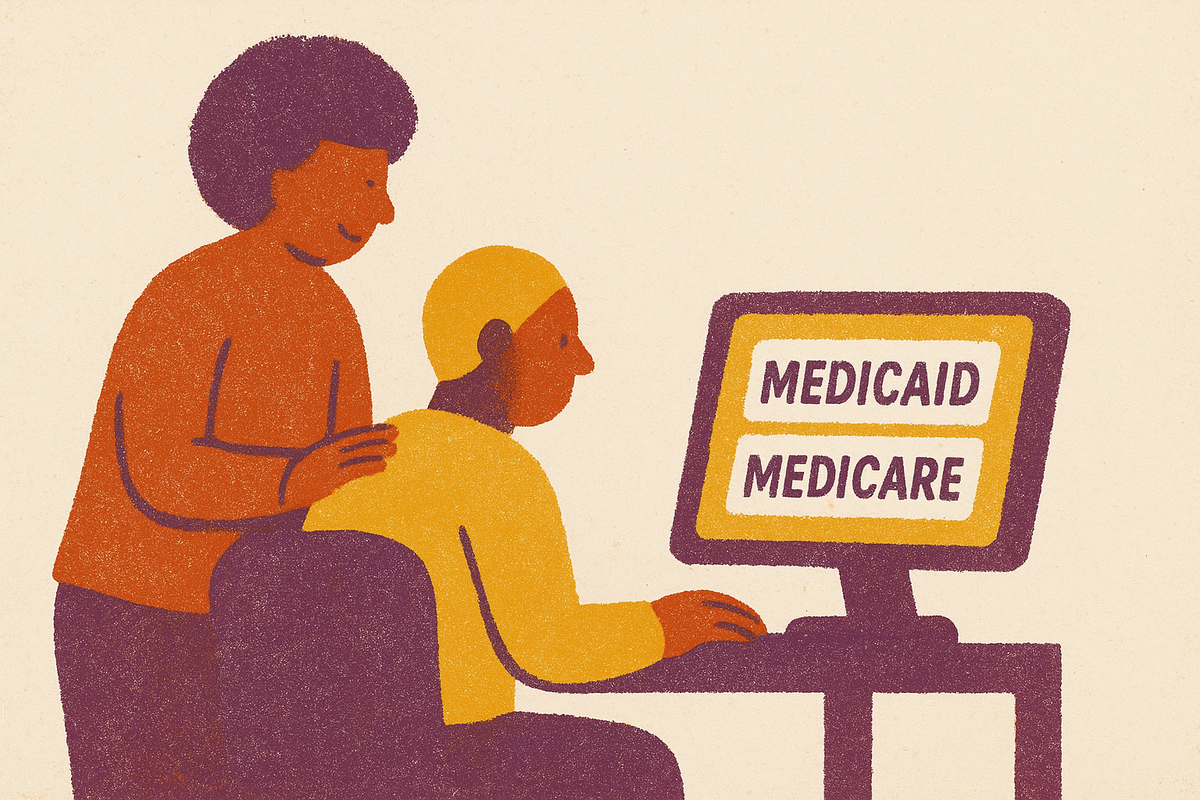
One option gets overlooked constantly, and it shouldn't. Paid caregiving programs already exist in many states. Medicaid-funded programs, Consumer-Directed Personal Assistance programs among them, allow family members to be compensated for the care they're already providing, which converts unpaid hours into reported wages, and reported wages count toward Social Security credits. Eligibility varies by state, by the care recipient's Medicaid enrollment status, and by the specific rules of the program in question, and that variability is a large part of why so many eligible families never find their way into these programs at all. The system is opaque by default. Families who qualify for compensation often have no idea the option exists, and no straightforward path to finding out, which is exactly the gap that AI-powered benefit discovery tools are starting to close, surfacing which Medicaid-funded caregiver compensation programs a specific family qualifies for and walking them through enrollment.
Finally, a financial planner familiar with Social Security optimization can model the specific dollar impact of a caregiving gap on an individual's benefit and help identify which combination, part-time work, delayed claiming, spousal benefit coordination, does the most to offset the damage in that particular case. The math here isn't generic. It depends on exact work history, exact gap length, and exact state programs available, which is precisely why the averages cited throughout this piece are a starting point for understanding the problem, not a substitute for running the numbers on any one caregiver's actual situation.