Medicare Plan F vs Plan G for New Enrollees
Plan G is now the most complete option for new enrollees since Plan F closed to new buyers.

Plan F stopped taking new customers on January 1, 2020. That single date reshaped the Medigap decision for everyone turning 65 after it, and Plan G, not Plan F, is now the real starting point for the comparison that matters: what it costs, what it leaves uncovered, and why that one gap barely moves the math.
The Medicare Access and CHIP Reauthorization Act of 2015 (MACRA) is the law behind the change. Congress didn't ban Plan F. It closed the door to new buyers while letting existing policyholders keep what they had, and the cutoff runs on eligibility date, not enrollment date, a distinction that trips up more people than it should. Someone who became eligible for Medicare before January 1, 2020, whether through turning 65 or qualifying earlier via disability or ESRD, can still buy Plan F today even if they delayed enrolling in Part B until later. Someone who turned 65 in 2021 can never buy it, no matter when they actually sign up for Part B. Two people applying for Medigap on the same afternoon in 2026, one who turned 65 in late 2019 and one who turned 65 in early 2021, land in entirely different markets: the first can still walk away with a Plan F policy, the second cannot.
Plan C fell under the same rule for the same reason. Both plans paid the Part B deductible for the enrollee, and lawmakers believed that first-dollar structure dulled cost-consciousness and pushed utilization higher across the system. Whether that theory fully holds up is a separate argument, but it's the one Congress acted on.
One note before going further: Massachusetts, Minnesota, and Wisconsin standardize Medigap plans differently than the rest of the country, so letter-based comparisons don't translate directly if the enrollee lives in one of those three states.
What Plan G actually covers, and the one gap it leaves
With Plan F closed to new buyers, Plan G is now the most complete Medigap plan a new enrollee can purchase. It covers Part A coinsurance and hospital costs in full, including up to 365 extra days of hospital care once regular Medicare benefits run out, and it covers the Part A deductible, set at $1,736 per benefit period in 2026. It picks up the 20% coinsurance under Part B that Original Medicare leaves unpaid, and it covers Part B excess charges, the extra amount a doctor can legally bill above what Medicare approves in states that allow it.
Skilled nursing coinsurance, $217 a day for days 21 through 100 in 2026, is covered in full. So is the hospital coinsurance for extended stays, $446 a day for days 61 through 90. Plan G also pays 80% of foreign travel emergency costs after a $250 annual deductible, up to a lifetime cap of $50,000, and it covers the first three pints of blood in a transfusion, a benefit that sounds oddly specific until someone actually needs blood and discovers Original Medicare doesn't cover it on its own.
The one place Plan G doesn't reach is the Part B deductible: $283 in 2026, up from $257 in 2025. The enrollee pays that amount out of pocket before Plan G coverage kicks in for the year. It's a small number next to everything else Plan G covers, but naming it clearly matters, because it's the entire basis of the cost comparison in the next section. Neither Plan F nor Plan G touches prescription drugs, long-term care, private-duty nursing, dental, vision, or hearing aids. Those need separate coverage no matter which letter someone picks.
Medigap benefits are federally standardized, so every insurer selling Plan G in a given state has to offer the identical set of benefits just described. What varies is only the premium, and that fact matters more than it sounds like it should. It comes up again in the section on comparing quotes.
High-Deductible Plan G is one more variant. It carries a $2,950 deductible in 2026 that the enrollee pays before any coverage begins, in exchange for a much lower monthly premium. It's a real option for people comfortable with more upfront risk, and it gets its own numbers in the next section.
The arithmetic that makes Plan G the better value in almost every scenario
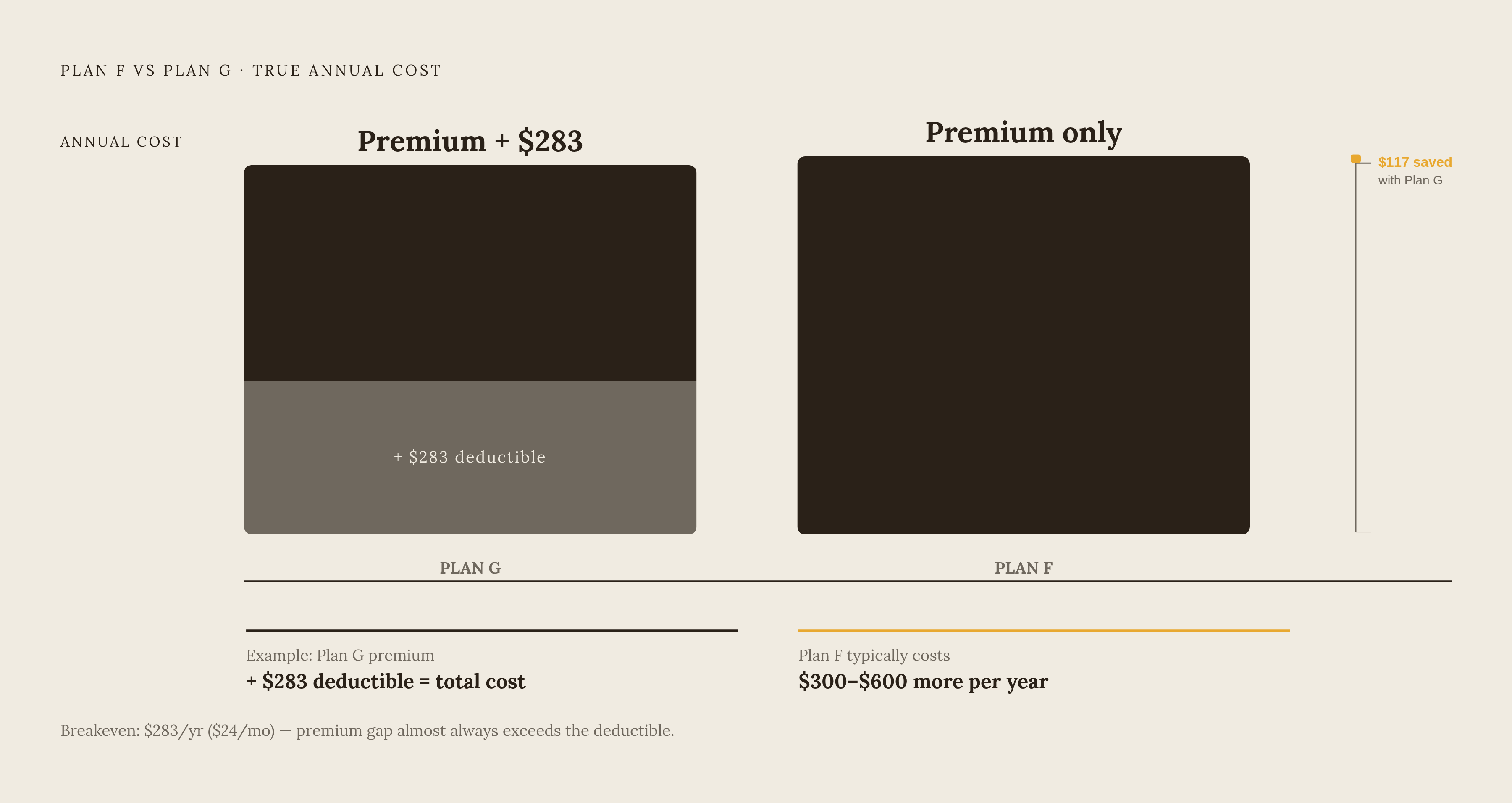
Here's the test that actually settles the Plan F versus Plan G question for most people: add Plan G's annual premium to the $283 Part B deductible, then compare that total to Plan F's annual premium. In most states, Plan G's total comes in lower, often by a wide margin, and Plan G wins on cost.
The premium gap is what makes the math work. In most states, Plan G runs $300 to $600 less per year than Plan F, and the breakeven point is around $24 a month. If Plan G saves more than that relative to Plan F, the savings outweigh paying the Part B deductible out of pocket. Take a simple version of it: if Plan F costs $400 more per year than Plan G, and the Part B deductible that year is $257, the enrollee still comes out $143 ahead by choosing Plan G. Scale that over ten or twenty years of retirement and the number stops being trivial.
What does Plan G actually cost a new enrollee in 2026? The range runs wide, roughly $140 to over $400 a month, depending on age, ZIP code, gender, tobacco use, and whether an insurer offers a household discount. At age 65 or 66, the average monthly premium is around $143, climbing to roughly $319 by age 98, based on 2025 data. Averaged across all Plan G policyholders, the monthly premium rose from $159 to $180 between 2025 and 2026, a jump that says something about where Medigap pricing is headed generally, not just for this one plan.
High-Deductible Plan G offers a cheaper entry point for enrollees willing to carry more of the early-year risk themselves. Its average monthly premium in 2025 was $57.92, or $695 a year, roughly a third of what standard Plan G costs. The trade-off is direct: the enrollee covers the first $2,950 in Medicare-eligible costs each year before HDG coverage activates. That structure suits someone in solid health who wants a safety net against a catastrophic bill without paying for first-dollar coverage they may not use.
2025 brought some of the steepest Medigap rate increases in recent memory, ranging from roughly 8% to 50% depending on the carrier and state. That kind of spread is exactly why getting the plan choice right at enrollment, rather than assuming a switch later will be easy or cheap, carries real weight.
Why Plan F's closed risk pool makes its premiums a long-term liability
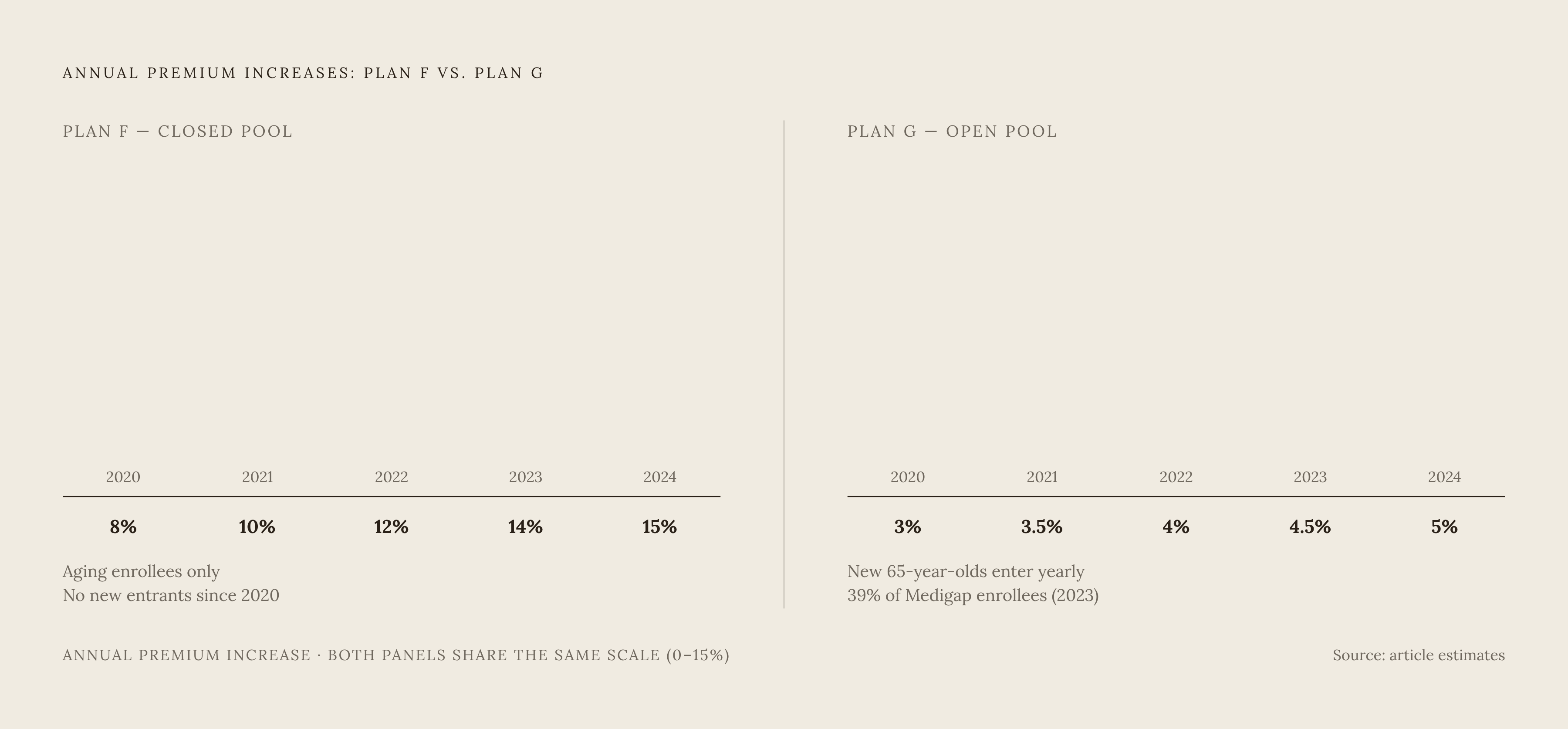
Since January 1, 2020, nobody newly eligible for Medicare has been able to join the Plan F risk pool. That pool only ages from here. It never gets refreshed with a new cohort of healthy 65-year-olds the way Plan G's pool does every single year, and that difference is the whole argument against choosing Plan F even for someone who technically still can.
Insurance pricing runs on risk pooling. A pool where the average age keeps climbing generates more claims per member over time, and more claims push premiums up, which in turn pushes younger or healthier members to look elsewhere if they're able to, which leaves the pool even older and costlier on average. Actuaries call this pattern block aging, and it tends to compound rather than level off. Before 2020, a steady stream of new 65-year-olds entering Plan F each year helped spread the cost of older, sicker members across a broader base. That mechanism is gone now, permanently, with no legislative fix on the horizon to bring it back.
The numbers already show the split. Many Plan F policyholders have seen annual premium increases of 8% to 15%. Plan G's typical annual increase has run 3% to 5%, meaningfully lower, because its pool keeps drawing in new, younger members every year as people turn 65. As of 2023, 39% of all Medigap enrollees, close to 5.3 million people, were on Plan G, and that share grows every year a fresh class of 65-year-olds enrolls. A larger, continuously refreshed pool behaves more predictably than one that can only shrink and gray.
This is more than an abstract actuarial concern. Leaving Plan F later, once someone's already locked in, usually means passing medical underwriting outside a guaranteed-issue window, and insurers can ask about health history and price accordingly, or decline the application. The decision about which plan to enter has to weigh more than year-one premiums, then, because it's a one-way door for a lot of people. The long-term premium trajectory belongs in that decision from day one, not just the number on the first bill.
When the enrollment window closes and what happens if you miss it
The Medigap Open Enrollment Period starts the first day of the month someone is both 65 or older and enrolled in Medicare Part B, and it lasts six months. During that window, any Medigap plan sold in the state is available without medical underwriting, regardless of health history. For most people, this is the only federal guaranteed-issue window they'll ever get for Medigap in their lifetime.
Once that window closes, switching plans in most states means going through medical underwriting again. Insurers can decline an application or charge more based on pre-existing conditions. That's the practical stakes behind the enrollment timing question, and it's why the choice between Plan G and anything else deserves attention before the six months run out, not after.
A handful of states soften this. California, Idaho, Illinois, Maryland, Oregon, Nevada, Louisiana, Oklahoma, Utah, Virginia, and several other states have some version of a birthday rule, giving enrollees an annual window around their birthday to switch to a plan with equal or lesser benefits without underwriting. New Mexico is set to join that list in 2027. New York and Connecticut go further still, allowing Medigap enrollment at any time without underwriting at all.
Medicare Advantage and Part D run on their own annual open enrollment period, October 15 through December 7, a point worth clearing up because it confuses a lot of new enrollees. Medigap doesn't follow that calendar. The two systems get lumped together in casual conversation, but they run on entirely separate timelines, and assuming Medigap works like Part D enrollment is a mistake that can cost someone their guaranteed-issue protection permanently.
Where Plan N fits for new enrollees who want lower premiums and can accept more exposure
Plan N sits one tier below Plan G in coverage, and it deserves to be understood on its own terms rather than treated as a discount version of Plan G. It doesn't cover Part B excess charges, and it comes with small copays for office visits and emergency room visits that don't result in admission.
Who does that suit? Someone whose doctors accept Medicare assignment, meaning excess charges never come into play to begin with, and someone who doesn't see specialists often enough for the copays to add up to real money. For that profile, Plan N's gaps stay small and cheap in practice even though they exist on paper.
Plan N holds a meaningful share of Medigap enrollees. Combined with Plan G and the closed Plan F, these three plans dominate the Medigap market, which says most people choose among a fairly narrow set of options despite the full alphabet of plans technically available. The trade-off is direct: a lower premium buys less certainty. If health needs grow, or if a beneficiary ends up seeing a doctor who doesn't accept assignment, out-of-pocket exposure rises, and moving back to Plan G later runs into the same underwriting wall described above.
For most new enrollees who value predictability and want coverage that's about as complete as anything left on the market since Plan F closed, Plan G remains the stronger default. Plan N works for a specific kind of enrollee, one who's made peace with some variability in exchange for a lower bill every month. It was never built to be simply the cheaper version of the same decision, and treating it that way misreads what it's actually for.
How to compare Plan G quotes and find qualified enrollment help
Since coverage is standardized by law, comparing Plan G across insurers comes down to price, the company's financial stability, and its history of rate increases over time. That's a narrower, more honest comparison than shopping for most other kinds of insurance, where benefit differences muddy the price comparison before it even starts.
Premiums still vary a fair amount person to person, driven by age, ZIP code, sex assigned at birth, tobacco use, marital status, and whether an insurer offers a household discount. As a market reference point, the average monthly premium across all current Medigap enrollees, of any plan letter, was $217 in 2023, according to KFF. That figure is a useful anchor, but individual quotes swing well above or below it depending on the factors just listed.
Medicare's own Medigap Plan Finder tool, at medicare.gov, lets someone compare plans and rates by ZIP code directly. Working with an independent licensed agent, one who isn't captive to a single insurance company, opens up rate comparisons across multiple carriers at once rather than one company's price in isolation. Newer AI-assisted benefit discovery tools have also started to help here, surfacing which Medicare and supplemental programs a specific household actually qualifies for and walking enrollees through the fuller picture of available coverage before they commit to a plan structure. Programs and subsidies get missed constantly simply because the system is complicated, and tools built to catch that gap are worth a look before finalizing a decision.
The six-month Medigap Open Enrollment window doesn't repeat in most states, so acting inside it, with quotes already gathered, is what avoids the underwriting risk described earlier. For anyone newly eligible for Medicare, Plan G is the sensible starting point for a serious Medigap comparison. Plan F simply isn't on the table anymore for this group, and the premium-plus-deductible math, in state after state, keeps landing on Plan G as the stronger long-term value.