AI tools that help families enroll in Medicaid and Medicare
Most AI enrollment tools automate paperwork, not the human help that actually keeps people covered.
Roughly 25 million people lost Medicaid coverage after pandemic-era protections ended, and 69% of them were disenrolled for procedural reasons: missed forms, missed deadlines, nothing to do with whether they still qualified. That ratio is the whole story. The gap between qualifying for Medicaid or Medicare and actually keeping that coverage deserves a specific label: a paperwork problem, easily confused with an eligibility problem despite being something quite different. This piece asks whether the AI enrollment tools now built to close that gap are actually closing it, or whether they're just automating the same paperwork trap at higher speed. The honest answer is that most of them aren't built to close it at all; only the tools that combine proactive outreach with human escalation for hard cases seem to move the number, and that's a narrower category than the marketing suggests.
Total Medicaid enrollment today sits around 76 million, above the pre-pandemic baseline of 71 million but well below the pandemic peak of 94.1 million. That gap reflects churn: people cycling on and off coverage because a form got missed, distinct from people who aged out of the program or found other insurance.
Why does paperwork carry this much weight? Renewal forms, documentation rules, and deadlines vary by state, so a household that crosses a state line has to relearn the entire system from scratch. Low-income families often lack stable internet access, flexible work schedules, or language support, and any one of those gaps can turn a 20-minute form into a missed deadline. Medicare adds its own version of the same failure: plan comparison windows and penalty rules that punish people for enrolling late, even when the delay came from simply not knowing the window existed.
This traces back to process, not eligibility. That's exactly where AI enrollment tools have started to concentrate, for better or worse.
What's making the procedural burden heavier starting in 2027
Two federal changes are about to make this worse. The One Big Beautiful Bill Act introduces work requirements for adults enrolled under ACA Medicaid expansion: starting January 1, 2027, these enrollees need to log at least 80 hours a month of qualifying work or community engagement, or document an exemption, just to hold onto coverage they already have. The same law also increases the documentation and renewal burden states have to manage.
States are staring down that doubled workload at the exact moment federal Medicaid spending is getting cut. Someone has to verify 80 hours of work or community engagement, twice a year, for millions of people, with fewer resources to do it than before. Both federal and state policy experts have pointed to AI as the mechanism meant to absorb that volume without a matching hire-up in staff. Here's where it's worth being blunt: that's a bet, and a convenient one for states that would rather not staff up. There's a real difference between AI solving a workload problem and AI papering over a staffing shortfall nobody intended to fix, and right now nobody has the data to say which one is happening at scale.
Medicare isn't sitting this one out either. CMS has issued a public Request for Information on AI tools for Medicare modernization, a signal the agency sees the same volume crunch coming for its own side of the ledger.
The group actually worth watching is people who already qualified once, under the old rules, who will now have to re-prove it more often, under tighter rules, with less room for error. That's precisely the population automated enrollment support is built to serve. Whether it actually serves them is the question the rest of this piece tries to answer.
How AI enrollment tools actually work — the four functions that matter
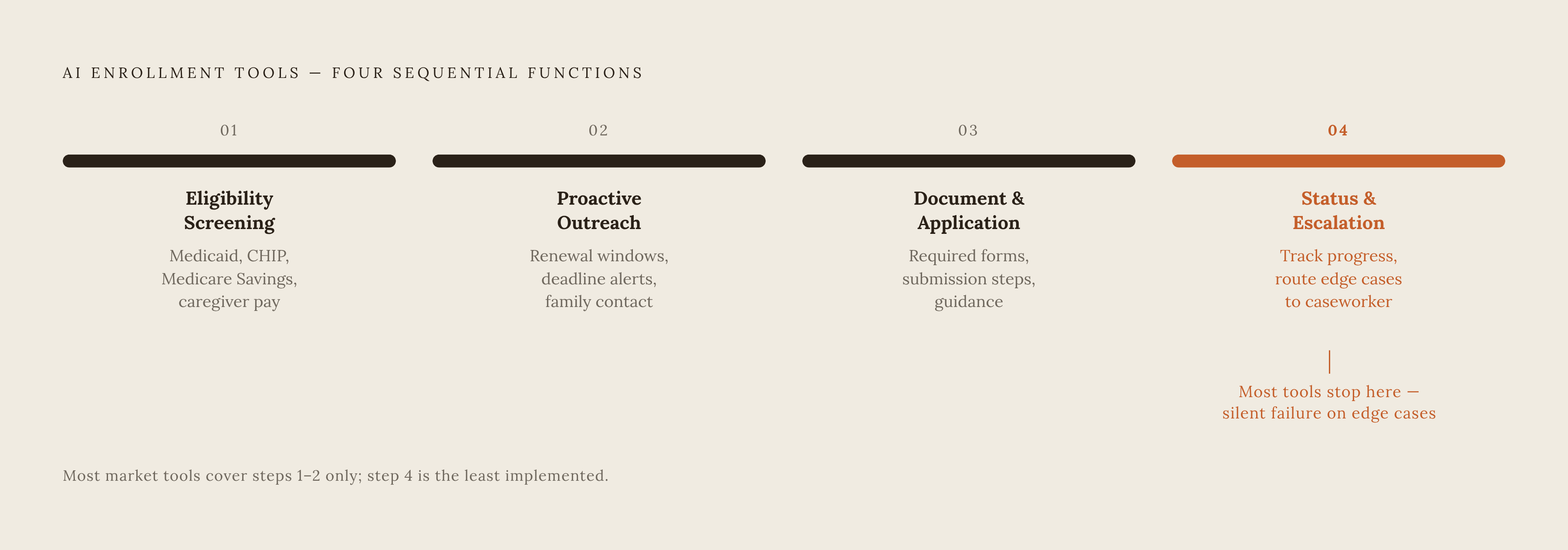
"AI enrollment tool" is a label wide enough to cover products that don't do the same job at all. Strip the marketing language away and the category splits into four distinct functions. Most products on the market only perform one or two of them, and that distinction matters more than any feature list a vendor hands over, because a family judging a tool by its marketing copy has no way to tell which function it's actually buying.
Eligibility screening is the entry point. The AI takes household data (income, age, household size, state of residence) and checks it against program rules to figure out what a family actually qualifies for. Done well, this surfaces programs a family wouldn't think to ask about: Medicaid, Medicare Savings Programs, CHIP, even caregiver compensation programs that rarely come up in a routine call to a state agency. A phone agent works from a script built around the question asked; the screening function works from the full range of programs a household might qualify for, which is why it tends to surface more.
Proactive outreach and deadline tracking flips the usual dynamic. Instead of waiting for a family to remember a renewal date, the AI reaches out first, by phone, text, or app, before the window closes. Under the incoming renewal requirements, this stops being a convenience and starts being load-bearing; some platforms track renewal deadlines well in advance. This is arguably the single function that matters most once 2027 hits, more than screening, more than document help.
Document and application guidance handles the part that causes the most dropout: knowing what forms are needed, what to gather, and how to actually submit it. A lot of procedural disenrollment traces back to nothing more complicated than a family not knowing where to start.
Ongoing status monitoring and escalation is the quieter function, and arguably the one that decides whether a tool deserves trust. It tracks where an application stands, flags problems that need a human, and routes genuinely complex cases, disputed eligibility, unusual household situations, to an actual caseworker. Done right, this also means the tool only touches the enrollee data it's authorized to see, holding to HIPAA rather than treating access as unlimited.
Few tools attempt all four functions, and that's the real story here. Knowing which function a platform covers tells a family whether it solves their actual problem or just a slice of it.
What Kern Family Health Care's Medi-Cal experiment shows in practice
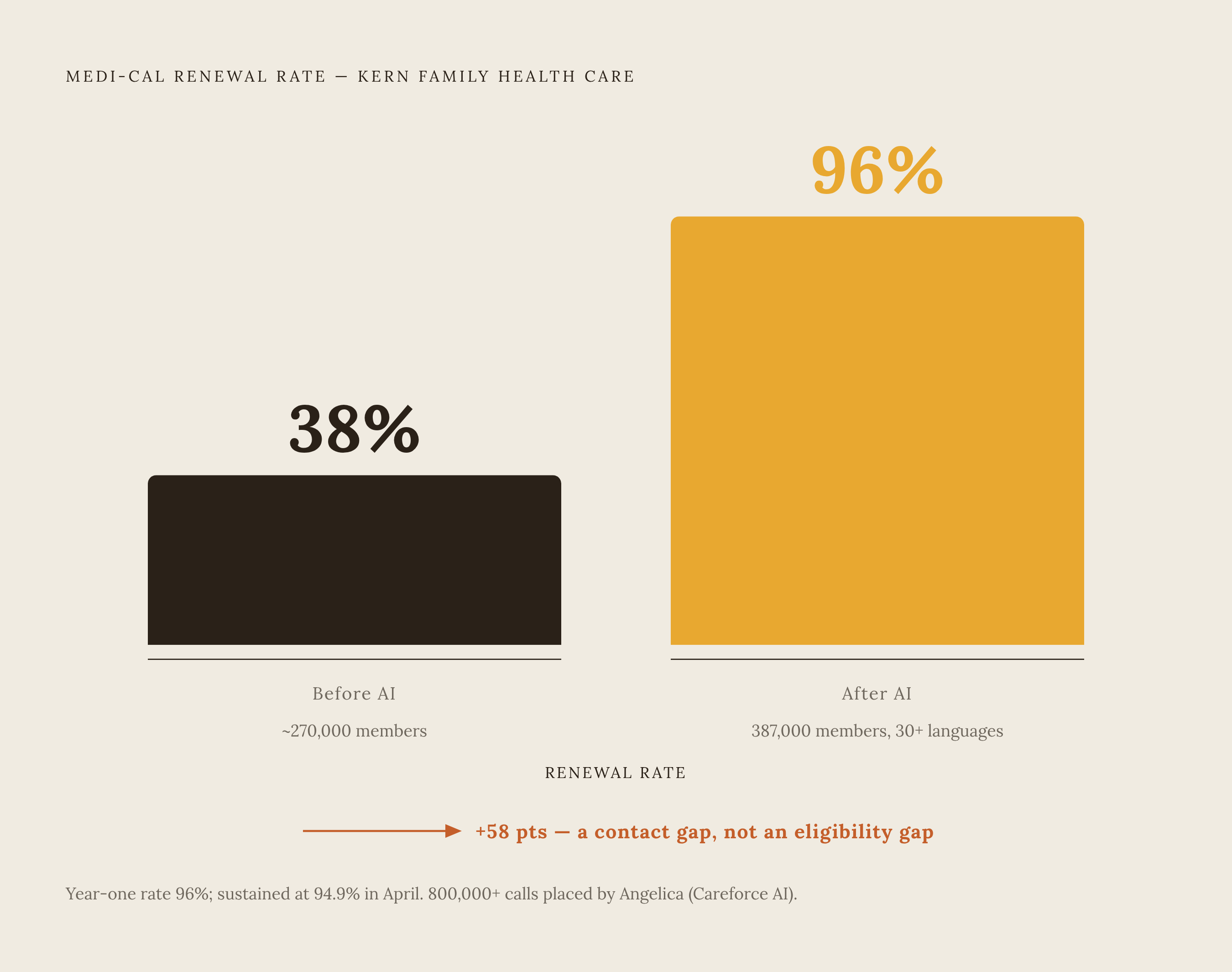
Kern Family Health Care, a Medi-Cal managed care plan serving the Bakersfield area, offers the clearest real-world test of this approach so far. When the pandemic-era policy of automatic renewal ended on July 1, 2025, roughly 270,000 KFHC members suddenly had to actively renew their coverage, something 70% of them had never done, since years of auto-renewal meant they'd never had to lift a finger.
KFHC's answer was Careforce, a San Francisco startup, deployed at a cost of $370,000. The platform's AI voice agent, named Angelica, placed over 800,000 calls to 387,000 Medi-Cal members starting in late 2025, working in more than 30 languages, around the clock.
The number worth sitting with is the renewal rate: it went from 38% to 96% in the first year, close to a threefold jump, and it says something uncomfortable about what the original 38% actually represented. If nearly all of those members turned out to be reachable and eligible once someone actually contacted them properly, the 62% who weren't renewing were never ineligible; they were simply unreached. That's the distinction the whole procedural-disenrollment argument rests on, and it's the strongest piece of evidence in this entire piece that the paperwork problem is real and not exaggerated. April's renewal rate held at 94.9%, which rules out the possibility that the initial jump was a one-month fluke tied to a launch push.
What happened to the capacity this freed up matters as much as the number itself. The 40 full-time staff Angelica effectively replaced in volume outreach got redirected toward complex case resolution: fixing incomplete data, correcting documentation errors, the work that actually needs judgment rather than repetition. Kern Family estimated the AI program produced roughly $2.4 million in staffing savings.
Does this generalize, though? Probably not as cleanly as the case study wants it to. KFHC succeeded partly because it already had structured member data, a managed care plan's built-in advantage. A family navigating Medicaid renewal alone, with no existing plan relationship and no prior record for an AI to draw on, doesn't start from the same position, and that gap is the real limit on this case study. The KFHC case is also a hybrid model: AI absorbed the volume, and staff time got reallocated toward complexity rather than eliminated outright. Any vendor claiming pure automation, staff untouched or unmentioned, should be read against that distinction.
Other platforms serving families directly — Medicare and Medicaid tools in the market
KFHC's deployment was institution-to-member, a health plan reaching its own enrollees. Several other platforms start from a different point entirely: a family approaching enrollment on its own, with no plan already holding its data.
HeyMedicaid is a virtual assistant designed to support families through the Medicaid enrollment process. Its renewal tracking exists to catch the last-minute scramble before it becomes a missed window.
Cedar Cover uses AI agents to connect patients to coverage enrollment and financial assistance options. Like KFHC's deployment, it mostly reaches people through hospital systems rather than families searching on their own, another sign that institution-initiated outreach is becoming the more common entry point than the direct-to-consumer model.
On the Medicare side, some platforms offer tools built around the Annual Enrollment Period, pairing AI-assisted navigation with live human support and flagging plan changes before AEP closes. Application status tracking addresses one of the more common anxieties for someone new to Medicare: not knowing whether anything is actually happening after they hit submit.
Some chatbot platforms are built for brokers and health plans rather than consumers directly, but they still shape the conversation beneficiaries end up having with agents. Such tools typically handle common Medicare questions and compliance requirements.
A newer category tries to cover both programs at once, Medicare and Medicaid, instead of treating them as separate problems. Platforms in this category use AI to map household data against the full range of programs a family might qualify for, including programs that a single call to a state agency typically wouldn't surface.
Specialization is the pattern across nearly all of these tools, and it's also the weak point buyers underestimate. Most cover one slice of the enrollment arc well and quietly stop there. Families with tangled situations (dual eligibles, a caregiver who might qualify for compensation, someone straddling Medicaid and Medicare at once) get the most value from a platform that covers discovery through enrollment in one place. Stitching together three single-purpose tools by hand just reproduces the fragmentation these tools were supposed to fix.
What governments and civic organizations are building at the infrastructure level
CMS has been direct about where it wants this headed. Its public RFI on "AI Tools for Medicare Experience Modernization" specifically asks for personalized plan recommendations, conversational AI, predictive analytics, and call center automation. How beneficiary trust in these tools develops over time remains an open question worth watching as the technology rolls out.
Federal adoption backs this up at scale. A 2025 GAO report found AI use cases across eleven federal agencies nearly doubled, from 571 in 2023 to more than a thousand in 2024. HHS posted the single largest increase of any agency, going from 157 to 271 total use cases, with generative AI deployments specifically jumping from 7 to 116 over the same stretch. That's a sign of an agency restructuring around the technology in real time, considerably beyond incremental adoption.
New CMS models are already running with AI built in from the start. The WISeR model, active since January 2026 across six states, uses AI-assisted review as part of Original Medicare administration. The ACCESS model, starting July 2026, uses AI diagnostics to identify chronic disease patients for technology-enabled care management. The Health Technology Ecosystem, launched in July 2025, has drawn engagement from more than 600 organizations focused on breaking down the data silos that make AI-guided enrollment harder to build in the first place.
Civic infrastructure is moving in parallel. In November 2025, the Center for Health Care Strategies and the Medicaid Innovation Collaborative, working with CMS, convened more than two dozen vendors at Medicaid Tech Demo Days specifically around work-requirement-related technology; most of the companies showcased used AI as a core component. Code for America has taken a different angle, using AI to pinpoint exactly where eligible people fall out of the enrollment funnel, a design-for-equity approach that complements the commercial tools rather than competing with them.
None of the tools covered in this piece are operating in isolation. They're being built against active government and civic investment aimed at making the underlying systems more workable for AI in the first place.
Where AI enrollment tools fall short and what the legitimate concerns are
Start with the workforce question, because it's the one most vendors would rather skip past. The KFHC case displaced 40 full-time workers in the sense that their outreach labor got absorbed by Angelica; they were reallocated, not laid off, in that specific instance. But what happens to enrollment navigators and caseworkers as this scales beyond a single managed care plan remains genuinely unsettled, and one clean case study doesn't answer it. Vendors citing KFHC as proof that AI creates capacity rather than layoffs are generalizing from a sample of one, and that generalization should be treated with real skepticism until a second and third case study show the same pattern.
Data access is where the equity gap shows up most sharply. Angelica performs as well as it does partly because KFHC already held structured member data going in: names, phone numbers, prior enrollment history, all ready to feed the model. A family with no prior plan relationship, no existing record for an AI to draw from, starts from a colder position and gets less out of the identical technology. That's not a hypothetical; it's the direct consequence of how these systems are trained and deployed, and it means the tools tend to work best for the families who needed the least help to begin with.
Language support has genuinely improved; tools running in 30-plus languages address a real barrier. Language coverage, though, doesn't touch low digital literacy, and a voice agent still assumes reliable phone access on the other end, which isn't universal even among enrolled Medicaid households.
Trust is its own obstacle, and not a small one, because CMS itself has acknowledged that many Medicare beneficiaries don't yet trust AI tools. That creates an adoption gap that quietly decides who benefits from the technology and who avoids it. Immigrant families, and anyone with reason to be cautious about data privacy, may hesitate to hand household information to an AI system no matter how well it performs.
Accuracy carries its own risk. An eligibility check is only as good as the program rules it's trained on, and state-level Medicaid rules change often enough that a tool lagging one update behind can hand a family a wrong eligibility assessment with total confidence. That's arguably worse than no answer at all, since a wrong answer delivered with confidence closes off the instinct to double-check. Scope is the final limit worth naming plainly: most tools handle one program, or one phase of one program, and a family that's dual-eligible, or has a caregiver who might qualify for compensation, or is moving between Medicaid and Medicare, needs either a platform built for that whole landscape or the patience to juggle several tools at once.
None of this argues against using AI enrollment assistance. The unassisted alternative is the same system that already produced 25 million coverage losses, most of them procedural, and going back to that baseline isn't a serious option. The case for AI here rests on a narrower claim than most vendor pitches make: it works when the function matches the family's actual gap, and it fails quietly when a family assumes one function covers a job the tool was never built to do. The argument is for choosing carefully, not for opting out.
What families should look for when evaluating an AI enrollment tool
Not every tool fits every household. The right choice depends on where a family sits in the process and how tangled their situation actually is, and the checklist below is really a filter for that, not a scorecard where every box carries equal weight.
Program breadth is the first thing worth checking, and it's the single biggest predictor of whether a tool is worth a family's time. Does it cover Medicaid only, or does it reach Medicare, Medicare Savings Programs, caregiver compensation programs, and other benefits a household might qualify for without knowing it? A family with a simple, single-program situation loses little from a narrow tool, while a family with anything more layered loses real value by picking one.
Enrollment arc matters just as much. Does the tool stop at telling a family what they qualify for, or does it walk them through application, document submission, and renewal? A tool that identifies eligibility and hands the paperwork back to the family has simply moved the procedural problem along rather than solved it. That's the failure mode worth watching for above all others, because it's the one that looks like progress on a demo and does nothing once the actual deadline hits.
Renewal tracking is no longer optional given what's coming in 2027. With semi-annual renewals about to double the outreach burden on states, a tool without proactive deadline reminders is missing the one feature most likely to prevent procedural disenrollment.
Human escalation deserves real scrutiny too. What happens when a case is genuinely complicated: disputed income, an unusual household structure, a mixed-status family? The strongest tools pair AI for volume with a real path to a human navigator for the edge cases, the same hybrid structure KFHC landed on with Angelica and its reallocated staff. A tool with no escalation path at all is a red flag, not a minor gap.
Data security rounds out the list. HIPAA compliance should be the floor, not the ceiling; additional certifications like SOC 2 or ISO, along with clear answers about how household data is stored and used, are worth asking about directly instead of assuming.
A few direct questions are worth putting to any platform before committing. Does it reflect this specific state's Medicaid rules, or is it running on generic program logic? Is there a cost, and if so, does it land on the family or on a plan or hospital system footing the bill? And how does it handle a case where eligibility is unclear or actively disputed, rather than clean and straightforward?
For caregivers specifically, the most useful tools surface caregiver-specific programs, Medicaid waiver options among them, since those are exactly the programs a family is least likely to stumble onto through a standard call to a state office.