Retirement Savings Options for Family Caregivers
Medicaid programs and spousal IRAs can help caregivers rebuild retirement security.
Family caregiving quietly erodes retirement security for millions of Americans, and the tools built to fix it, from spousal IRAs to catch-up contributions to Medicaid payment programs, sit almost entirely unused by the people who need them most. Roughly 63 million American adults, close to two in five, provide care to someone with a medical condition or disability, according to the Georgetown Center for Retirement Initiatives. This isn't a fringe issue affecting an unlucky few. It's a mainstream financial event that lands, almost by design, at the worst possible time in a person's saving life, and the biggest mistake caregivers make is treating it as a cash-flow problem when it's actually a Social Security problem wearing a cash-flow disguise.
Consider the timing. Three in five caregivers are women, with an average age of 51, according to the 2025 AARP/National Alliance for Caregiving report. Age 51 sits squarely inside the peak contribution years, when a worker's income and savings capacity should be climbing fastest. Instead, caregiving shows up right then and starts pulling money, hours, and attention away from the accounts that were supposed to be compounding hardest.
Most caregivers aren't stepping fully out of the workforce, either. Around 70% of working-age caregivers hold paid jobs while also caregiving, per Georgetown Center for Retirement Initiatives data, logging an average of 27 hours of care a week on top of that job, essentially a second part-time position stacked on the first. Nearly 60% report some work-related adjustment because of it: reduced hours, a lateral move, or leaving a role entirely. Vanguard's 2025 How America Saves report puts the average 401(k) balance at $126,971 for women versus $171,859 for men, and since women make up the majority of caregivers, the caregiving penalty doesn't just add to that gap. It compounds on top of it, in the same years, through the same mechanism.
Why the Social Security gap is the most underestimated part of the problem
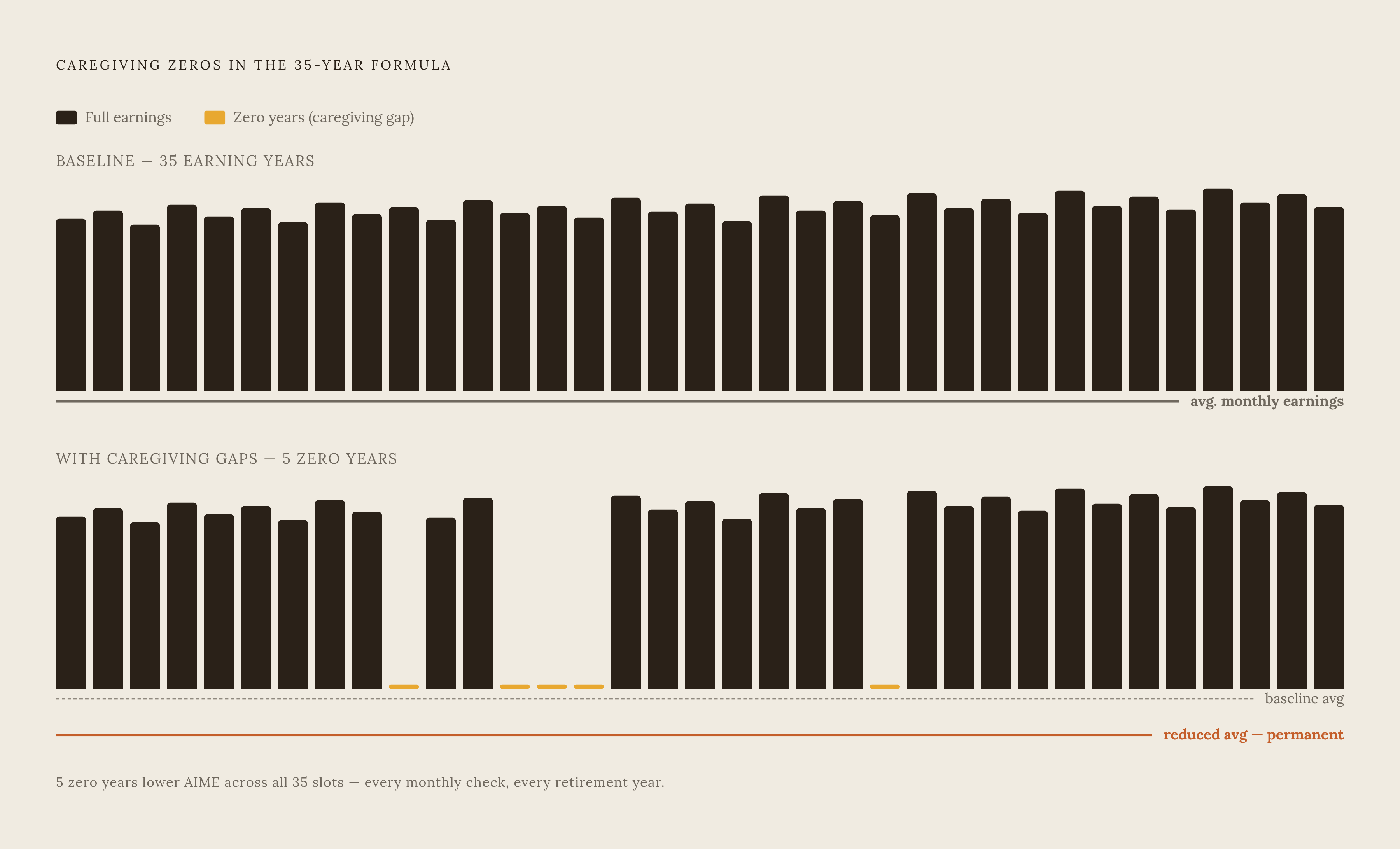
Social Security retirement benefits get calculated using average indexed monthly earnings across a worker's highest-earning years. That formula sounds neutral, almost administrative. It isn't. Every year a caregiver spends out of paid work enters that calculation as a zero, and zeros drag the average down permanently, not temporarily. A caregiver who steps out of paid work for any stretch doesn't simply lose those years of contributions. Those zero years fold directly into the lifetime benefit formula, so the shortfall shows up every month for the rest of that person's retirement, not just during the years spent caregiving.
That's the part most people get wrong: they treat the missing paycheck as the cost of caregiving. The missing paycheck is temporary. The zero in the formula is not.
Social Security wasn't built with unpaid caregiving in mind, so the math treats caregiving labor exactly the same way it treats unemployment or early retirement: as an absence, not as work. The formula doesn't distinguish between someone who stopped working to travel and someone who stopped working to manage a parent's medications, arrange dialysis transportation, or supervise a disabled adult child around the clock. Meanwhile, a 2021 AARP survey found 78% of caregivers report out-of-pocket spending tied to their role, averaging $7,242 a year, cash leaving the household in the exact years income is already reduced and credits are already thinning.
So what actually breaks the cycle? Two things: getting paid for caregiving work in a way that generates real Social Security credits, and using tax-advantaged accounts that don't depend on continuous employment at all. The next several sections work through both, and the Medicaid route matters more than any of the retirement-account options that follow it, because it's the only one that touches the formula itself rather than working around it.
Getting paid through Medicaid self-directed care programs, and why it builds retirement credits
All 50 states offer some version of a Medicaid-funded program that pays a family member for caregiving. These are usually called self-directed care or consumer-directed care programs, and the structure lets a Medicaid recipient, the person receiving care, hire a family member as their paid caregiver using Medicaid funds. Payments show up most often under waivers designed for people with intellectual or developmental disabilities.
Eligibility hinges on the care recipient's Medicaid status, not the caregiver's income or assets. That surprises families who assume they're disqualified because a working spouse earns too much. The assumption is usually wrong, and it's worth checking directly instead of ruling it out on a guess.
Here's what gets buried in enrollment paperwork almost every time: when caregiving income comes through a Medicaid program and gets reported as wages or self-employment income, with FICA taxes actually withheld and paid, those years can generate an earnings record rather than registering as zeros in the Social Security formula. The caregiver isn't just getting paid today. A real earnings record starts building, one that shows up in the benefit calculation decades from now. Two outcomes from one program, current cash flow and future Social Security credits, yet caseworkers rarely walk families through the second half of that equation. Most families never ask, because they don't know there's a second half to ask about.
Caregivers trying to figure out which programs their state offers, and whether a care recipient qualifies, can turn to AI-powered benefits discovery tools built to match households against the patchwork of state Medicaid waiver rules. The rules genuinely differ enough state to state that manual research eats up time caregivers don't have, and that friction is likely a bigger reason for the program's low uptake than any eligibility restriction.
The spousal IRA: the most overlooked option for caregivers who are married
For caregivers married to someone still working, the spousal IRA solves a problem that trips up people who assume IRA contributions require personal earned income. They don't, not here. A spousal IRA lets a non-earning or low-earning spouse fund a separate IRA, Roth or traditional, using the working spouse's income. Certified financial planner Randy Bruns, founder of Model Wealth, called it "one of the most overlooked tax breaks in the retirement system," in comments to CNBC, and the description holds up against how rarely the option gets used relative to how many caregivers qualify for it.
For 2025, a caregiver under 50 can contribute up to $7,000, and $8,000 if 50 or older, as long as the working spouse earns at least that amount. Limits rise in 2026 to $7,500 per spouse, or $8,600 for those 50 and up, meaning a married couple could shelter $15,000 combined, or $17,200 if both spouses have crossed 50. The couple has to file jointly to use this option at all.
The choice between Roth and traditional matters more than it looks. Traditional contributions may be deductible in the year they're made, though that deduction phases out in 2025 for joint filers earning between $126,000 and $146,000 when the contributing spouse is covered by a workplace plan. Roth contributions use after-tax dollars, but growth and withdrawals come out tax-free later, an arrangement that can be advantageous when current-year income is lower than expected future income.
There's a second benefit that has nothing to do with taxes. The spousal IRA belongs entirely to the non-earning spouse, not to the couple jointly and not to the working spouse. That ownership matters if the marriage ends, if the working spouse dies, or if the caregiver becomes ill and needs independent financial standing. Call it a hedge against dependency as much as a retirement vehicle.
And yet the option sits mostly unused. The Investment Company Institute found that, as of mid-2024, only 37% of households with an IRA were actually contributing to it. That gap between having access and using it runs through this entire piece, but it shows up starkest here, on the one account type that costs nothing to open and requires no earned income at all. Caregivers who qualify for the Saver's Credit may be able to combine that benefit with a spousal IRA contribution, compounding the advantage of the same dollar saved.
Standard and Roth IRA options for caregivers with any earned income
Not every caregiver is married to a working spouse, and not every caregiver goes without income entirely. Anyone who earns money during the year, even from part-time work or freelance gigs squeezed in around caregiving duties, qualifies to contribute to a standard or Roth IRA. The catch: current law caps the contribution at whichever is lower, the annual limit ($7,500 in 2026) or 100% of that year's taxable earned income. A caregiver whose earned income for the year falls below the statutory maximum can only contribute up to that earned amount, not the full limit, no matter how much room the limit technically allows.
That earned-income ceiling is precisely the constraint the Improving Retirement Security for Family Caregivers Act, covered further down, is built to lift. Until that legislation moves, the cap is the reality caregivers plan around.
One thing worth sitting with: caregiving years often push someone into a lower tax bracket, simply because income drops. That's bad news for cash flow but arguably good news for Roth strategy. Contributing to a Roth IRA, or converting existing traditional balances to Roth, while sitting in a lower bracket means paying tax now at a discounted rate in exchange for tax-free withdrawals once income, and the tax bracket, rises again in retirement.
For caregivers earning income through a Medicaid self-directed program, this section and the spousal IRA aren't either-or. A caregiver receiving Medicaid wages can fund a standard or Roth IRA up to that earned income amount, and if married, the couple can also fund a spousal IRA for a non-earning spouse. Both tools run at the same time, which is worth flagging, because caregivers often assume they have to pick one path and stop there.
Catch-up contributions for caregivers who are still connected to an employer plan
Caregivers who've cut hours but haven't left their employer plan entirely still have real runway, particularly once they cross certain age thresholds. The standard 401(k) deferral limit sits at $23,500 for 2025, rising modestly in subsequent years. Workers 50 and older can add a standard catch-up contribution on top of that base.
SECURE 2.0 added something sharper for a narrow age band. Starting in 2025, workers ages 60 through 63 get an enhanced catch-up limit of $11,250, calculated as the greater of $10,000, indexed for inflation, or 150% of the regular catch-up amount. Put together, someone in that four-year window can contribute up to $34,750 in total employee contributions for 2025, a genuinely aggressive acceleration window for caregivers whose kids have left the house and whose own caregiving duties, for a parent perhaps, land right in that same age bracket. Turn 64, and the enhanced catch-up disappears; the limit reverts to the standard catch-up amount.
But what happens when hours get cut enough that maxing out isn't realistic? The employer match becomes the priority, full stop, before catch-up strategy even enters the conversation. Employer matches function as an immediate 100% return on whatever gets contributed to capture them. Walking away from a full match to save cash elsewhere almost always costs more than it saves, so caregivers reducing hours should run the numbers on hitting that match threshold before cutting contributions any further.
For caregivers who leave employment entirely, the instinct to cash out a 401(k) under financial pressure is understandable and usually the wrong move. Rolling the balance into an IRA instead preserves tax-advantaged growth and avoids the early withdrawal penalty attached to cashing out before the qualifying age. The money keeps compounding either way. It just needs to change addresses, not disappear.
How an HSA can double as a retirement account for caregivers with a high-deductible health plan
A Health Savings Account requires enrollment in a high-deductible health plan, but for caregivers who have one, the HSA quietly functions as one of the most efficient retirement tools available, arguably more efficient than a traditional IRA. Contribution limits for 2025 sit at $4,300 for individual coverage and $8,550 for family coverage.
The tax treatment is the draw: contributions are deductible going in, the balance grows tax-free, and withdrawals for qualified medical expenses come out tax-free too. Three tax advantages stacked on one account, rarer than it sounds anywhere else in the retirement system. Once the account holder turns 65, the rules loosen further. Withdrawals for any purpose, not just medical expenses, become available penalty-free, taxed only as ordinary income, functionally identical to how a traditional IRA works at that age.
Here's the strategy most people never think to try. If a caregiver pays medical costs out of pocket, for a care recipient or for themselves, and keeps the receipts, the reimbursement doesn't have to happen right away. Filing that claim years later is permitted, with no time limit imposed on reimbursements. That means the money can stay invested and growing tax-free for years before the caregiver ever pulls it out to reimburse the original expense, turning old receipts into a delayed-withdrawal strategy nobody explains at account opening.
Given that 78% of caregivers report out-of-pocket spending averaging $7,242 a year, an HSA doesn't erase that cost. It turns a slice of that unavoidable spending into a tax-efficient bridge toward retirement, which counts for something even if it doesn't solve the underlying expense problem. Pending legislation would expand how HSA funds can be used specifically for caregiving-related costs, worth watching even though nothing has passed yet.
Two bills in Congress that would change the rules specifically for caregivers
Two bills introduced in the House and Senate in April 2026 aim directly at the gaps laid out above. House versions went to the Ways and Means Committee, Senate versions to the Finance Committee, and both carry bipartisan sponsorship, including Senator Susan Collins of Maine.
The Improving Retirement Security for Family Caregivers Act targets the earned-income cap from the IRA section. It would let qualifying caregivers contribute up to the full annual Roth IRA maximum even in a year when actual earned income falls short of that number. Qualification would require 500 or more hours of caregiving per year, combined with fewer than 500 hours of paid work. Paul Richman of the Insured Retirement Institute described it to CNBC as "similar in spirit to a spousal IRA, but broader and more flexible, especially for caregivers who may not neatly fit into existing rules." That framing captures the gap well: a spousal IRA needs a working spouse's income to lean on, while this bill would let a caregiver qualify on the caregiving itself.
The Catching Up Family Caregivers Act attacks the age restriction on enhanced catch-up contributions. Right now, that $11,250 enhanced catch-up is locked to ages 60 through 63 under SECURE 2.0. This bill would extend it to qualifying caregivers regardless of age, and would let caregivers returning to the workforce after a caregiving stint claim the enhanced catch-up for five years, no age requirement attached.
Collins put the stakes plainly: "These two bipartisan bills would give these individuals a better opportunity to build a secure financial future and help ensure they are not penalized for the vital care they provide." As of April 2026, both bills remain in committee. Worth tracking, not worth planning around yet. Committee referral is an early step, and neither bill has a guaranteed path to a floor vote, let alone a signature.
Putting the options together: how to sequence these tools given the realities caregivers actually face
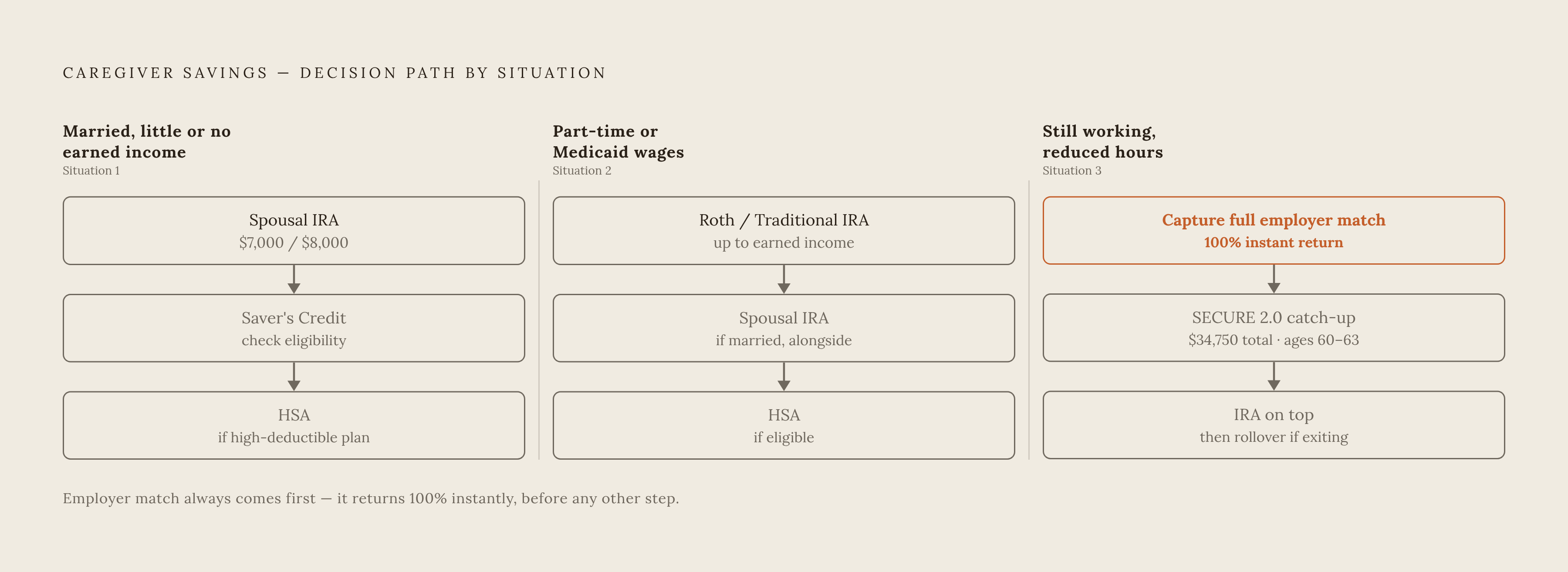
None of these tools works alone, and the right order depends heavily on which situation actually describes the caregiver in question.
A married caregiver with a working spouse and little or no earned income should start with the spousal IRA. It's the single most accessible account for someone without wages, and checking Saver's Credit eligibility alongside it costs nothing. If the household carries a high-deductible health plan, layer an HSA contribution on top, both for the tax treatment and for the ability to bank medical receipts for a later reimbursement.
A caregiver earning part-time or Medicaid-sourced income has more room. A standard or Roth IRA up to that earned income amount comes first; if married, a spousal IRA runs alongside it for the full household contribution. An HSA stays available if the coverage qualifies, and anyone still connected to a former employer's plan should keep an eye on what that account is doing rather than let it sit forgotten in a drawer of old statements.
A caregiver still working, but at reduced hours, inside an employer plan faces a different order of operations entirely. Capturing the full employer match comes first, always, because nothing else on this list returns 100% instantly. From there, caregivers between 60 and 63 should look hard at the SECURE 2.0 enhanced catch-up, given how short that window runs. IRA contributions can stack on top if income allows, and anyone anticipating a full exit from the workforce should have a rollover plan ready ahead of time, so the decision doesn't get made under financial duress at the worst possible moment.
The Social Security zero-year problem sits apart from all of this, and it only closes through two real paths. Getting paid for caregiving through a Medicaid self-directed program is one, so those years generate an actual earnings record instead of a gap. Time is the other: working enough paid years elsewhere across a career to push the zeros further from the 35-year formula's center of gravity. Neither path moves fast, and neither one is optional if the goal is actually closing the gap rather than just managing around it. But between Medicaid payment programs, spousal IRAs, catch-up windows, HSAs, and legislation still working through committee, the toolkit for caregivers runs larger, and more specific, than most people realize when they first take on the role.
Sources
- The Financial Strain and Savings Penalties for Caregiving: A Significant and Growing Threat to Retirement Security - Georgetown Center for Retirement Initiatives
- Retirement savings for caregivers a focus of new bipartisan bills in Congress
- tcare.ai
- Retirement savings for caregivers a focus of new bipartisan bills in Congress
- legion.org
- empower.com