Medicare Supplement Plan G Coverage and Costs
Plan G plugs nearly all gaps in Original Medicare coverage except one annual deductible.

Original Medicare pays its share and leaves the rest to the beneficiary. Plan G is the Medigap policy built to close nearly all of that remaining gap, and what follows breaks down what it actually covers, what it costs, and why the way an insurer prices it matters as much as the number on the first bill.
Start with the exposure itself. In 2026, the Part A hospital deductible runs $1,736, owed again each time a new benefit period starts, not once a year. Part B coinsurance sits at 20% of every Medicare-approved outpatient charge, with no ceiling no matter how high the bills climb. Skilled nursing coinsurance kicks in after day 20 of a stay, and if a doctor doesn't accept Medicare assignment, Part B excess charges can add up fast. None of these are fixed costs. They depend on how much care someone ends up needing in a given year, and nobody knows that number in advance. Medigap exists to turn that uncertainty into a flat monthly premium, though only some beneficiaries can make that trade: of the roughly 62.8 million people on Medicare, 46% (28.7 million) use traditional Medicare and can buy a Medigap plan, while the other 54%, some 34.1 million people in 2025, sit in Medicare Advantage, where Medigap isn't an option at all.
What Plan G is and how federal standardization shapes what you actually buy
Plan G is one of about ten lettered Medigap plans, and federal law standardizes what each letter has to cover. That single fact should change how a person shops for one. Most people still shop the wrong way, though, chasing a brand name instead of a number, when the honest comparison is a spreadsheet with a price column and nothing else worth arguing about. A Plan G sold by one insurer covers the same set of services as a Plan G sold by any other insurer, dollar for dollar, benefit for benefit. What differs is the premium, how that premium behaves over the years, and how solid the company behind it is. This structure holds in most states; Massachusetts, Minnesota, and Wisconsin run their own separate systems with different plan designs, so the letter-based comparison doesn't apply there the same way.
Plan G rides alongside Original Medicare rather than replacing it. Medicare pays first, then Plan G picks up the remaining approved balance. There's no network to worry about, either: any provider that takes Original Medicare has to accept a Medigap Plan G, full stop. That single fact means the decision of which Plan G to buy has nothing to do with coverage quality and everything to do with price, how that price is likely to move, and whether the insurer is stable enough to trust with what's often a decades-long relationship. Anyone spending real time comparing benefit summaries between two Plan G policies is spending time on a question that federal law already answered.
Why Plan G became the most popular Medigap option for new enrollees
Plan G now accounts for 39% of all Medigap policyholders, nearly 5.3 million people as of 2023, according to KFF's analysis of NAIC and Mark Farrah Associates data. Total Medigap enrollment across every plan type that year came to 13,564,595, so Plan G's share isn't just the largest, it's the largest by a wide margin.
Why did Plan G specifically win out? Not through marketing. Through regulation. Plan F used to hold the top spot, and it covered everything Plan G covers plus the Part B deductible on top. But as of January 1, 2020, insurers can no longer sell Plan F to anyone newly eligible for Medicare. That single rule change turned Plan G into the most complete plan still available to new enrollees, and enrollment followed the rule, not the other way around. A wide range of Medicare supplement insurers offer it, which keeps the shopping process genuinely competitive rather than a search for a rare product. Worth sitting with: an entire market reshaped itself around one regulatory line drawn on a calendar, and the plan that happened to sit on the winning side of that line is the one now carrying the largest enrollment in the category.
Exactly what Plan G covers, and the one gap it leaves
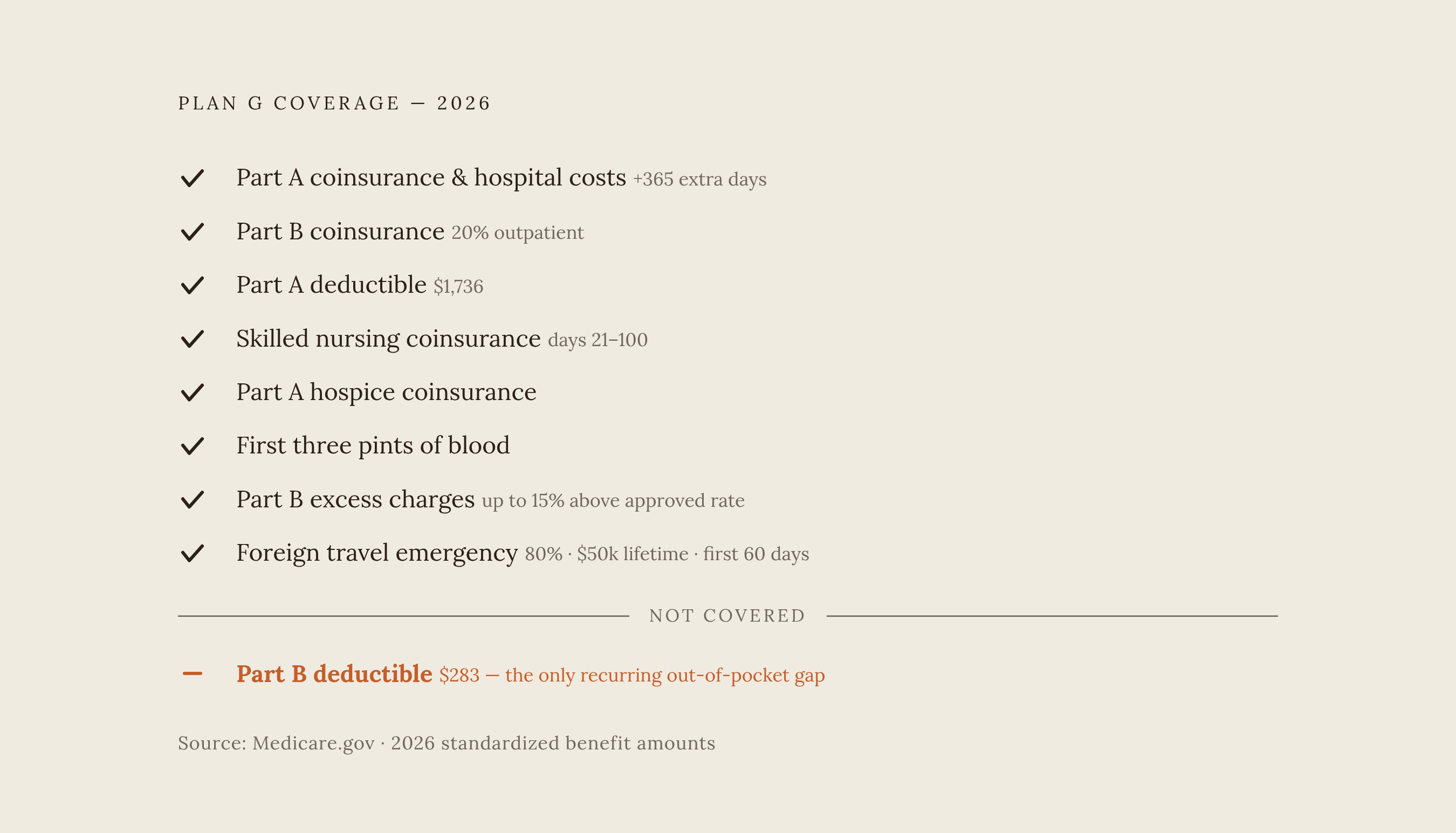
Plan G's standardized benefit package covers eight distinct things, and the details matter more than the summary.
Part A coinsurance and hospital costs are covered in full, including up to 365 extra days of hospital care after Medicare's own benefits run out. Part B coinsurance, the 20% left over on approved outpatient costs (doctor visits, outpatient procedures, lab work, preventive care), gets picked up entirely. Blood is a specific, often-overlooked one: Original Medicare only pays starting with the fourth pint in a year, so Plan G covers the first three. Part A hospice coinsurance is covered in full as well.
Skilled nursing gets more nuanced treatment. Original Medicare covers days 1 through 20 outright. From day 21 through day 100, a daily coinsurance charge applies, and Plan G absorbs it. After day 100, all costs shift back to the enrollee no matter which Medigap plan is in place. That's a Medicare structural limit, not a Plan G shortfall, and the distinction is worth keeping straight before blaming the insurer for something Medicare itself set up. The Part A deductible, $1,736 in 2026, is paid in full by Plan G. Part B excess charges, the up to 15% a non-participating provider can add above the Medicare-approved rate, are also covered completely, which matters more in states where balance billing is common. And the foreign travel emergency benefit covers 80% of eligible emergency costs abroad, after a $250 annual deductible, for the first 60 days of a trip, capped at a $50,000 lifetime maximum. That's an emergency benefit only, not routine coverage abroad, and it does not include medical evacuation.
So what's left? One thing: the Part B deductible, set at $283 in 2026, up from $257 in 2025. That's the single recurring cost Plan G doesn't touch. Pay it once, and for the rest of the calendar year, a Plan G holder owes nothing more for any Medicare-approved service. That's a striking level of predictability once the deductible is behind them.
What Plan G, and every other Medigap plan, leaves untouched entirely: routine dental, vision exams, hearing aids, long-term custodial care, prescription drugs (that requires a separate Part D plan), and most care received outside the country beyond the narrow travel benefit already described. None of those are gaps specific to Plan G. No lettered Medigap plan touches them, and anyone shopping on the promise that a richer plan somewhere covers dental is shopping for a product that doesn't exist.
High-Deductible Plan G: the same coverage with a different financial structure
Plan G comes in two versions, and the difference has nothing to do with what's covered. High-Deductible Plan G (HD-G) pays for the exact same standardized benefits as standard Plan G. The only variable is when that coverage switches on.
Under HD-G, the enrollee pays all Medicare-covered costs out of pocket up to the plan's annual deductible, $2,870 in 2025, rising to $2,950 in 2026 according to a state insurance regulator's documentation. Cross that threshold, and HD-G behaves exactly like standard Plan G for the rest of the year.
The appeal sits in the premium gap. TZ Insurance Solutions sales data puts the average HD-G premium at around $57.92 a month in 2025, about $695 a year; a separate figure from the same period lands at $58.08 a month, or $697 a year. Standard Plan G, by comparison, typically runs $155 to $220 a month. That's a wide enough gap to change the math for a lot of people, but not for everyone equally, and this is where the honest recommendation splits down the middle instead of pointing one direction.
Someone generally healthy, who doesn't see a doctor often and has enough set aside to cover the deductible in a bad year, comes out ahead on HD-G most years. Someone with a chronic condition or a history of hospitalizations tends to hit the deductible anyway, and at that point the higher premium on standard Plan G is buying real peace of mind, not marginal savings. One detail applies no matter which version gets picked: the $250 foreign travel emergency deductible sits outside the annual deductible entirely and works the same way under both.
What Plan G premiums actually cost and why the range is so wide
Plan G premiums swing on age, location, gender, tobacco use, and carrier, and any one of those variables can move the number substantially. National averages are useful as an anchor. They are not a quote, and treating them as one is the single most common mistake in this entire buying process.
TZ Insurance Solutions' internal sales data puts the 2025 average for standard Plan G at roughly $155.33 a month, or $1,864 a year, though the company itself notes this isn't a comprehensive national average. MoneyGeek's analysis of quotes across states found an average of $220 a month for a 65-year-old.
The carrier spread inside those averages is where the real story lives. MoneyGeek found a spread of $214 more per month between two carriers for the identical plan, for coverage that is, by federal design, exactly the same benefit for benefit. That variance is too large to shrug off. It's the entire ballgame: paying more for identical coverage because a name sounded more familiar. Geography swings just as hard. Some markets price Plan G under $100 a month, while MedigapAdvisors.com reports New York City residents paying more than $400 a month in some cases.
What should a shopper actually take from all this? The published averages set expectations, not prices. The number that matters is the quote built around a specific age, zip code, gender, tobacco status, and carrier, not the headline figure in a press release. Anyone buying Plan G off the average alone is buying blind, and given a $214 spread between two carriers selling the identical benefit, blind is an expensive way to shop.
How insurers price Plan G premiums over time, and why the pricing method matters as much as the starting rate
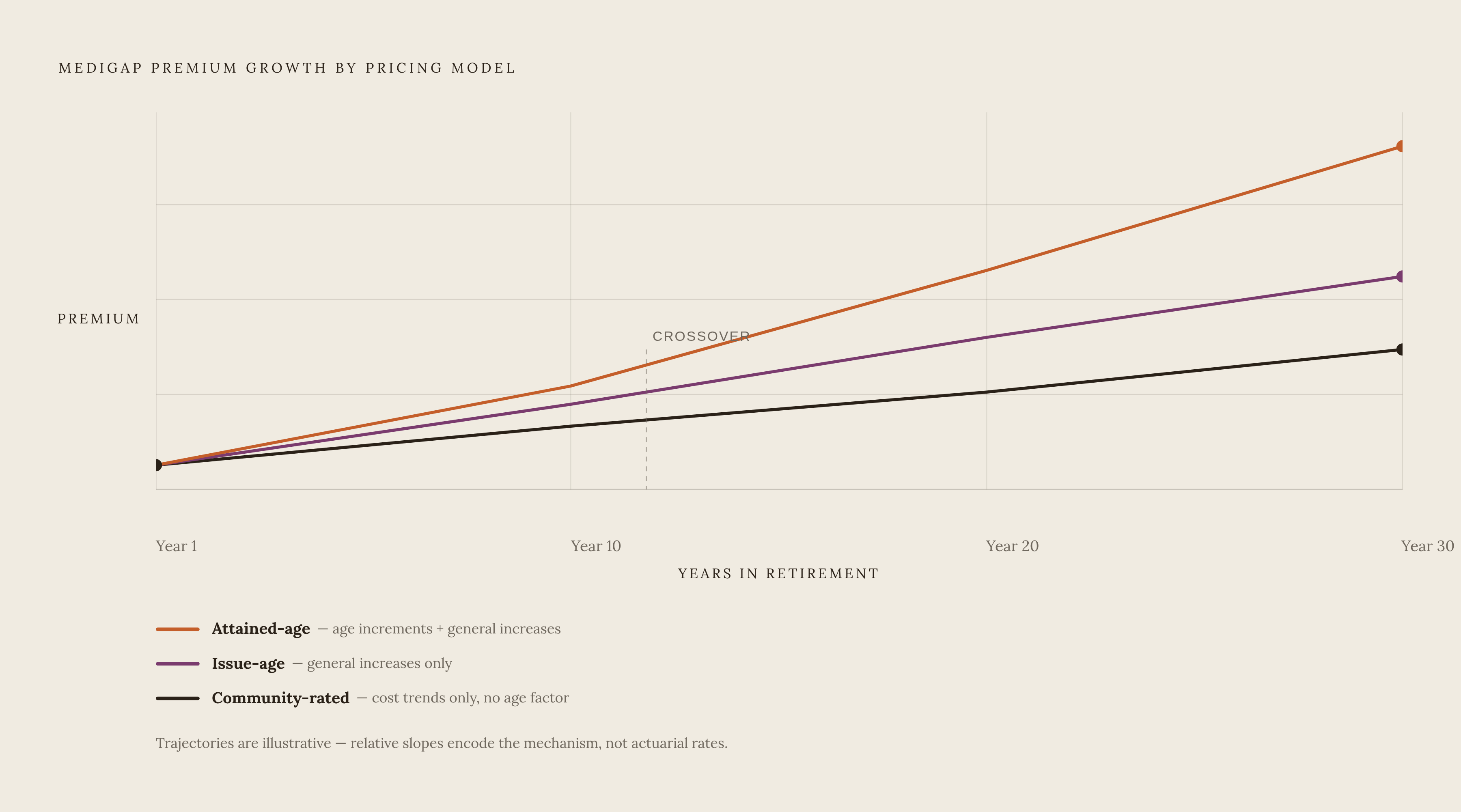
Federal rules permit three ways to price a Medigap policy, and all three produce identical Plan G coverage. The difference lives entirely in how the premium moves after the first year, the piece most people skip past when they shop, and it matters more than the starting price itself. Skipping this part is the second most expensive mistake in this whole process, right behind buying off the national average.
Attained-age pricing bases the premium on the enrollee's current age and raises it every year as they get older. Two forces stack on top of each other here: a general rate increase applied to the whole pool, plus an additional bump tied specifically to aging a year. Attained-age policies tend to start out cheapest on paper and get expensive fastest over time. It's also the default in states without a specific pricing mandate, since it tracks insurer risk most closely.
Issue-age pricing locks the premium to the enrollee's age at the time of purchase. General rate increases still apply across the board, but there's no separate charge tacked on just for getting older. Enrolling younger locks in a lower base rate than enrolling later would.
Community-rated pricing charges everyone in the pool the same premium regardless of age, whether they enrolled at 65 or 80. It can still rise due to overall cost trends or regulatory adjustments, just never because any one person had a birthday.
Here's the wrinkle that trips people up most: a policy that looks cheapest in year one, usually the attained-age option, can end up costing more over time than an issue-age or community-rated policy that started higher. Comparing only first-year quotes can obscure how premiums diverge over time. Not every method is sold in every state, so confirming which pricing model a carrier actually uses is worth doing before signing anything, not after the third rate increase shows up. Anyone who picks Plan G based on the lowest first-year number without asking which of the three pricing methods produced it is negotiating with incomplete information.
When to enroll in Plan G and what happens if you wait
Timing carries more weight in Medigap than in almost any other type of coverage, and this is the section where waiting costs the most and shows up the least in the sales pitch. The Medigap open enrollment period runs six months, starting the month a person turns 65 and enrolls in Part B. During that window, insurers have to sell any Medigap plan they offer: no medical underwriting, no health questions, no premium surcharge tied to health history.
Miss that window, and the rules flip hard. In most states, insurers can deny coverage outright based on health history once open enrollment closes, and they can charge more for pre-existing conditions on the policies they do sell. Someone who leaves Medicare Advantage later hoping to switch to Medigap isn't guaranteed to get one either; underwriting applies in most states at that point, and a health event in the meantime can close the door entirely.
Guaranteed issue rights exist outside the open enrollment window, tied to specific situations like losing other coverage or moving out of a plan's service area, but they're narrower protections than the blanket guarantee during open enrollment. For anyone newly eligible for Medicare on or after January 1, 2020, guaranteed issue rights cover a defined subset of Medigap plans. Plans C and F aren't part of that guarantee for this group, since both have already been phased out for new enrollees.
The six-month open enrollment window is the lowest-risk, lowest-cost point at which to buy Plan G, full stop. Wait past it without a guaranteed issue right, and a decision that should be about price alone turns into a question of whether coverage is available at all. That detail is not buried in fine print. It's the single highest-stakes date on the entire Medigap timeline, and it comes and goes in six months whether anyone's paying attention or not.
How Plan G compares to Plan N and Plan F, the three options most new enrollees weigh
Plan F, for those still eligible to hold it, covers everything Plan G covers plus the Part B deductible, $283 in 2026. It's no longer sold to anyone newly eligible for Medicare after January 1, 2020, so it isn't a live choice for most people entering the market today. For those grandfathered in, broker rate data shows Plan F running notably higher than Plan G at the same age, $180 a month versus $152 for a 65-year-old male in one sample. That gap generally exceeds the $283 deductible Plan F covers and Plan G doesn't, which makes Plan G the better value even for people who technically still qualify for Plan F. Anyone holding onto Plan F purely out of habit is very likely overpaying for a benefit that costs less than the premium difference: Plan F, at these numbers, is the wrong plan for almost anyone still comparing the two.
Plan N sits below Plan G on price. The same sample data shows Plan N around $114 a month for a 65-year-old male against $152 for Plan G. That gap isn't free, though. Plan N doesn't cover Part B excess charges, so a patient seeing a non-participating provider could face a bill up to 15% above the Medicare-approved amount with no backstop. Plan N also carries small copayments for some office visits and ER visits that Plan G eliminates entirely.
So which one actually makes more sense? It depends on what's being optimized for, not on which plan sounds more complete. Someone who wants zero exposure to excess charges and no per-visit copays tends toward Plan G. Someone willing to trade a slice of that certainty for a meaningfully lower monthly premium tends toward Plan N. Between the two of them, they account for nearly 80% of every Medigap policy sold today, and that split says something worth noticing: most new enrollees aren't chasing the cheapest plan on the shelf, and they aren't chasing the most complete one either. They're landing somewhere in between, based on exactly how much unpredictability they can stomach living with.